Offered by Poncelin de Raucourt Fine Arts
REQUEST INFORMATION

Paintings and drawings, from 16th to 19th century
French School, 18th century (circa 1760)
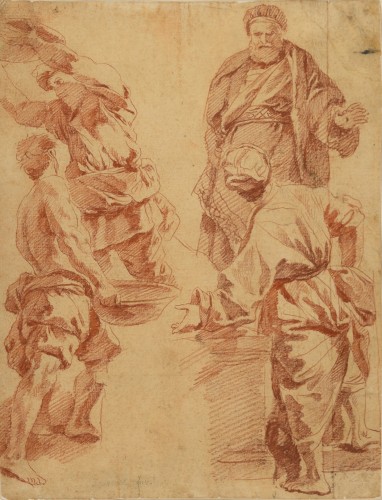
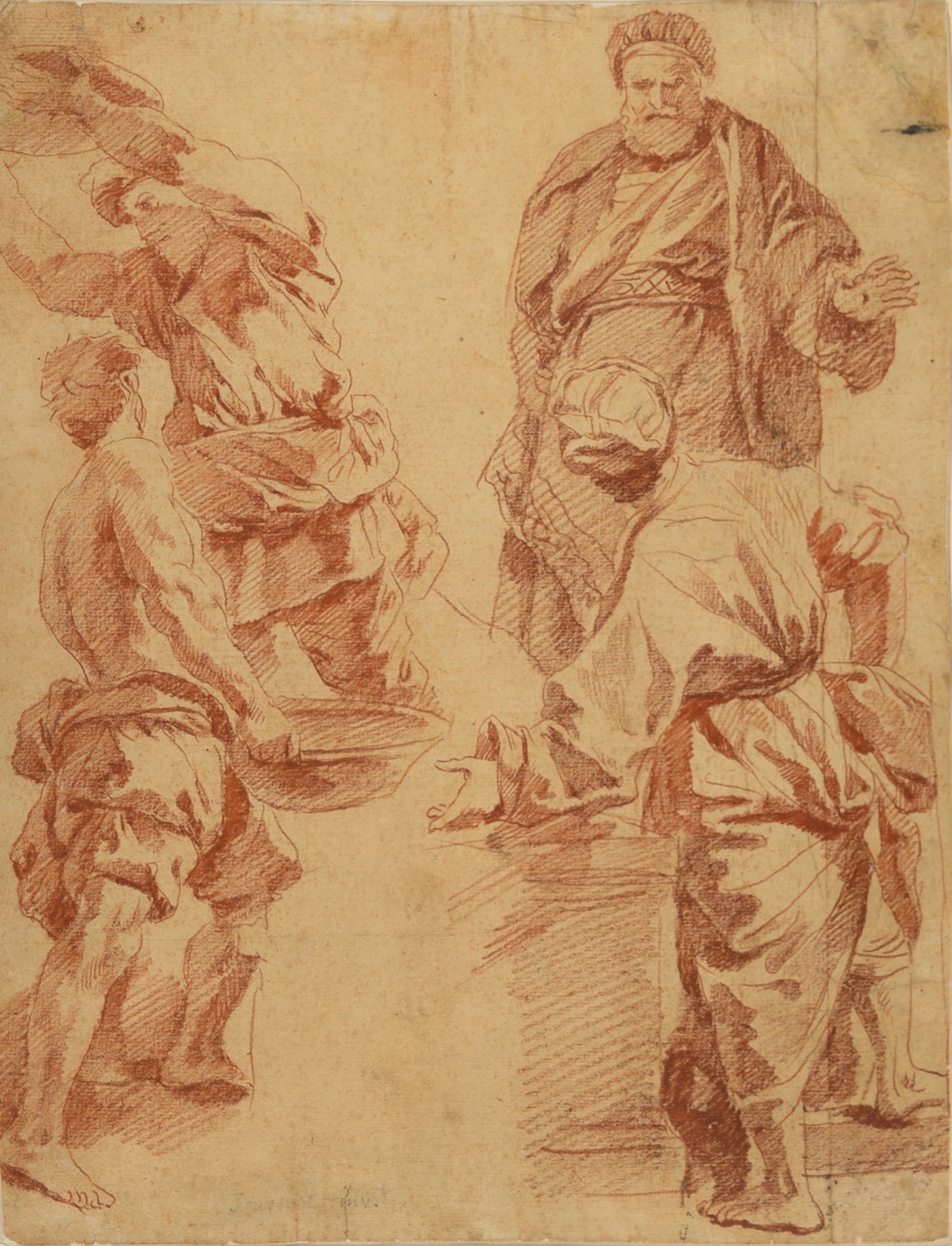
Studies of figures after The Feast at the House of Simon the Pharisee by Jouvenet, after the engraving by Duchange
Red chalk on paper,
29 × 23 cm
Provenance:
Private collection
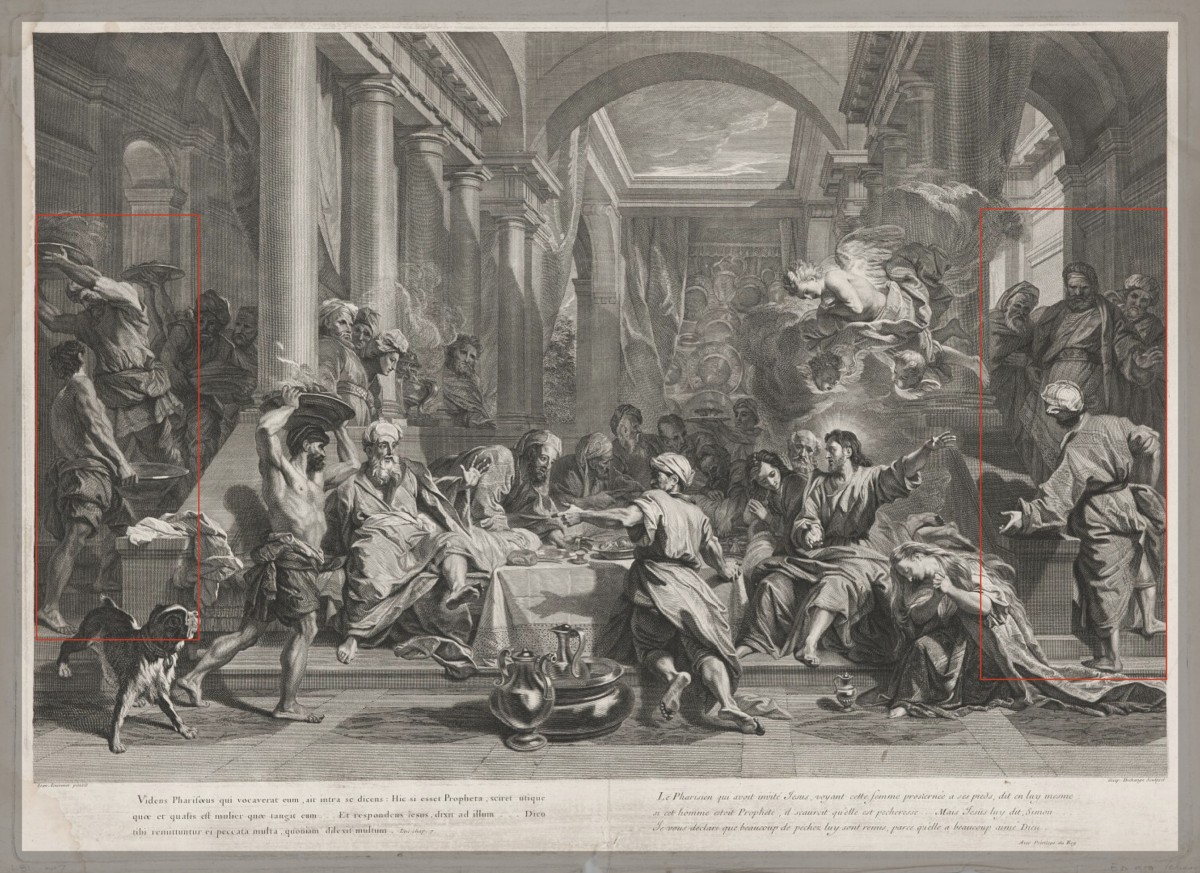
This study sheet belongs to the academic tradition of the 18th century, in which copying after the masters, often mediated through prints, was a fundamental part of artistic training. Inspired by The Feast at the House of Simon the Pharisee by Jean Jouvenet, a major work of early 18th-century French religious painting, it reflects the dissemination of compositions through engraving, here that of Gaspard Duchange. Published as early as 1705, Duchange’s print played a key role in the transmission of such models, notably through its reversed composition, which subtly alters the reading of the figures.
The anonymous artist gathers on a single sheet several significant fragments of the scene: a servant in motion carrying a vessel, a seated draped figure, a bearded old man in “oriental” attire, and a kneeling figure seen from the back. This process of selection and isolation reveals an analytical approach, aimed at studying poses, proportions, and especially the rendering of drapery.
The red chalk technique is handled with finesse, relying on dense parallel hatching to structure volume and enhance shadow effects. This graphic language, closely related to that of engraving, reinforces the hypothesis that the drawing was made after a print rather than directly after the painting. The artist does not attempt to recreate the coloristic atmosphere of the original work, but instead seeks to understand its formal construction.
Within the artistic context of the 18th century, such sheets participated in a shared visual culture in which works circulated, were transformed, and reinterpreted. They also evoke the practice of copyists active in Rome and Paris, such as Jean-Robert Ango, as well as that of more celebrated artists like Fragonard or Hubert Robert, whose attributions have often overlapped in this type of production.
As a study, this work holds significant documentary value: it reveals the mechanisms by which models were transmitted and underscores the importance of engraving as a pedagogical tool. It is equally appealing for the quality of its execution, where the liveliness of the line and the sensitivity of the modeling give the figures a strong expressive presence, despite their fragmentary nature.