Offered by Galerie de Frise



REQUEST INFORMATION


Victor-Jean NICOLLE (Paris, 1754 – Paris, 1826)
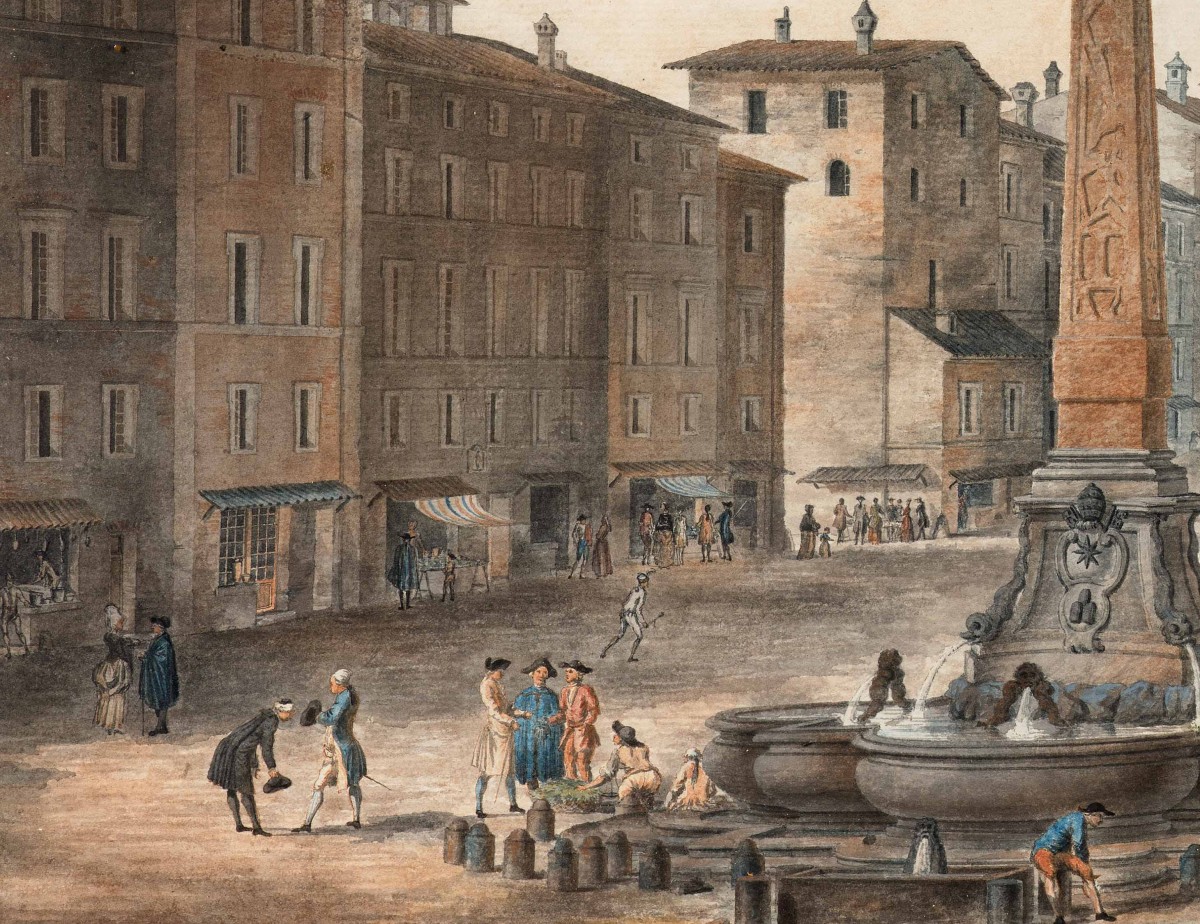
Rome, the animated Pantheon Square (Piazza della Rotonda)
Watercolour and gouache
H. 39 cm; W. 60 cm
Signed lower centre, at the foot of the fountain
Circa 1790
Provenance:
– Sale of 7 April 1995, Tajan, Paris, Dessins anciens, no. 106, €16,800 excluding fees
– French private collection
Nicolle began his training around the age of 15 at the Royal Free School of Drawing created in 1766 by Jean-Jacques Bachelier, and won the grand prize for perspective in 1771. He then studied for several years in Paris in the studio of the architect Louis-François Petit-Radel (1739–1818), who directed, for example, the creation of the Palais Bourbon. He then moved to Italy with the support of Louis XVI, who had sent him there with fifteen other artists in order to produce almost photographic views of all the sites and buildings “worthy of interest”.
He spent most of his time in Rome, but also visited Venice, Verona, Florence, Bologna and Naples. It is considered that he carried out two long Italian stays, from 1787 to 1798, then from 1806 to 1810/11.
In the meantime, Nicolle produced views of Paris, and on the occasion of a commission from Napoleon for a gift to Marie-Louise in 1811, a series of fifty views of Malmaison. Representations of the south of France are also known by him, in particular Nîmes, Orange and Avignon, and even Valençay in Touraine. He placed his meticulous and extremely precise technique at the service of his topographical qualities and his sense of the picturesque, thus producing works that are at once charming and of real documentary interest. While enjoying at the time great success among amateurs of art and of “vedute”, Nicolle nevertheless never exhibited at the Salon.
Nicolle’s production is so considerable that one may suppose that he had a sort of studio, which sometimes explains works of somewhat average quality. While most of his work consists of circular watercolours of small format (almost always 7 cm in diameter), it is exceptional to find drawings of a format as large as ours.
Bordered to the south by the church of Santa Maria Rotonda, the Pantheon Square has at its centre a fountain in baroque style built in 1575, and surmounted in 1711 by a red marble obelisk dating from the reign of Ramses II.
By its technique and also by the clothing of the figures, the work seems to us to date from the artist’s first Roman stay, around 1790.