Offered by Poncelin de Raucourt Fine Arts
REQUEST INFORMATION

Paintings and drawings, from 16th to 19th century
Roman School, 17th century, circa 1606 to 1630
Circle of Giovanni Baglione
Rome, 1566 to 1643/44
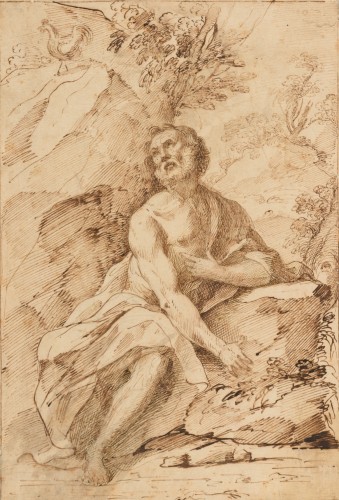
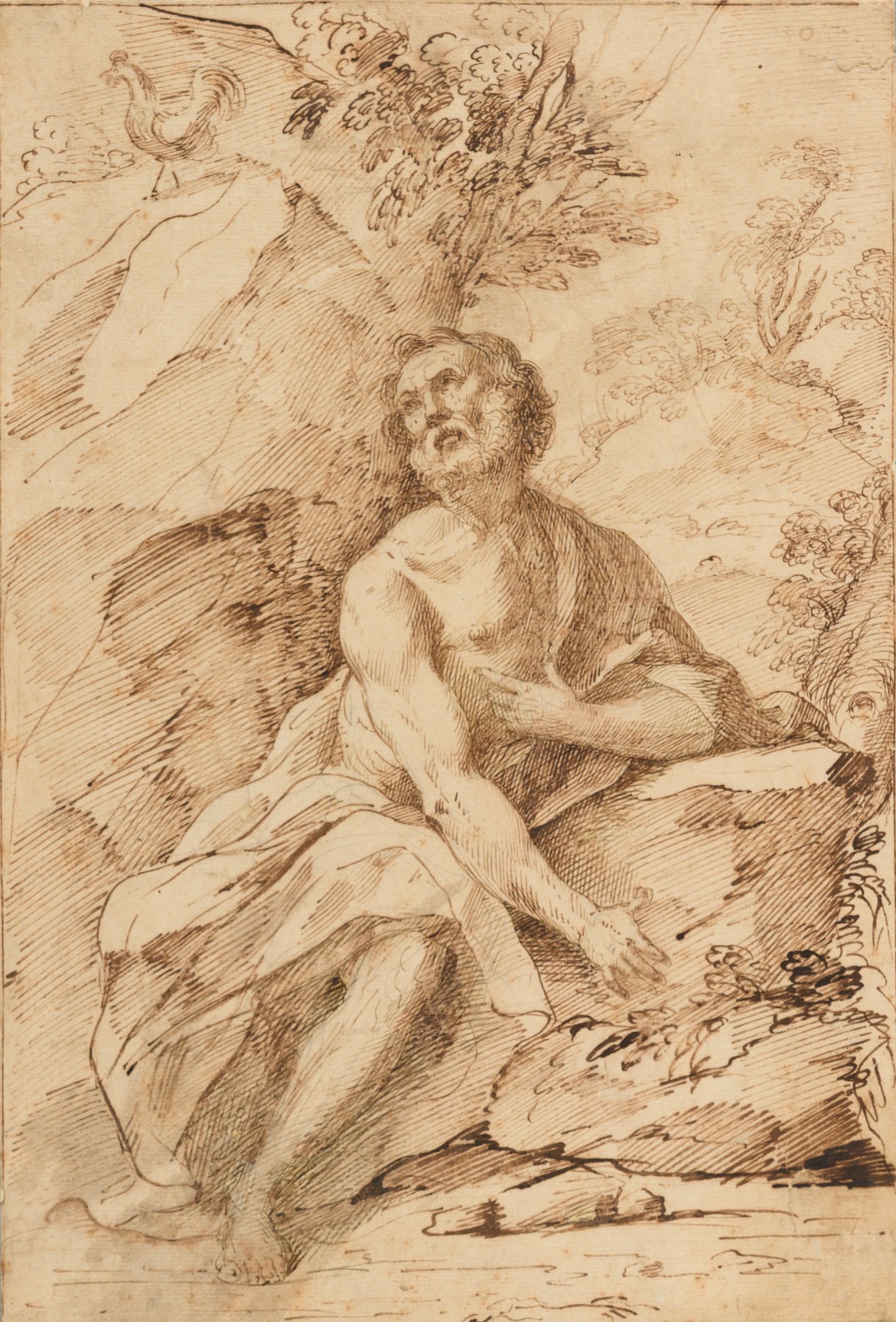
The Penitent Saint Peter, also known as Saint Peter and the Rooster
Pen and brown ink over traces of black chalk.
29.8 × 20.2 cm.
Laid down; small tears and losses.
Seated in a rocky landscape, Saint Peter turns his gaze towards heaven while a rooster, perched on a ridge to the left, crows. The scene should not be understood simply as a representation of the Mount of Olives, but rather as the dramatic moment of the Apostle’s repentance after his denial of Christ. The hand drawn back towards the chest, the open arm and the upward gaze powerfully convey the awareness of sin and the appeal for forgiveness.
The sheet is distinguished by a lively and highly structured use of the pen: close oblique hatching, shadows built up through accumulations of ink, rocks rendered with broad parallel strokes, and foliage treated in a nervous, calligraphic manner. This graphic language, both dramatic and decorative, places the work within the Roman artistic climate of the early Seicento, between the legacy of late Mannerism and a Caravaggesque sensibility.
The composition resonates with the type of the Penitent Saint Peter and the Rooster that circulated within the milieu of Giovanni Baglione, particularly the painting preserved in the Galleria Sabauda, attributed to Baglione and dated to around 1606. There, too, the saint is shown seated in an attitude of contrition, his eyes raised, accompanied by the rooster placed on a rock. The present drawing, however, is not a slavish copy: the artist expands the rocky and vegetal setting, introduces a greater sense of landscape, and gives the scene a freer, almost meditative character.
Through its format, subject and execution, this sheet may therefore be associated with a draughtsman active within Baglione’s circle, or with a Roman artist familiar with this penitential iconography in the early 17th century.