Offered by Poncelin de Raucourt Fine Arts
REQUEST INFORMATION

Paintings and drawings, from 16th to 19th century
Attributed to Domenico Maria Canuti
(Bologna, 1625–1684)
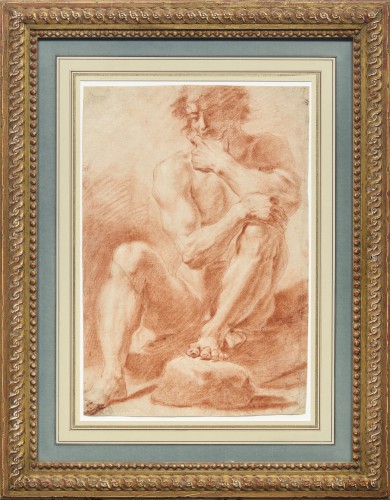
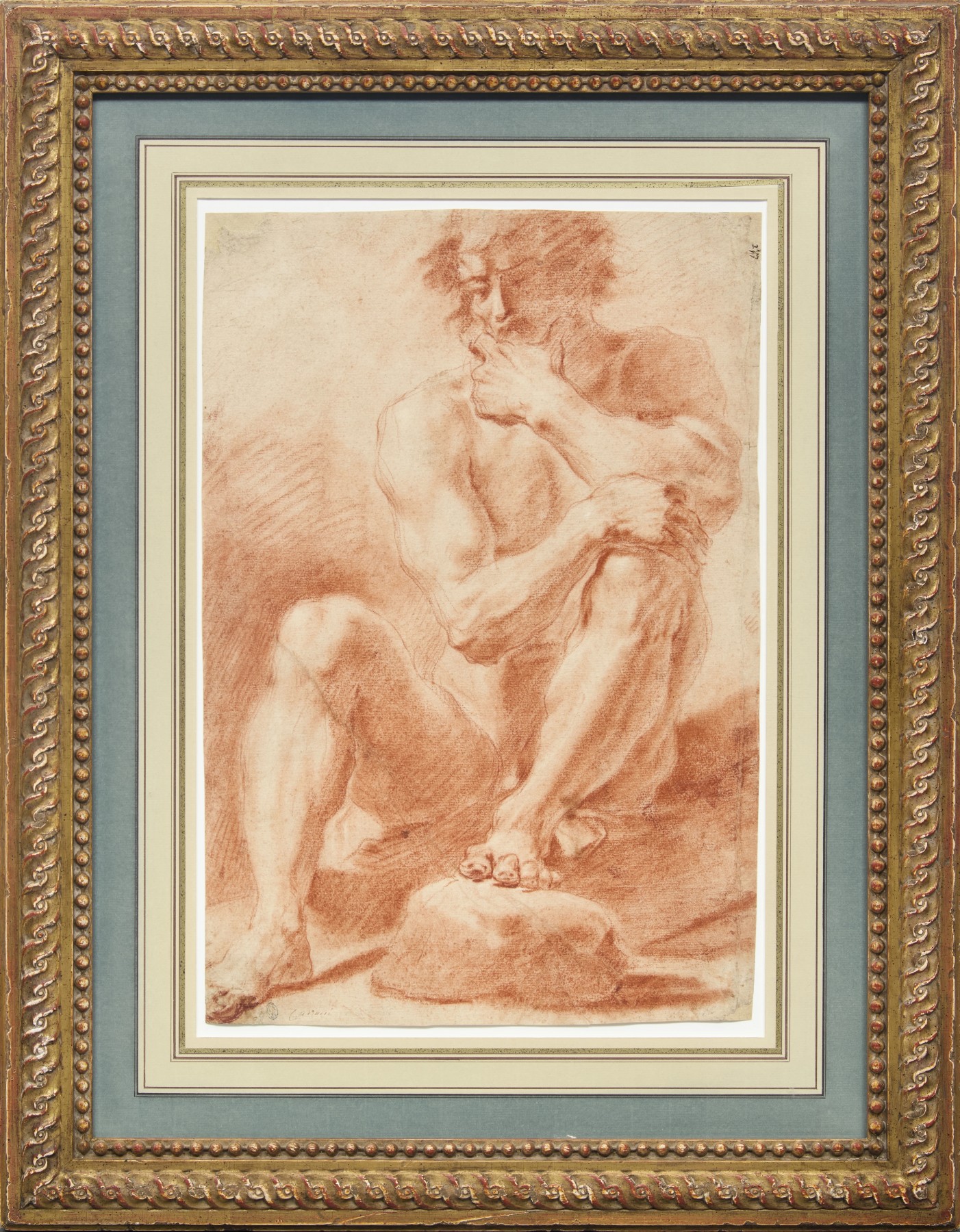
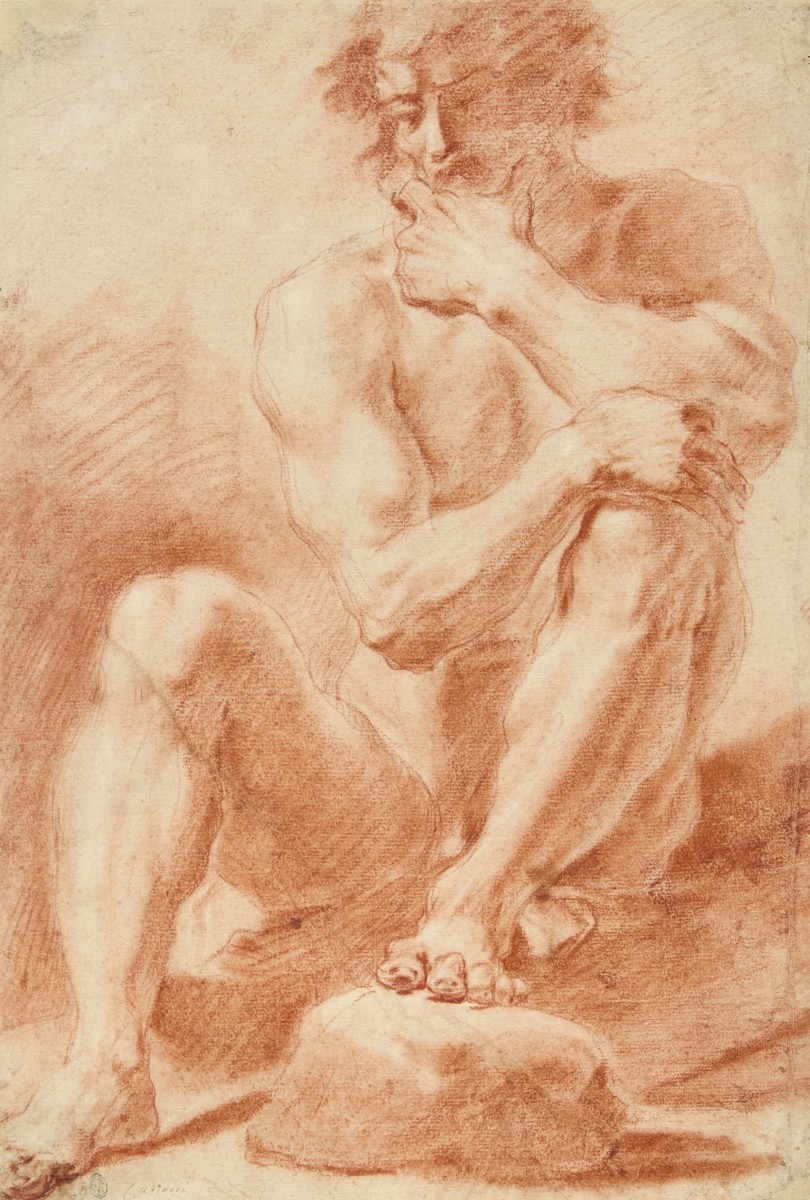
Study of a Seated Male Nude, possibly a Satyr
Red chalk on paper
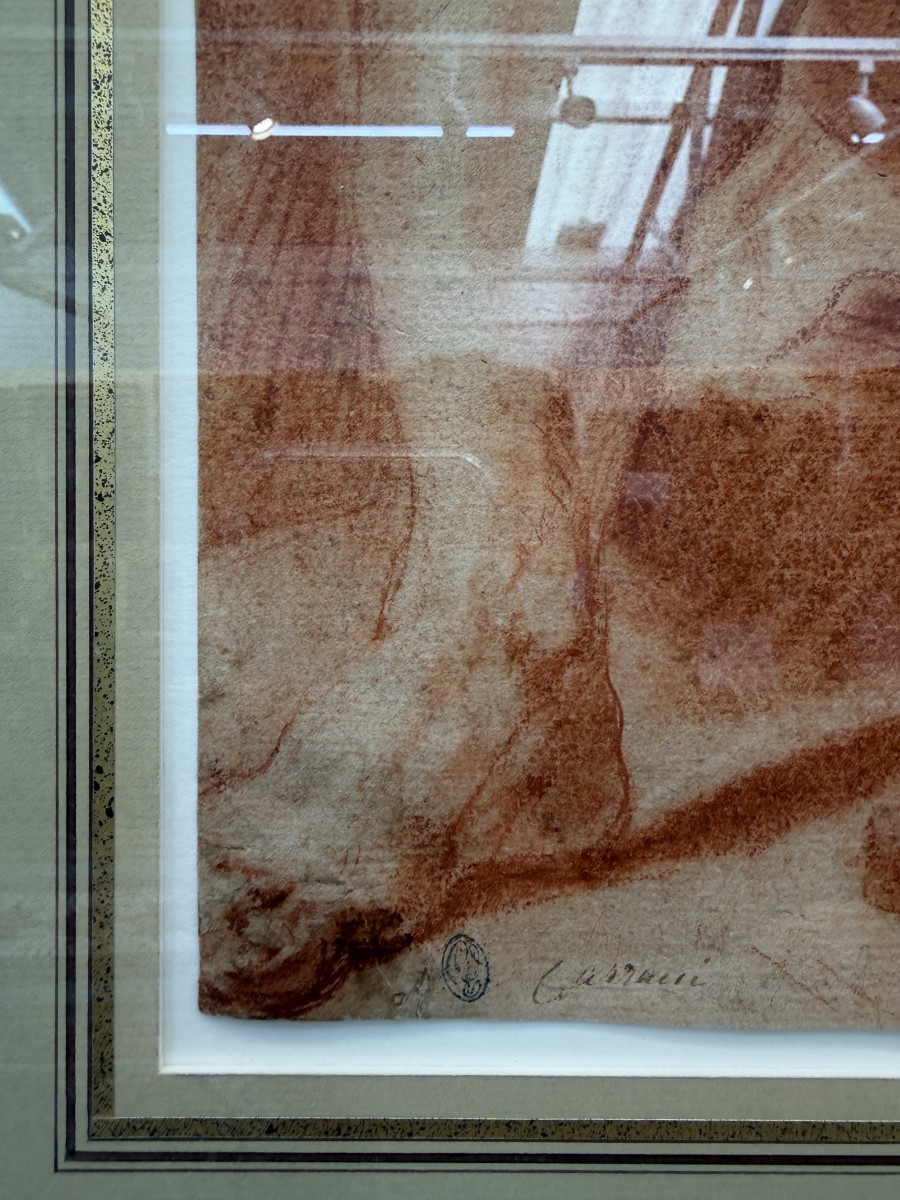
Bears the inscription Carracci lower left; bears the collector’s stamp of Giuseppe Vallardi, Milan, Lugt 1223, lower left.
45.5 × 31 cm
Executed c. 1665
Provenance
Giuseppe Vallardi, Milan, 1784–1863, Lugt 1223;
Private Collection, United Kingdom;
Private Collection, France.
Long associated with the Carracci, as indicated by the old inscription Carracci at the lower left, this vigorous red-chalk study is better understood as a work by, or very close to, Domenico Maria Canuti, one of the most accomplished Bolognese draughtsmen of the later seventeenth century.
The traditional Carracci attribution is not without significance: the pose, the concentrated anatomy, and the seated, almost satyric type all belong to the visual inheritance of the Carracci academy. Yet the sheet’s breadth of handling, its rubbed and atmospheric modelling, and its sculptural but softened treatment of the male body point away from Annibale or Ludovico around 1600 and towards the more expansive Baroque language of Canuti in the 1660s.
Canuti was trained in Bologna and became especially celebrated as a painter of large-scale decorative cycles. He worked in Rome in the early 1650s and again in the 1670s, developing a pictorial language well suited to monumental fresco decoration, ceiling paintings, and illusionistic architectural schemes.
His mature graphic style is inseparable from this decorative ambition. Even in a single figure study, the body is conceived monumentally, almost as an architectural mass, with strong diagonals and a sense of weight projected into space.
The present figure, seated with one knee raised and one foot thrust forward onto a block or ledge, is not treated as a purely academic nude. The head is shadowed and heavy, the hair and beard are suggested in broad, smoky passages, and the compressed pose has a distinctly bacchic or satyric character.
This explains the old Carracci association: Annibale’s studies for the satyrs of the Farnese Gallery, such as the Seated Male Nude at Museum Boijmans Van Beuningen, established precisely this type of powerful seated male body within the Bolognese tradition. Canuti, however, translates that inheritance into a later, more painterly and theatrical idiom.
A particularly close comparison is Canuti’s Sheet of Studies: A Seated Nude Man, A Youthful Head and a Caricature Head of a Man Playing a Pipe in the J. Paul Getty Museum, dated about 1669–71 and executed in red chalk. The Getty sheet shows the same interest in a compact, seated male nude, modelled through warm sanguine tone, with contours that alternately tighten and dissolve into rubbed shadow.
The comparison is important not only technically but psychologically: in both drawings the body seems introspective, almost brooding, rather than posed with classical clarity.
Another relevant comparison is Canuti’s Study of a Man Seated on a Ledge, Hands Tied behind Him in the Nationalmuseum, Stockholm, dated 1669–71. That drawing, in black and red chalk heightened with white, shows Canuti’s characteristic use of a seated model on a low support, with the body built through strong masses and broken contours rather than through a clean linear outline.
The Stockholm sheet is also close in scale and ambition, measuring 36.7 × 29.8 cm, and confirms Canuti’s repeated interest in large, physically present male studies during this moment of his career.
Especially persuasive is the comparison with the Seated Male Nude in the Nasjonalmuseet, Oslo, now catalogued as attributed to Domenico Canuti but formerly given to Annibale Carracci “by erroneous tradition.” This is a useful parallel for the present sheet: a robust seventeenth-century Bolognese nude, long absorbed into the prestige of the Carracci name, can be more accurately placed within Canuti’s later Carraccesque revival.
The British Museum also preserves an instructive group of drawings by or attributed to Canuti. Its artist record includes, among the related objects, a drawing catalogued as Attributed to Domenico Maria Canuti and formerly attributed to Annibale Carracci, a revealing example of the same historical slippage between Carracci and Canuti.
Another British Museum sheet, Taddeo Pepoli Elected Prince, drawn in red chalk with red-brown wash on grey paper and dated 1666, is connected with Canuti’s fresco decoration in the Palazzo Pepoli Campogrande, Bologna. Although compositional rather than academic, it demonstrates the artist’s use of red chalk in preparation for large decorative schemes.
The old inscription Carracci should therefore be read as an early attribution rather than as a signature. It records the sheet’s correct artistic family — Bolognese, Carraccesque, rooted in the practice of life drawing — but not, in my view, its precise hand.
The broader handling, the deep tonal rubbing, the grand Baroque massing of the figure, and the comparison with Canuti’s studies of c. 1665–71 all support an attribution to Domenico Maria Canuti.
The Vallardi provenance strengthens the historical interest of the sheet. Giuseppe Vallardi was one of the important Milanese dealers and collectors of Old Master drawings in the nineteenth century. His collector’s mark, Lugt 1223, is frequently encountered on significant Italian drawings.
The presence of his stamp, together with the old Carracci inscription, indicates that the drawing had already entered a serious collecting context as a notable Bolognese sheet.