Offered by Poncelin de Raucourt Fine Arts
REQUEST INFORMATION

Paintings and drawings, from 16th to 19th century
Eduard VEITH (Neutitschein, 1858 – Vienna, 1925)
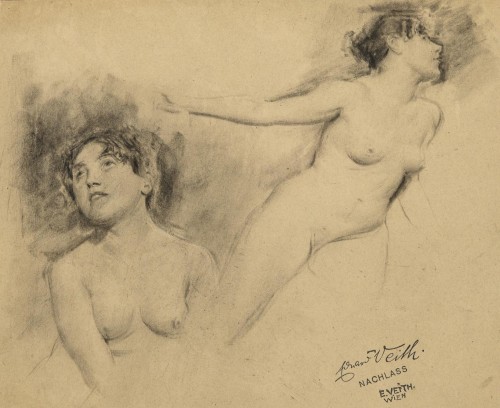
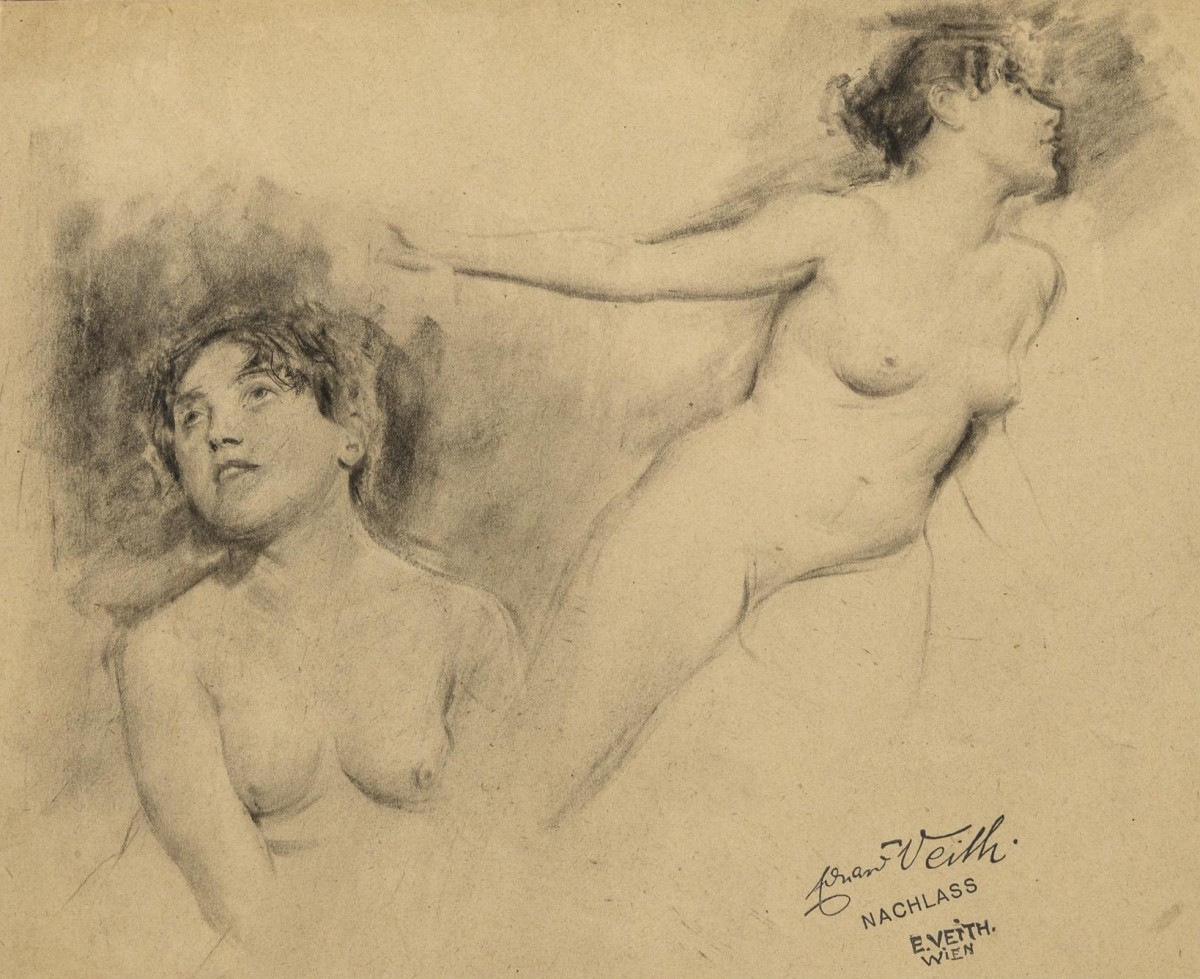
Two Studies of Female Half-Nudes, c. 1900
On the recto, cursive stamp “Eduard Veith” and stamp “NACHLASS / E. VEITH / WIEN”
Charcoal on buff paper
10 3/8 x 12 3/4 in
26.5 x 32.5 cm
Provenance:
Private collection, Germany
Trained at the Vienna School of Arts and Crafts under Ferdinand Laufberger, whose pupils also included Gustav Klimt and Franz Matsch, Eduard Veith belonged to the generation that bridged the grand historicist decoration of the Ringstrasse era and the Symbolist sensibility of fin-de-siècle Vienna. His career gained significant momentum in 1887, when he contributed to the decoration of the Neues Deutsches Theater in Prague, and he subsequently worked on several theatres in Austria and abroad, including the Volkstheater in Vienna. He also achieved considerable recognition for his decorations in the Neue Burg and for the monumental frieze of the former Hotel Meißl & Schadn on Vienna’s Kärntner Straße.
Veith’s importance lies less in any radical avant-garde position than in the accomplished synthesis he created between monumental painting, theatrical culture and Symbolist imagery. While remaining firmly attached to a learned and idealised treatment of the human figure, he introduced into his compositions an atmospheric sensuality and a particular taste for mythological heroines, nymphs and female personifications, placing his work firmly within the visual culture of “Vienna 1900”. The Leopold Museum accordingly situates his oeuvre at the intersection of Historicism and Symbolism.
The present sheet most probably brings together two independent studies of poses, rather than figures conceived from the outset as part of a single composition. On the left, a young woman represented half-length turns her face upwards; the careful modelling of the eyes, mouth and hair contrasts with the more summary treatment of the torso. On the right, a second and more expansive figure unfolds along a strong diagonal. Her extended arm, backward-tilted head and twisting torso lend the pose an almost choreographic quality, characteristic of a study intended for an allegorical or decorative composition.
Veith here exploits the expressive possibilities of charcoal with considerable virtuosity. Contours that are sometimes only lightly indicated alternate with broad passages of smudged shading. The untouched areas of the paper allow light to emerge across the shoulders and breast, while the dark tonal passages surrounding the faces heighten their sculptural relief. This contrast between luminous bodies and a deliberately undefined setting takes the sheet beyond the realm of a conventional academic exercise and gives it the evocative quality of a vision.
A date of circa 1900, within a plausible range of approximately 1895–1905, appears the most convincing. The fluidity of the draughtsmanship, the decorative elongation of the figure on the right and the dreamlike character of the models correspond to Veith’s mature period, during which he painted works such as The Fountain of Youth (Jungbrunnen), circa 1895, The King’s Daughter (Die Königstochter), before 1902, and Nymphs by a Fountain, circa 1905. No direct connection can presently be established with any of these compositions, however, and the proposed dating should therefore be regarded as stylistic rather than documentary.
Veith’s works are now represented in several of Vienna’s principal public collections. The Belvedere holds, among others, The Fountain of Youth, Nymphs by a Fountain, The King’s Daughter and Alberich and the Rhinemaidens. The Wien Museum preserves his Self-Portrait with a Model of 1885 and the Triumph of Vindobona, a design for the Volkstheater dated 1888. The Leopold Museum houses Perseus and Andromeda, while the MAK – Museum of Applied Arts holds an important group of drawings and documents originating from the artist’s studio.
The marks visible on the sheet should be understood as estate stamps rather than autograph signatures. The MAK preserves drawings from Veith’s estate, acquired in 1929, which likewise bear an “Eduard Veith / NACHLASS” stamp. These marks therefore support a provenance from the artist’s studio, although they do not in themselves provide any precise indication of date.
Through the freedom of its draughtsmanship and the expressive elegance of its two figures, this sheet offers a particularly appealing insight into the manner in which Veith developed the idealised female type that occupies such a central place within his Symbolist and decorative oeuvre.
Reference bibliography:
Silvia Freimann, Eduard Veith (1858–1925). Kommentierter Werkkatalog mit Werkverzeichnis, Berlin, 2011.