Offered by Ars Antiqua


REQUEST INFORMATION


Old Masters paintings, furniture, sculptures and modern art
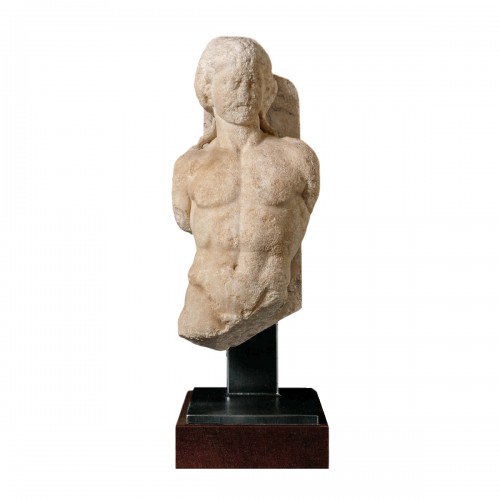
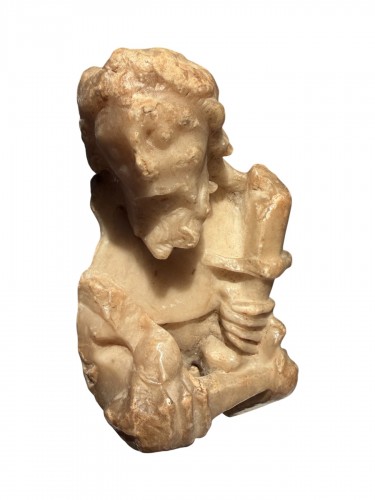
Girolamo Viscardi (Laino, 1467 – Genoa, after 1522)
Saint John the Baptist
Marble, 24 x 14 x 10 cm
With base, 1 x 10 x 9 cm
Critical entry by Prof. Giancarlo Gentilini and David Lucidi
Probably originally placed to decorate a niche, as suggested by the incompletely finished back of the sculpture, the work depicts Saint John the Baptist, also known as the Forerunner for having foretold the coming of the Messiah. The iconography is typical of the Saint: depicted at a young age with long hair and a full beard framing a bony face, dressed in a tunic and cloak draped with broad folds, holding a book and an eagle (headless) that also associate him with the Evangelist.
The work is attributable to the sculptor Girolamo Viscardi, of Lugano origin but trained in Lombardy. His master was indeed Antonio della Porta, known as Il Tamagnino, during the years in which he assisted Amadeo with the sculptural decoration of the Certosa di Pavia at the close of the 15th century. His contribution to the site was likely located on the façade of the Certosa, an undertaking that Amadeo had begun in 1491 and shared the following year with Della Porta and Mantegazza.
Before concluding his four-year apprenticeship, Viscardi moved to Genoa, which was then a crossroads for Lombard craftsmen. There, in 1497, he undertook the execution of the tomb of Agostino and Giovanni Adorno alongside the brothers Giovanni and Michele D’Aria. Between 1502 and 1504, Viscardi, Michele D’Aria, and the Tuscan sculptors Benedetto da Rovezzano and Donato Benti were chosen by King Louis XII of France to execute the funerary monument commemorating his ancestors, the Dukes of Orléans, intended for the Church of the Celestines in Paris (now in the Basilica of Saint-Denis).
The authorship of the present work is confirmed by comparison with several statues at Saint-Trinité in Fécamp decorating a tabernacle executed, according to sources, beginning in May 1507. Indeed, these exhibit the same rendering of the drapery, slender physique, and sharp-featured face, which are completely analogous to those of our Saint John the Baptist. One would therefore be inclined to place the present sculpture within Viscardi's corpus of works datable from 1505 to 1510; however, the use of Candoglia marble suggests an earlier execution dating back to his Lombard period, thus before 1497.
It should nevertheless be remembered that Viscardi remained active until at least 1522, and his output—whether early or mature—relies on compositional stylistic traits that recur frequently over the years. Therefore, it is difficult to establish a precise chronological sequence for his works without the support of documentary sources or, as in the present case, the analysis of the material used.
Delevery information :
Les frais d'expédition seront calculés au moment de la commande en fonction de la destination, des dimensions et du poids du tableau, ainsi que de l'assurance couvrant la valeur totale de l'œuvre.
For paintings purchased from abroad: following payment, the application process to obtain the export license (ALC - Attestato di Libera Circolazione) will be initiated. All antiques shipped abroad from Italy require this document, which is issued by the Ministry of Cultural Heritage. The procedure may take 3 to 5 weeks from the date of request; therefore, the painting will be shipped as soon as the document is obtained