Offered by Cristina Ortega & Michel Dermigny
REQUEST INFORMATION

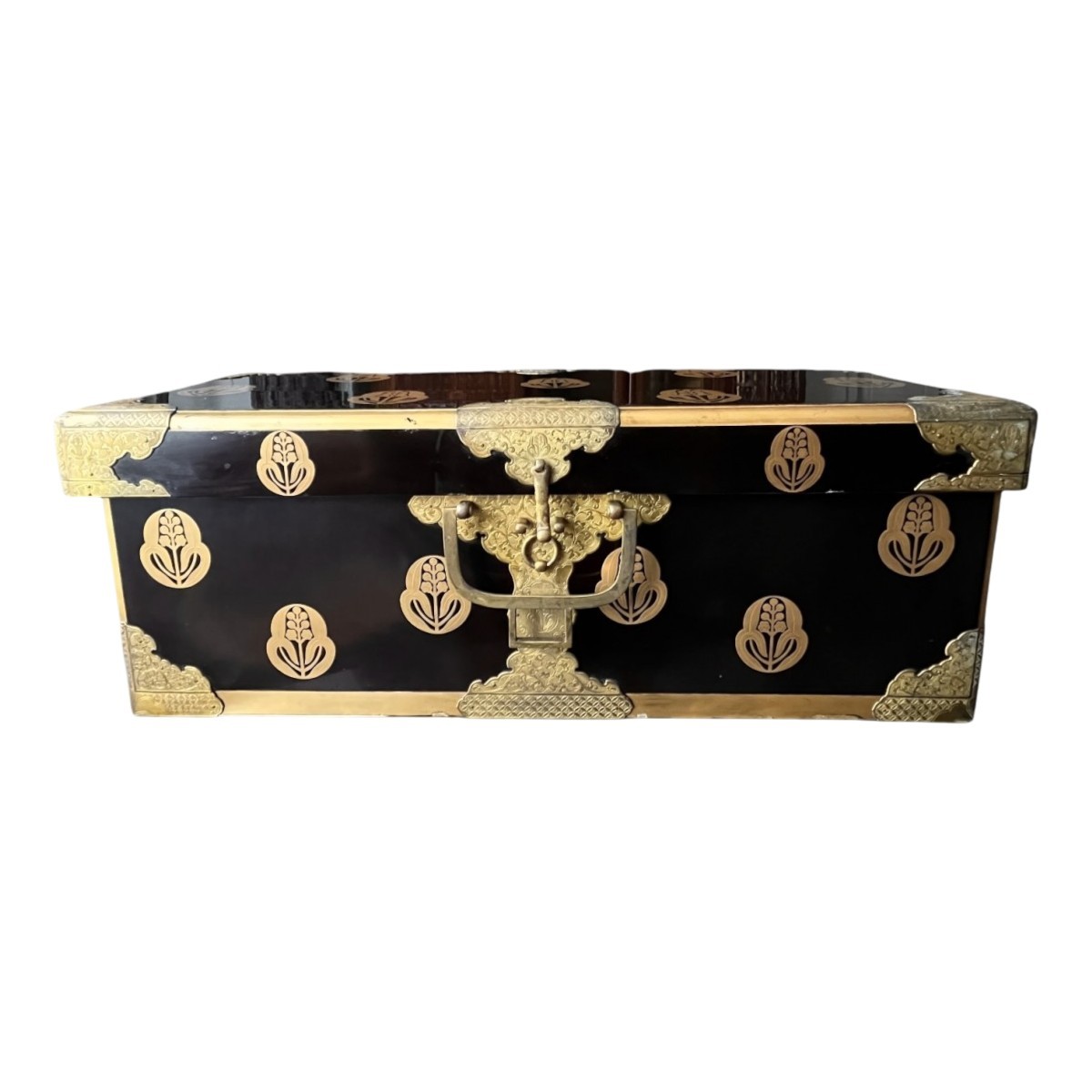
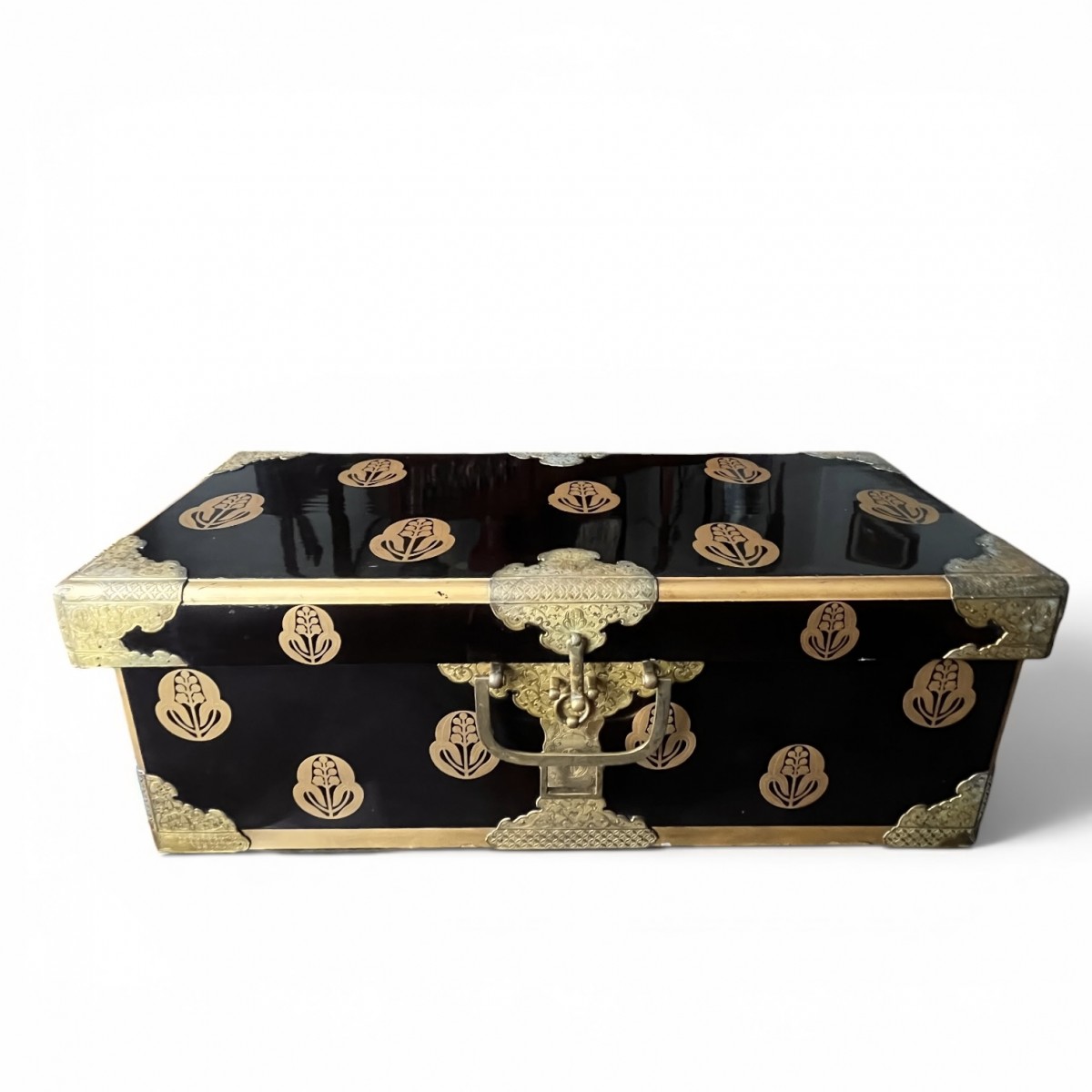
Large Japanese transport chest in black lacquer with M?ri kamon, Edo period, second half, late 18th to early 19th century
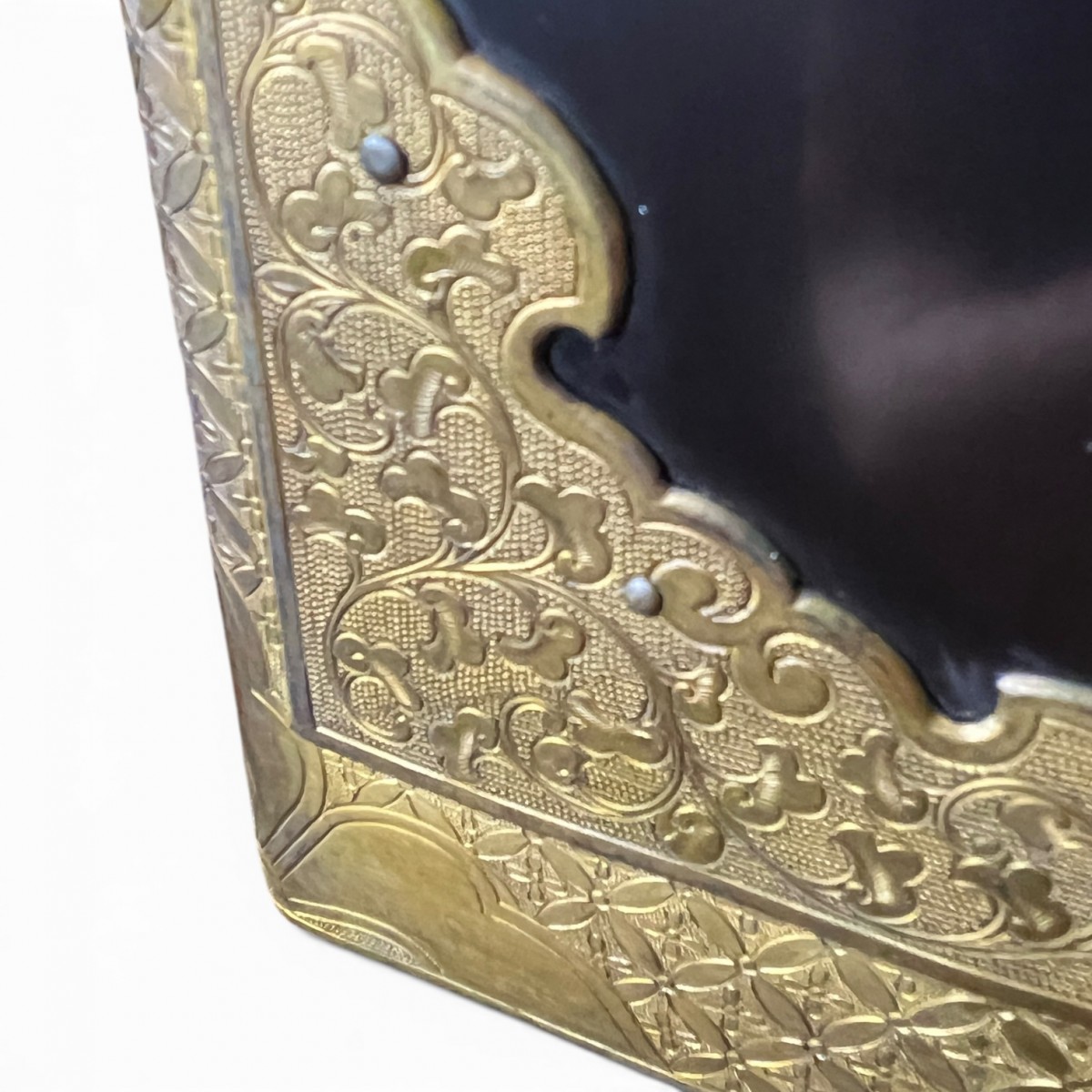
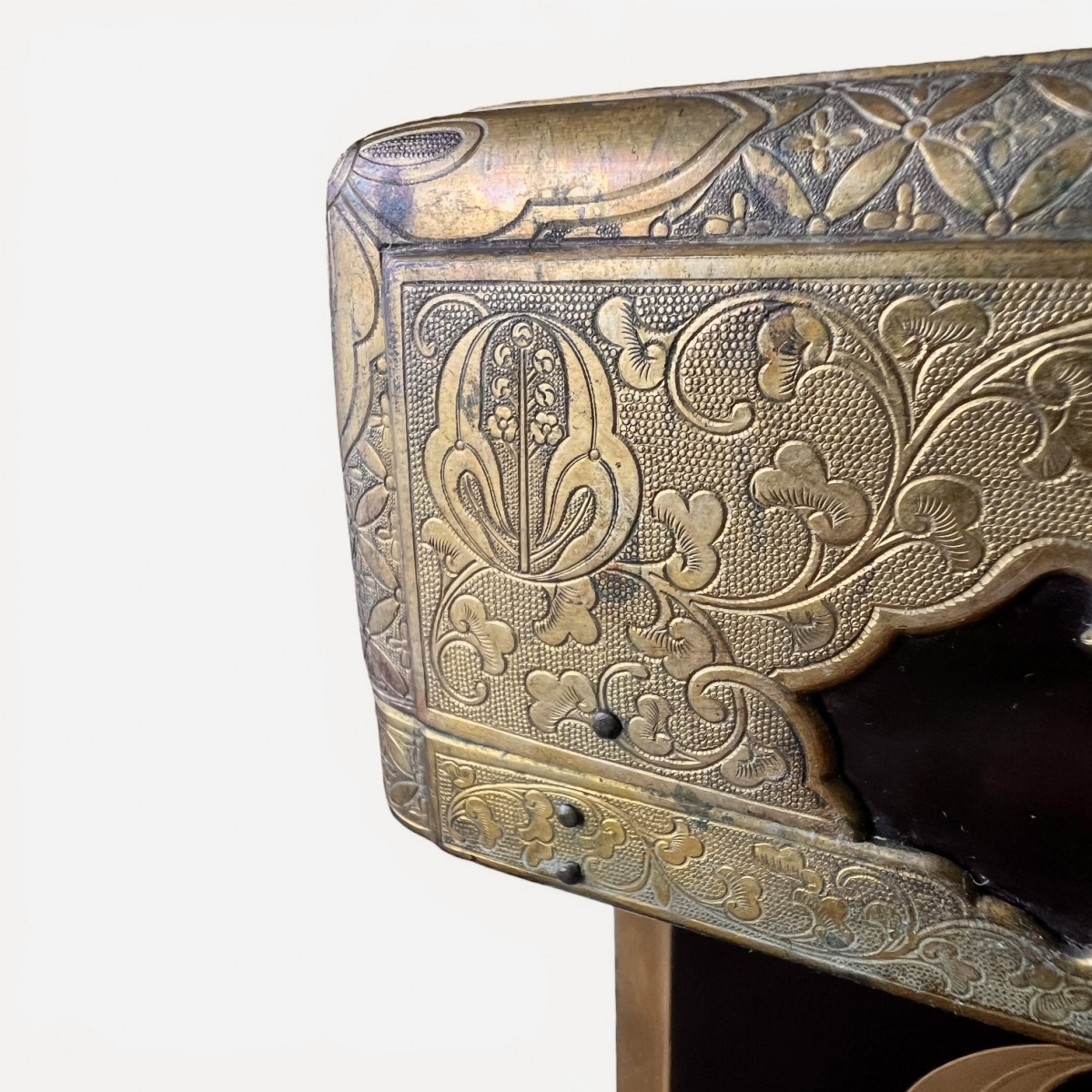
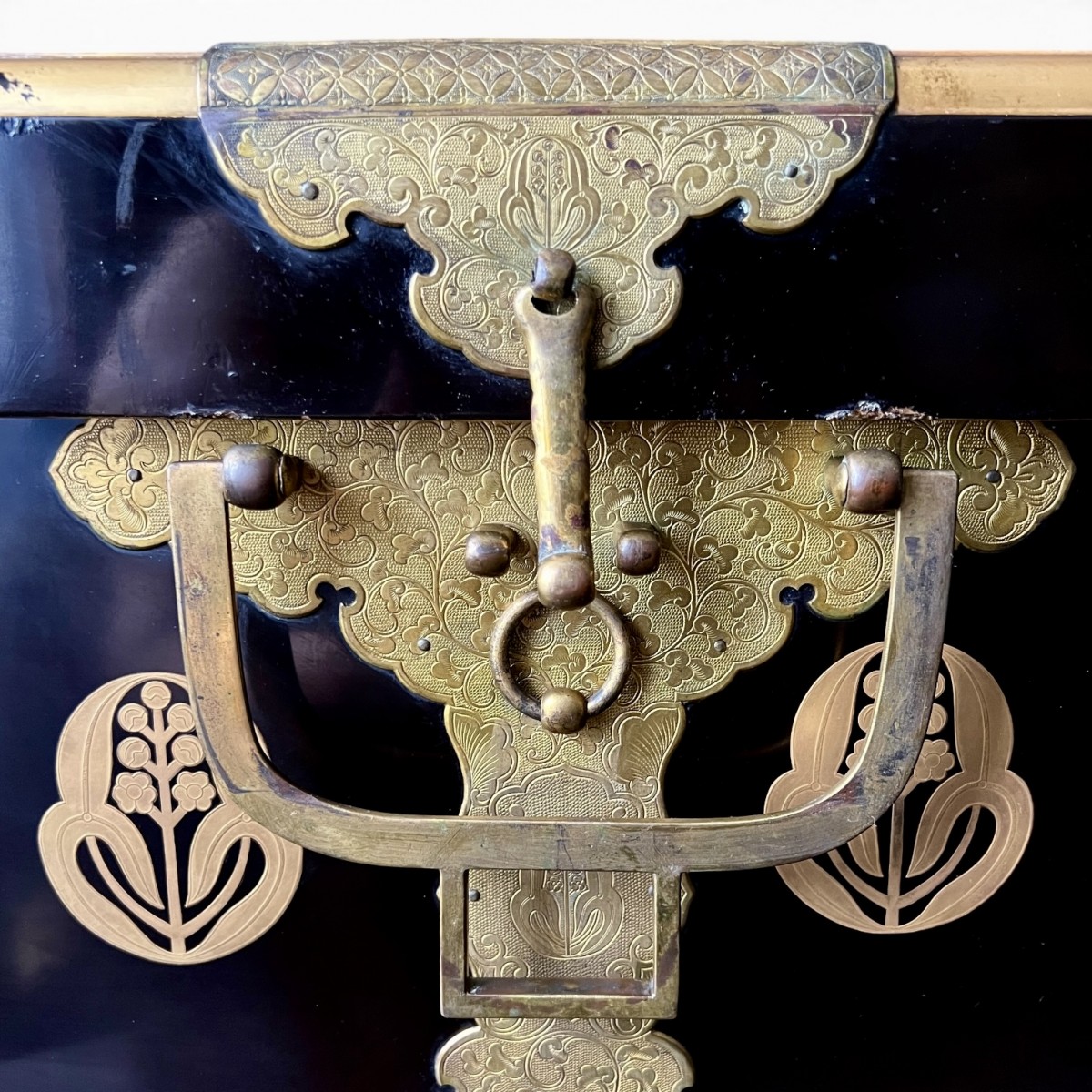
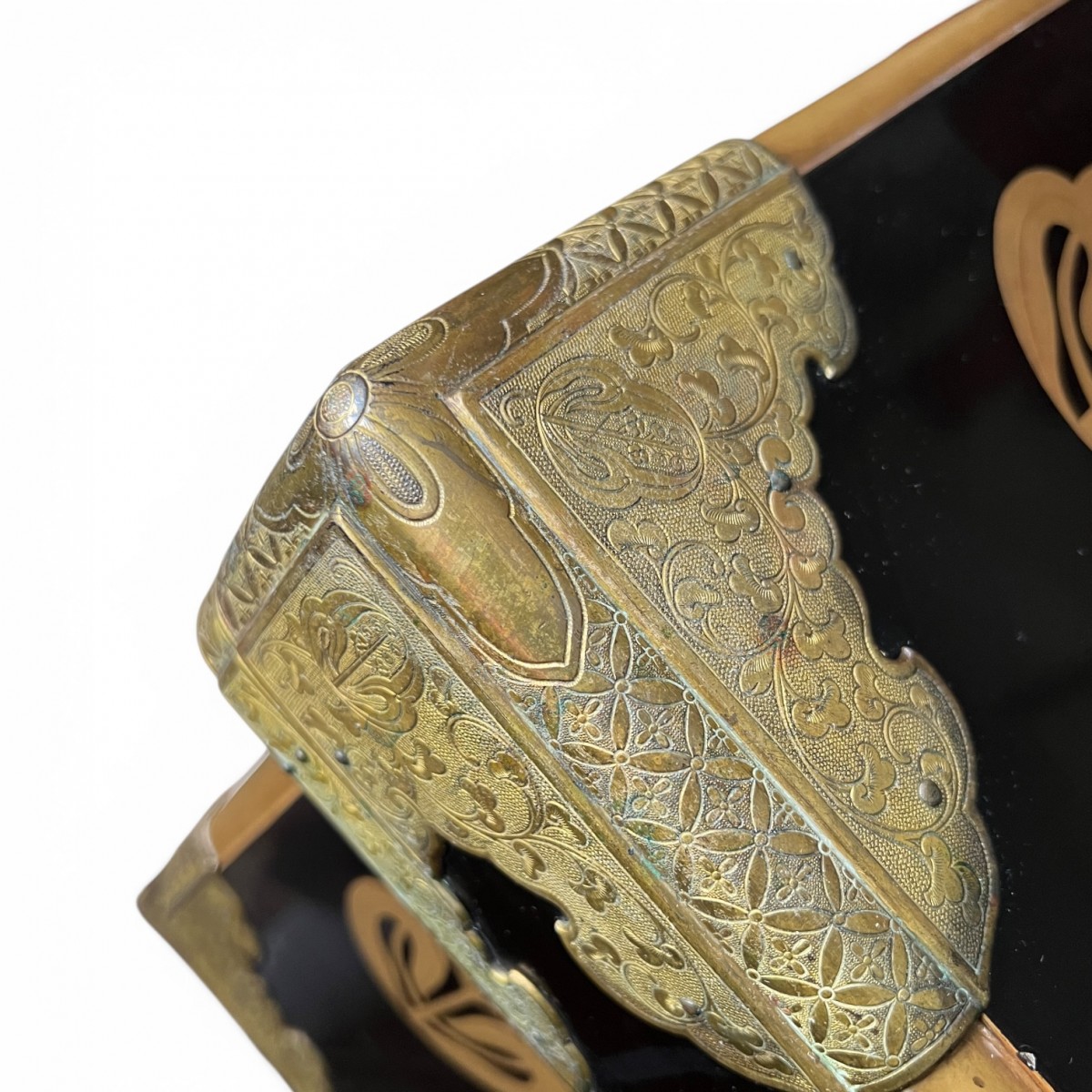
Large Japanese transport chest in black lacquer, decorated with a regular semis of Nagato omodaka kamon in gold lacquer, a heraldic emblem associated with the M?ri family of Hagi. The edges are emphasized with broad gold lacquer chamfers, while the corners, borders, and opening elements are fitted with finely engraved gilt metal mounts. These mounts display a scrolling arabesque design, but also the mon itself, repeated even in the metal fittings, which is a particularly notable sign of quality. The contrast of black and gold, the powerful simplicity of the form, and the insistent repetition of the heraldic motif give the piece an exceptionally noble presence.
Typologically, this chest belongs to the group of large transport coffers of the Edo period known as nagamochi. These chests were used for the movement of precious belongings, clothing, textiles, or documents within aristocratic and feudal households. In the world of the daimy?, they accompanied official journeys, transfers of residence, and processions, where they served both practical and representational purposes. An example bearing the Nagato omodaka so prominently clearly belongs to the material world of a great warrior house.
The M?ri family ranks among the most powerful feudal lineages of Japan. Its political fortune rose in the sixteenth century with M?ri Motonari, one of the major figures of the Sengoku period. After the Battle of Sekigahara, the M?ri lost a large part of their holdings but retained considerable status by concentrating their power in the Ch?sh? domain, centered on Nagato and Su?, with Hagi as its castle town. For more than two centuries, Hagi remained the center of M?ri authority, and the former castle town still preserves an essential part of that historical memory.
The omodaka motif, a water plant whose recurved leaf became an important heraldic design, is closely linked to the M?ri tradition. The Nagato omodaka refers more specifically to the Hagi branch, that is, to the political framework of Ch?sh? during the Edo period. The M?ri family continued to exist beyond the feudal era, at least as a historical lineage extending into modern Japan, taking on a patrimonial rather than political role.
A date in the second half of the Edo period, between the late eighteenth and early nineteenth century, appears more accurate for this chest. It corresponds to a phase when the material culture of great feudal houses had reached a high level of refinement, perceptible here in the repeated kamon, the balance of the black-and-gold decoration, and the exceptional quality of the engraved mounts.
This chest is therefore a rare testimony to the material culture of power in the Edo period, when transport furniture combined function, prestige, and dynastic affirmation. The repeated kamon, the contained monumentality of the form, and the quality of the decoration make it an object that far exceeds mere domestic use to enter the sphere of seigneurial representation.
Dimensions: width 85.5 cm; depth 38 cm; height 31.5 cm.
Delevery information :
A special care is given to packing. Bigest pieces are crated.
All our shippings are insured with tracking.
As we do a lot of shippings, we do have very special rates. Please inquire!