Offered by Stéphane Renard Fine Art
REQUEST INFORMATION
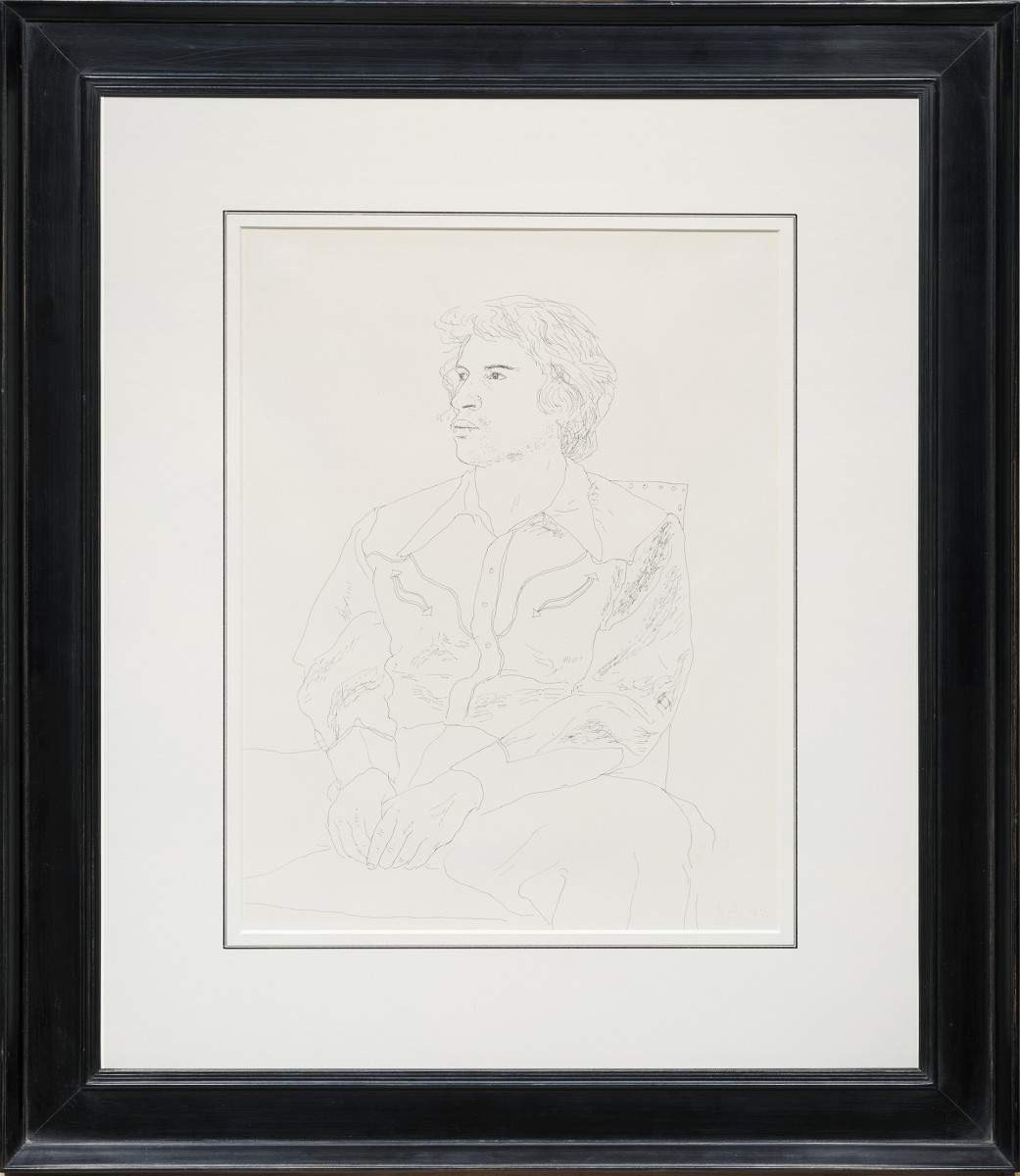

Provenance: Private collection, Paris. This drawing has belonged to the same family since it was purchased in a gallery in the 1970s by its first owner.
Modern blackened wood frame, “cassetta” type
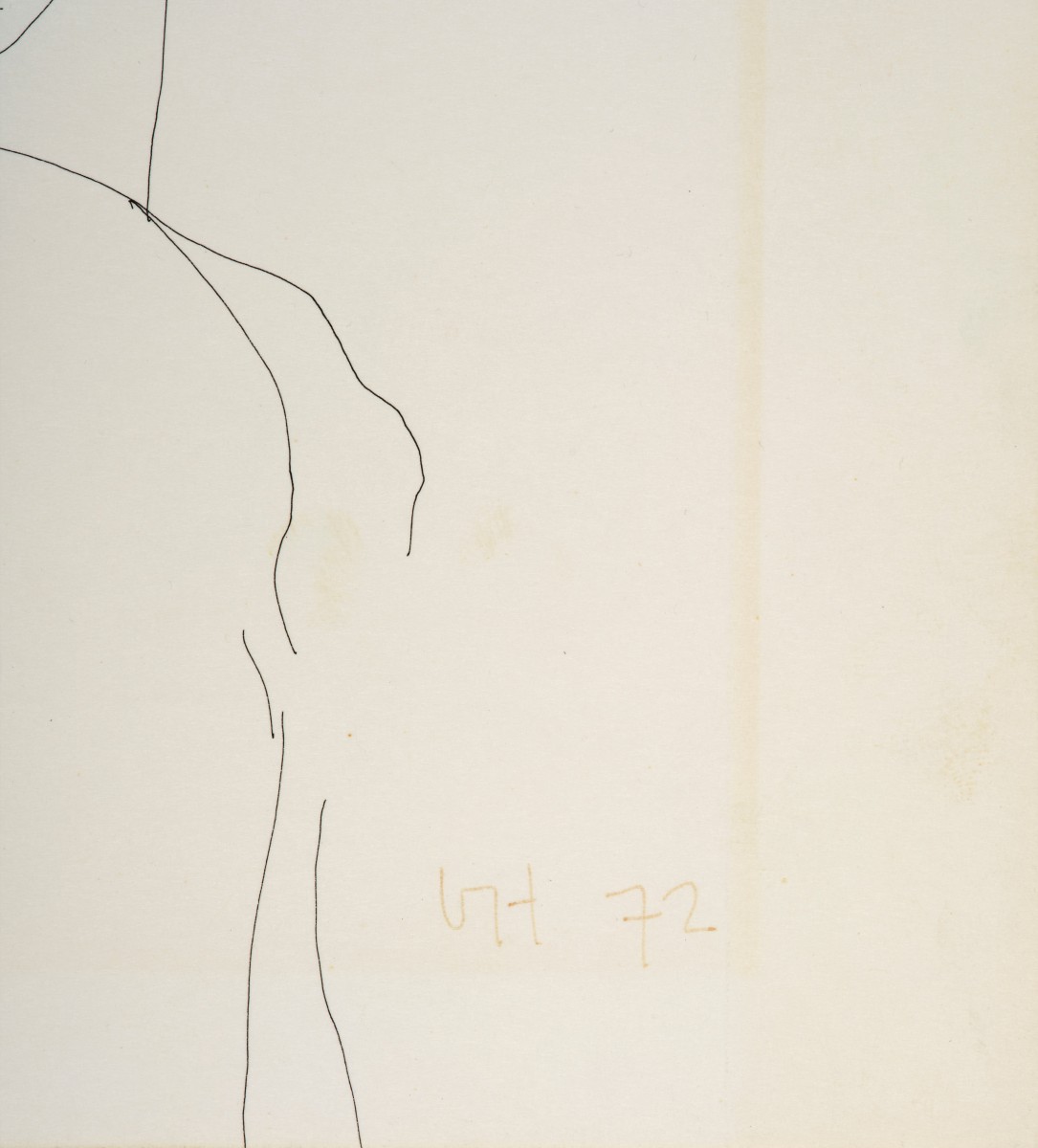
The David Hockney Foundation has informed us by mail that this drawing has been examined by Mr. David Hockney, who confirmed in January 2026 that he was indeed the author. A photography of the drawing will be included in the Foundation's archives.
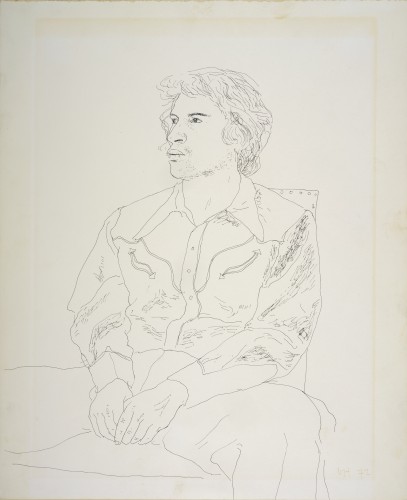
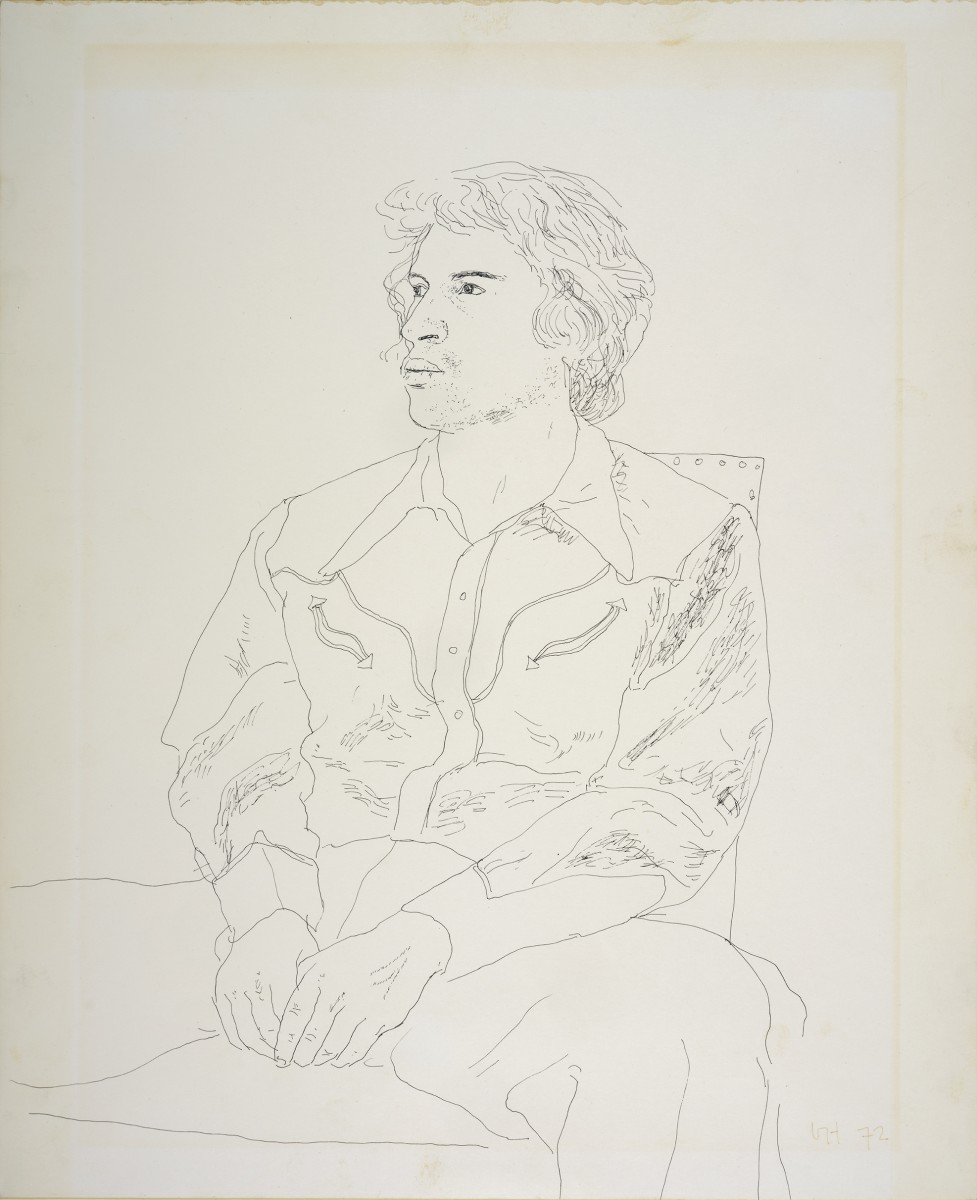
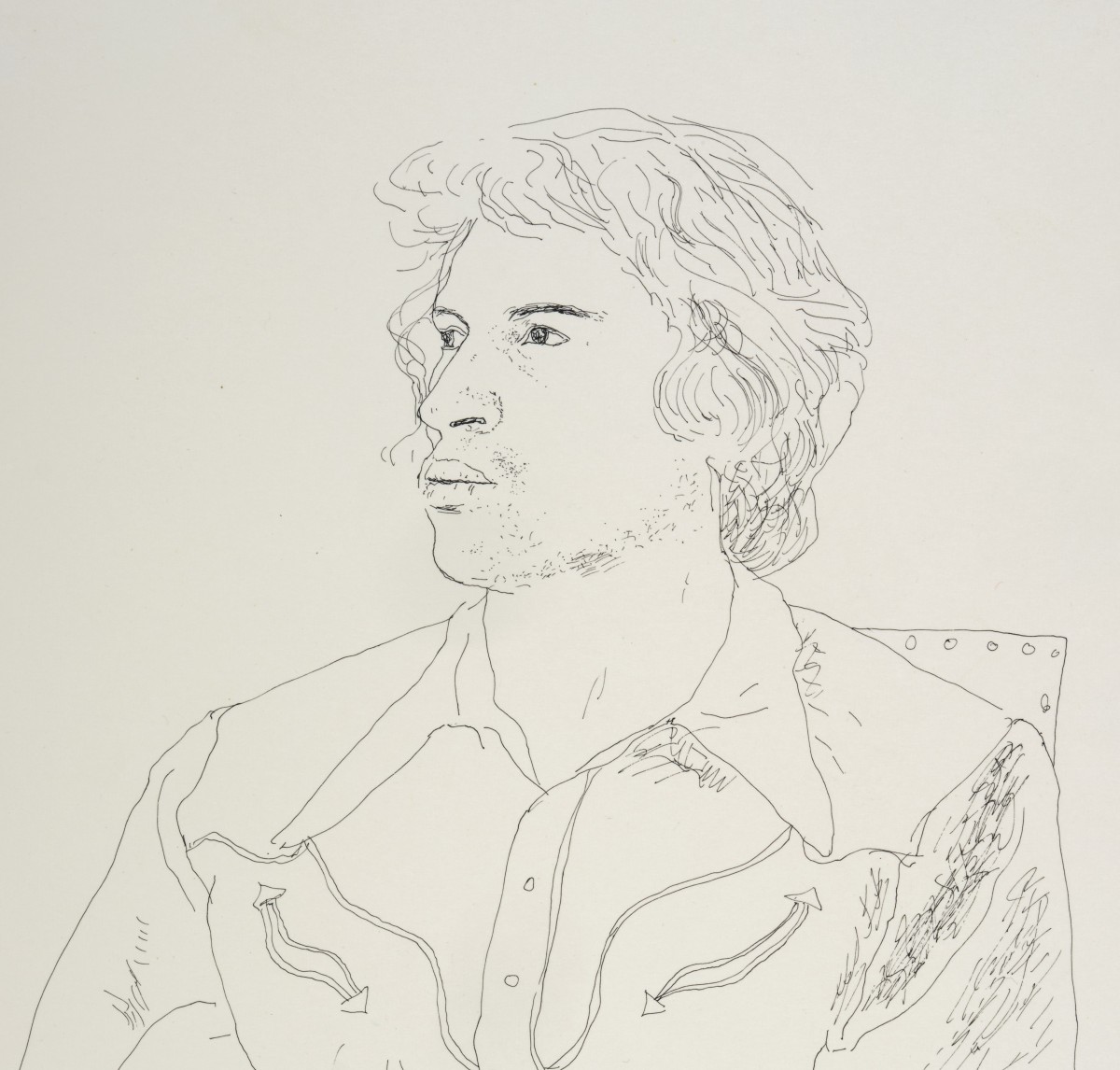
This previously unpublished drawing, kept out of public view in a French private collection since its purchase in the 1970s, is a rediscovery. It depicts Peter Schlesinger, David Hockney's former lover, in 1972, the year following their breakup. This drawing was probably made during Peter Schlesinger's visit to Paris in march 1972, while Hockney was finalizing what is undoubtedly his most famous painting: “Portrait of an Artist.”
1. 1972: a pivotal year in Hockney's life
The year 1972 was a pivotal one for David Hockney. His former lover, Peter Schlesinger, left his home in Powis Terrace in 1971 , and Hockney immersed himself in painting, working day and night. The paintings from this prolific period often deal with the theme of absence, but also with his reflections on art history.
Hockney's thirst for painting continued throughout 1972. Hockney completed a particularly ambitious painting, which required an immense amount of work and plunged him back into the intimacy of his relationship with Peter Schlesinger. This painting was born from the fortuitous juxtaposition of two photos in his studio: one showing a man swimming underwater, the other a figure standing with his gaze directed towards the ground, who would become the representation of Peter Schlesinger in “Portrait of an Artist.” The title of the painting, which has a certain irony to it, refers to Peter Schlesinger's artistic activity, as he is still a renowned sculptor today.
Hockney painted a first version of this painting over a period of four months at the end of 1971, but, dissatisfied with the composition, he abandoned his work and decided to start again from scratch. He then left for several months with Mark Lancaster, before returning to work in early 1972.
In April 1972, Hockney traveled to the south of France to better visualize the figure swimming underwater, using the swimming pool at director Tony Richardson's villa, Le Nid du Duc, near Saint-Tropez. Hockney's assistant, Mo McDermott, recreated the pose of the man standing, while a young photographer, John St Clair, played the swimmer. Hockney took hundreds of photographs based on his original composition.
Back in his London studio, Hockney assembled the photos with those representing Peter Schlesinger in Kensington Gardens, where Schlesinger was wearing the same pink jacket. Hockney worked on the painting for two weeks, 18 hours a day, and only completed it the day before he left for New York for the opening of the André Emmerich Gallery exhibition.
Hockney said about this painting: “I must admit that I loved working on this painting, [...] working with such intensity; it was wonderful, really exciting.” The creation of this painting and the breakup between Hockney and Schlesinger were dramatized in the 1974 semi-fictional documentary A Bigger Splash, which takes its name from a Hockney's 1967 painting. When it was sold at Christie's on November 15, 2018, for $90.3 million, Portrait of an Artist became the most expensive painting by a living artist ever sold.
2. Peter's portraits painted in Paris in March 1972, or the portraiture of a breakup
The exhibition held from May 13 to 31, 1972, at the André Emmerich Gallery featured several drawings executed in Paris in March 1972, including this portrait of Peter Schlesinger dated March 13, 1972, reproduced below from the exhibition catalog, where it was presented under the title "Paris March 13th, 1972 ."
However, it is indeed a portrait of Peter Schlesinger, as indicated on the back of a reproduction kept in the archives of Kasmin Ltd , a London gallery where this drawing was also presented during an exhibition dedicated to the artist, which opened on December 6 of the same year, 1972. Like our portrait, Peter Schlesinger is shown slightly sideways, his legs wide apart.
At least two other portraits of Peter, of the same size (17 x 14 in.), were probably also made during this stay in Paris, when Hockney was preparing to leave for Saint-Tropez to complete his Portrait of an Artist. The first, “Portrait of Peter 1972,” also comes from the André Emmerich Gallery . The second, “Reclining Boy 1972,” was featured in the 1972 exhibition held at Kasmin Ltd .
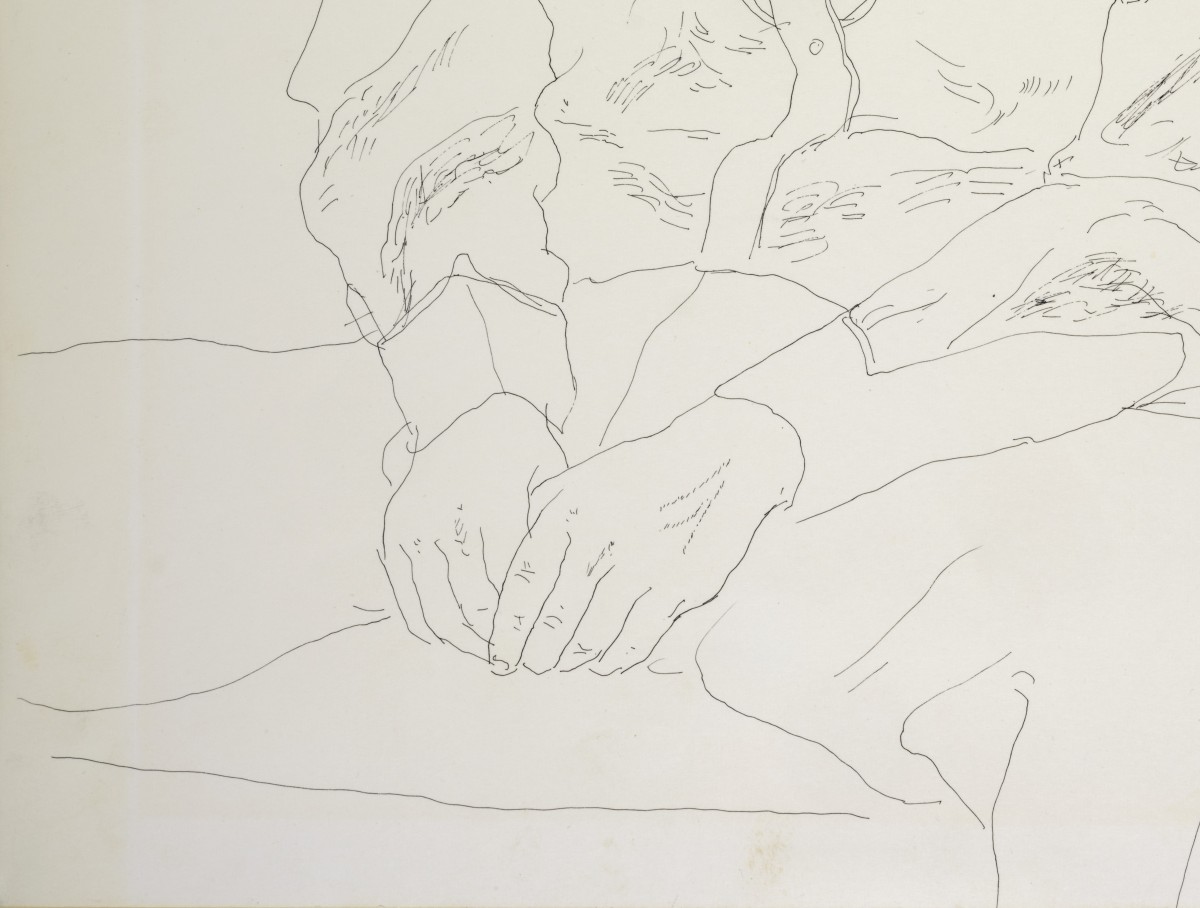
These portraits have in common a breathtaking dexterity: they were drawn entirely in ink, freehand, without the aid of a preparatory sketch, which explains why those drawings are not exactly centered, with some lines extending to the edge of the sheet. These four portraits all present an image of Peter Schlesinger which is both distant and somewhat elusive: the model (who is always depicted fully clothed) never looks at the artist.
The position of the hands crossed over the fly of the pants seems to us to be an explicit symbol of distancing. This position is particularly evident in the portrait we are presenting, in which Peter Schlesinger is depicted in an almost provocative position, his legs wide apart. We also sense a palpable tension between the artist and his model, as if the latter wanted to make it clear that their relationship was definitely over.
3. Framing
Our drawing was reframed by its last owner in the early 1980s using a mat that significantly reduces the view to hide the marks left by the previous mounting a few centimeters from the edge. As it was impossible to erase these marks, we chose to keep this mounting (which is centering the portrait), despite the fact that it is hiding part of the two legs, which were originally drawn right up to the edge of the sheet.
Delevery information :
The prices indicated are the prices for purchases at the gallery.
Depending on the price of the object, its size and the location of the buyer we are able to offer the best transport solution which will be invoiced separately and carried out under the buyer's responsibility.