Offered by Stéphane Renard Fine Art
REQUEST INFORMATION
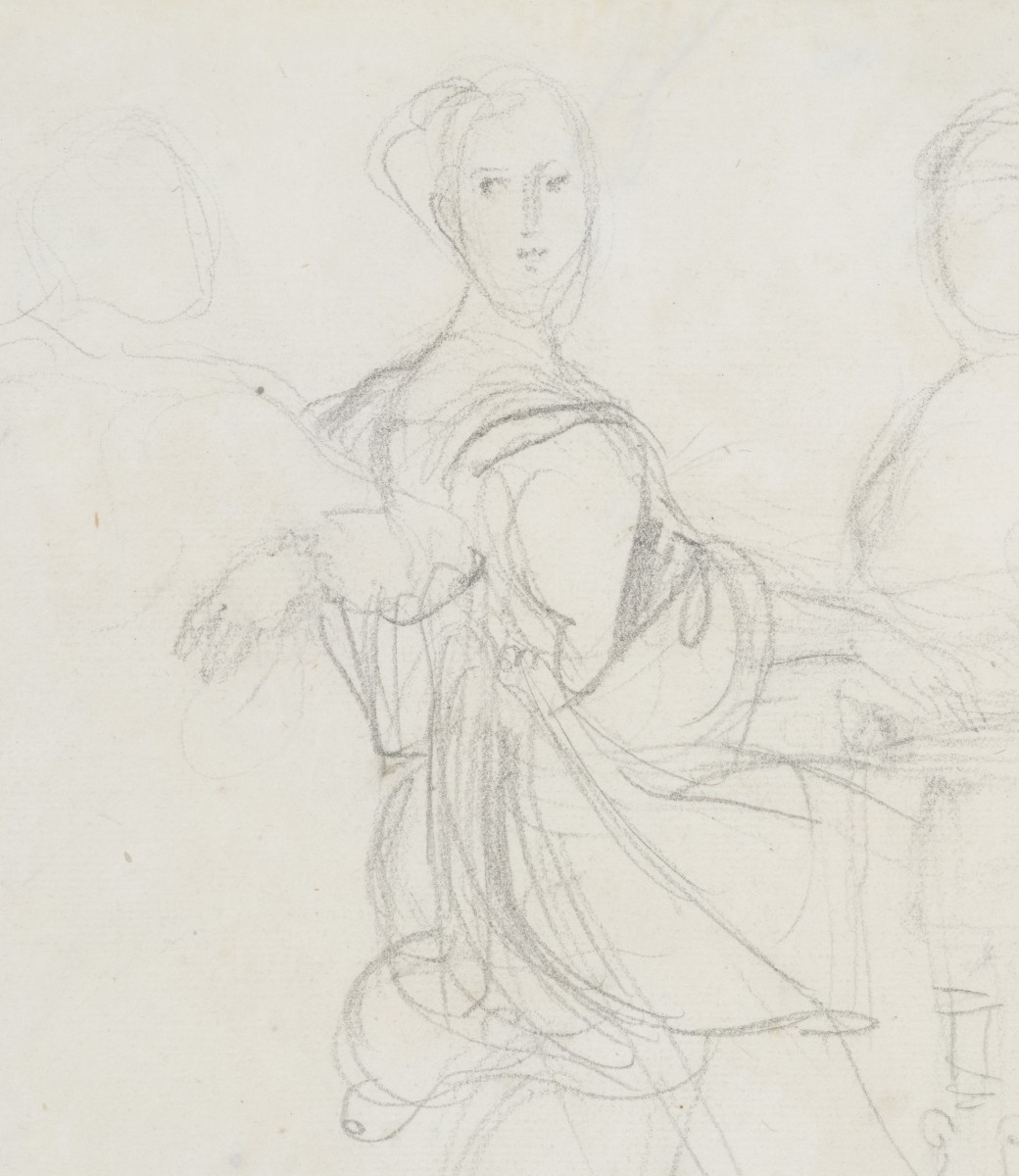

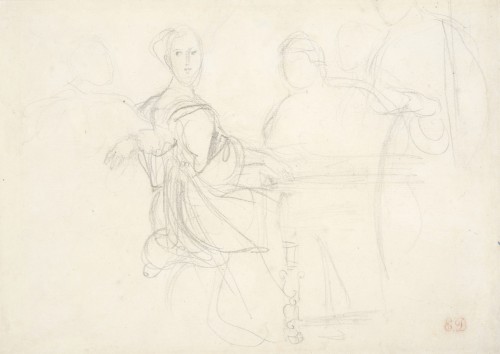
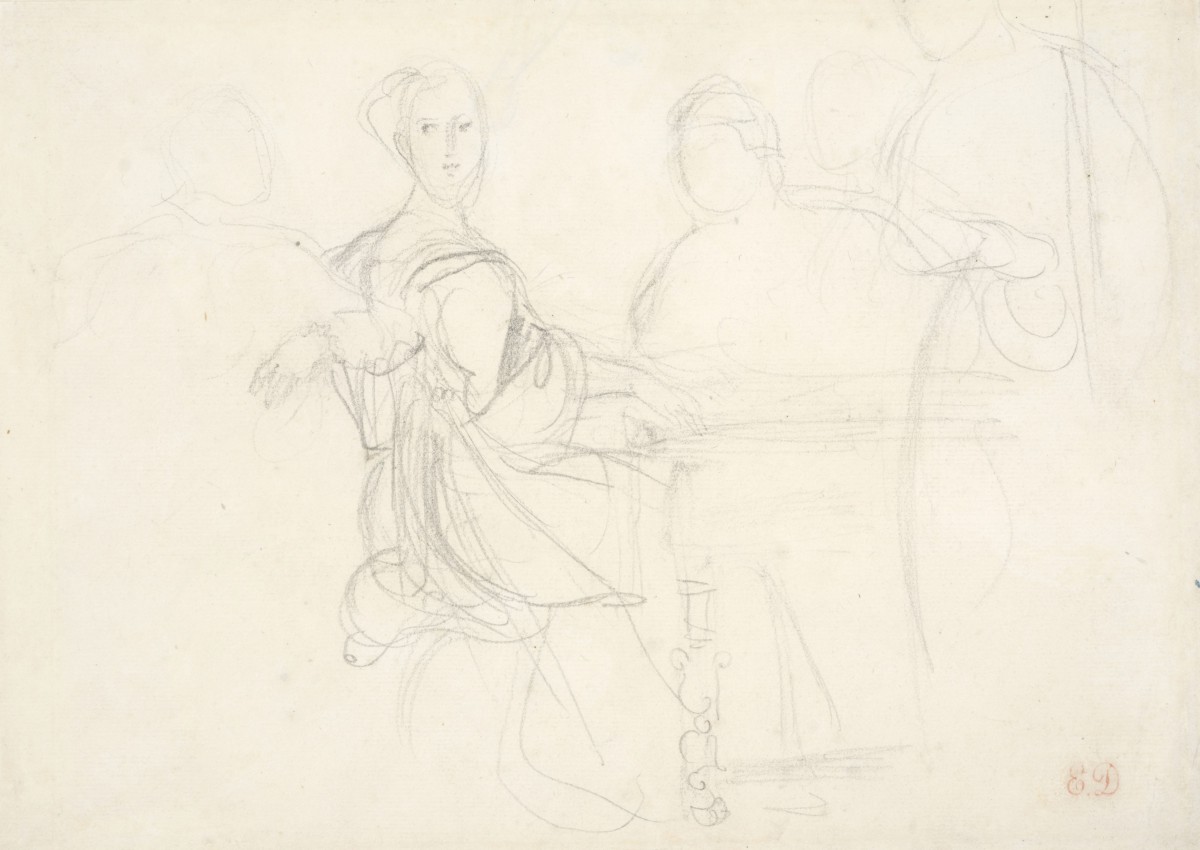
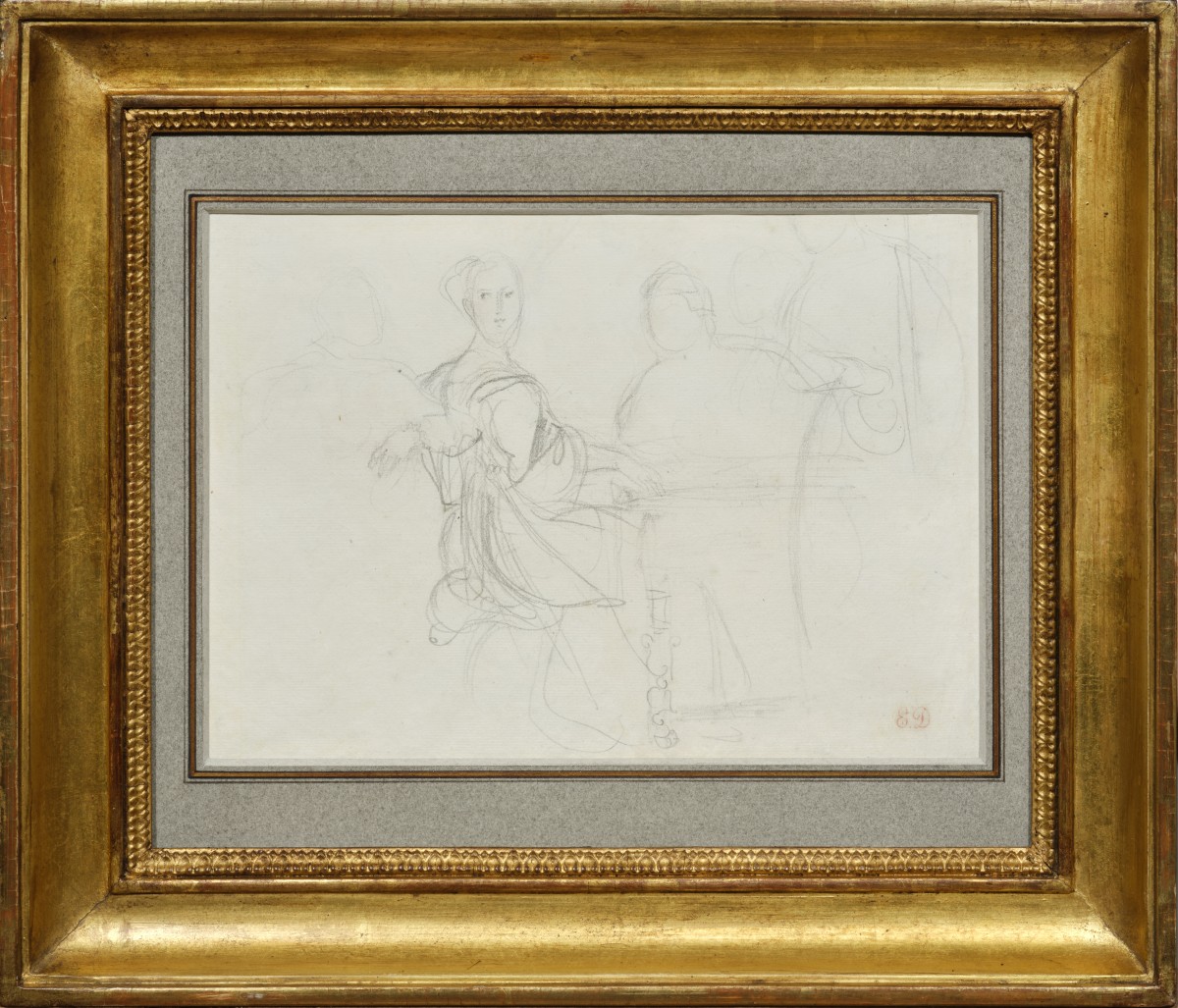
Graphite lead on paper
Dimensions: 6 x 8 ¼ in. (15.4 x 21 cm) – framed 11 ¼ x 12 5/8 in. (28.5 x 33.2 cm)
Studio sale stamp in the lower right corner (L. 838a)
A certificate from the Delacroix Committee (experts Brame and Lorenceau will be provided to the buyer.
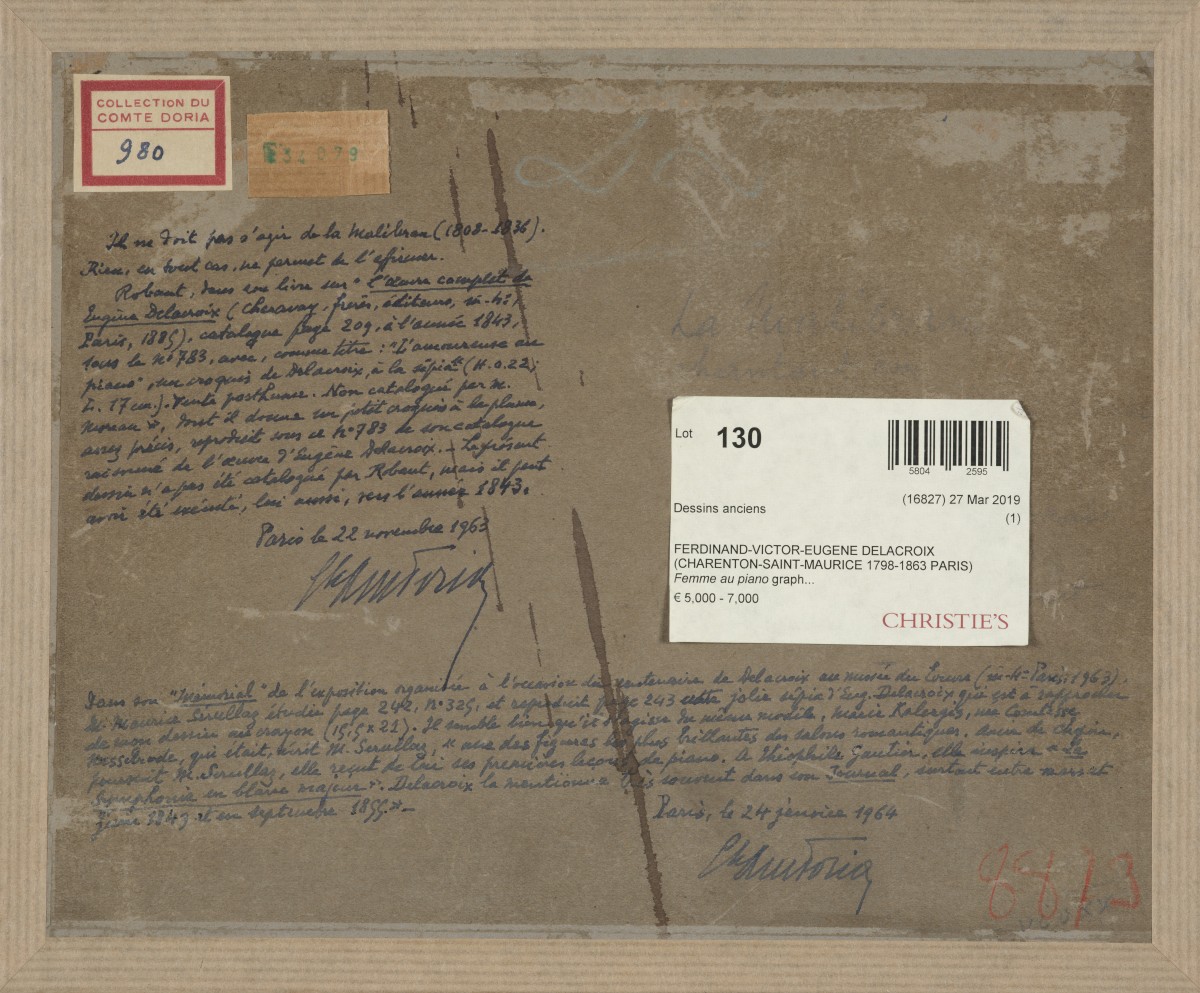
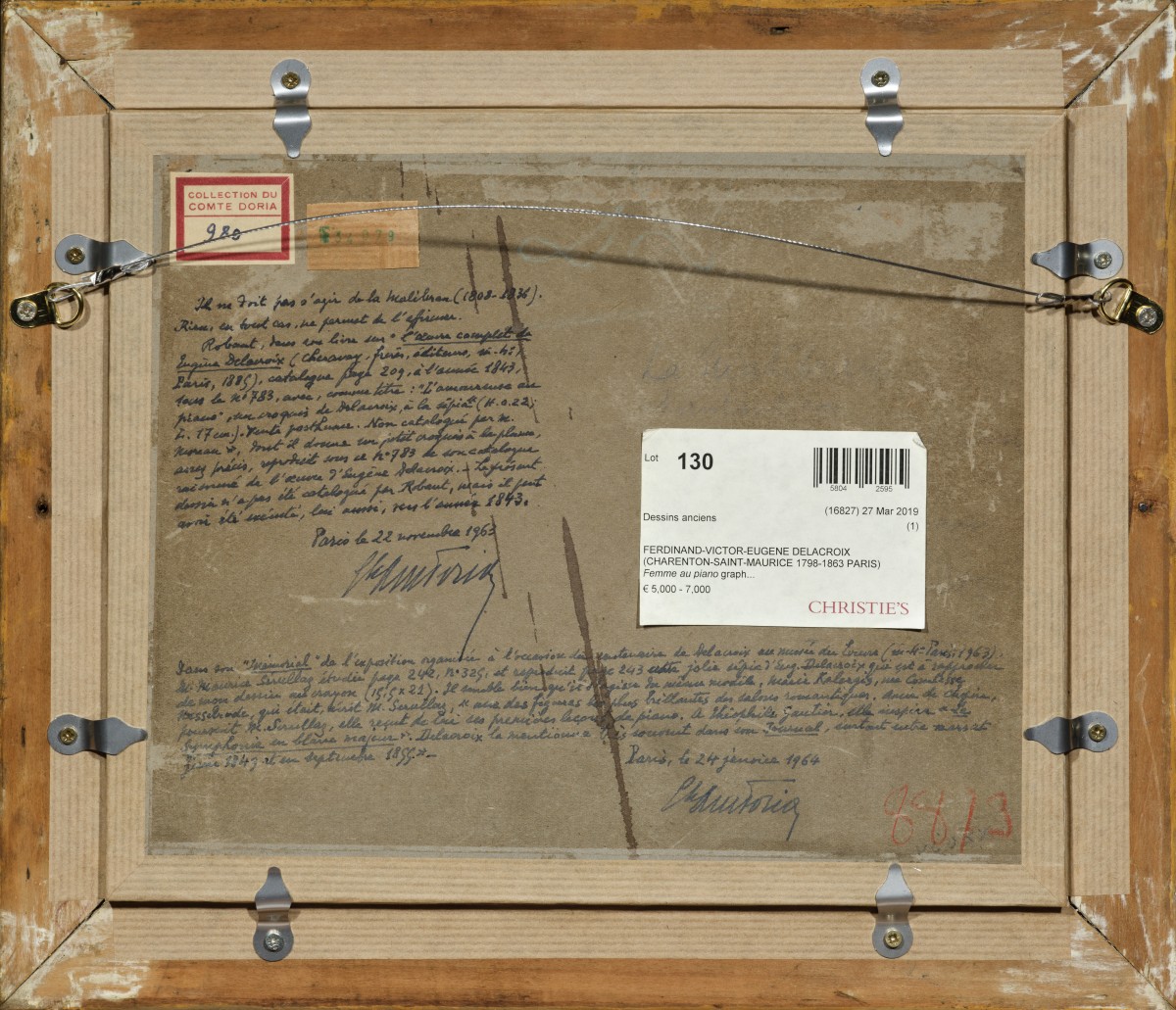
Provenance: Delacroix’s studio sale, February 17–29, 1864/ Count Doria (collection label on the reverse, no. 980), then through family inheritance/ Christie’s sale of March 27, 2019 – lot 130
Louis XVI-style frame in stuccoed and gilded wood – 19th-century France
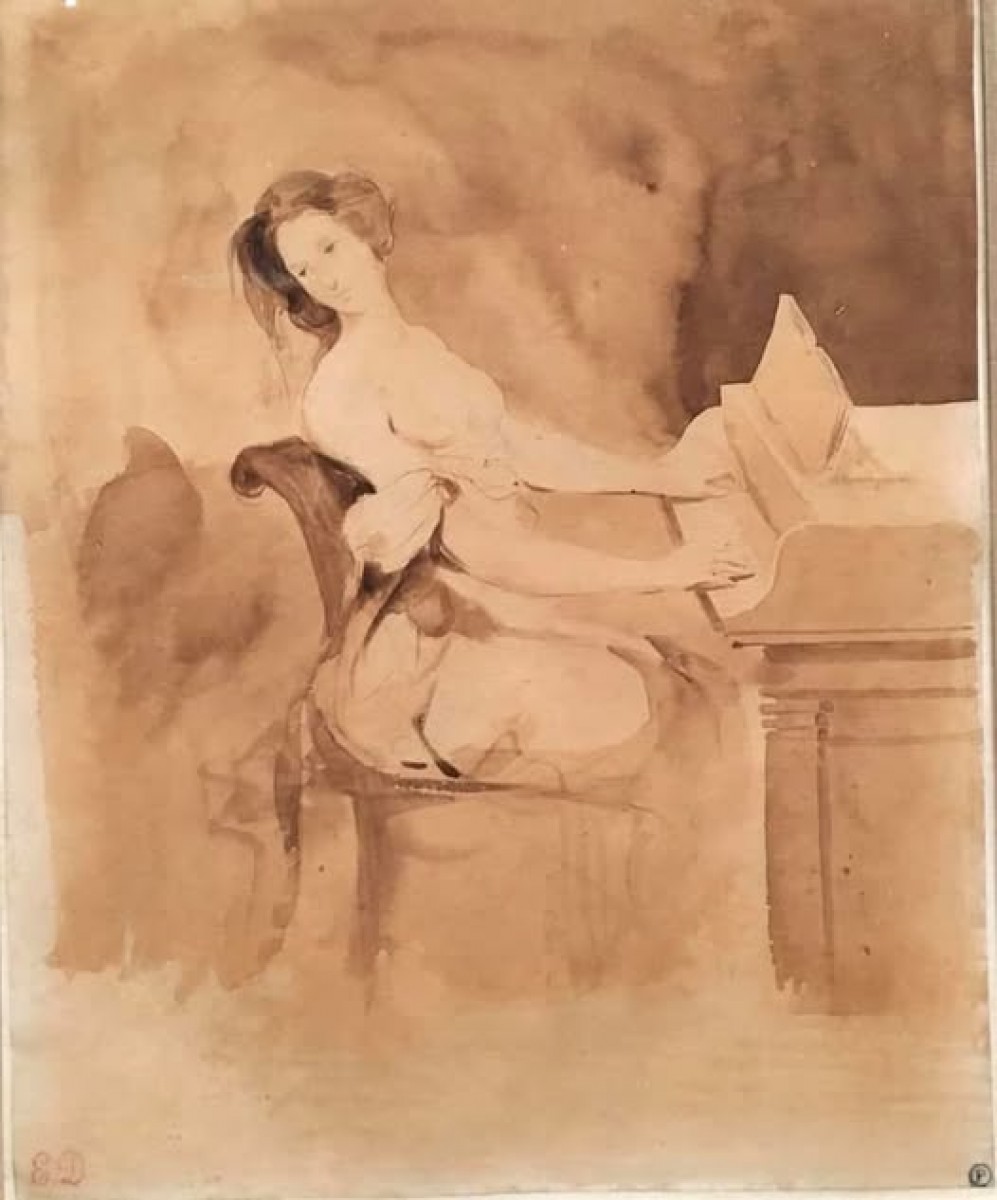
This charming graphite study, from the sale of the artist’s studio, captivated us with its dreamy spontaneity, which immerses us in the heart of Parisian artistic life during the Romantic era. We propose to apply to this drawing of a woman at the piano the title of a famous wash by Delacroix (The Lover at the Piano), now in the Prat Collection, which has a very similar composition. According to a handwritten inscription on the reverse of the mount, both works may, in fact, depict the same model: Maria Kalergis von Nesselrode-Ereshoven, a German-Polish aristocrat, pianist, and a student of Chopin whom Delacroix met in Paris in 1843…
1. Eugène Delacroix “for mortal hearts […] divine opium”
Eugène Delacroix was born in 1798 into a privileged family: his father, Charles Delacroix, who had briefly served as Minister of Foreign Affairs under the Directory, was then ambassador to Holland. His mother, Victoire Oeben, came from a family of cabinetmakers. Both parents died prematurely, his father in 1805 and his mother in 1814, leaving him in the care of his older sister, Henriette de Verninac, the wife of a former ambassador to Turkey and minister plenipotentiary to Switzerland. As a child, he had played on the lap of Talleyrand, his father’s successor at the Ministry of Foreign Affairs. It has been suggested, though not proven, that Talleyrand—to whom Delacroix bore a strong resemblance in his later years—was in fact his biological father.
In 1815, at the age of seventeen, Delacroix began taking painting lessons with Pierre Guérin (1774–1833), in whose studio Théodore Géricault had briefly studied. The classical training had little effect on him: a self-taught artist, his true school would be the Louvre, where the splendor of Titian, Veronese, and Rubens shone brightly enough to eclipse the school of David. Among his fellow copyists in the Louvre galleries, he met the young Englishman Richard Parkes Bonington (1801–1828), who, alongside his friend Raymond Soulier, introduced him to watercolor and the British tradition of colorism, and helped awaken his interest in Shakespeare, Byron, and Scott—the primary literary sources of his Romanticism.
In 1822, at his debut at the Salon, his Dante’s Boat (Louvre) attracted attention. Two years later, his Massacres at Chios (Louvre) burst onto the scene at the 1824 Salon as “a terrifying hymn in honor of fate and irremediable suffering” . The government’s purchase of the work allowed Delacroix to visit England in the spring and summer of 1825.
The colossal and orgiastic Death of Sardanapalus (Louvre), exhibited at the 1827 Salon, was another shock to the public. Delacroix had drawn the subject from a play by Byron, but composed the voluptuous cast of this massacre scene from his own imagination. The Revolution of 1830 inspired his only truly popular work, Liberty Leading the People (Louvre). For once, the public and critics united in praising the artist, and the government of Louis-Philippe awarded him the Legion of Honor.
In early 1832, Delacroix traveled to North Africa as part of a French diplomatic mission to the Sultan of Morocco. Islamic Africa exceeded all his expectations. He encountered the classical beauty he had sought in vain in the plaster casts of Guérin’s studio, along the roads beneath the African sky. He filled sketchbooks with observations of Arab life and gathered ideas that would serve him until the end of his life. Upon his return to Paris, he began a series of Oriental subjects based on his travel memories. Algerian Women in Their Apartment (1834, Louvre) depicts a visit to a harem. The sensual intensity of the painting marks the culmination of a mature style, more restrained yet also more powerful.
After 1830, Delacroix identified increasingly with the great tradition of the Venetians and Flemish masters, particularly Veronese and Rubens. The governments of Louis-Philippe and Napoleon III entrusted him with major monumental commissions, beginning in 1833 with the allegorical decorations for the King’s Salon at the Palais Bourbon (Chamber of Deputies). This commission was closely followed by the even more significant one for the library of the Palais Bourbon (1838–1847), then the Senate library at the Palais du Luxembourg (1840–1846). Next came the ceiling of the Apollo Gallery at the Louvre (1850–1851), the decorations for the Hall of Peace at Paris City Hall (1852–1854, destroyed in 1871), and the Chapel of the Holy Angels at the Church of Saint-Sulpice (1854–1861).
No other painter of the time was so consistently engaged in large-scale monumental works. His murals demonstrate that this artist possessed the energy to compose on immense surfaces and the mental vigor to invent images that dominate these walls.
The 1855 World’s Fair featured thirty-six of his paintings, earning him the reputation, alongside Ingres, as one of the two greatest living French artists. Long rejected by the Academy, he was finally admitted in 1857. Often suffering from bronchial infections and conserving his physical strength, he led a frugal bachelor’s life but worked with unwavering energy until the end. He died on August 13, 1863.
2. Description of the drawing and related artwork
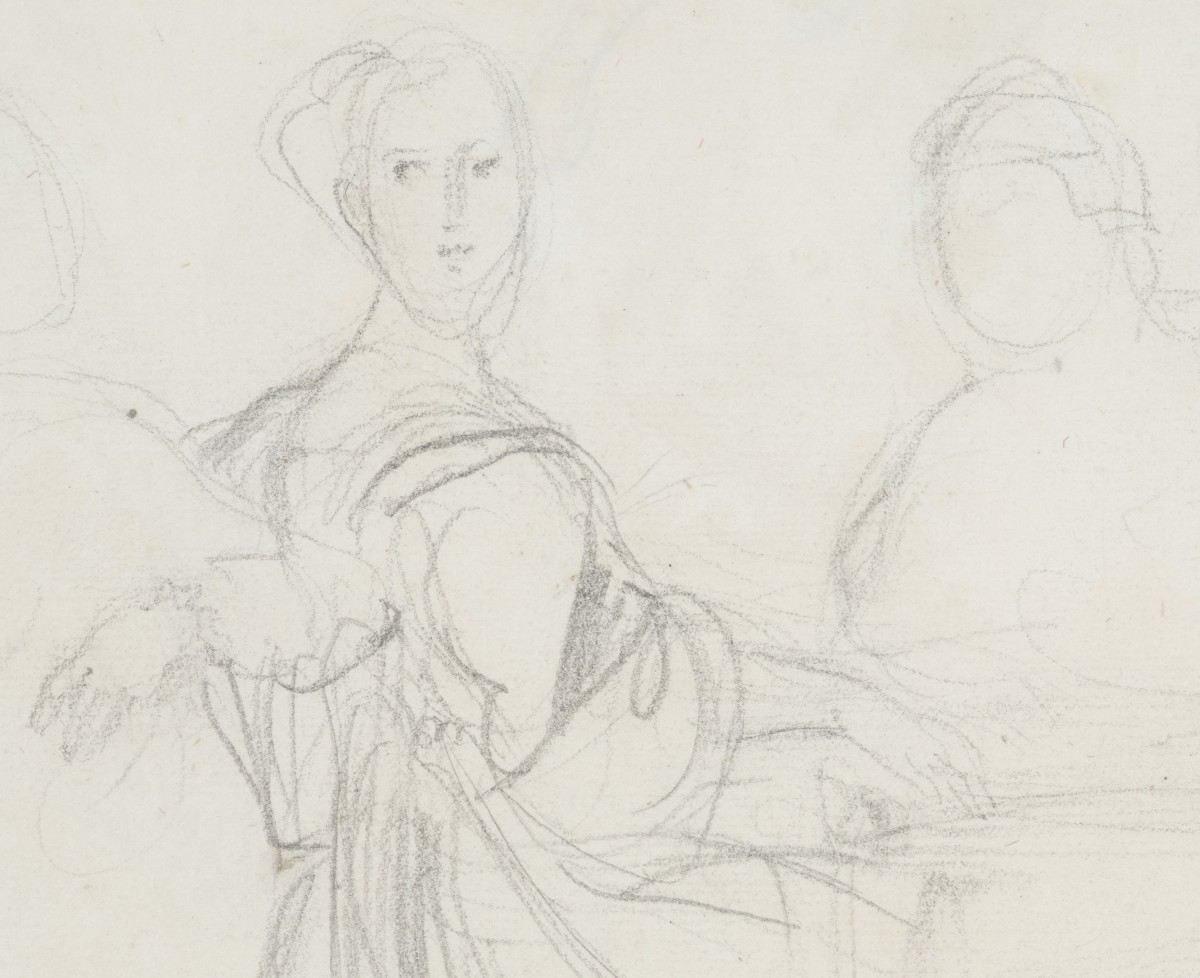
Our drawing depicts, in an intimate style, a pianist performing before a friendly gathering. Distracted for a moment from her keyboard, she turns toward a figure seated behind her, his arm resting on the back of his chair, the rest of whose silhouette is only sketched, adding a mysterious and fleeting dimension to this scene.
The composition evokes a wash drawing by Delacroix titled “The Lover at the Piano,” (7th photo in the gallery) and which may depict the same figure.
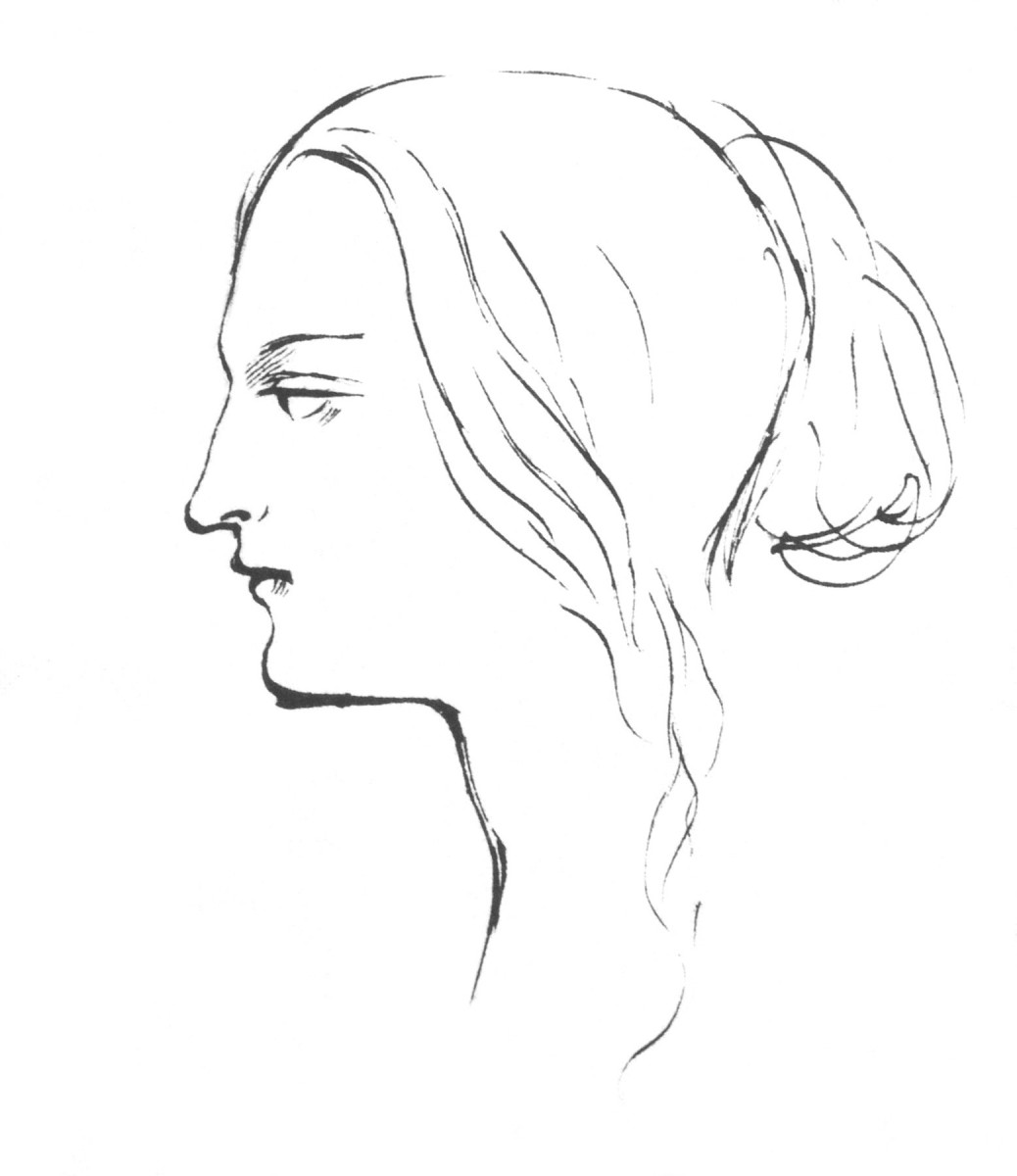
According to a handwritten inscription by Count Doria, the collector from whom this drawing originates, the two works depict Maria Kalergis von Nesselrode-Ereshoven, a German-Polish aristocrat, a pianist, and a student of Chopin whom Delacroix met in Paris in 1843… A portrait of this beautiful pianist executed in 1845 (two years after the presumed date of our drawing) by Cyprian Norwid, the famous Polish poet who is said to have been her great love, also bears witness to a certain resemblance between the model in these two works and Maria Kalergis (8th photo in the gallery).
3. Provenance and framing
Our drawing comes from the posthumous sale of the artist’s studio, as evidenced by the stamp bearing the artist’s initials affixed in the lower right corner. It subsequently belonged to Count Doria, a French art historian (Orrouy 1890 – Paris 1977), and then to his descendants.
We have chosen to frame this drawing in a 19th-century French Louis XVI-style frame, made of stuccoed and gilded wood.
Delevery information :
The prices indicated are the prices for purchases at the gallery.
Depending on the price of the object, its size and the location of the buyer we are able to offer the best transport solution which will be invoiced separately and carried out under the buyer's responsibility.