Offered by Franck Baptiste Provence
REQUEST INFORMATION
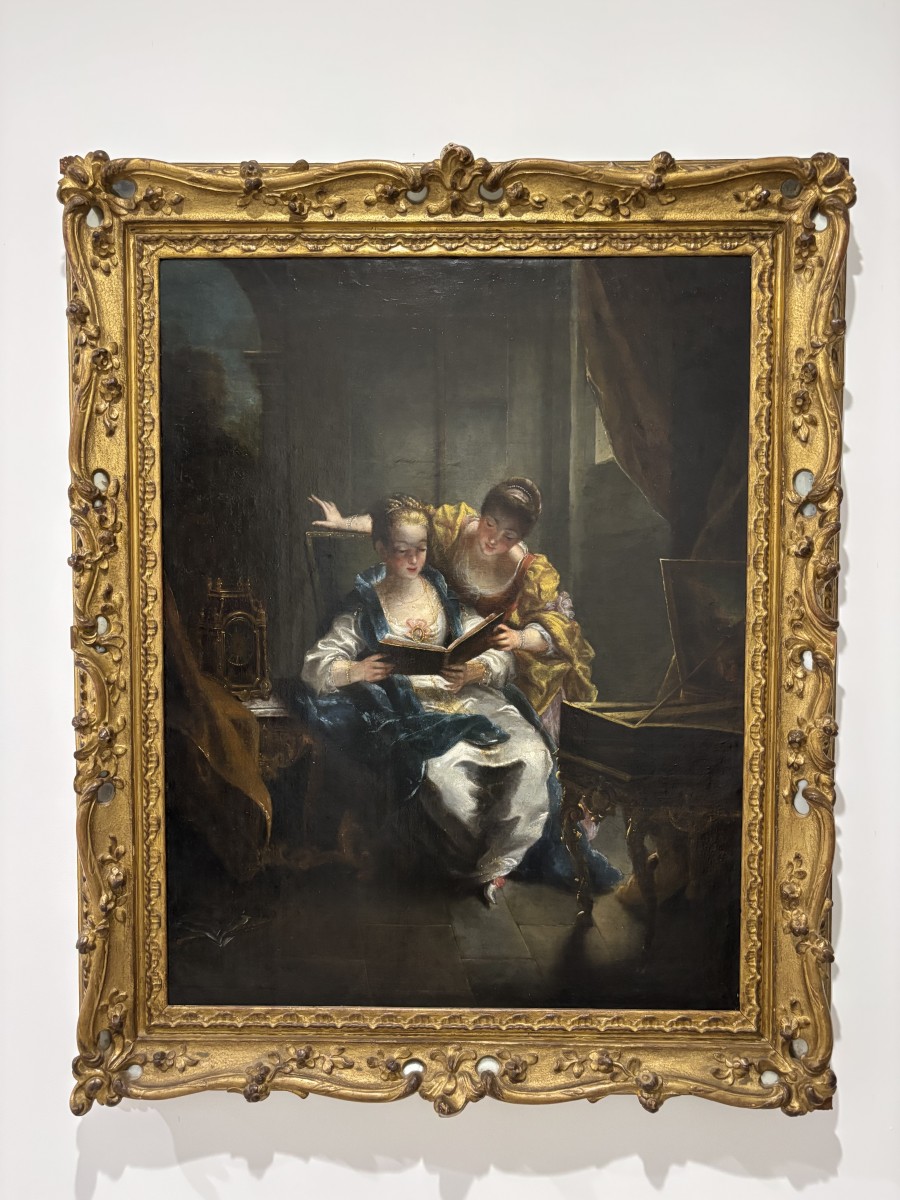

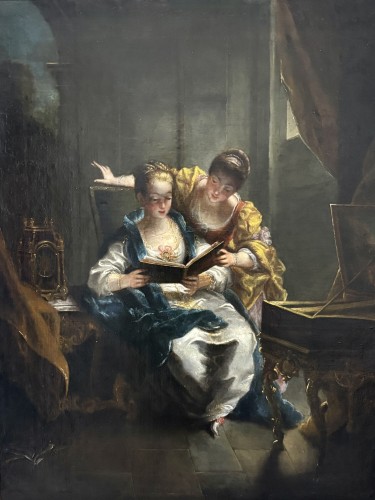
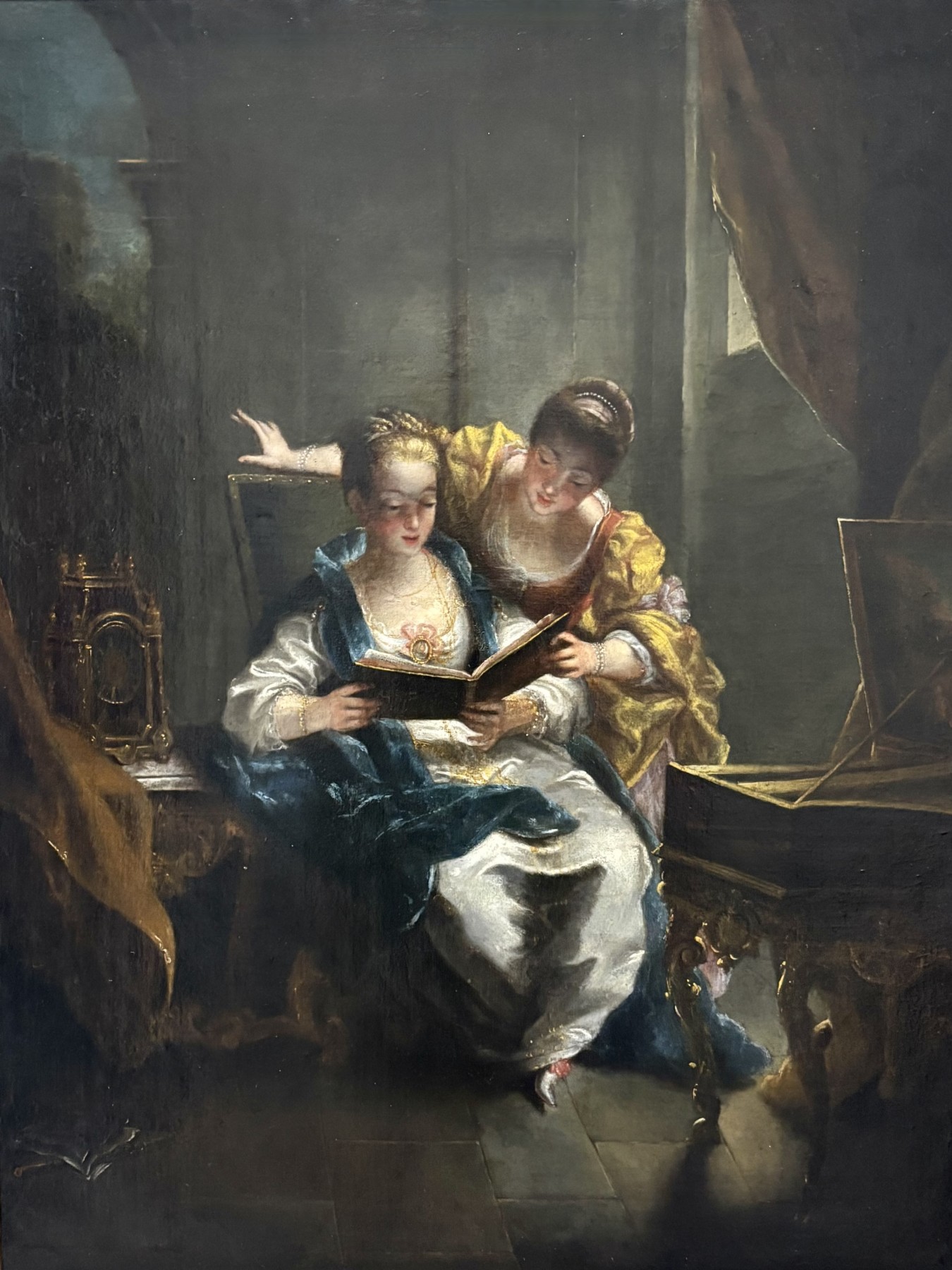
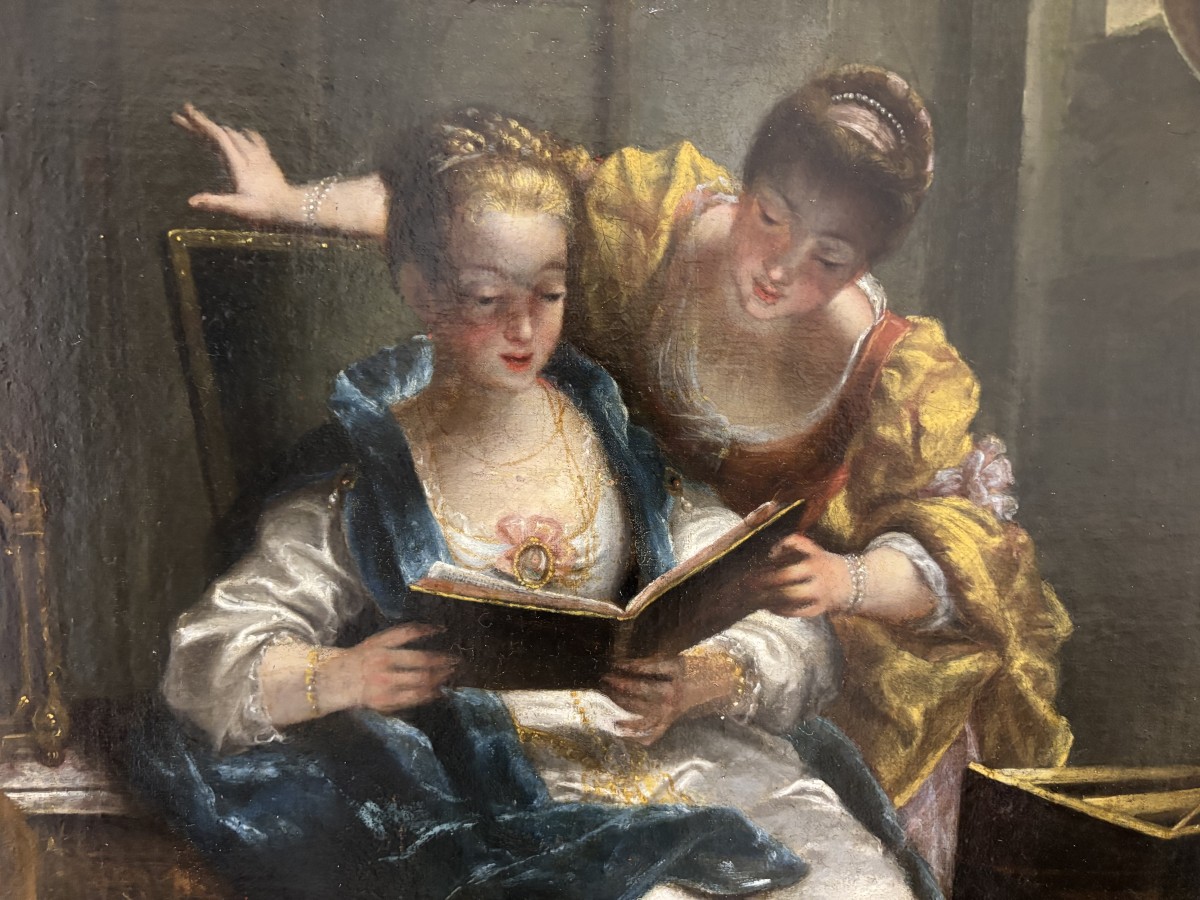
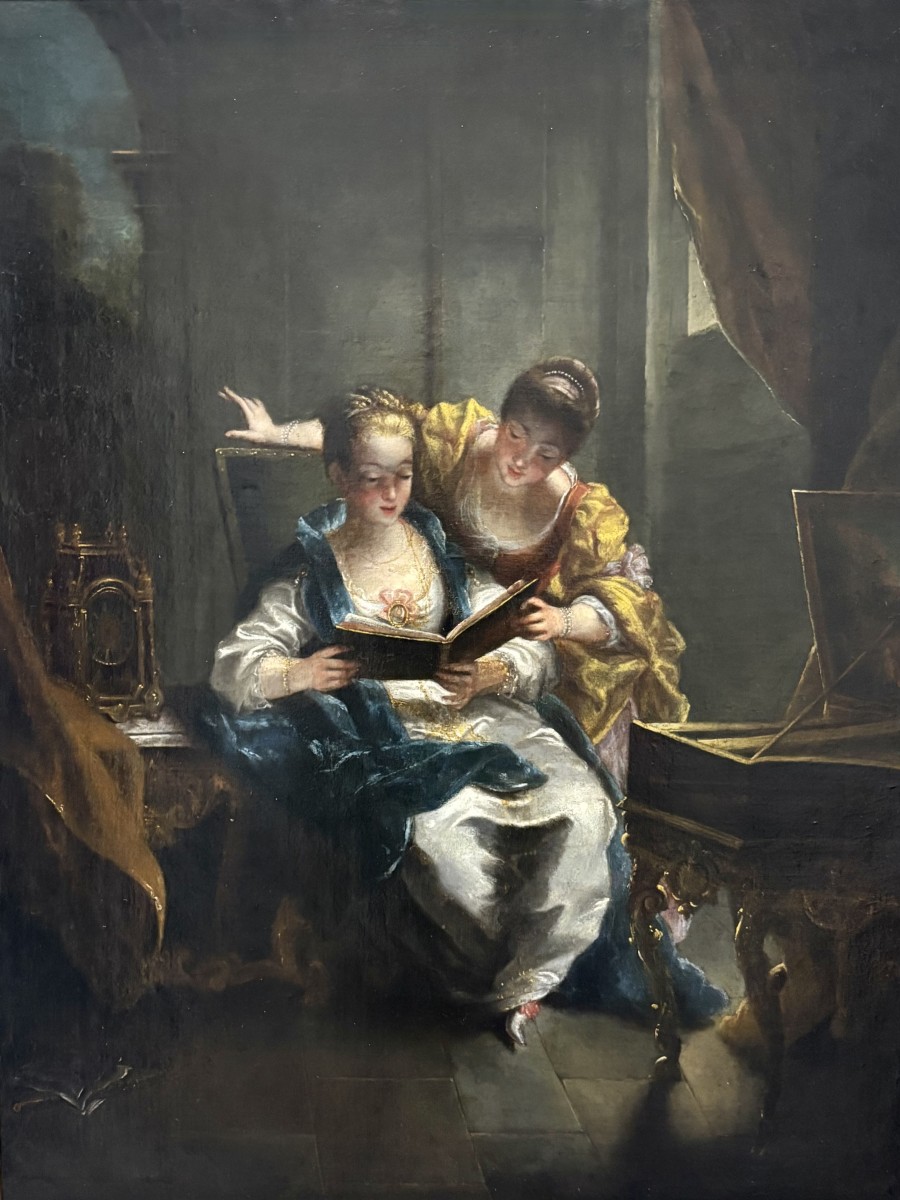
A beautiful genre scene depicting a music lesson in a château's drawing room, featuring two elegantly dressed young women in a particularly refined aristocratic setting. One of the protagonists is seated, holding an open book, while her companion, likely her teacher, leans delicately towards her in a pose full of grace and complicity.
The artist emphasizes the theatrical and precious nature of the scene through the richness of the fabrics with their satin sheen, the sophisticated hairstyles, and the almost choreographed poses of the figures.
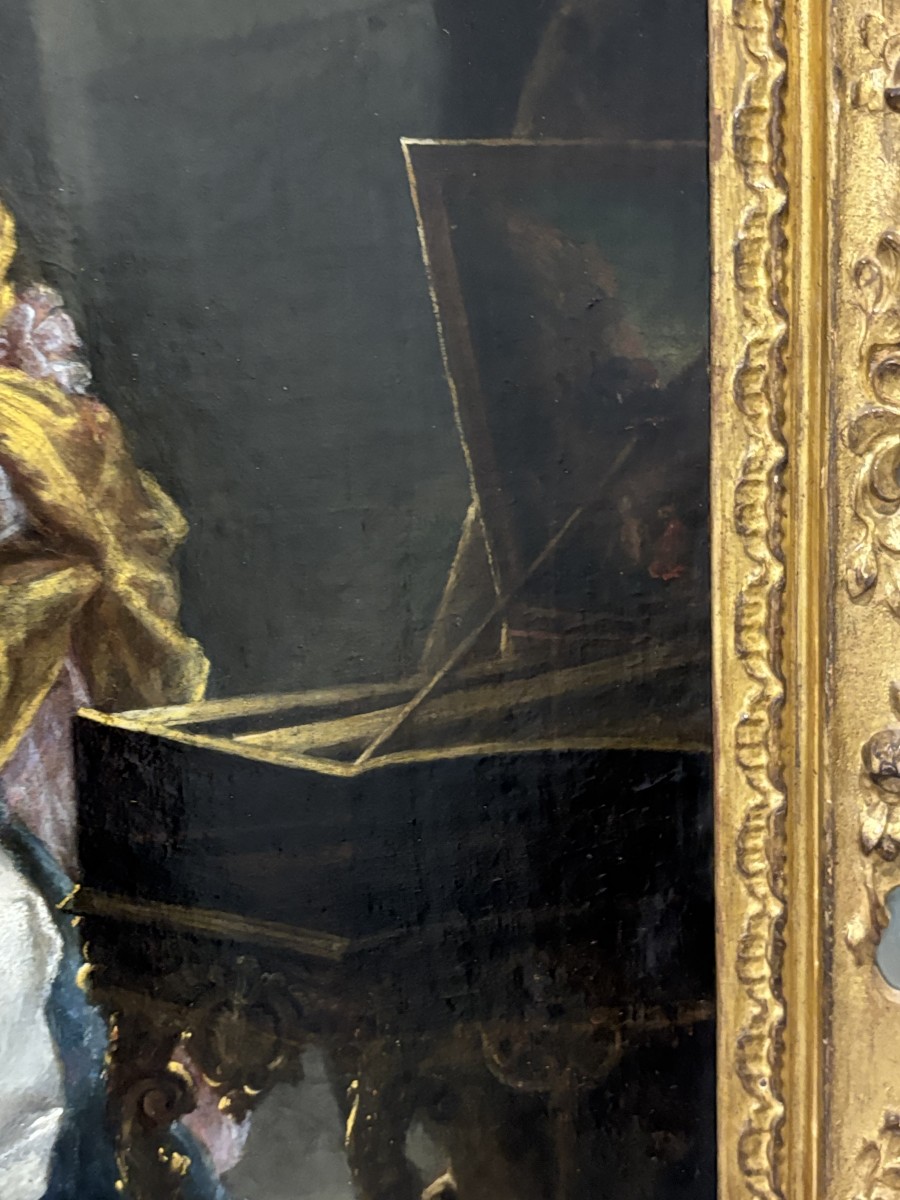
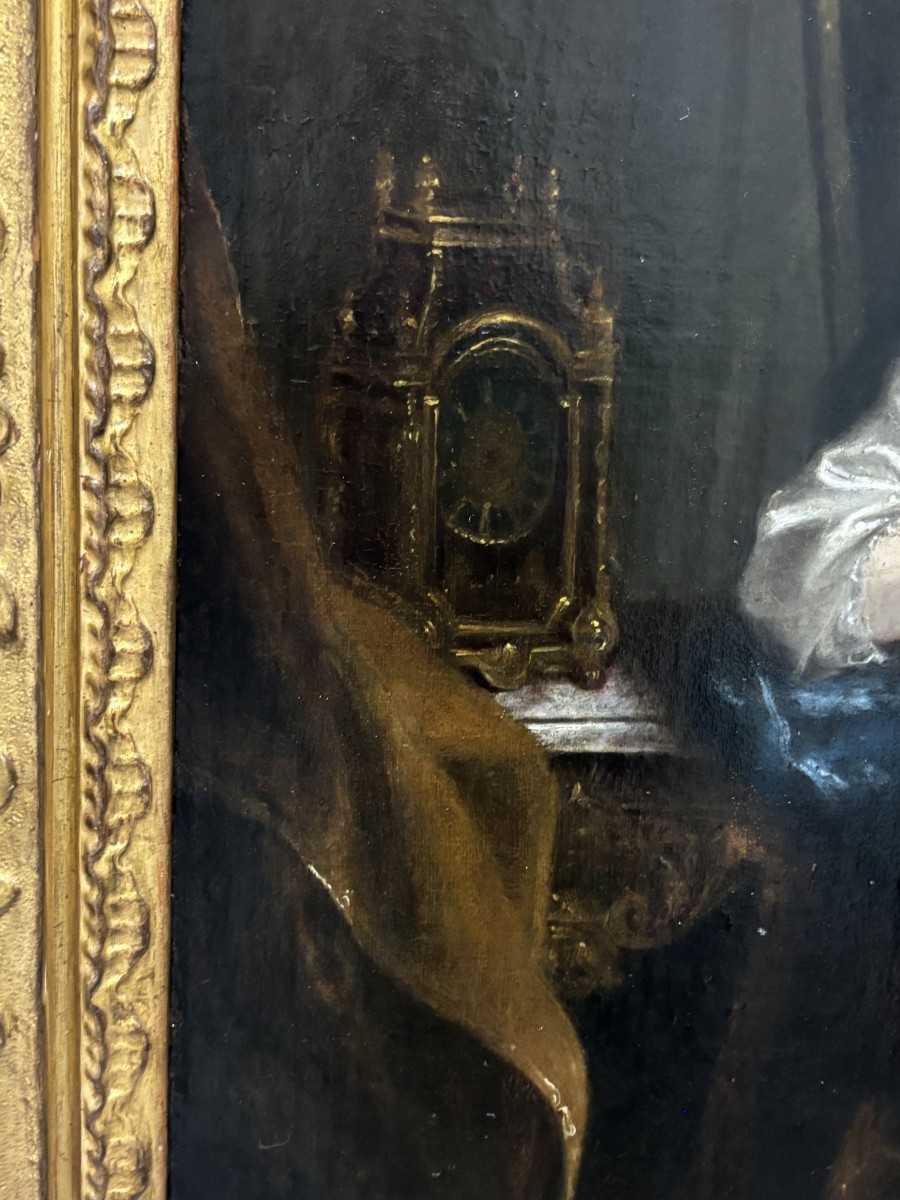
The setting also testifies to the luxury of this stately home, as evidenced by the painted drop-front harpsichord in the foreground, the carved and gilded wooden console table, and the Boulle marquetry religious clock resting upon it. The heavy draped curtain and the interplay of light and shadow enhance the intimate and elegant atmosphere characteristic of the finest French courtly scenes of the Regency period.
The painting is framed in giltwood and adorned with small mirrored panels. Oil on canvas, in excellent condition, with minor restorations to the background.
Workshop of Jean Raoux, circa 1720-1730.
Dimensions:
Frame: Height: 105 cm; Width: 85 cm
Canvas: Height: 83 cm; Width: 64 cm
Our opinion: The painting we are presenting perfectly evokes the spirit of the Enlightenment, where education and the transmission of knowledge were practiced with gentleness and refinement. The scene illustrates this apprenticeship in the arts and sciences characteristic of the 18th century: music, reading, and study, symbolized in particular by the presence of the harpsichord and the clock, a true evocation of time, knowledge, and progress. The whole is treated with great delicacy, in an intimate and harmonious atmosphere, characteristic of this cultivated society where education became an art of living.
This type of intimate scene, profoundly French in spirit, rendered with subtle chiaroscuro effects and a light, almost Venetian-inspired mist in the background, is characteristic of Jean Raoux's work, where a refined exploration of light blends with a theatrical emphasis on the foreground.
Jean Raoux (1677-1734) was a student of the painter Antoine Ranc in Montpellier, then of Bon Boullogne in Paris, who enabled him to win the Prix de Rome (1704) and become a royal pensioner in Italy. He resided in Rome, then in Florence, Padua, where he created religious frescoes for its cathedral, and finally Venice, where he became a favorite of Philippe de Vendôme, Grand Prior of the Order of Malta. A true European artist, Jean Raoux gradually combined his knowledge of Dutch art with his French and Venetian experiences to create an artistic synthesis marked by a blended palette and the art of chiaroscuro. The portrait of a young girl reading a letter, now in the Louvre, is a perfect example, clearly influenced by the chiaroscuro portraits of Gaspard Netscher (1639-1684) or Godfried Schalken (1643-1706), though less naturalistic and with a Venetian use of color.
Returning to Paris in 1711, he became the portraitist of choice for the aristocracy and the world of theater and dance, even though he was admitted to the Royal Academy of Painting and Sculpture as a history painter.