Offered by Galerie Nicolas Lenté
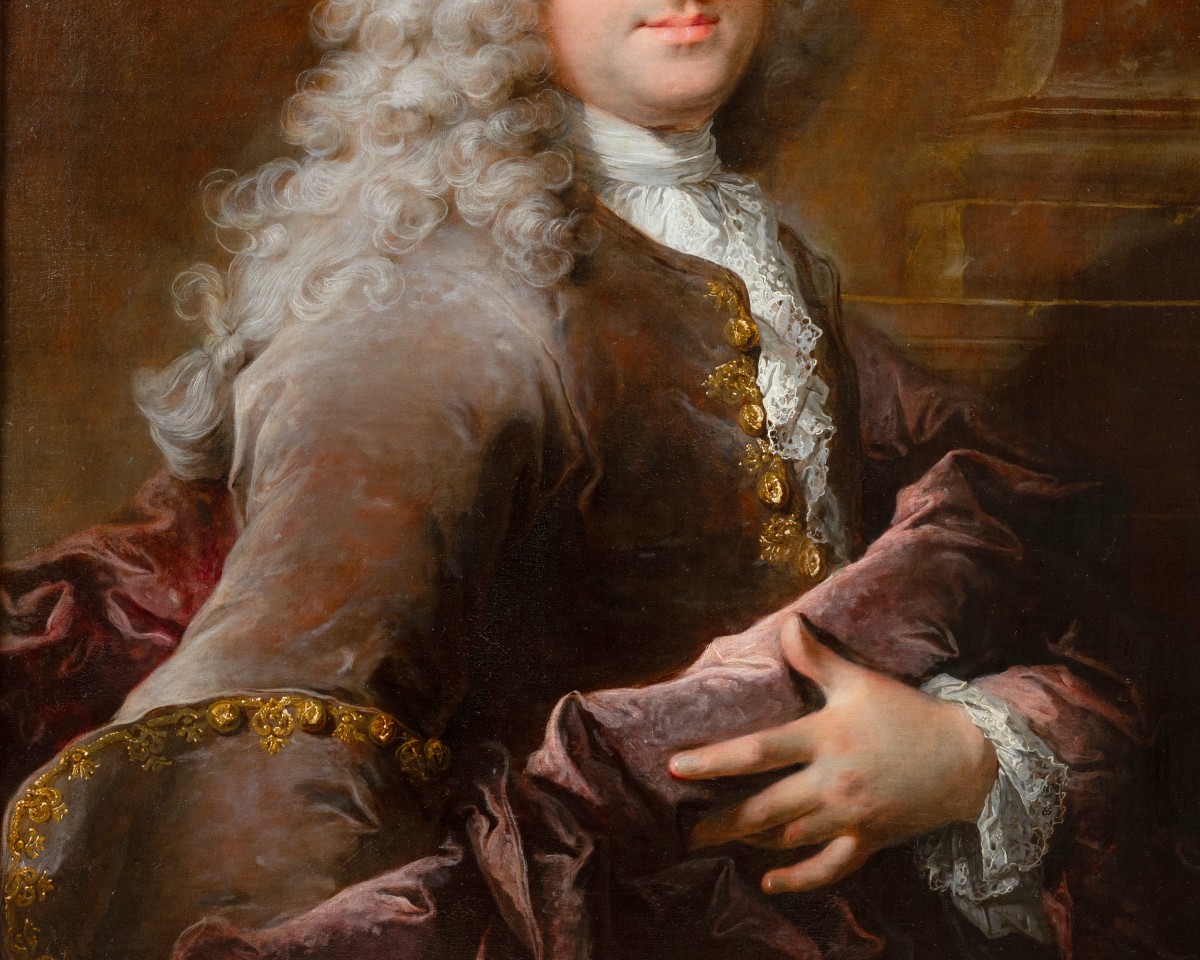

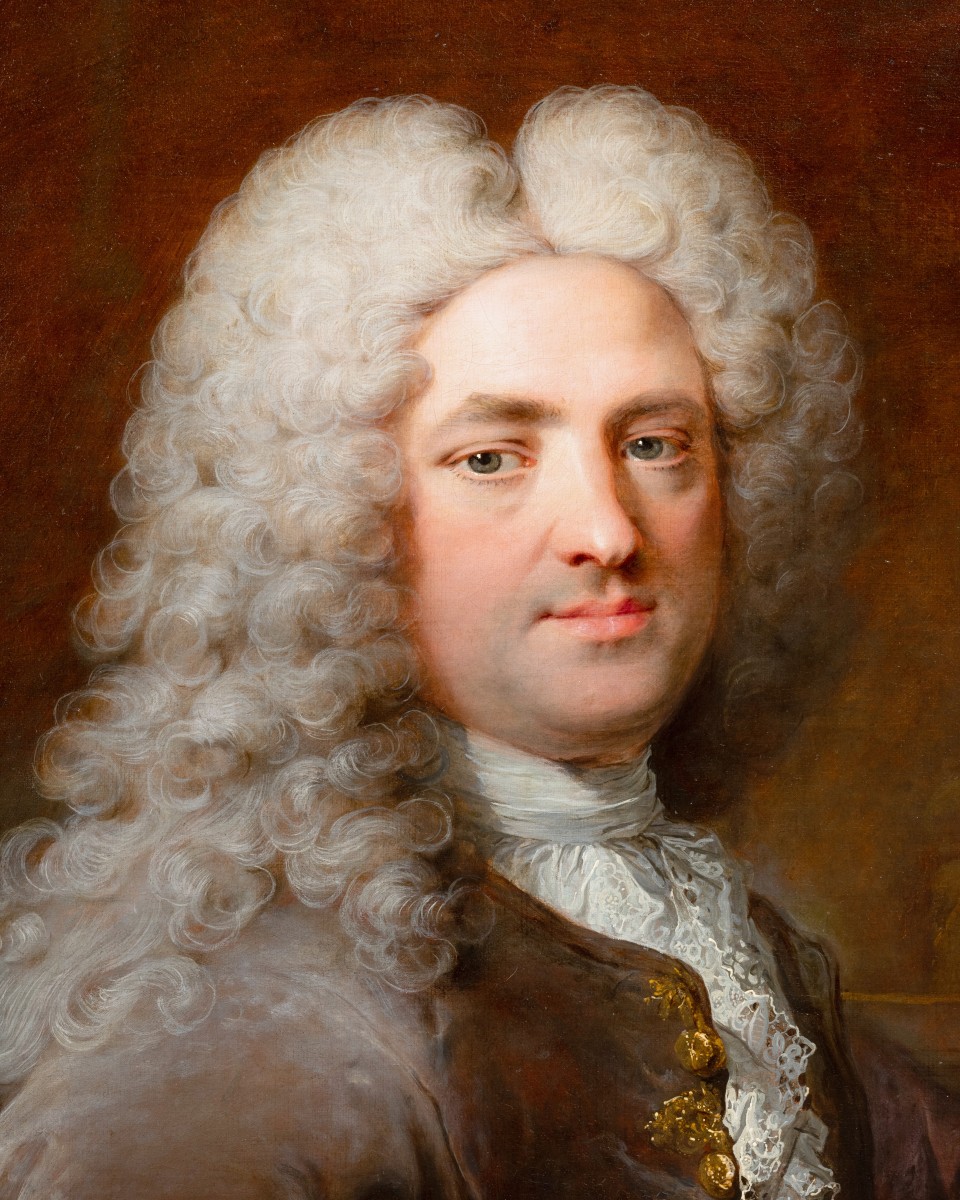
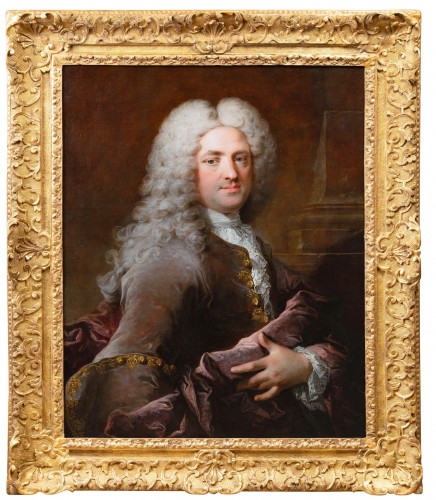
Portrait of a Gentleman
Robert Le Vrac Tournières (1667-1752),
18th century French School, circa 1725
Oil on canvas
Dimensions: h. 81 cm, w. 64 cm.
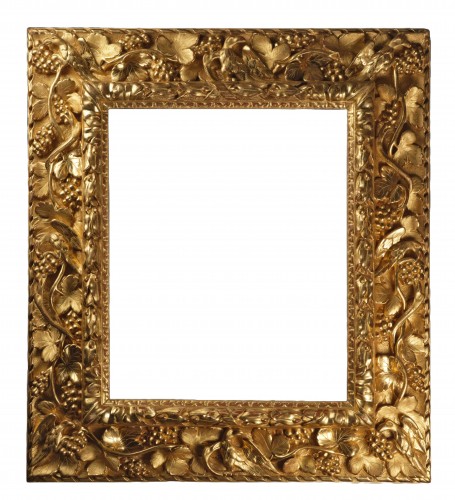
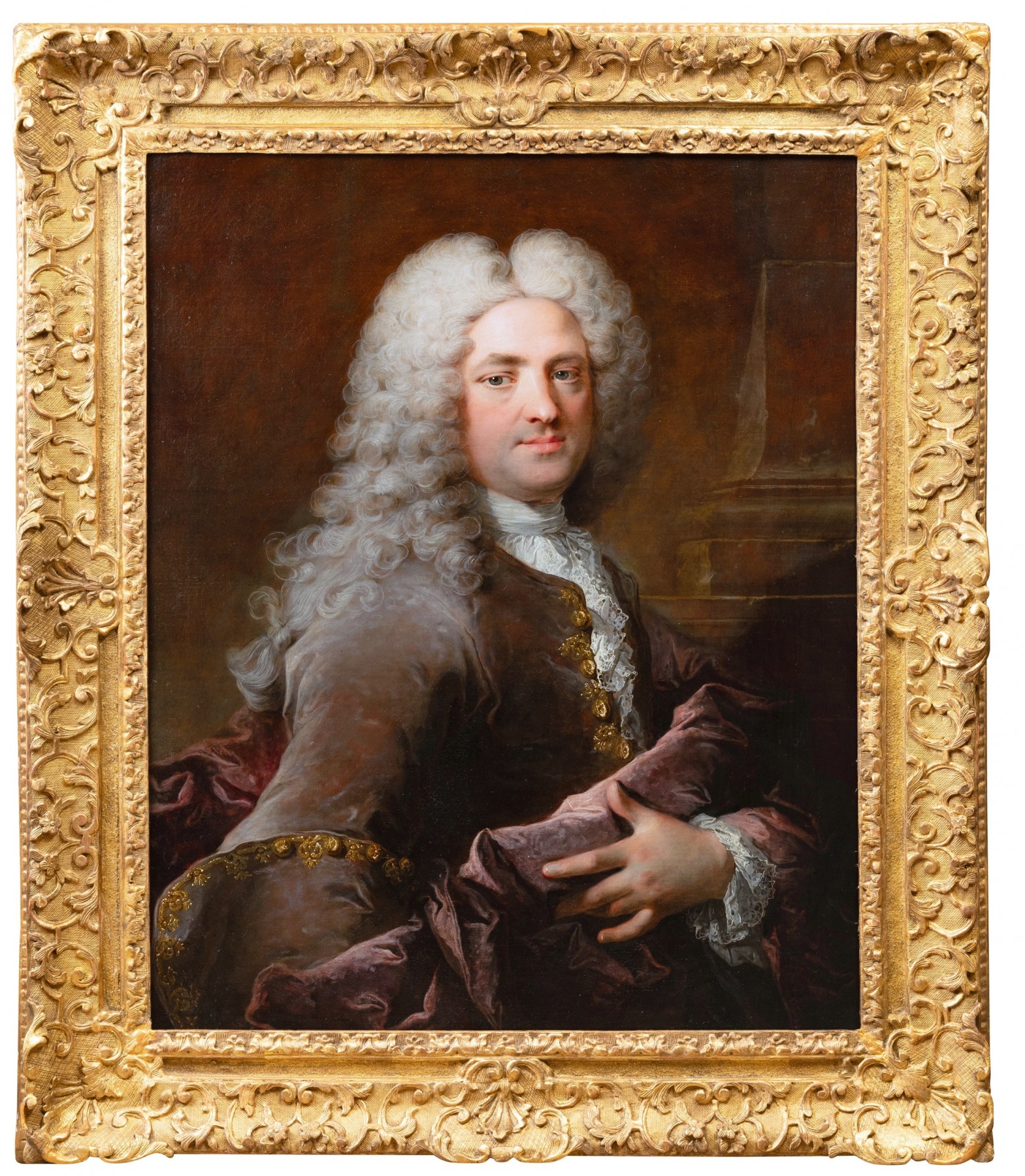
Important giltwood and richly carved Louis XIV period frame.
Framed dimensions: h. 103 cm, w. 87 cm.
We're grateful to Mr. Eddie Tassel, specialist of Robert Le Vrac Tournières, for confirming the attribution of our portrait to the artist, which he dates around 1725.
Bibliography:
Regarding the work of Robert le Vrac Tournières, see the exhibition catalogue from the Caen Museum of Fine Arts: Robert Le Vrac Tournières, les facettes d'un portraitiste , by Eddie Tassel and Patrick Ramade; June-September 2014 (Snoeck 2014)
Provenance:
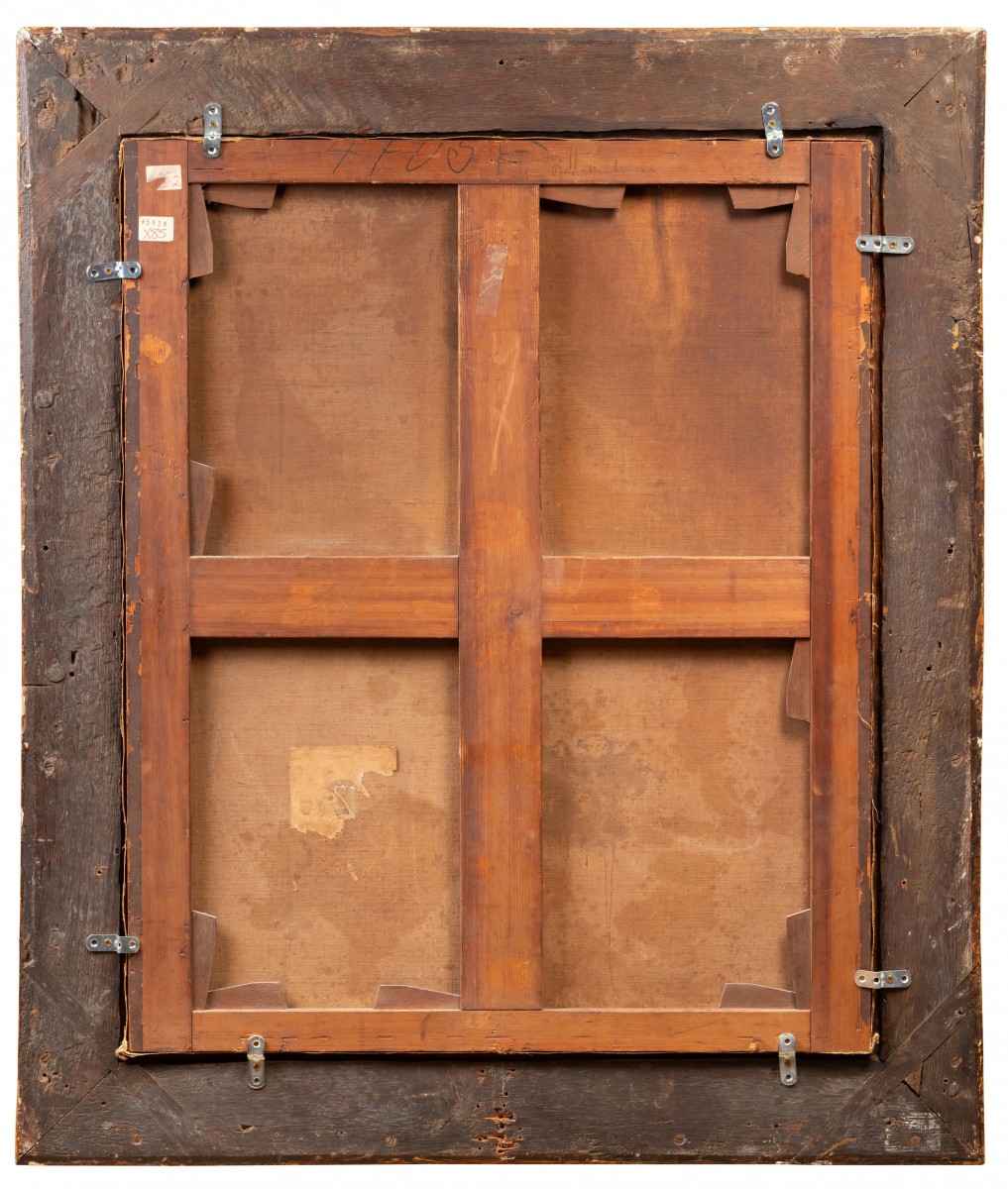
According to the label affixed to the back: probably Count Léon (1806-1881), illegitimate son of Napoleon I.
Collection of Mr. A… L…, his sale in Paris, Hôtel Drouot, June 15, 1903.
Collection of an American private institution: The Barker Welfare Foundation.
Sotheby's auction, New York, January 17, 1985, lot no. 162.
American private collection .
The portrait we are offering is firmly rooted in the tradition of grand French aristocratic portraiture from the first quarter of the 18th century, inherited from the Louis XIV aesthetic while also foreshadowing the formal flexibility and pursuit of naturalism characteristic of the Regency period. Trained in the studio of Hyacinthe Rigaud, Robert Le Vrac Tournières developed a pictorial language based on elegance, restraint, and mastery of texture and color.
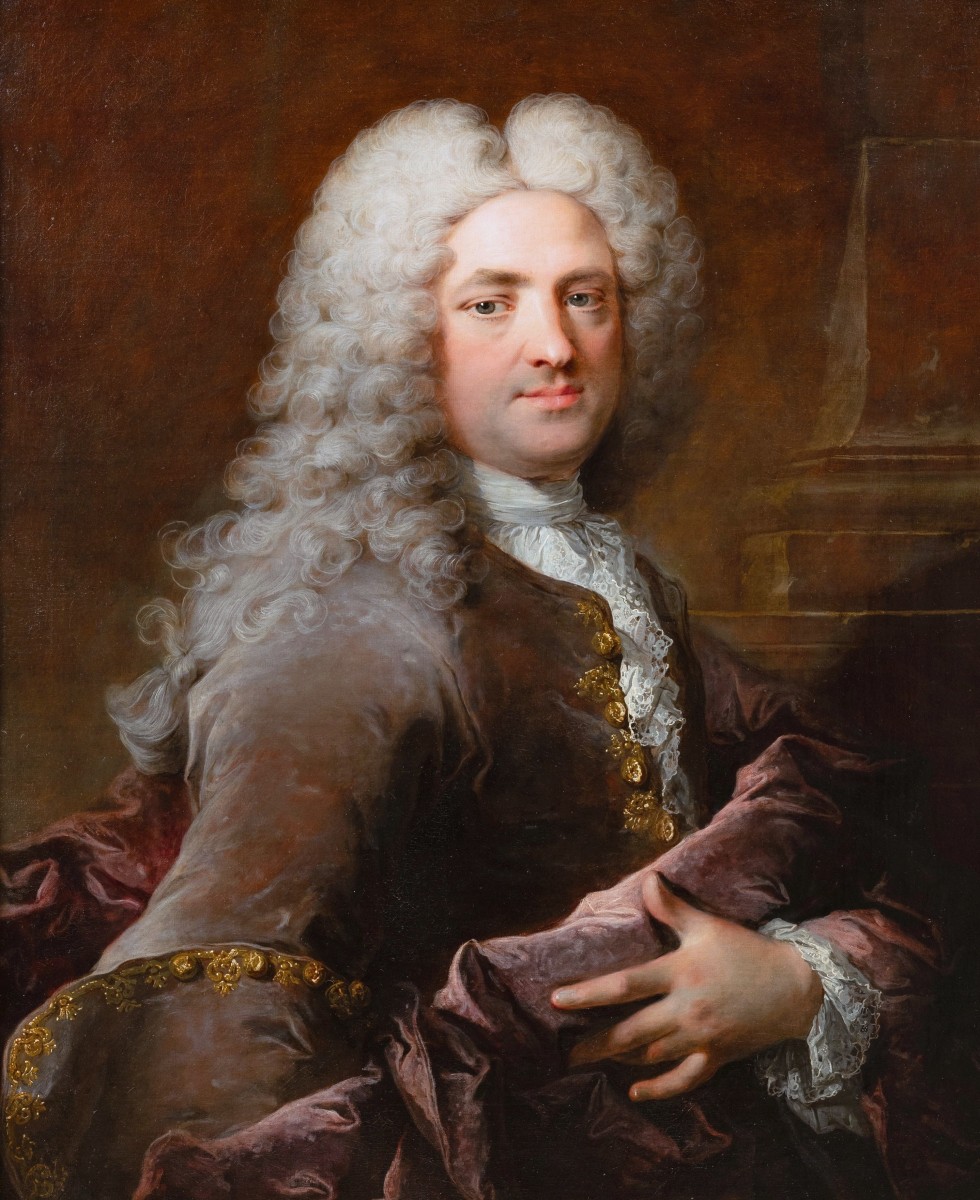
The deliberately understated composition highlights the sitter, depicted half-length in a palatial interior against a discreet architectural backdrop. The brown, ochre, and earthy tones of the background create a warm and intimate space, conceived as a setting designed to allow the figure to emerge while avoiding any superfluous decorative effect.
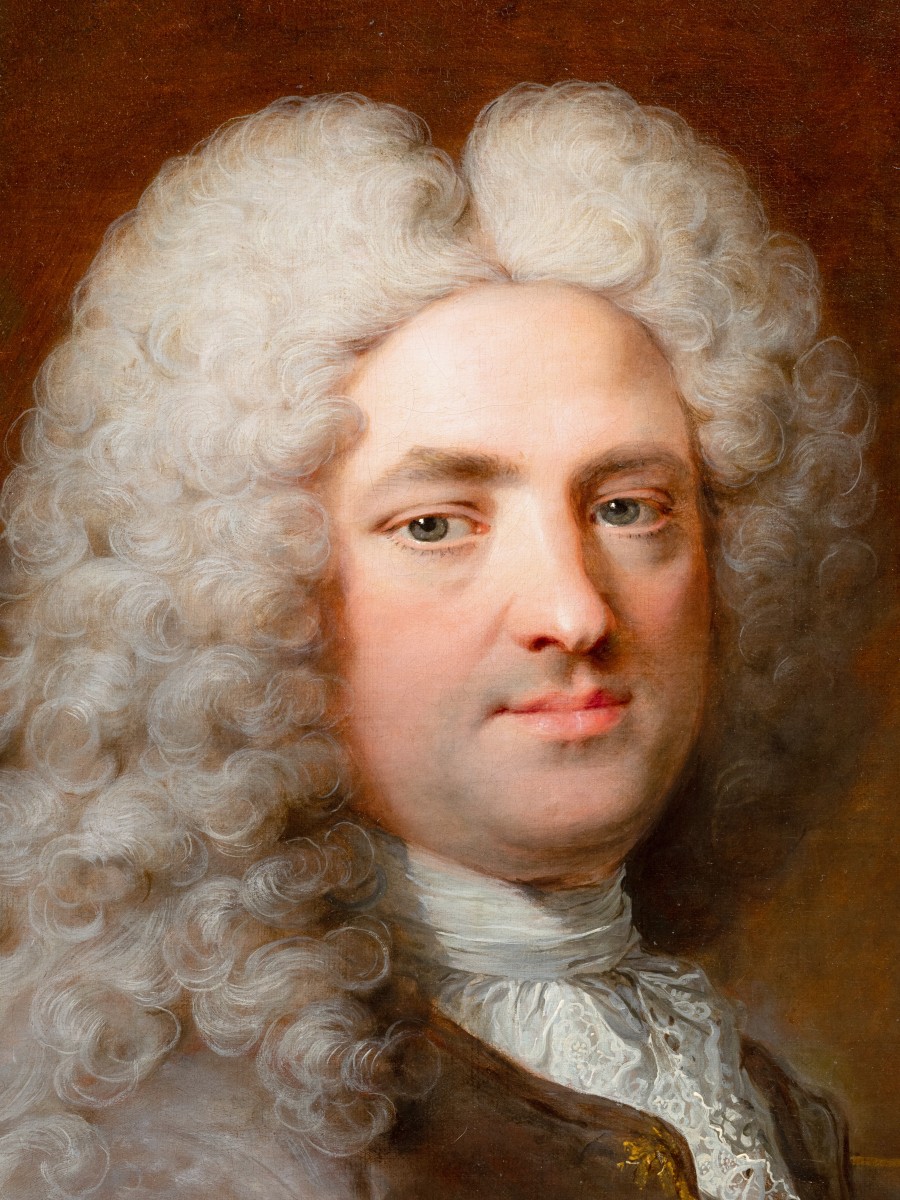
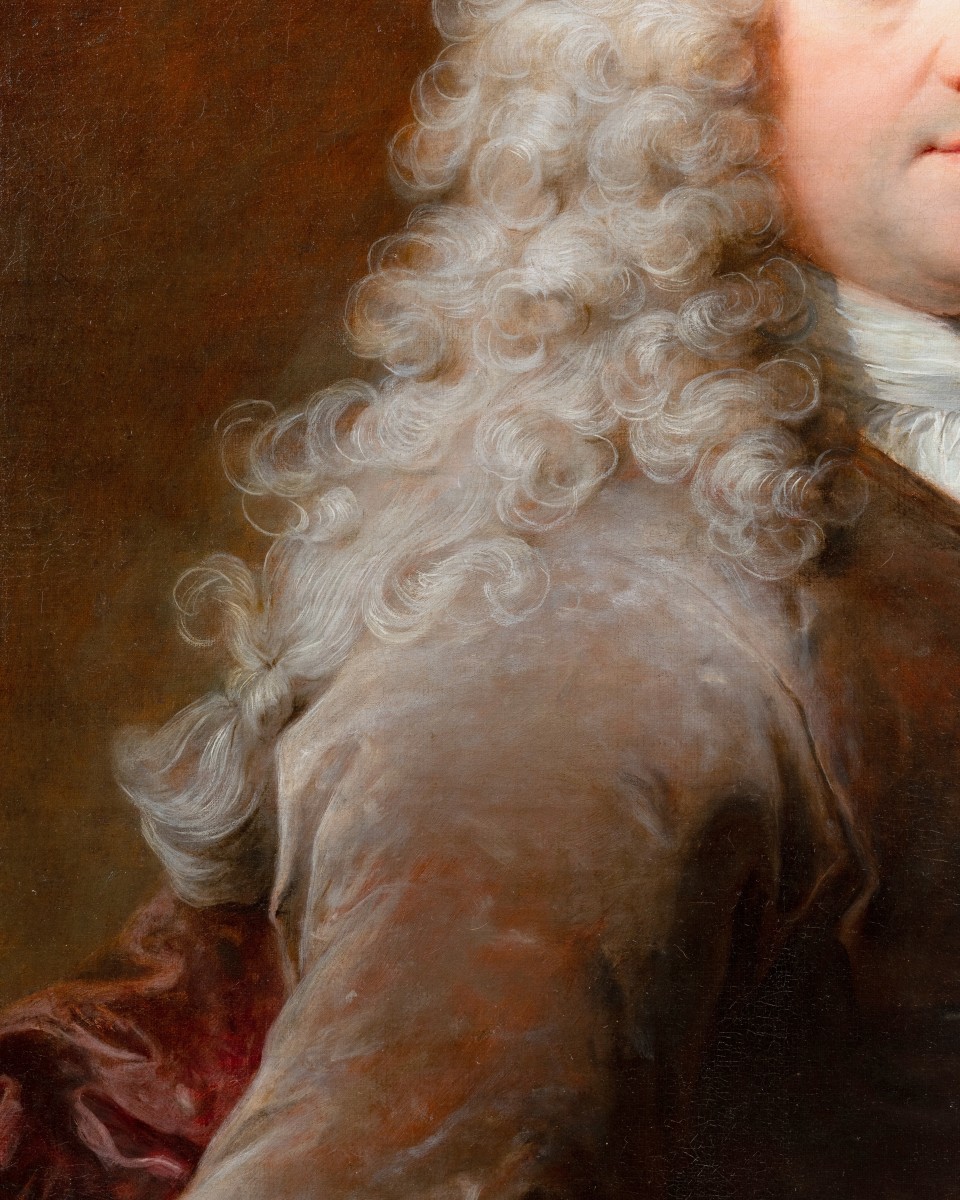
Intense lighting reinforces the presence of the sitter, whose gentle and amiable expression, lively gaze, and calm serenity are hallmarks of a certain psychological dimension sought by the artist. A full, powdered wig, composed of light, airy curls, perfectly shaped and meticulously arranged, enhances the face's regular features, carefully sculpted by subtle gradations of pink, beige, and warm gray in the stubble, without any harsh contrasts.
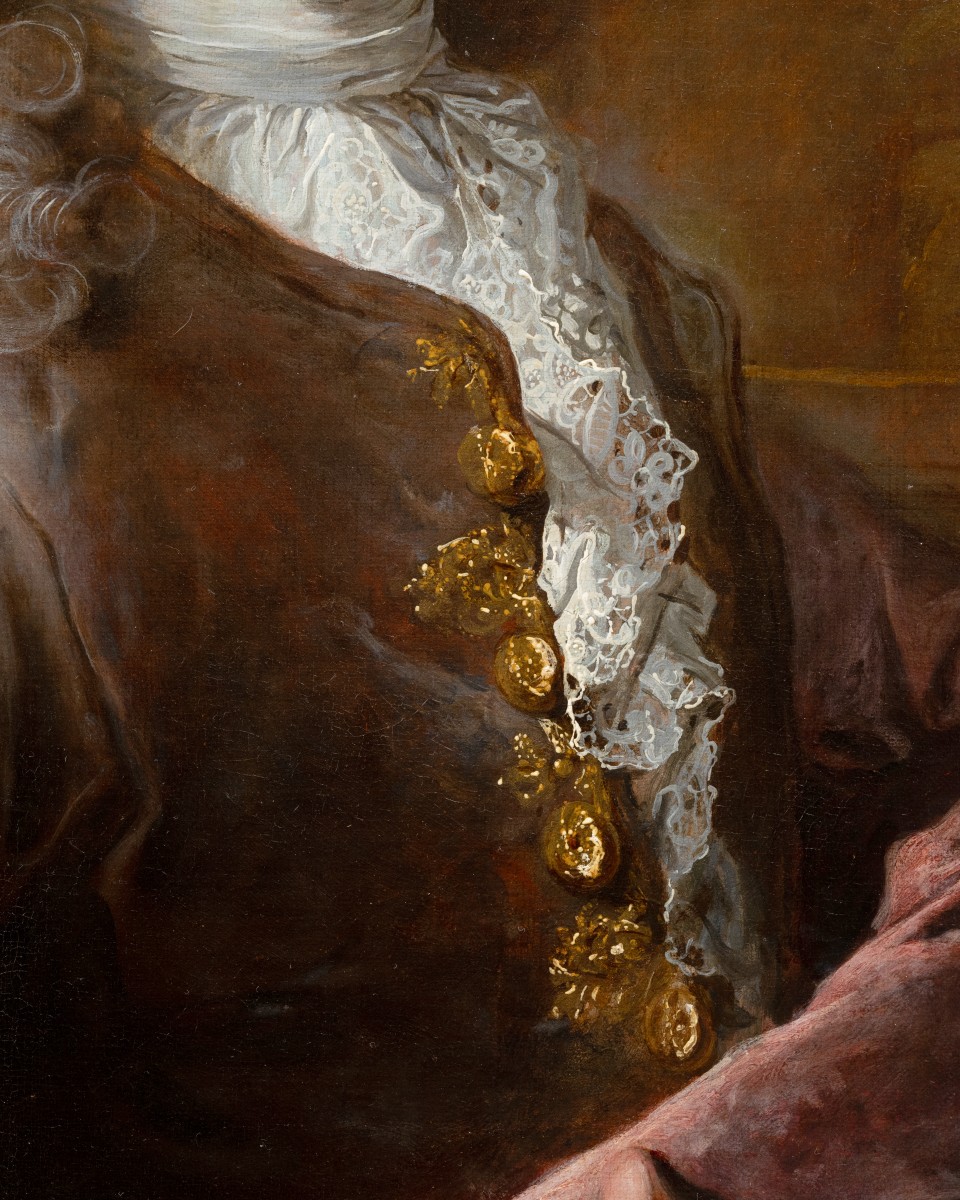
The white powder of the wig seems to fall delicately onto the model's shoulder, creating an almost imperceptible deposit on his brown velvet coat with its frosted tones. This detail of great pictorial refinement highlights the artist's attention to the phenomena of texture and surface: the contrast between the matte, light powder and the warm, slightly satiny depth of the velvet accentuates the tactile richness of the whole, while reinforcing the impression of the figure's real presence.
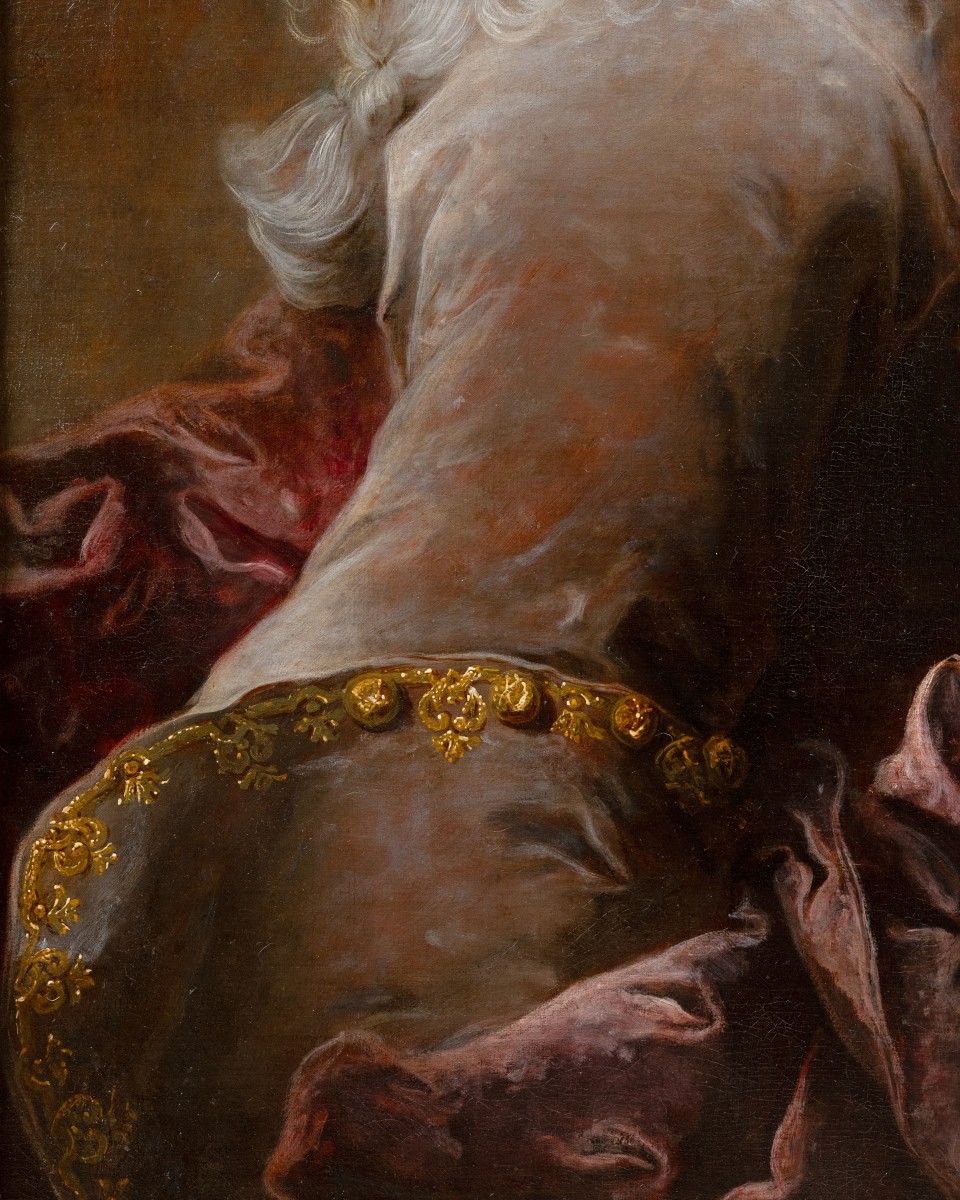
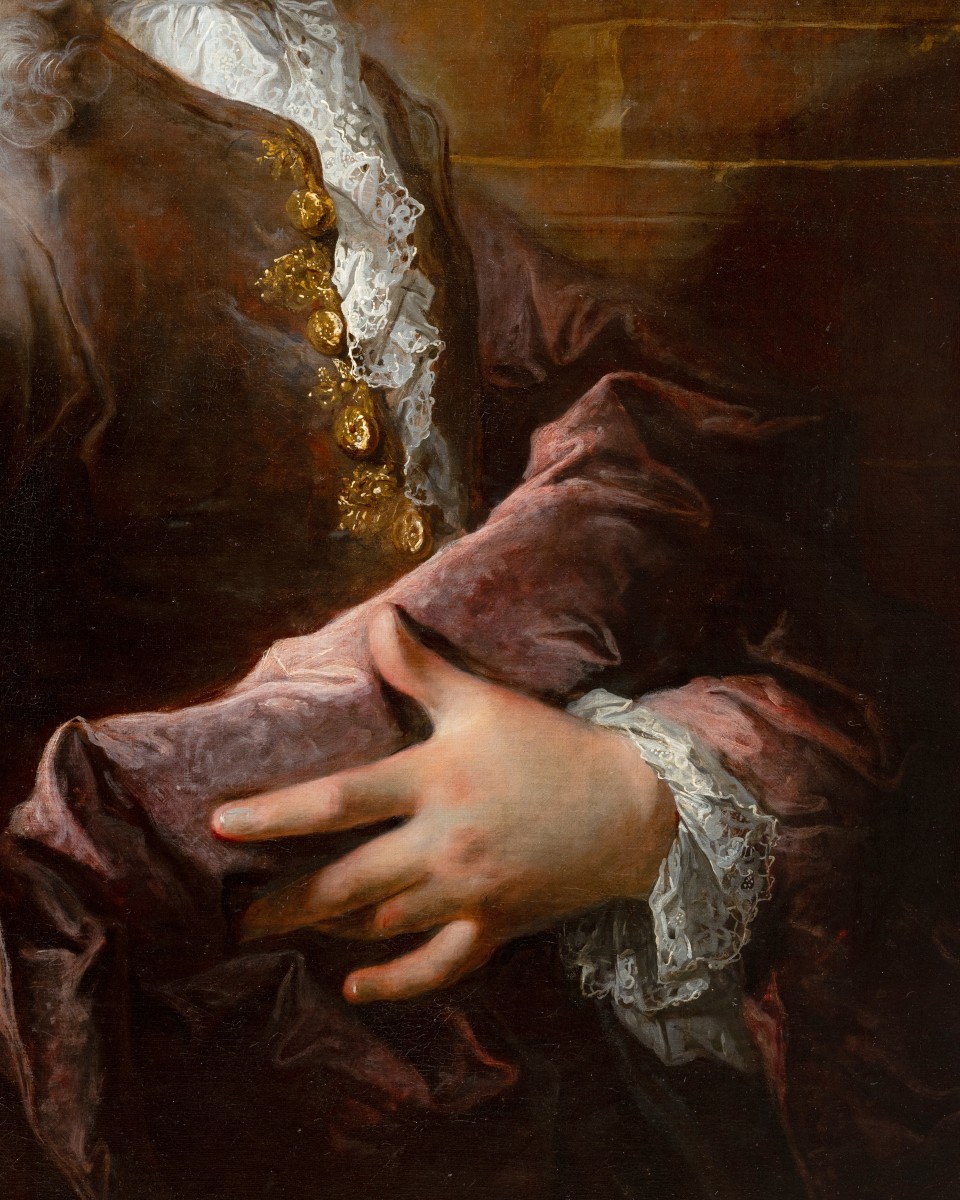
The gold elements—buttons and embroidery on the collar and sleeves—punctuate this restrained chromatic mass with luminous and measured accents. Their restrained brilliance interacts with the white lace of the jabot and cuffs, treated in shades of grey and white, which bring visual depth and highlight the finesse of the design demonstrated by the artist.
The execution is particularly sophisticated in the treatment of the cloak, the true visual focal point of the work. The velvet fabric, far from being a uniform color, is brushed with a chromatic range of purplish pinks, deep purples, and wine-red browns, sometimes enriched with pearly highlights. These nuances, achieved through a subtle interplay of superimposed glazes and bold serifs, lend the velvet a vibrant depth and a rich visual appeal. Light catches on the crests of the fabric's sharp, angular folds, revealing delicate transitions between slightly cool shadows and warmer highlights, giving the cloak an almost tactile presence without ever disrupting its overall balance.
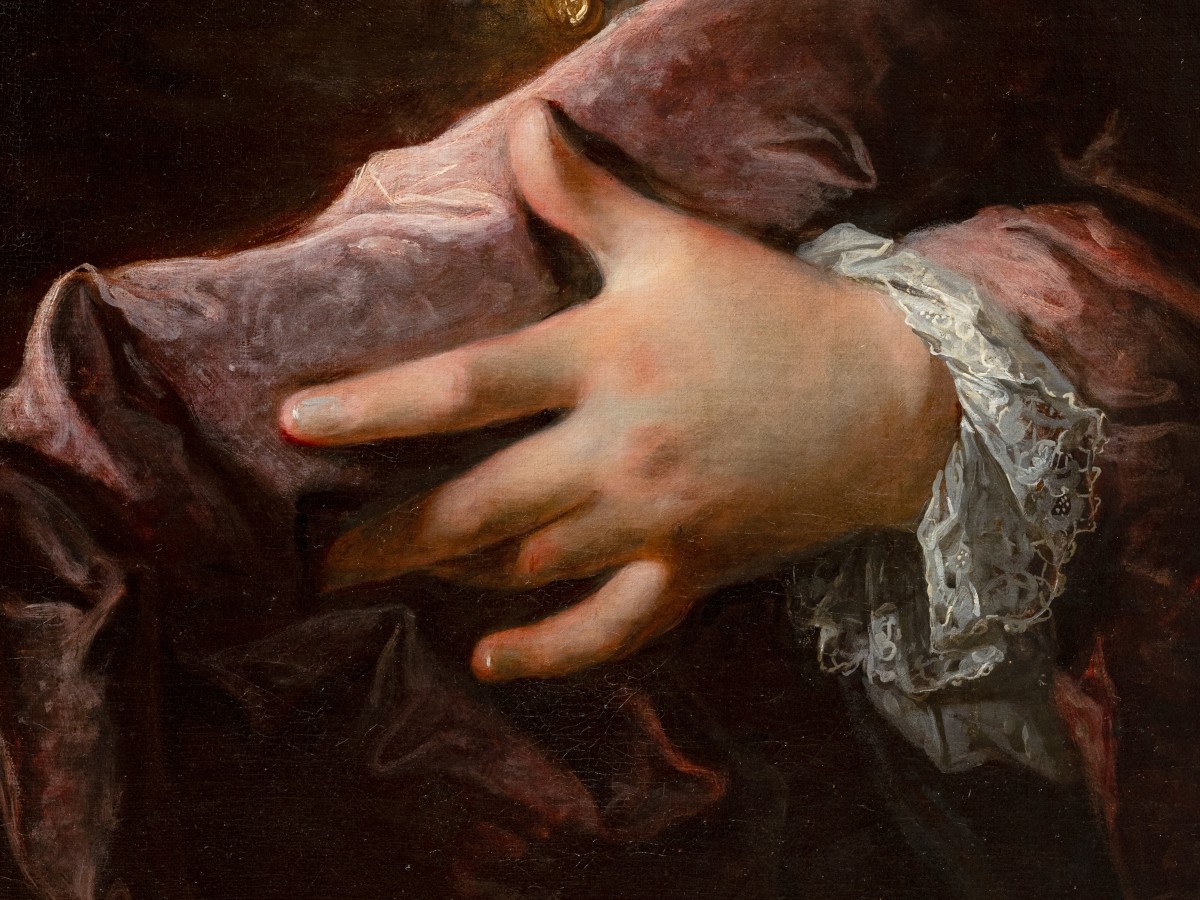
The hand holding the cloak is rendered with particular care. The supple, long fingers, with the little finger slightly spread, suggest an ideal of distinction and aristocratic refinement. The smooth, delicately gleaming nails signal purity and contribute to the social codification of the portrait. The highly mannered gesture introduces a discreet and controlled tension, belonging to a codified gestural vocabulary specific to formal portraiture.
Stylistically, the work lies at the crossroads of the solemnity of the official portrait and a more flexible and intimate approach. The confident posture, direct gaze, and rich attire affirm the sitter's social rank, while the fluidity of the brushstrokes and the subtlety of the colors soften any excessive rigidity. Through both the virtuoso use of color and the attention to detail, Robert Le Vrac Tournières delivers here an exemplary image of the French aristocracy during the Regency, where the art of portraiture became a privileged vehicle of elegance, power, and social distinction.
Robert Le Vrac Tournières (Caen 1667-1752),
son of a tailor from Caen, trained under Bon Boulogne in Paris. He became a member of the Academy of Saint Luke in 1695. The painter adopted the name Robert Tournières, referring to the family's ancestral homeland, a place near Bayeux. He collaborated with Hyacinthe Rigaud and made copies of his works in 1698 and 1699. He was admitted as a portrait painter to the Academy in 1702. Tournières was noticed at the Salon of 1704, where he exhibited about twenty works, primarily portraits, both individual and group, and history paintings. Ambitious and resourceful, Tournières did not confine his talent to the narrow genre of portraiture, but also explored secular and sacred history, a specialty that earned him a second admission to the Academy as a history painter.
Despite this dual recognition, it was primarily in portraiture that he enjoyed a long and brilliant career, almost exclusively in Paris. For nearly half a century, his studio was frequented by an aristocratic and bourgeois clientele. His singular and recognizable style, while remaining faithful to the formulas established by Rigaud and Largillière, reveals a respectable talent and skill. A patient observer, he is known for his delicate colors, the suppleness of his brushstrokes, and his elegant drapery.
Often neglected and overlooked by art critics, unjustly relegated to the background compared to the giants of 18th-century portraiture, and rarely engraved by his contemporaries, his work is now emerging from obscurity, and he was honored by the Caen Museum in 2014 with a monographic exhibition.
Delevery information :
We organize the shipping and delivery of our artworks worldwide, working with specialized fine art carriers as well as DHL Express for the secure shipment of small and medium-sized works (up to 120 cm).
Each artwork is carefully packed and shipped in a custom-made transport crate to ensure optimal protection. All shipments are fully tracked and insured.
We pay the utmost attention to every stage of the shipping process to ensure fast, reliable delivery. Shipments via DHL Express are generally dispatched within approximately 7 days of purchase.
All of our artworks can be viewed at our Paris gallery and may also be collected in person.