Offered by Jan Muller
REQUEST INFORMATION

JAN VAN BALEN
1611- 1654
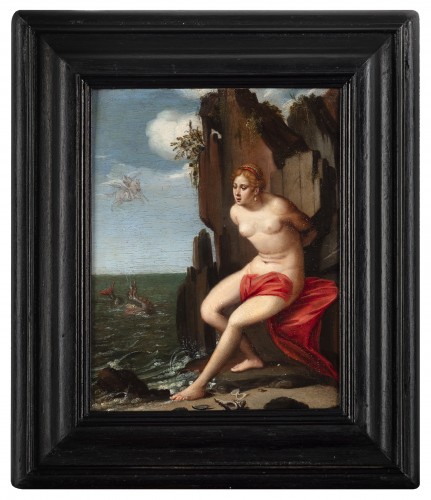
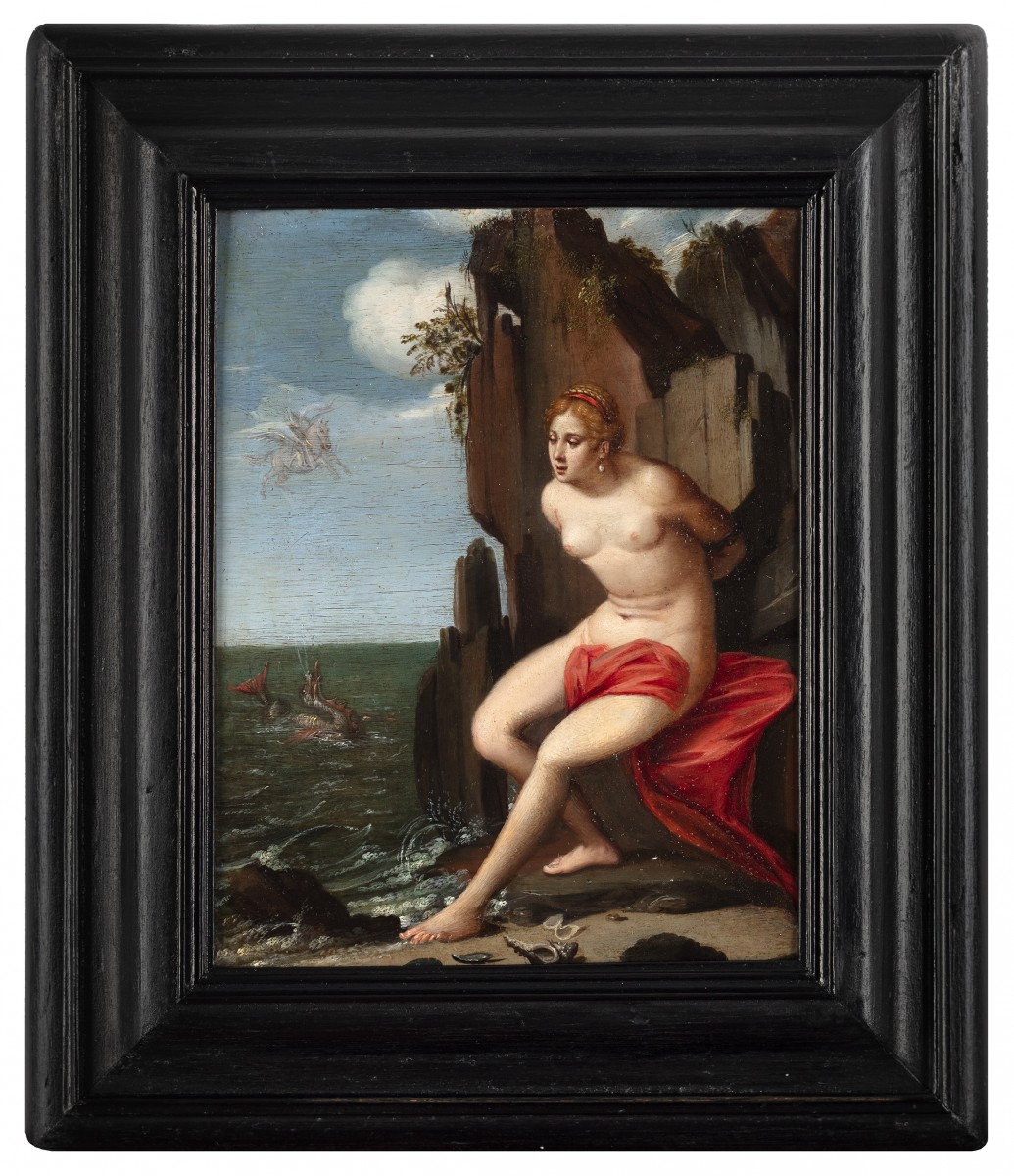
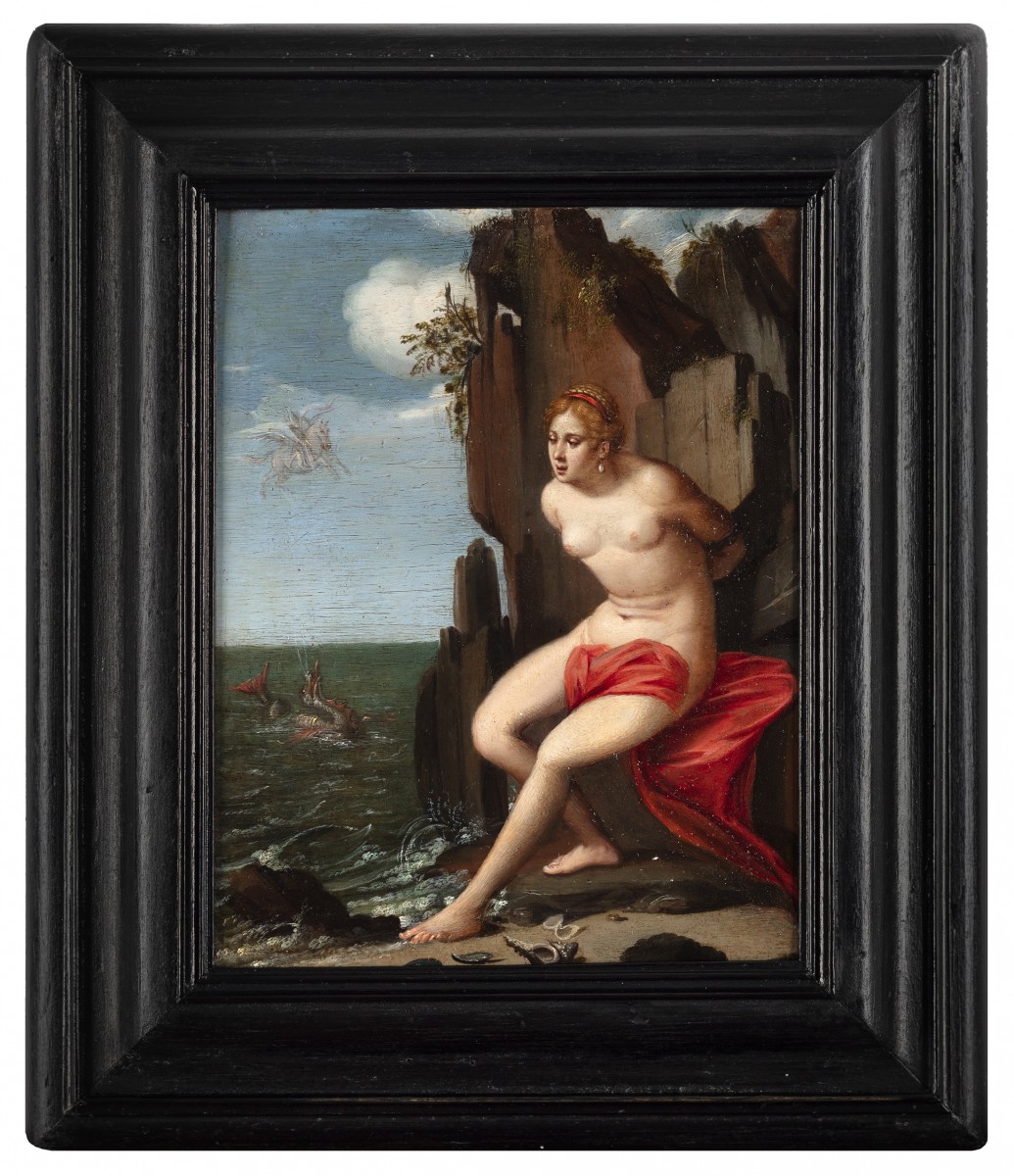
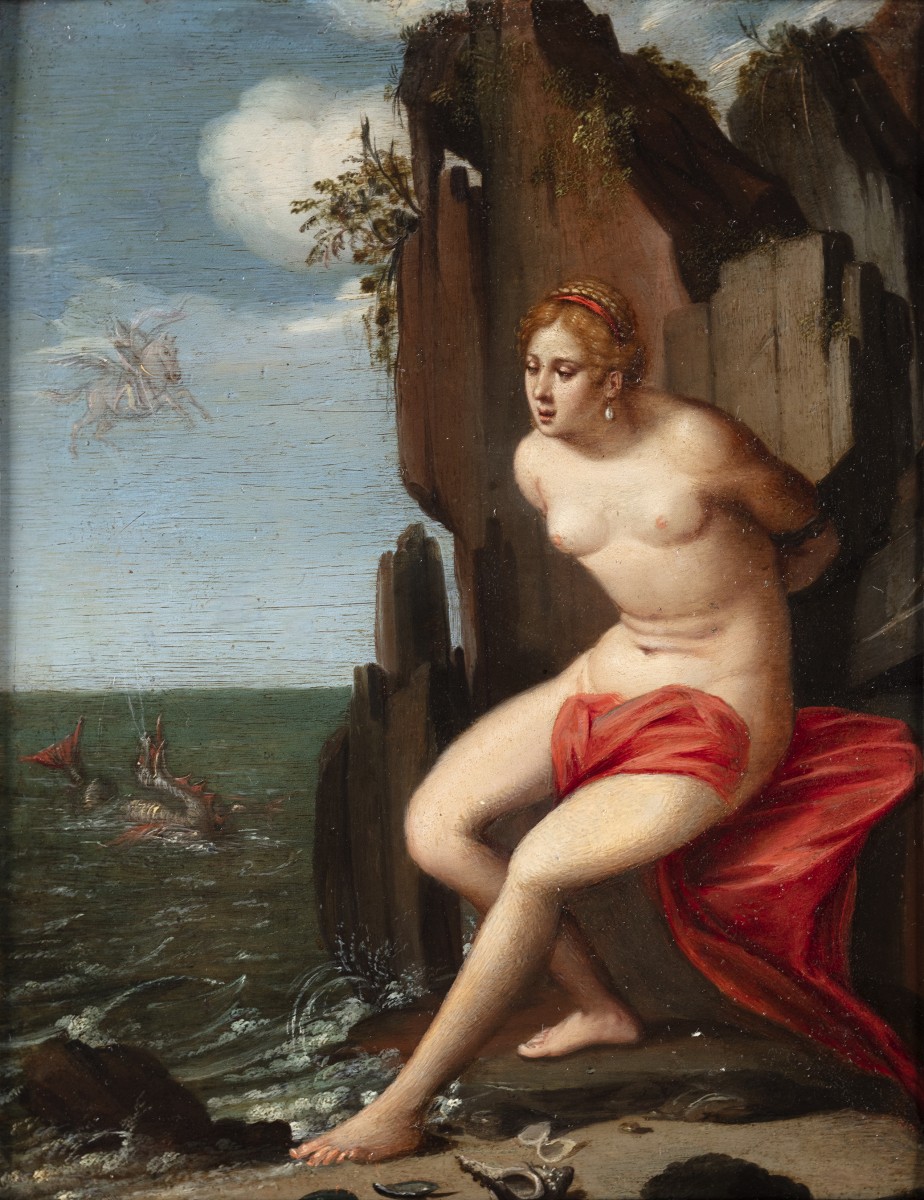
“Andromeda & Perseus”
Oil on copper
We’d like to thank dr. Joost Vander Auwera for his advice.
Dimensions: 16 x 13 cm, 25 x 21 cm (framed)
THE ARTIST
Jan van Balen (21 July 1611, Antwerp – 14 March 1654) was a Flemish Baroque painter known primarily for his history and allegorical paintings, but he also produced landscapes and genre scenes. He was the son of the painter Hendrick van Balen and Margriet Briers and grew up in a highly artistic family. His father was a prominent figure in Antwerp painting and played an important role in the renewal of Flemish art in the early seventeenth century; he was also one of the teachers of Anthony van Dyck. Jan van Balen had two younger brothers, Gaspard (born 1615) and Hendrik (born 1620), who both became painters and were trained by him. His sister Maria married the painter Theodoor van Thulden.
an van Balen received his artistic training from his father and was registered as an apprentice at the Antwerp Guild of Saint Luke in 1631. He was admitted as a master in 1639–1640. In 1635, he took part in the Joyous Entry (Pompa Introitus) of Cardinal-Infante Ferdinand, the new governor of the Spanish Netherlands, collaborating with his brother Gaspard, Theodoor van Thulden, Jan de Labare and Erasmus Quellinus the Younger on the execution of decorative designs for the gallery on the Meir and the triumphal arch at St John’s Church in Antwerp. The entire project was coordinated by Peter Paul Rubens.
In 1639, Jan van Balen travelled to Italy with his brother Gaspard, where both worked in Rome. After Gaspard’s death in 1641, Jan returned to Antwerp. He married Joanna van Weerden, a wealthy woman from Antwerp, in 1642, but she died shortly after the birth of their son Peeter in 1643.
Throughout his career, Jan van Balen painted mythological and religious scenes in the manner of his father, as well as landscapes and genre scenes. He frequently collaborated with other painters who specialized in particular genres, most notably Jan Brueghel the Younger. A distinctive form of collaboration involved garland paintings, in which a devotional image or portrait is surrounded by a flower garland, a genre in whose development his father Hendrick van Balen had played an important role. Jan van Balen is mentioned in Cornelis de Bie’s ‘Gulden Cabinet’ and in Arnold Houbraken’s ‘Groote Schouburgh.’
THE ARTWORK
The subject of Perseus and Andromeda derives from classical mythology and recounts one of antiquity’s most celebrated tales of heroism, beauty, and divine intervention. Perseus, returning from his victory over Medusa, rescues the Ethiopian princess Andromeda from a sacrificial death and ultimately marries her. Their union, according to myth, made them ancestors of great heroes such as Hercules, and their story was immortalised among the stars as constellations.
The narrative unfolds in several key episodes. Queen Cassiopeia, mother of Andromeda, boasted that her daughter surpassed the sea nymphs in beauty, provoking the wrath of Poseidon. As punishment, Andromeda was chained to a coastal rock and offered as a sacrifice to the sea monster Cetus. Perseus, flying on winged sandals, discovered her and was immediately captivated. He agreed to slay the monster on the condition that Andromeda would become his wife. Using the head of Medusa, Perseus defeated Cetus and saved her. Even after their marriage, conflict followed when Andromeda’s former suitor Phineus confronted Perseus and was turned to stone by the same fearsome weapon. Perseus and Andromeda’s legacy endured through their descendants and their elevation to the heavens.
This myth has been a rich source of artistic inspiration for centuries, particularly the dramatic moment of rescue. Themes of heroism, sacrifice, beauty, and triumph over chaos are central to its appeal. Perseus embodies the classical hero, while Andromeda’s vulnerability and resilience play an equally important role in the emotional power of the scene.
In this work Andromeda and the sea monster Cetus occupy the central focus of the composition. Andromeda is shown seated, framed by rocky formations, with the sea extending behind her. These elements correspond closely to the established iconography of the myth, which traditionally depicts the naked princess chained to a rock along a rugged coastline, moments before or during her liberation by Perseus. The presence of rocks and the maritime setting situate the scene firmly within its mythological context and heighten the dramatic tension between vulnerability and imminent salvation.
The painting reflects the broader artistic tendencies of early seventeenth-century, where classical subjects were reinterpreted through a renewed interest in realism, physical presence, and emotional immediacy, shaped by the dynamic interplay of Mannerist heritage and emerging Baroque sensibilities.
Delevery information :
After reception of payment we can box and ship our items all over the world. Estimates of this service can be provided.