Offered by Galerie Léage
REQUEST INFORMATION

France, end of the 18th century
Painted and gilded sheet metal
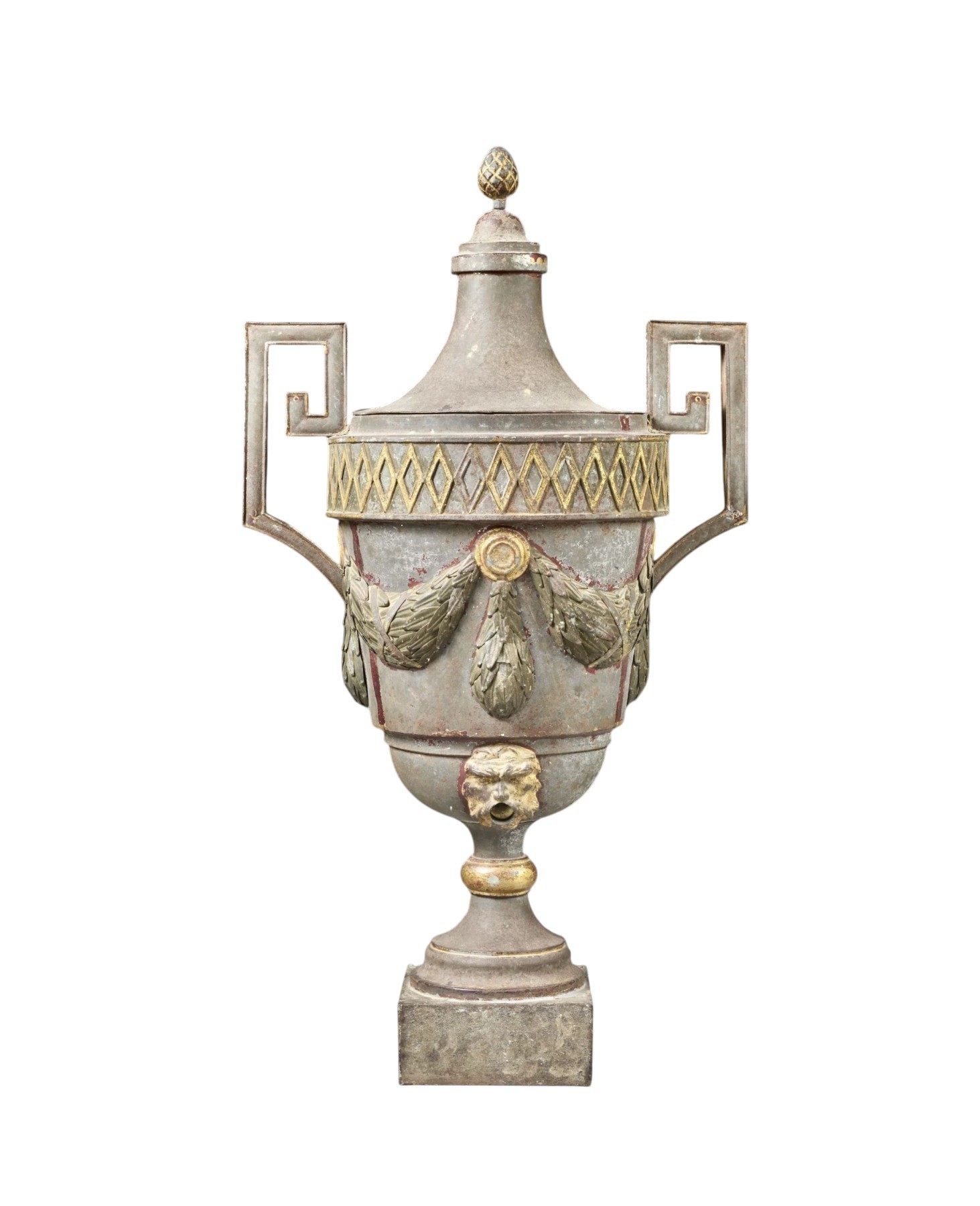
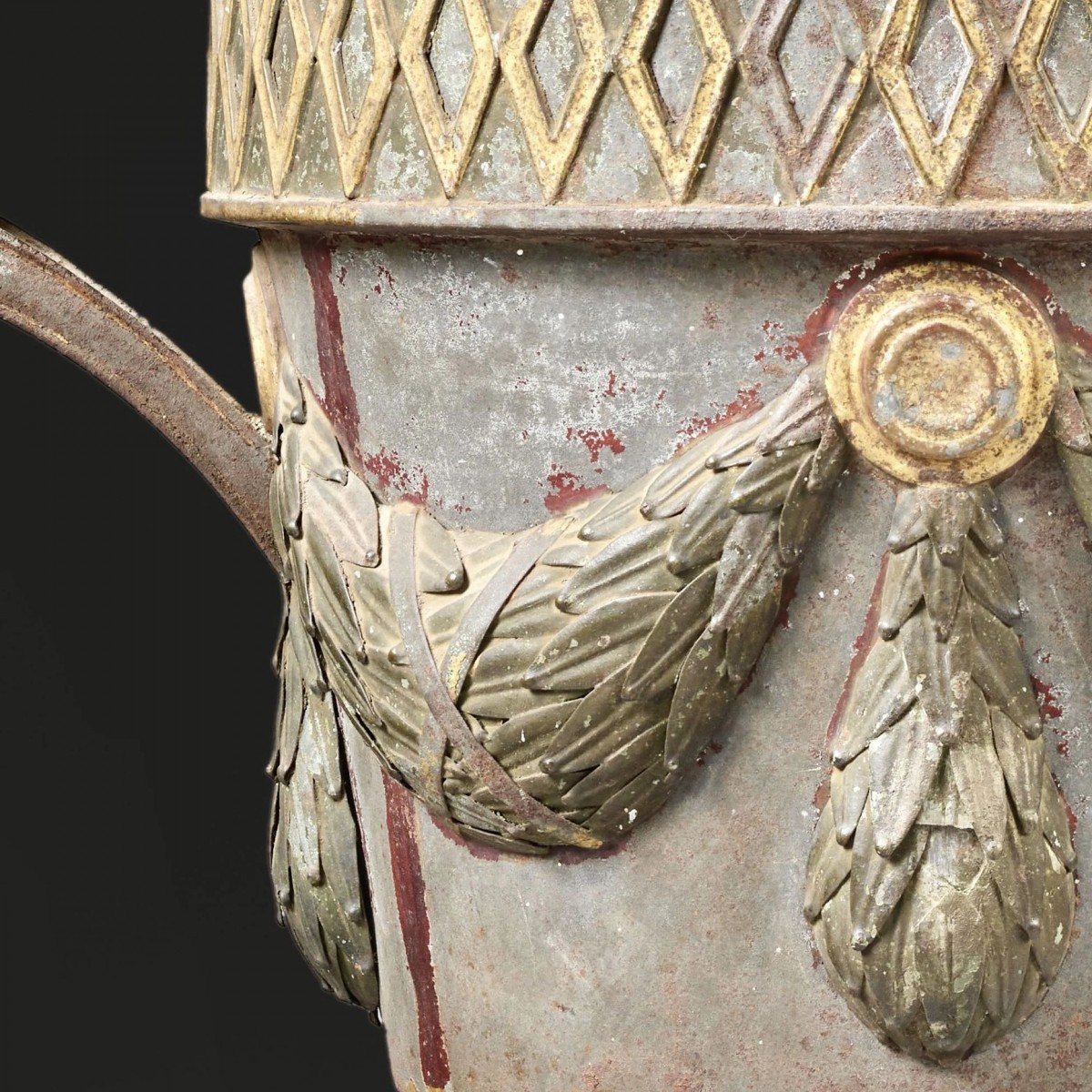
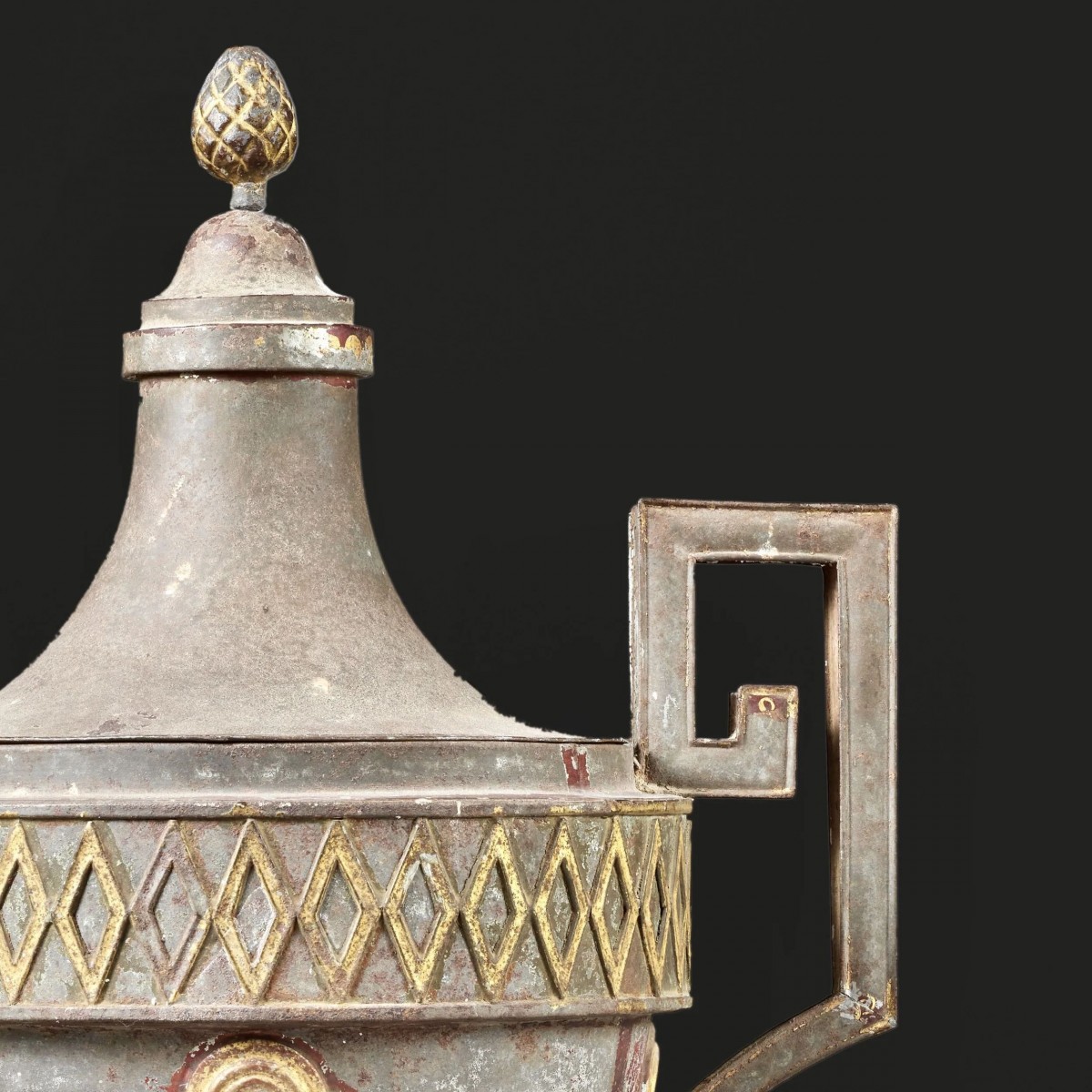
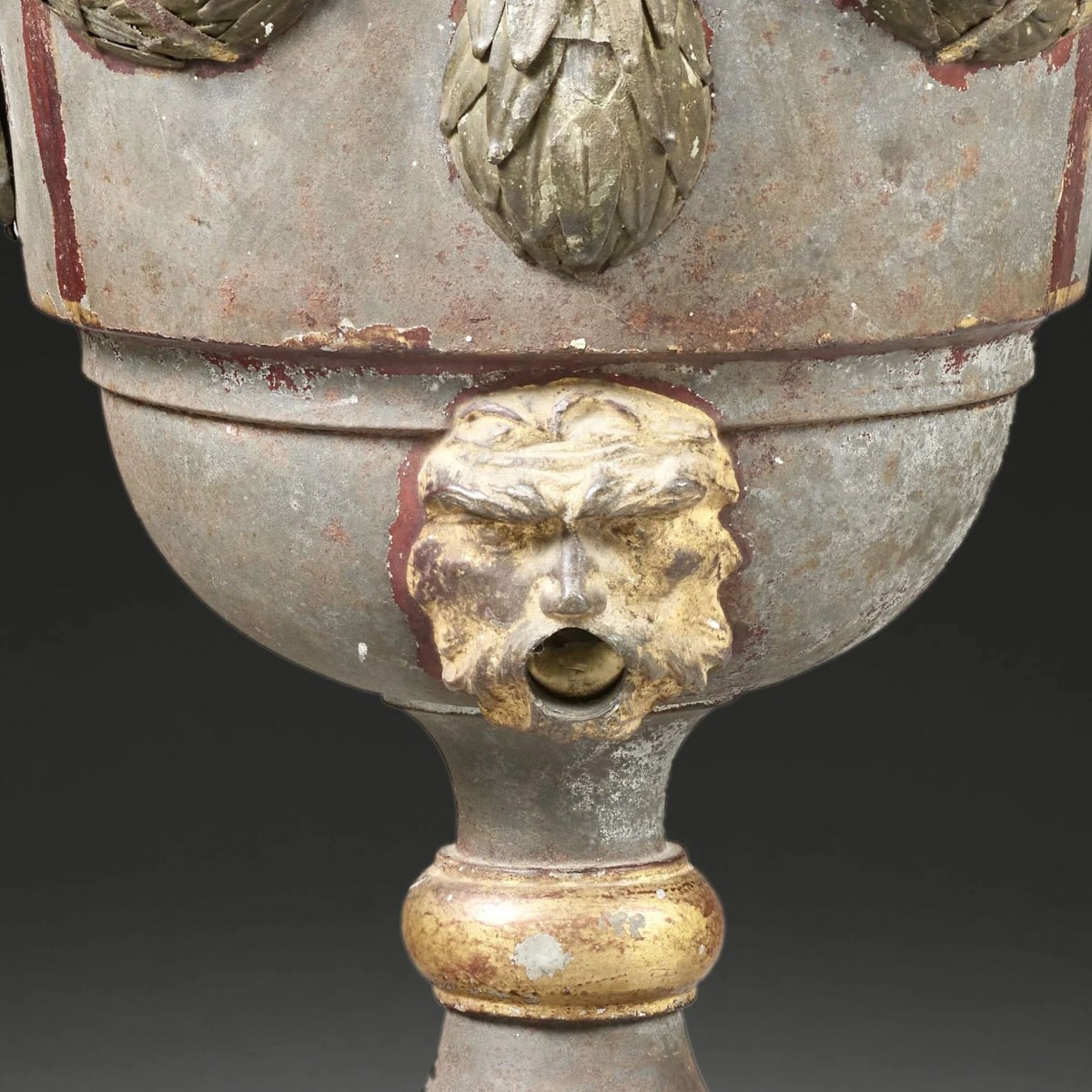
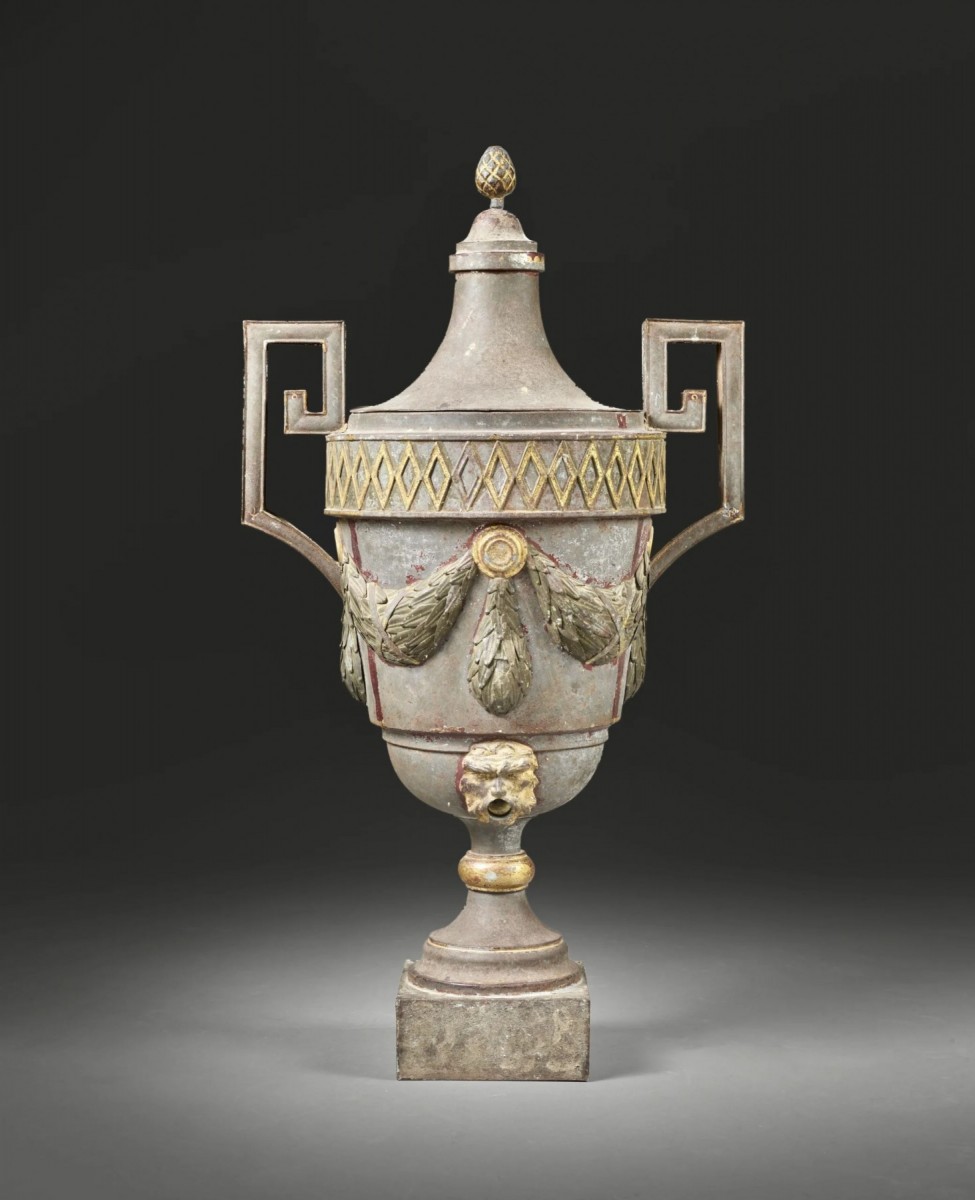
This sheet metal fountain presents the silhouette of an urn, topped with a capital lid, and topped with a pine cone. The belt is decorated around its edge with a wide band formed of golden diamonds. A loose garland of laurel, held by a disc of golden sheet metal, decorates the central part of the fountain. The base of the lamp is decorated in its center with a golden sheet metal mask, whose wide open mouth allows the water to flow. The base, formed of a pedestal, has a large ring of gilded sheet metal in its center, and is simply molded on its lower part. Large Greek-shaped handles, placed on each side of the fountain, complete the whole, where there remain some traces of red paint erased by time. The whole thing rests on a small square base.
Painted sheet metal objects:
Studied recently, the oldest objects in lacquered sheet metal that have come down to us date from the Regency period or the beginning of the Louis xv period, where the craze for oriental lacquers and the feverish search for imitation of these lacquers seems to have been at the origin of the development of this technique.
If the decoration of these objects imitates lacquer, their shapes and typologies were inspired from the beginning by that of silverware and, above all, earthenware and porcelain. Rare, however, under Louis xv, lacquered sheet metal enjoyed renewed popularity due to Anglomania in the second half of the 18th century. Indeed, in England, in Pontypool, a painted sheet metal factory had been established since the 1730s which enjoyed great success. In France, two stores specialized, among other things, in English objects and imitations of England. The first, the English Store, was run by Madame Blakey from 1766 to 1776 rue des Prouvaires. The second, under the Au Petit Dunkerque brand, was one of the most fashionable stores in Paris at the end of the 18th century. In reaction to these English imports, two factories were created dedicated exclusively to this production, which therefore joined the workshops of painters and varnishers in the production of this type of object. The first factory known as “Little Poland” had a very short existence since it was created on May 5, 1768, it ceased its activity in December 1772. The second Parisian factory was created on March 30, 1771 but in 1776 its production of locksmith objects was almost three times higher than that of lacquered objects.
Certain haberdashery merchants like Granchez at the Au Petit Dunkerque brand, or Madame Blakey in particular, major players in the art market always eager to create new fashions among their enthusiasts, were interested in sheet metal objects and are probably at the origin of the rare examples of gilded bronze frames serving as a case for some of them.
Neoclassical taste and Greek influence
This fountain fits perfectly into the neoclassical movement of the 1770s.
From the 1750s, responding to the complaints of a small group of critics who, denouncing the extravagances of rocaille, aspired to rediscover the “noble simplicity” of the masters of Antiquity, began to appear an increasingly pronounced taste for neoclassical vocabulary. The trip to Italy organized by the Marquise de Pompadour to form the taste of her brother, Abel Poisson, Marquis de Vandières, future director general of the King's buildings, in the company of the engraver Charles-Nicolas Cochin, the architect Jacques-Germain Soufflot and Abbé Leblanc between November 1749 and March 1751 was considered at the time to mark the emergence of "Greek taste". It was followed in December 1754 by the publication in the Mercure de France of a “supplication to goldsmiths, chiselers, wooden sculptors for apartments and others” by Louis-Sébastien Mercier, a real plea in favor of the straight line, respect for proportions and balance, and a pressing reminder of the nobility of the ancient ornamental repertoire. This is how in the 1760s, this new taste took over the capital like a true madness. Painters, cabinetmakers and bronze workers knew how to respond, prefiguring the vocabulary developed during the Louis xvi era. This fountain, with its shape of an antique vase with a mascaron head, its geometric frieze, its laurel garland, and the Greek-shaped handles, presents all the vocabulary of this stylistic movement.
Bibliography:
-Under the direction of Anne Forray-Carlier and Monika Kopplin, The secrets of French lacquer, Martin varnish, Paris, 2014.
-Pierre Verlet, French gilded bronzes of the 18th century, Paris 1987.
-Pierre Kjellberg, Objects mounted from the Middle Ages to the present day, Paris, 2000.