Offered by Galerie Léage
REQUEST INFORMATION

France,
Louis xvi period
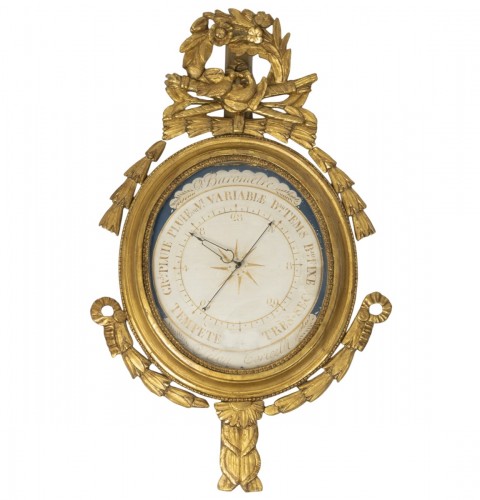
Attributed to Antonio Carcano said Carcani or Carcany (circa 1755–1820)
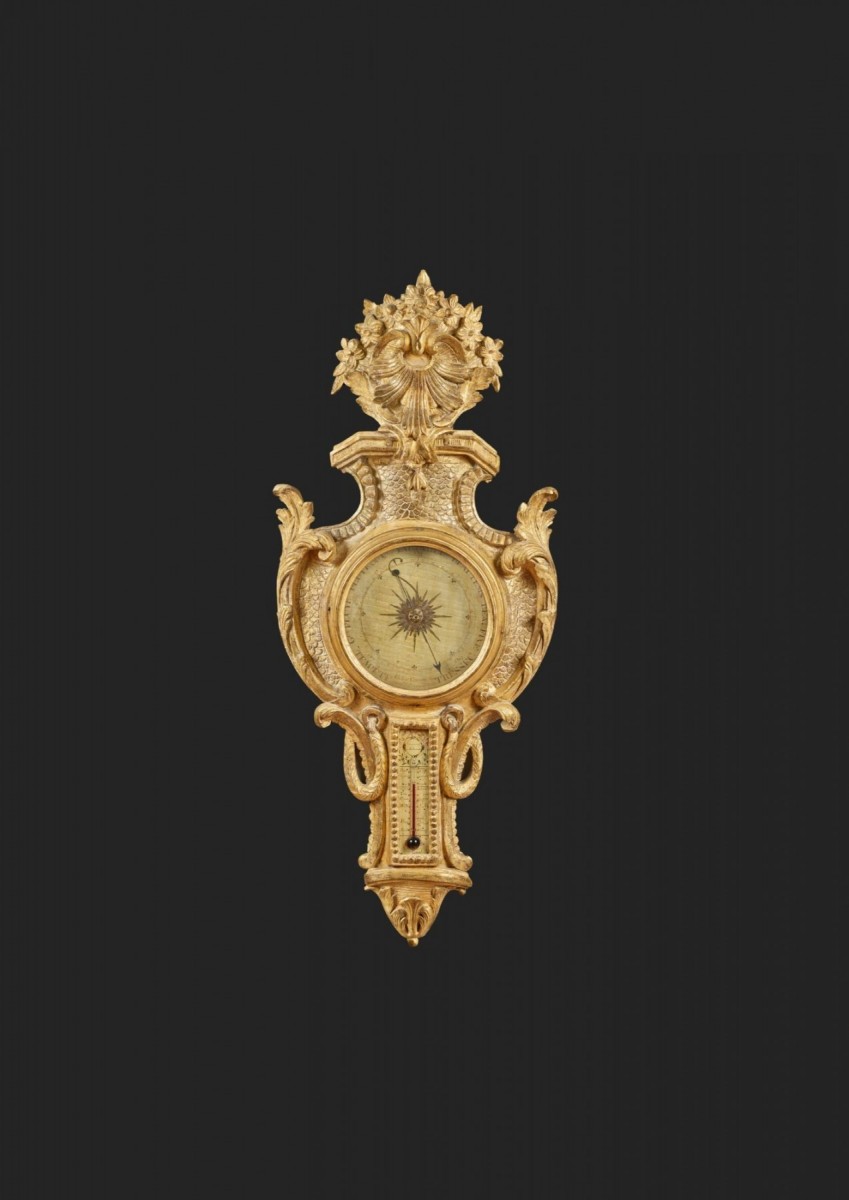
Carved and gilded wood
The dial is signed: “Par le Sr. Carcanï Rue et faubg St-Antoine a coté La fontaine charonne au Ladons Royaux”
Comparable examples
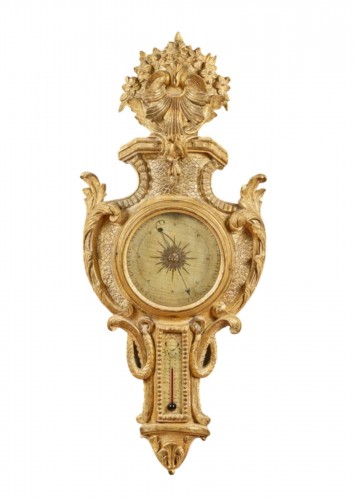
-Antonio Carcano said Carcani or Carcany, Barometer-thermometer with a flower vase, Louis xvi period, circa 1770, former collection of Galerie Léage.
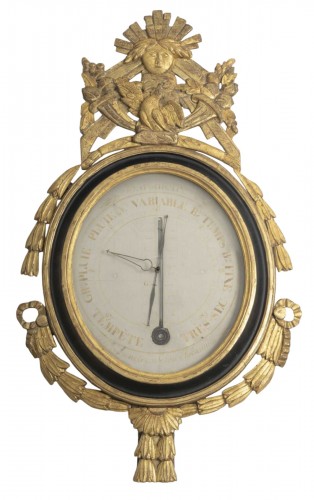
-Antonio Carcano said Carcani or Carcany, Barometer-thermometer with a war trophy, Louis xvi period, last quarter of the 18th century, private collection.
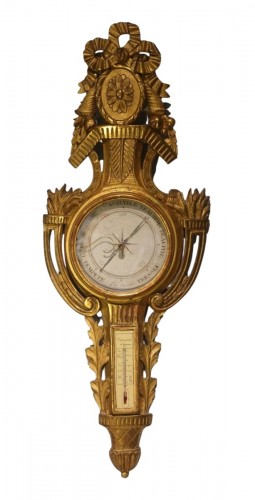
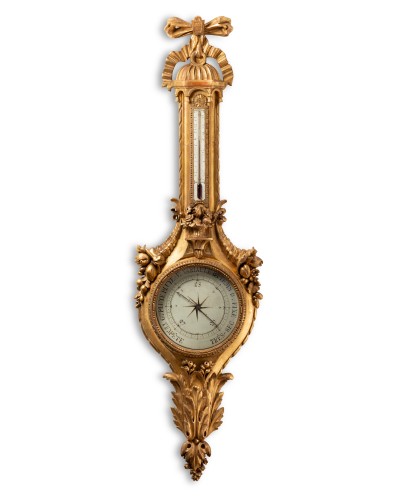
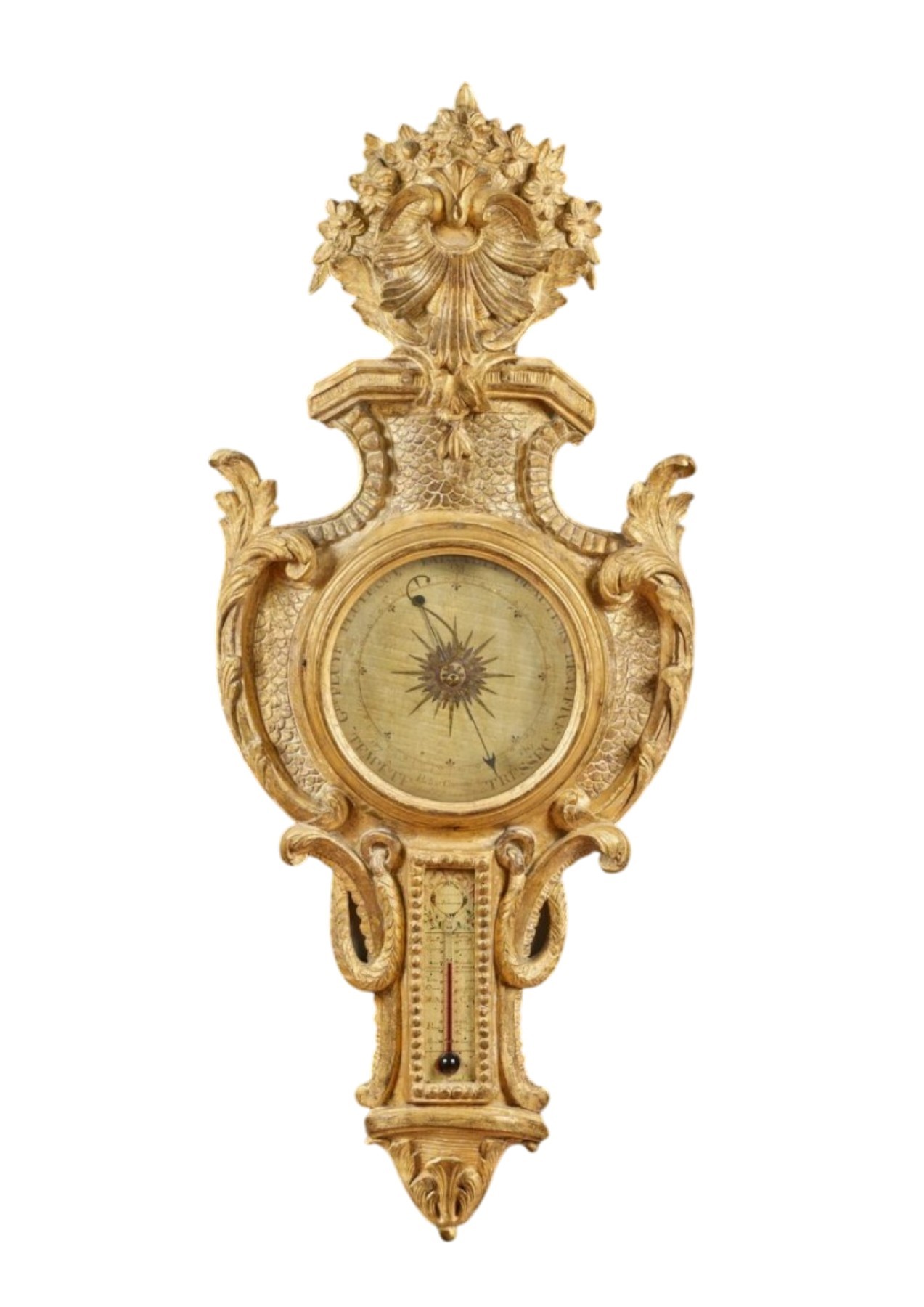
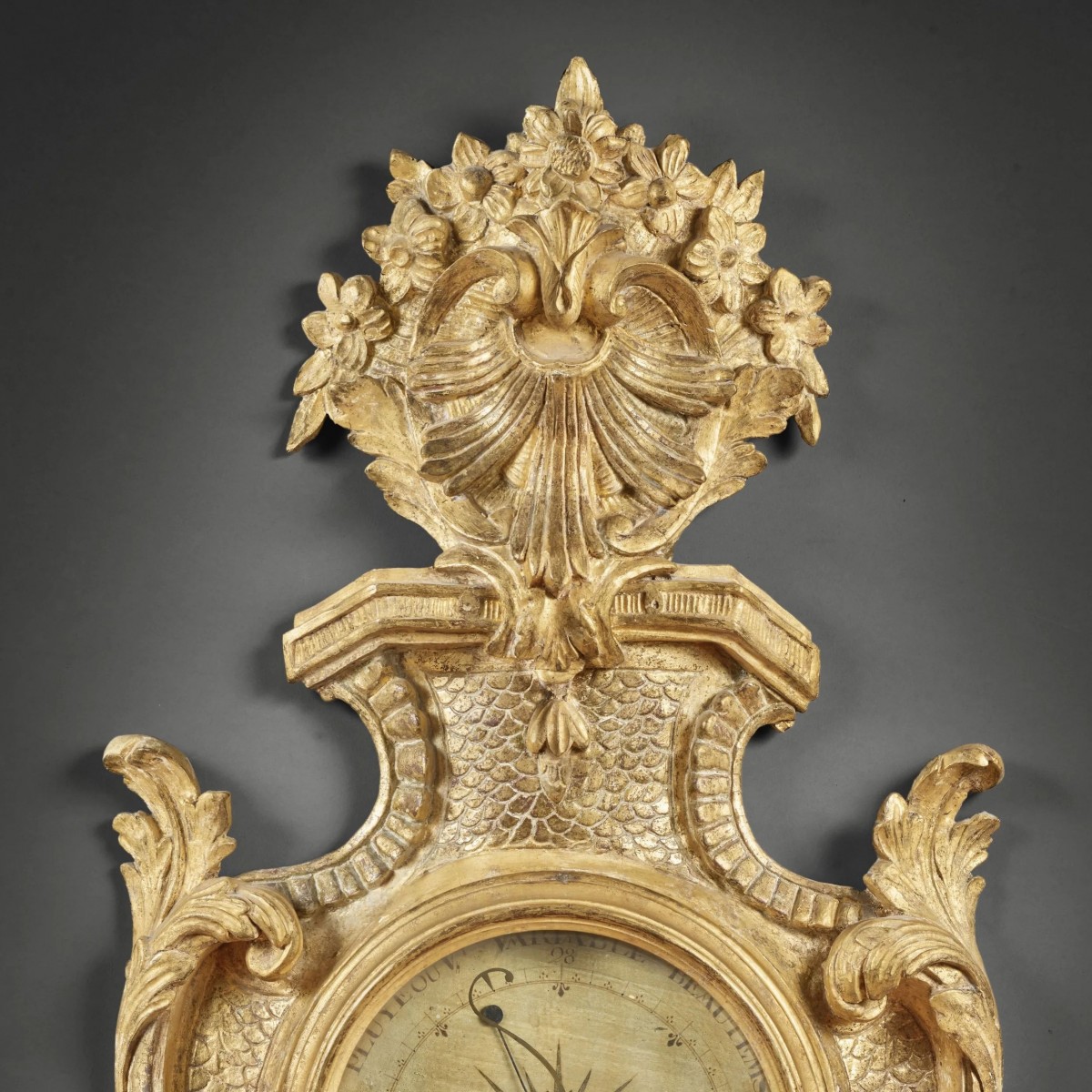
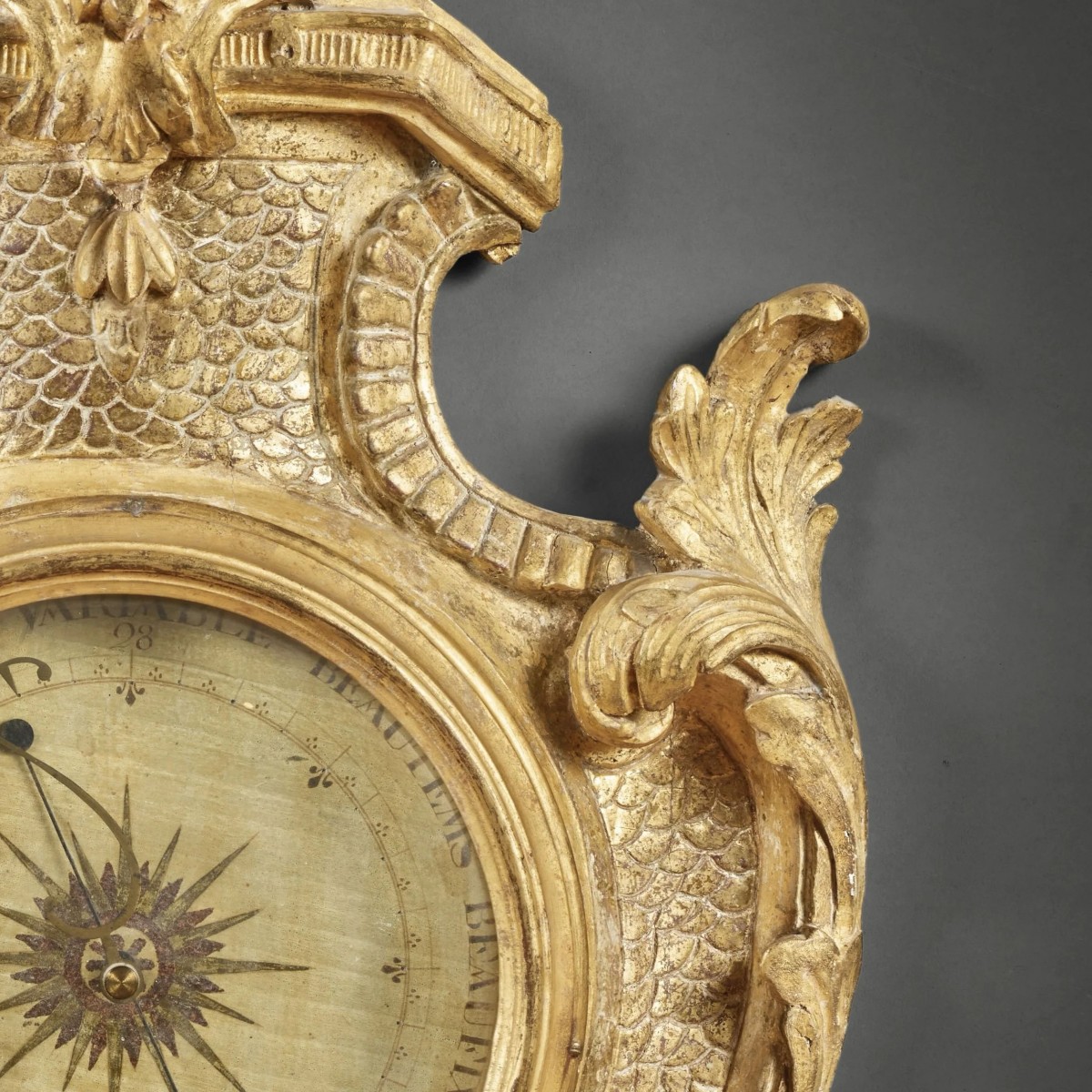
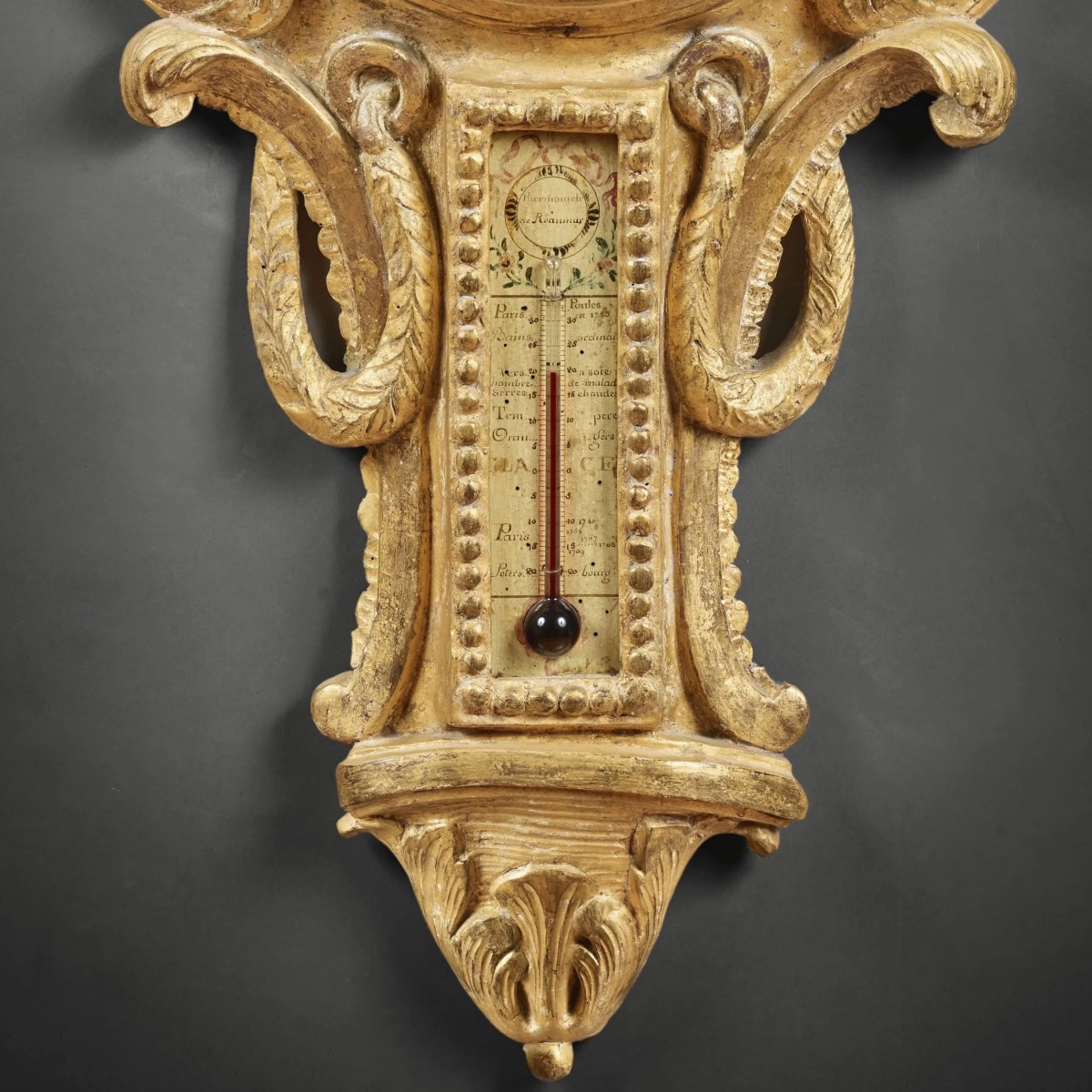
This wall-mounted barometer-thermometer features a tondo-shaped barometer topped by a thermometer framed by a pearl fillet. On the dial, a black metal pin points to various meteorological indications inscribed in ink around a compass rose. These indications are arranged clockwise as follows:
“VARIABLE” [litt. VARIABLE]
“BEAUTEMS” [litt. FINE WEATHER]
“BEAUFIXE” [litt. SUNNY WEATHER]
“TRÉSSEC”[litt. VERY DRY]
“TEMPÊTE” [litt. STORM]
“GDE PLUYE” [litt. HEAVY RAIN]
“PLUYE OU VT“ [litt. RAIN OR WIND]
Also indicated :
In the North axis, number “28”
In the South-East axis, number “29”
In the South-West axis, number “27”
Signature “Par le Sr. Carcani Rue et faubg St-Antoine a coté La fontaine charonne au Ladons Royaux” [litt. “By Mr. Carcani Rue and Faubourg Saint-Antoine next to the Charonne fountain at the Ladons Royaux”] between the words “TEMPÊTE” and “TRÉSSEC”.
The thermometer features a “Réaumur” gradation, in reference to the temperature scale designed by French physicist and inventor René-Antoine Ferchault de Réaumur in 1731, ranging from 30 degrees Celsius and above to -20 degrees and below.
History of the Barometer
The barometer was invented in 1643 by Evangelista Torricelli, who demonstrated atmospheric pressure by observing the variations in the height of the mercury according to weather conditions. The term "barometer" was introduced by Robert Boyle.
In the 18th century, as in the example studied, the mechanism was located at the back: air pressure acted on the mercury and moved a pointer on a dial. In a context of growing interest in science, these instruments were often associated with thermometers.
History of the Thermometer
Attributed to Galileo for its principle, the thermometer appeared in the 17th century and is based on the expansion of a liquid in a tube. It was gradually improved with the introduction of different scales:
- Fahrenheit (early 18th century),
- Celsius (1742), whose scale was reversed after his death,
- Réaumur, still in use in the 18th century.
Officially adopted in 1794, the Celsius scale eventually became the standard. Thermometers could be either direct-reading or dial-type, with a mechanism connecting a float to a pointer.
Diffusion and Use
At the end of the 17th century, barometers and thermometers moved beyond the scientific realm and into the homes of the educated elite. In the 18th century, they became prized objects for their scientific, decorative, and symbolic value.
Their manufacture relied on collaboration: opticians crafted the mechanisms, while carpenters designed the cases.
Antoine Carcano (c. 1755–1820)
Of Italian origin, Antoine Carcano was a manufacturer of scientific instruments active in Paris. Initially located on Rue de la Roquette and later on Place Dauphine, he achieved considerable success, becoming a maker for the Royal Military School in 1786.
His signature evolved with his social advancement, incorporating titles and addresses. Enlisting as a citizen-soldier during the Revolution, he nevertheless continued his research and activities.
He enjoyed an international clientele: he notably supplied components to the London optician Peter Dollond, and his instruments were used by scientists such as Rumford. His differential thermometer was also described in the United States, proof of his lasting recognition.
Bibliography
- Daniel Alcouffe, Anne Dion, Gérard Mabille, Les bronzes d’ameublement du Louvre, Dijon, Faton, 2004, p. 213, n°108.
- Bibliothèque universelle des sciences, belles-lettres, et arts faisant suite à la Bibliothèque Britannique, Tome 13, fifth year, Imprimerie de la Bibliothèque universelle, 1820, p.249.
- Antoine Carcano, Lettre manuscrite d’Antoine Carcano adressée à la Convention nationale, dated October 12, 1792, and received October 13, Paris, Archives Nationales (ref. C//241 1792).
- Camille Frémontier-Murphy, « Une collection d’instruments scientifiques au musée du Louvre», L’Estampille?L’Objet d’Art, n°342, December 1999, p. 40–53.
- Chevreul, Dumas, and al., Annales de Chimie et de Physique, sixième série, tome I, Paris, G. Masson Éditeur, p.288
- Alexandre Tuetey, Répertoire général des sources manuscrites de l’histoire de Paris pendant la Révolution française, Paris, Imprimerie Nouvelle, 1890–1914, Year 1908, Volume 8, page 23, article 167.