Offered by Galerie Laury-Bailly
REQUEST INFORMATION

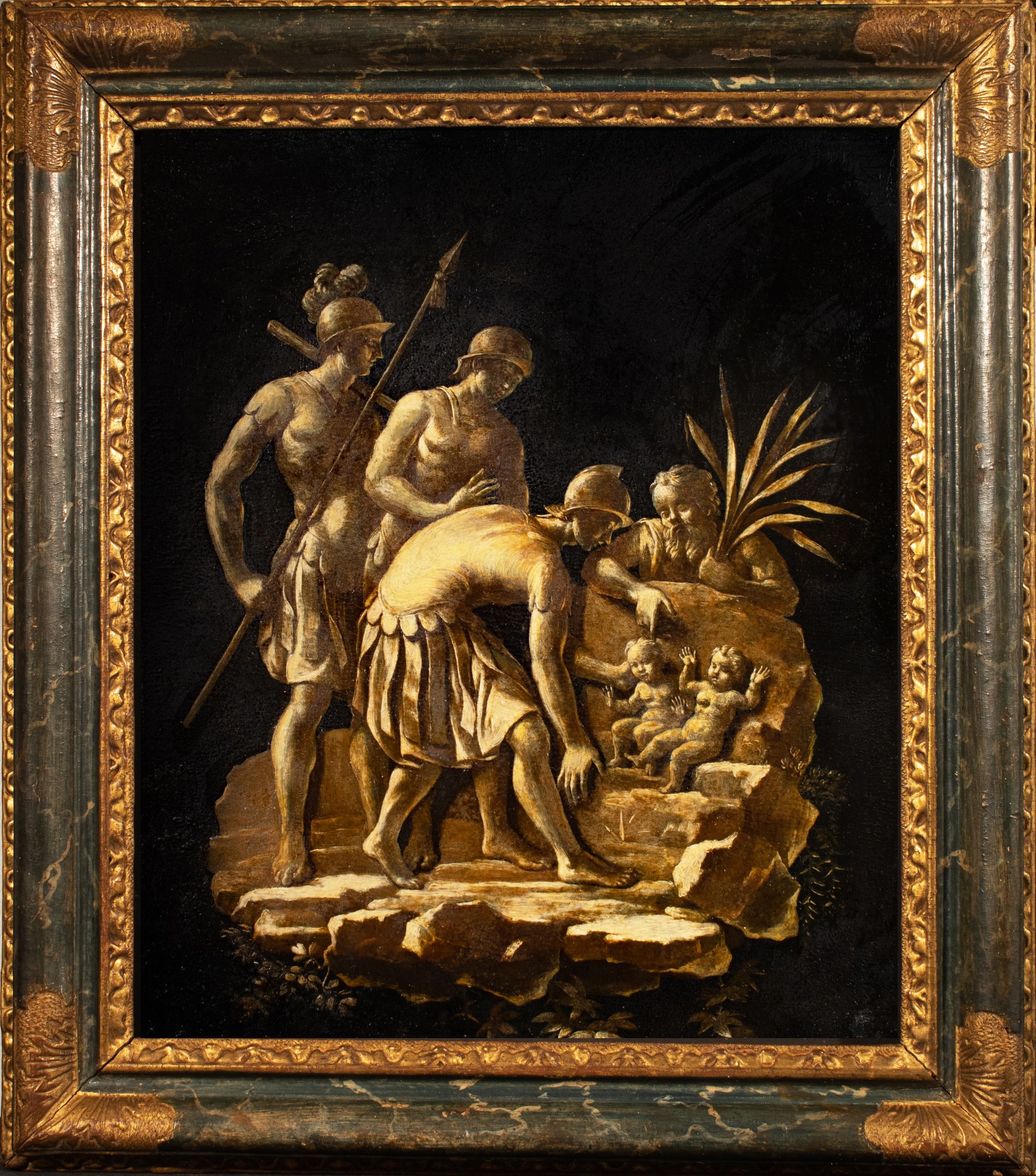
Oil on panel, 50.5 x 43 cm; with its period frame: 75 x 63 cm.
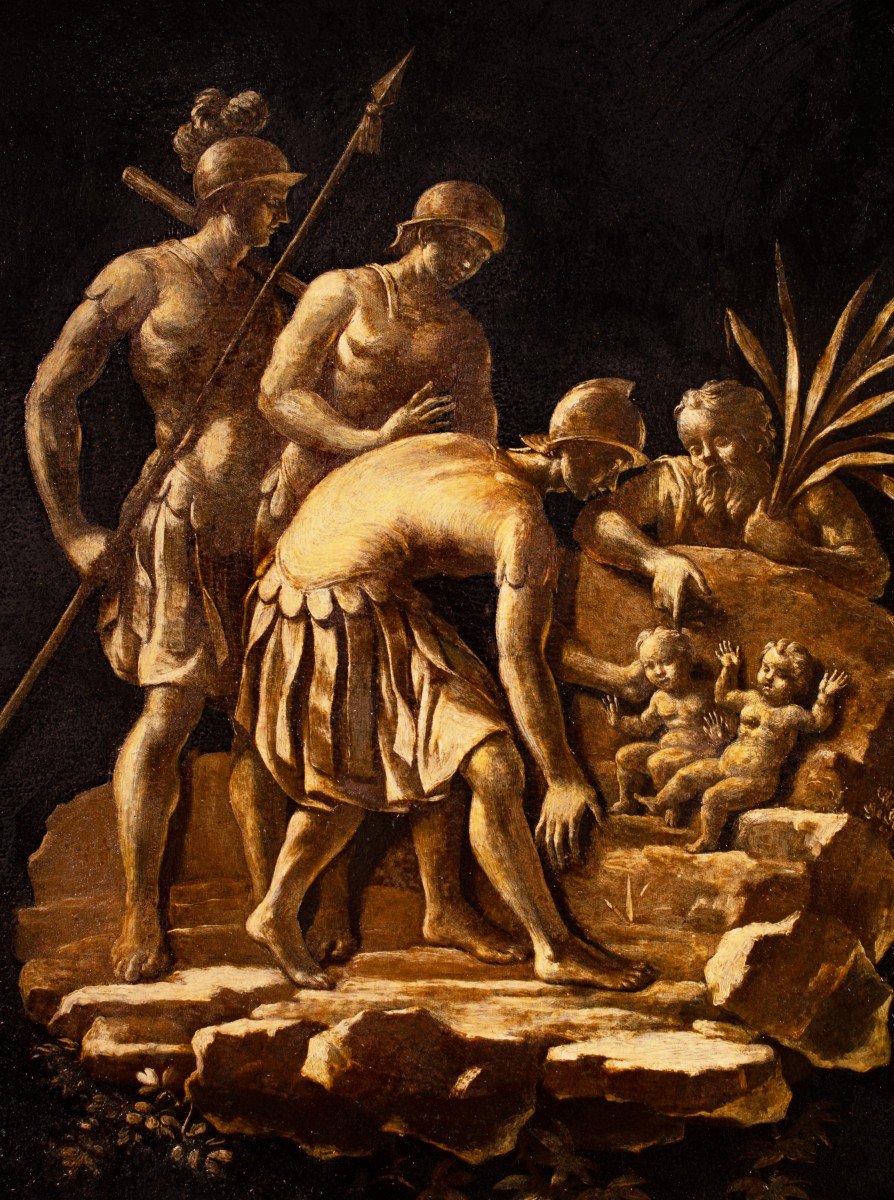
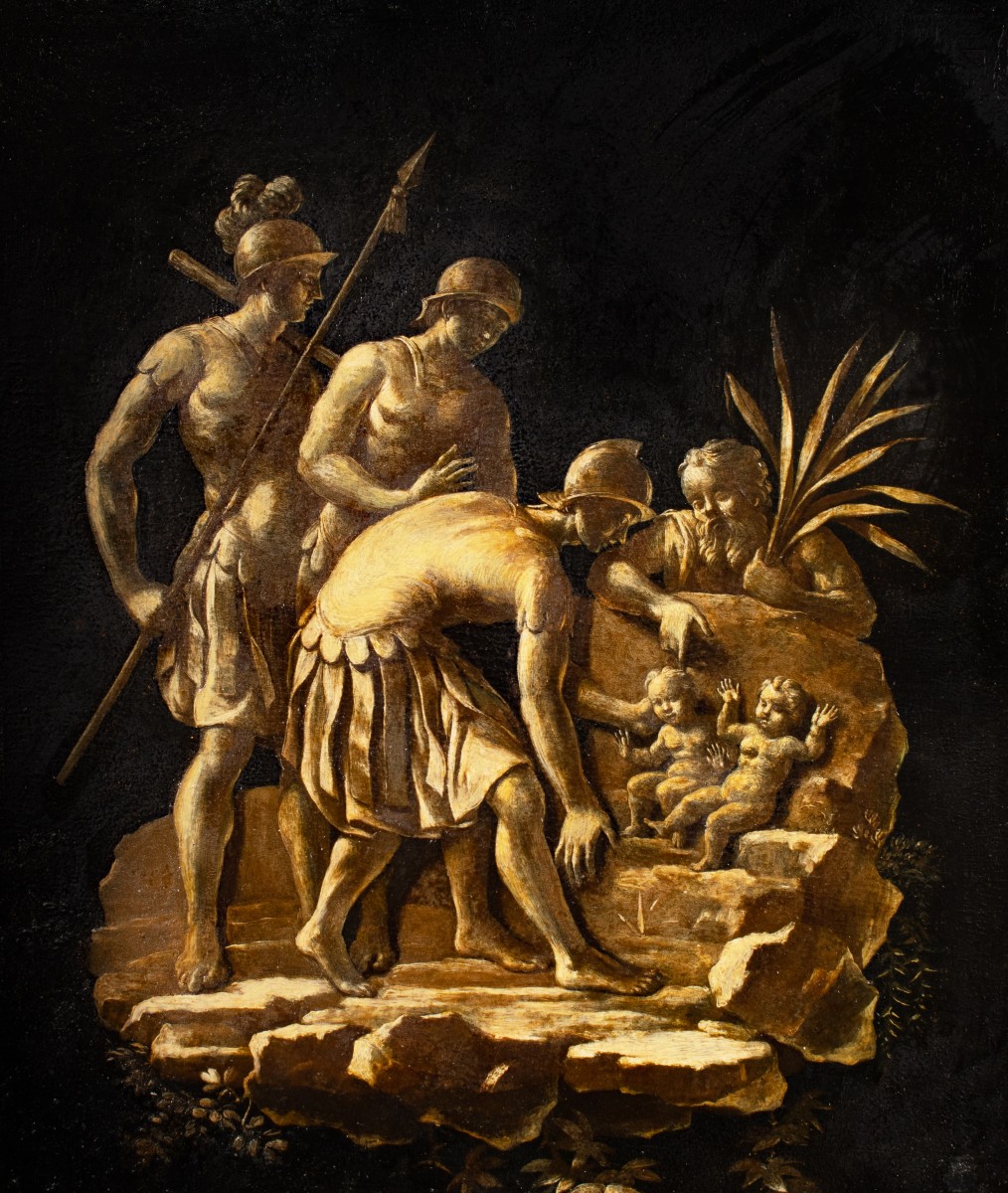
The work depicts the mythological scene of the discovery of Romulus and Remus by the shepherd Faustulus. Three armed figures, dressed in antique attire, advance from the left; the central figure bends toward the two infants seated on a rocky outcrop. On the right, a bearded old man gestures broadly toward the children, likely symbolising the Tiber.
The rocky setting, leafy tree, and dark background create a dramatic space in which light models the bodies like an antique bas-relief. The highly controlled brown monochrome palette reinforces this sculptural effect.
The theme of Romulus and Remus, the legendary founders of Rome, was a popular humanist subject in the 16th century. It allowed artists to demonstrate their erudition and virtuosity in the depiction of the male body, while also evoking the legitimacy of power and the origins of Roman civilisation.
The work clearly belongs to the Mantegnesque tradition of monochrome painting imitating bas-relief, derived from Andrea Mantegna. Several elements support this attribution:
– The brown monochrome: Mantegna popularised the use of grisaille and brunaille to create sculptural relief effects, an aesthetic that deeply influenced artists of the Cinquecento.
– The sculptural treatment of the figures: elongated silhouettes, precise modelling, angular drapery, and theatrical gestures, all characteristic of Mantegna’s legacy.
– The frieze-like composition: typical of works inspired by antique reliefs, which Mantegna studied and emulated.
– The diffusion of his style: by the mid-16th century, workshops in Northern Italy and the School of Fontainebleau widely adopted Mantegnesque models, notably through engravings.
The date 1564 corresponds perfectly to this period of reception and reinterpretation of Mantegna’s inventions. The reinforced panel support is also consistent with the technical practices of this tradition.
Thus, while not a work by Mantegna himself, the painting belongs to a late Mantegnesque vein, highly sought after in 16th-century collectors’ cabinets.
Former collection: Pierre de Demandalx Dedons.