Offered by Floris van Wanroij Fine Art
REQUEST INFORMATION

Old master painting, sculpture & works of art from the Haute Epoque period
Gillis van Conincxloo II
Antwerp 1544 – Amsterdam 1606
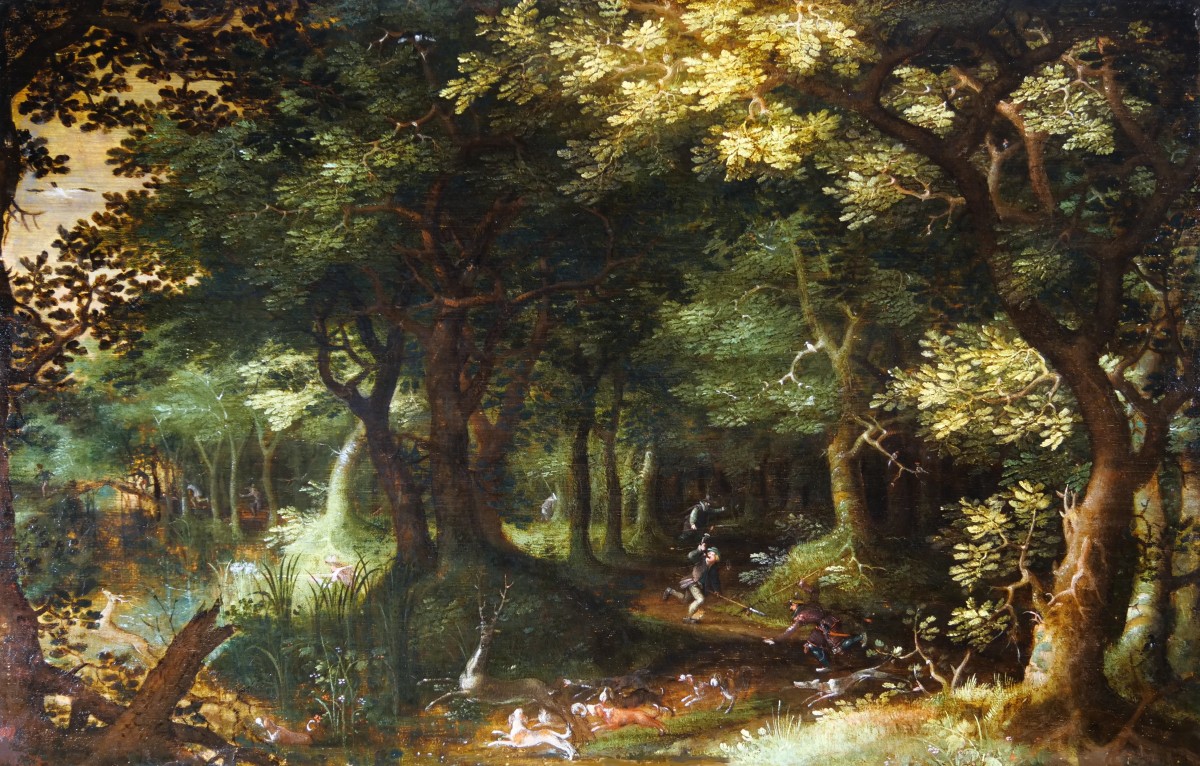
A Forest Landscape with Hunters and Dogs stalking a Stag
Oil on panel
H. 35 cm. W. 55 cm.
PROVENANCE
Private collection | Belgium
REFERENCE LITERATURE
Miedema H. (2014). ‘What’s in a name?’ In: Revue belge d’archéologie et d’histoire de l’art, 83, pp. 87-100
Linden, van der, D. (2015). ‘Coping with crisis. Career strategies of Antwerp painters after 1585’. In: De Zeventiende Eeuw, 31, pp. 18-54
CATALOGUE NOTE
Gillis van Coninxloo II is particularly known for his forest landscapes, like in the present picture. It shows a thick web of trees standing very close to each other. Only scattering light finds its way through the heavy vegetation. The landscape is animated by only a few staffages-figure of hunters and their dogs stalking a Stag. Van Coninxloo is arguably the most important landscape painter working in Northern Europe during the second half of the 16th century and a key member of two important schools: firstly the Antwerp School, into which he was born and secondly the Frankenthal School, which he helped found and of which he can be considered the leading artist. As such, he is one of the most interesting and notable Flemish artists of his generation. His move from Antwerp to Frankenthal, and ultimately to Amsterdam, belongs to the moment when the large-scale migration of artists and other intellectuals, spurred on by the religious tumult of the age, shifted the currents of artistic and cultural influence, creating new and fruitful channels of cross-pollination between the traditions of Germany and the Northern and Southern Netherlands. In the realm of landscape painting, which was first truly born as a self-sufficient genre only a few decades earlier, in the rocky valleys of Patinir’s Wallonia, this migration had a particularly earth-shaking effect. Artists born and formed in the Southern Netherlands, in the unfiltered influence of Patinir and his followers (Herri met de Bles and Pieter Bruegel I first and foremost amongst them), exported these innovations to neighbouring lands. Landscapists like Gillis Hondecoeter, Alexander Kierincx and – above all – Gillis van Coninxloo took the revolutionary new genre of landscape painting which had been nurtured in Flanders during the fertile years of the mid-16th century, and brought them to the northern Provinces, sowing the seeds of what would become one of the most characteristic aspects of Dutch landscape painting.
Gillis van Coninxloo II born in Antwerp on 24 January 1544. He was not the son of Jan van Coninxloo I (ca. 1489-1555) and Elisabeth Hasaert, but of Gillis van Coninxlo I and Adriana Martens van Doornicke Jansdochter. Gillis II travalled through Frand between 1565 and 1570 and visited Italy. He was back in his native city in 1570, when he became ‘wijnmeester’ (master by patrimony) in the Guild of Saint Luke. On 19 June 1582 he assisted Anna Mahu, widow of Frans Pourbus I to conclude her marriage contract with Hans Jordaens. He left Antwerp after the siege by Alexander Farnese. Already before 21 January 1585 he had started to pack goods and chests and sent them away (van der Linden, 2015). Between 1585 and 1587 Van Coninxloo lived in Middelburg and a travel from there to France to sell property he owned there. Later he moved to Frankenthal, where he would remain till 1595. He acquired citizenship in Amsterdam in 1597 and was a member of ‘Twit Lavendel’ (‘White Lavender’). He had his workshop at the Oude Turfmarkt. According to Van Mander (1604) and Houbraken (1718-1721) Gillis II married in Antwerp in 1570 to Maria Robroeck, the widow of Pauwels Coecke van Aelst, who died 1603. The couple had at least two children: Catalijne and Gillis III. Gillis II married Geertgen van Eden in Amsterdam on 23 August 1603. Gillis made his will on 7 December 1606 in Amsterdam and died in that city later in December of that year and was buried in the Nieuwe Kerk on 4 January 1607.