Offered by Galerie Léage
REQUEST INFORMATION

Southern France, Louis XV period
Carved and waxed natural wood
Red griotte breccia marble top
Comparable example:
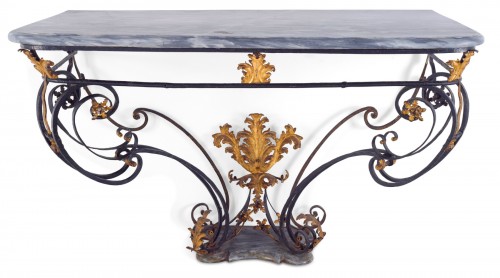
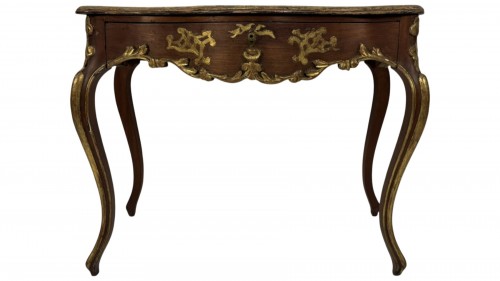
- Console table in gilded wood, Southern France, 18th century, private collection.
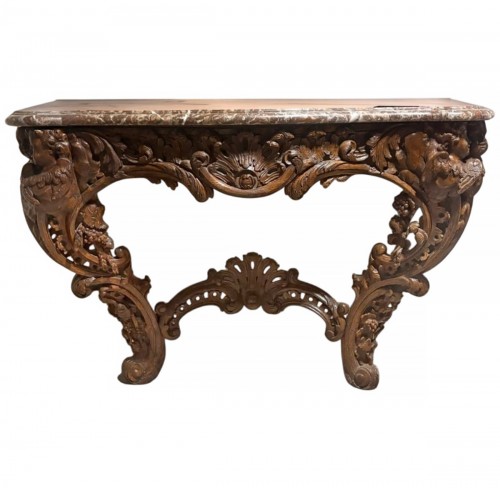
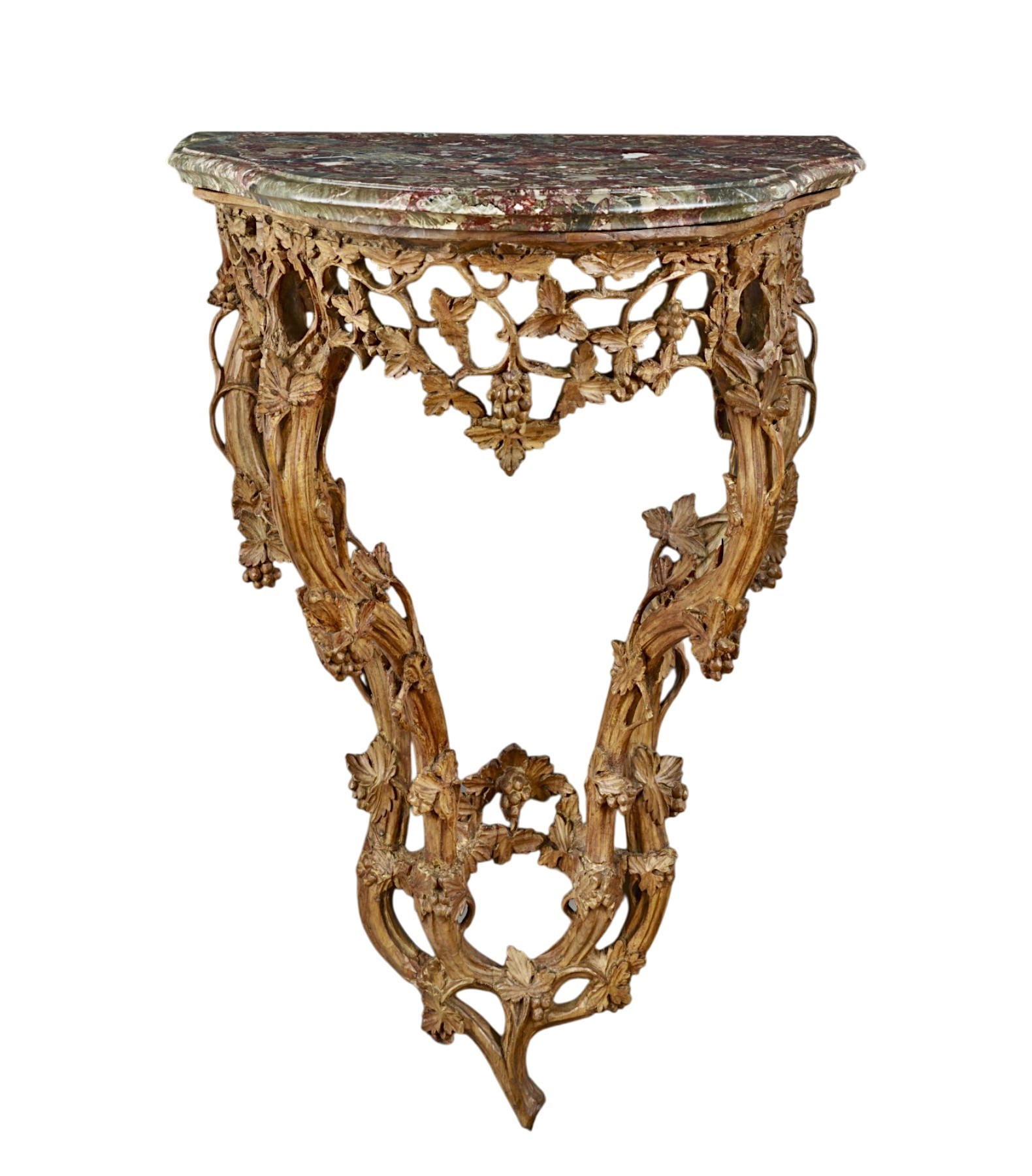
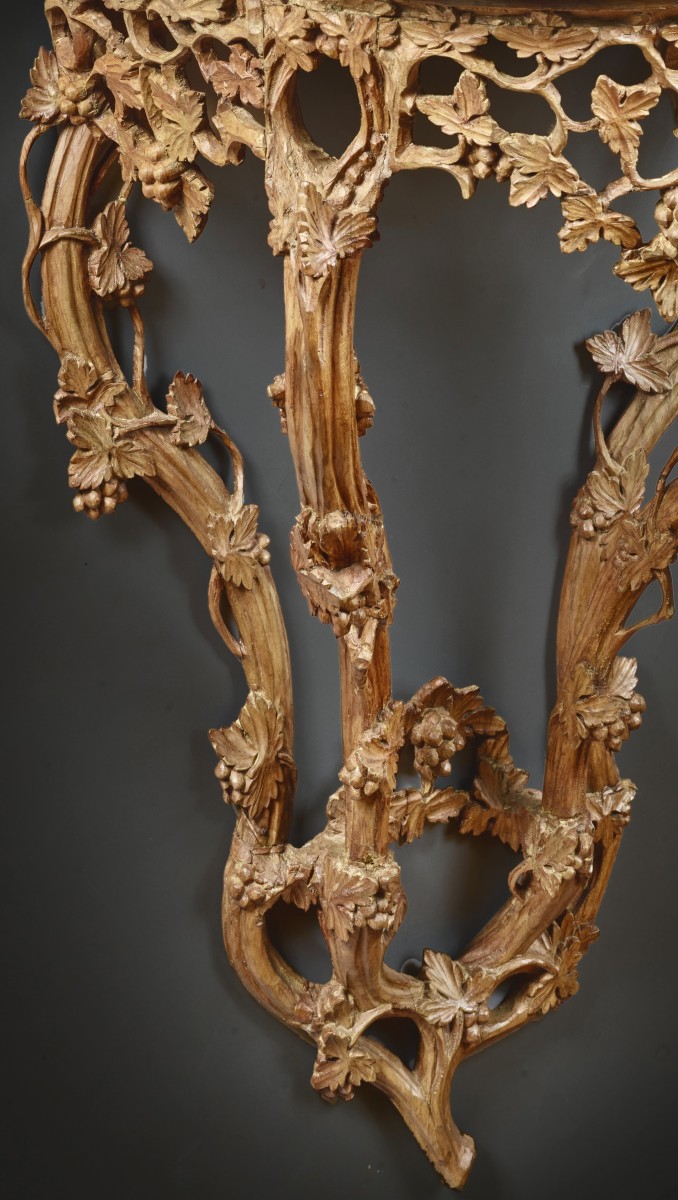
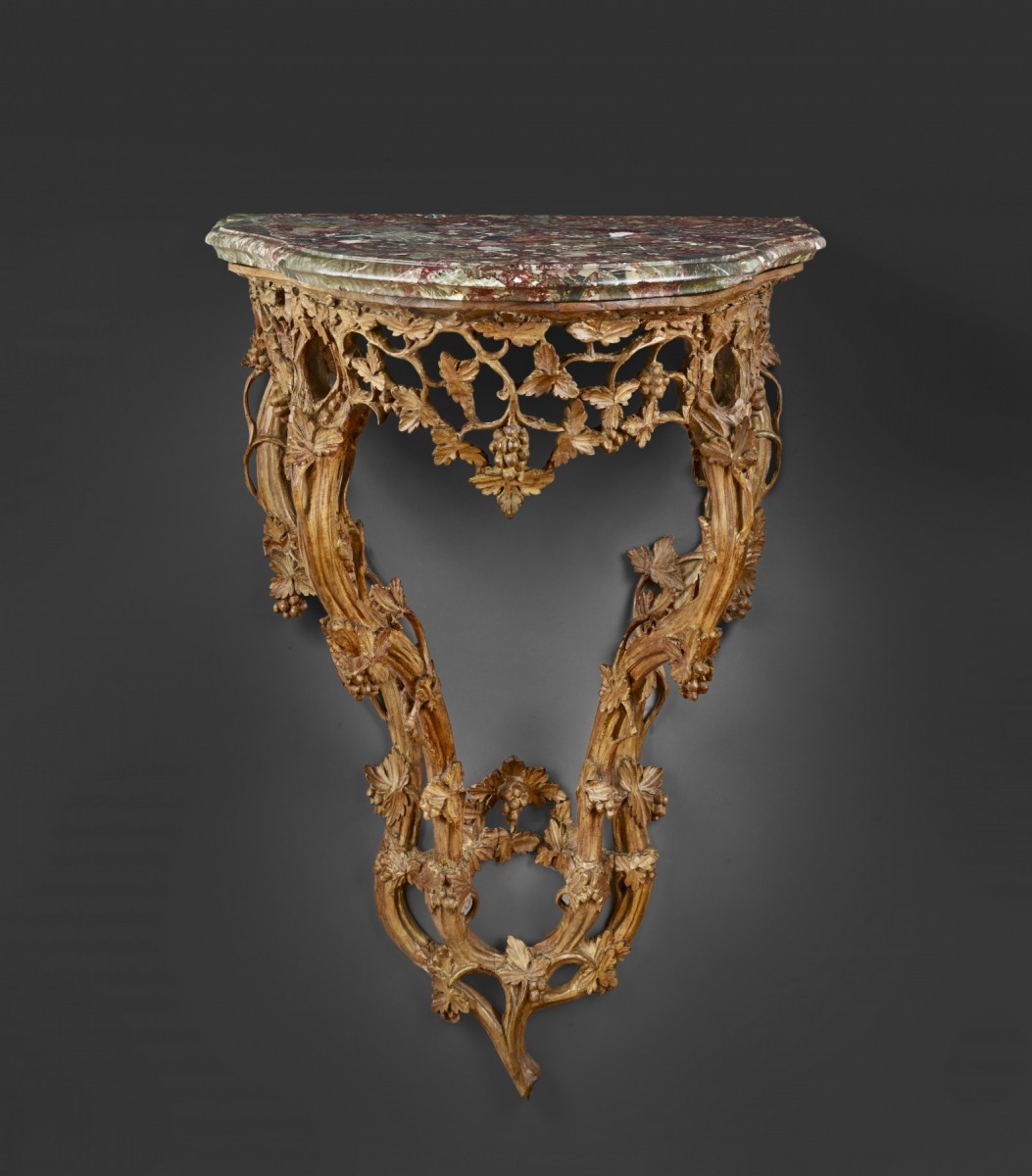
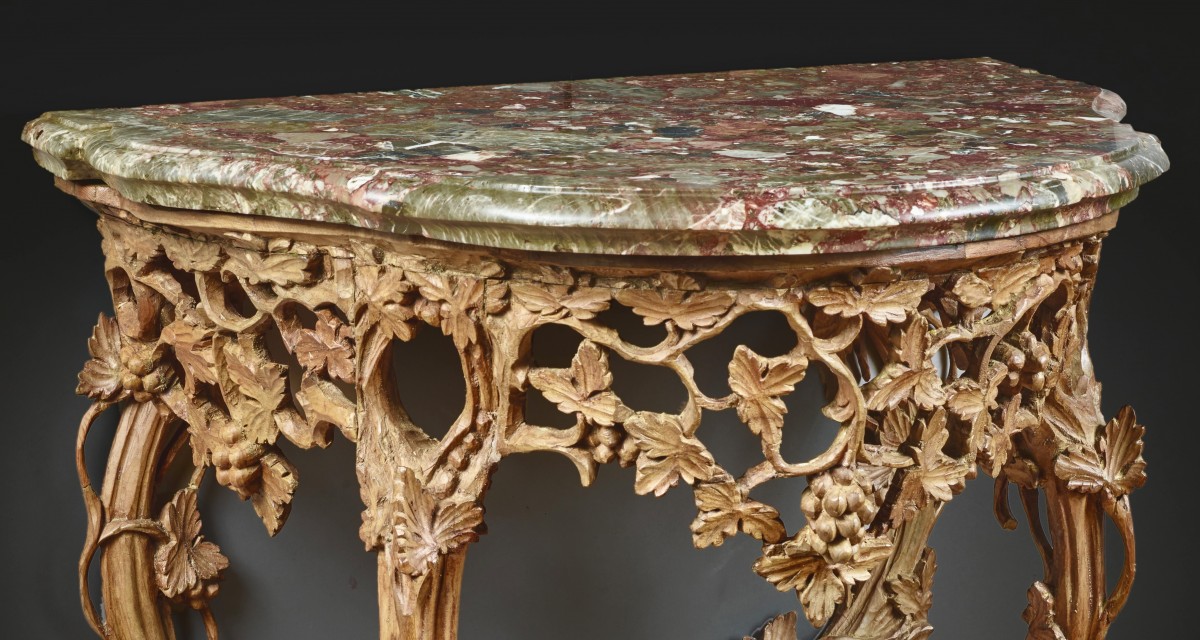
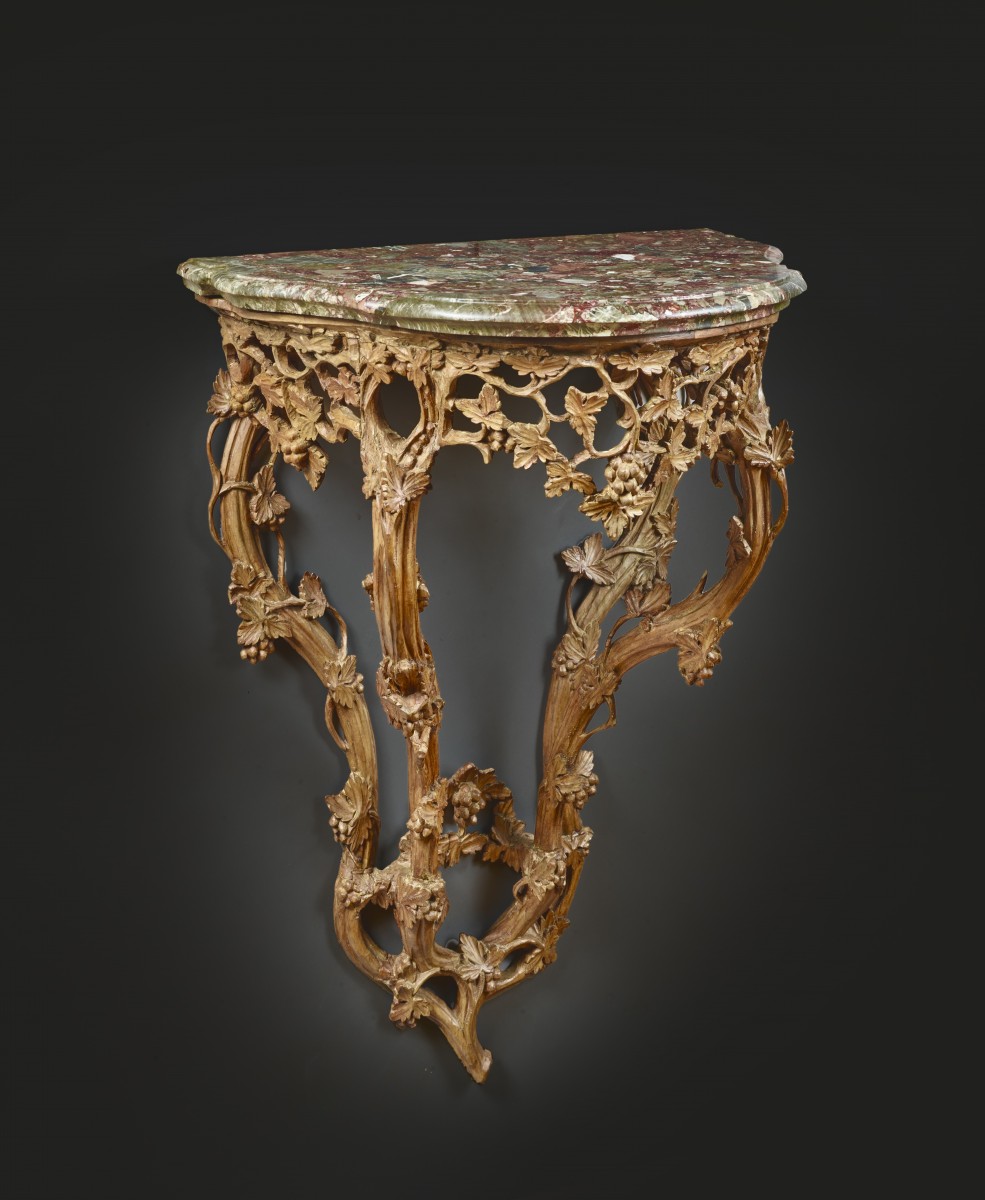
This small console table, conceived as a wall-mounted side table, is crafted from natural wood and features an openwork vegetal-inspired decoration. The apron is adorned at its center with grapevine motifs composed of branches, leaves, and bunches of grapes. This pierced ornamentation continues seamlessly along the lateral sides.
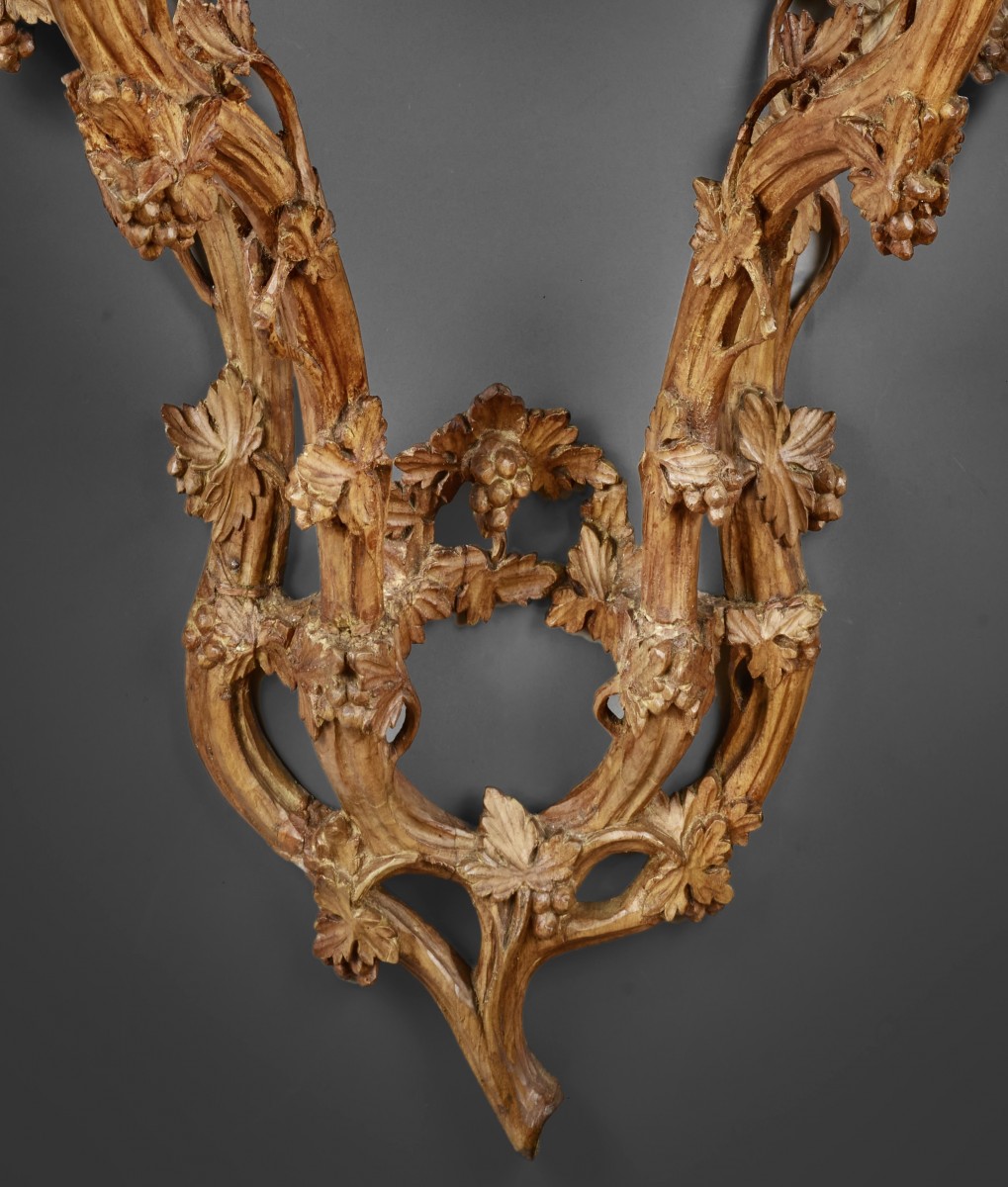
The four legs are shaped like winding branches, simulating trellises entwined with grapevines. The entire surface is intricately carved and pierced, with leaves, tendrils, and grape clusters forming a sculptural ensemble. These elements converge at the bottom to form a unified central foot. At the apron level, the wood is hollowed on either side of the grapevine motif, evoking the inner cavity of a tree trunk.
The rear face, designed to be placed against a wall, is left unornamented. A plain wooden band runs above the apron. The stepped top is made of red griotte breccia marble.
The Console Table in the 18th Century
Emerging in the late 17th century, the console table developed in tandem with pier mirrors, with which it formed a cohesive decorative unit, structuring interior walls and articulating room symmetry.
By the 18th century, the console table had become a standard feature in interior decorative schemes, particularly within paneling ensembles.
Originally conceived as a fixed element, integrated into wall paneling, the console table was designed for a specific location—typically between two windows or as a counterpart to a fireplace. The marble top often matched that of the mantelpiece. It served as a display surface for decorative objects such as bronzes, vases, or items from a collector’s cabinet. Freestanding furniture, such as the present example, often maintained a close dialogue with surrounding architectural elements. Certain models were designed to harmonize visually with paneling, with sculptural motifs echoing the rhythms and themes of adjacent wall carvings. The treatment of ornamental carving, particularly vegetal scrolls, fostered visual continuity. Well suited to elaborate sculptural adornment, the console table exemplifies here the exuberance embraced by certain woodcarvers under Louis XV. These craftsmen displayed great inventiveness, embracing bold and innovative decorative schemes.
The ornamentation on this console table, combining vine leaves and grape clusters, reflects mid-18th-century aesthetic preferences, where naturalistic inspiration and Bacchic references intertwined. The carving exhibits remarkable vitality and expressiveness.
Such grapevine motifs were well-suited to Rocaille compositions and found fertile ground in interior decoration around the mid-18th century.
At Sanssouci Palace in Potsdam, for instance, a music room created for Frederick II features a gilded ceiling decorated with vine and trellis motifs, executed by Michael Merck (1714–1784) and gilded by Adam Carlony. The composition evokes a golden garden in which contemporaries delighted to spend time—an allegory of the palace’s surrounding vineyard. Nearby, two console tables in the small gallery feature Bacchic ornamentation, with two bacchants delighting in playful abandon amidst vine-laden stretchers, expressing the hedonistic spirit of the setting and echoing Frederick I’s motto: “Live and let live.”
The console table presented here may well have belonged to a similarly coordinated decorative scheme, where wood paneling and mirrors shared vegetal Rocaille motifs.
An 18th-century piece, likely from Provence
This console table aligns with a regional tradition influenced by Parisian models, while developing traits specific to southern French workshops.
Alongside Parisian designs, distinct regional furniture schools emerged from the late 17th century onward. Though Paris exerted a strong influence, local craftsmen adapted these styles to provincial tastes.
Among the various styles developed during the 18th century, the Louis XV style was widely adopted across the provinces, particularly by the local nobility. In Provence, cabinetmakers and joiners—often referred to as fustiers [carpenters]—forged a distinct idiom while drawing inspiration from Parisian production. Cities such as Arles, Nîmes, and Fourques became important centers of furniture-making.
The style later known as the “popular Louis XV” flourished across the region. Characterized by curving silhouettes and a dynamic play of lines, it emphasized naturalistic ornamentation symbolic of love, rural identity, and the pursuit of prosperity.
Motifs drawn from the surrounding landscape—wheat sheaves, grapevines, wildflowers, roses, olive and laurel branches—frequently adorned these pieces.
The woods used were generally locally sourced. Mulberry, resistant to woodworm and hard enough to allow detailed carving, was often favored. Beech, a more supple wood, was also employed.
Fustiers developed several furniture types specific to the region, such as the panetière (a decorative bread cabinet) or the pétrin (a dough bin). In parallel, they produced more universal types, such as the console table examined here. Its form corresponded to widespread tastes and was integrated into interiors across the country.
A comparable console table, today in a private collection, displays a similarly openwork silhouette, especially in the base formed by four legs joined at their feet, carved as interlacing branches. Its documented origin in southern France supports the hypothesis of a regional provenance for the present console table.
Through its pierced vegetal decoration and adaptation of a widespread typology, this console table bears witness to how southern French workshops reinterpreted Parisian models within a regional decorative idiom.
Bibliography
-Daniel Alcouffe (dir.), 18e aux sources du design : chefs-d’œuvre du mobilier 1650-1790, [exhibition catalogue], Versailles, Domaine de Versailles et de Trianon, Éditions Faton, 2014.
-Françoise Deflassieux, Guide des Meubles et des Styles, Paris, Éditions Solar, 2005, p. 113. Petra Wesch, le château de Sans-Souci, la résidence d’été de Frédéric le Grand, Munich, Prestel Verlag, 2005.