Offered by Galerie Léage
REQUEST INFORMATION

Probably Italy, last quarter of the 18th century
Carved and gilt wood
Comparable examples:
- Italian armchair, late 18th century, auction website 1st DIBS
- Italian armchair (Genoa), late 18th century, Genoa, Palazzo Reale
- Giuseppe Sartorio, Stool, 1791, Palermo, Oratorio del Santissimo, Rosario in Santa Cita
- Giuseppe Sartorio, Armchair, 1791, Palermo, Oratorio del Santissimo, Rosario in Santa Cita
- Italian armchair (Tuscany), circa 1825, private collection
- Georges Jacob, A pair of voyeuse chairs made for Monsieur de Septeuil, first valet to the King, Louis XVI period, private collection
- Georges Jacob, Bergère with eagle head décor, Louis XVI period, private collection
- Italian armchair, late 18th century, private collection
- Italian armchair, late 18th century, private collection
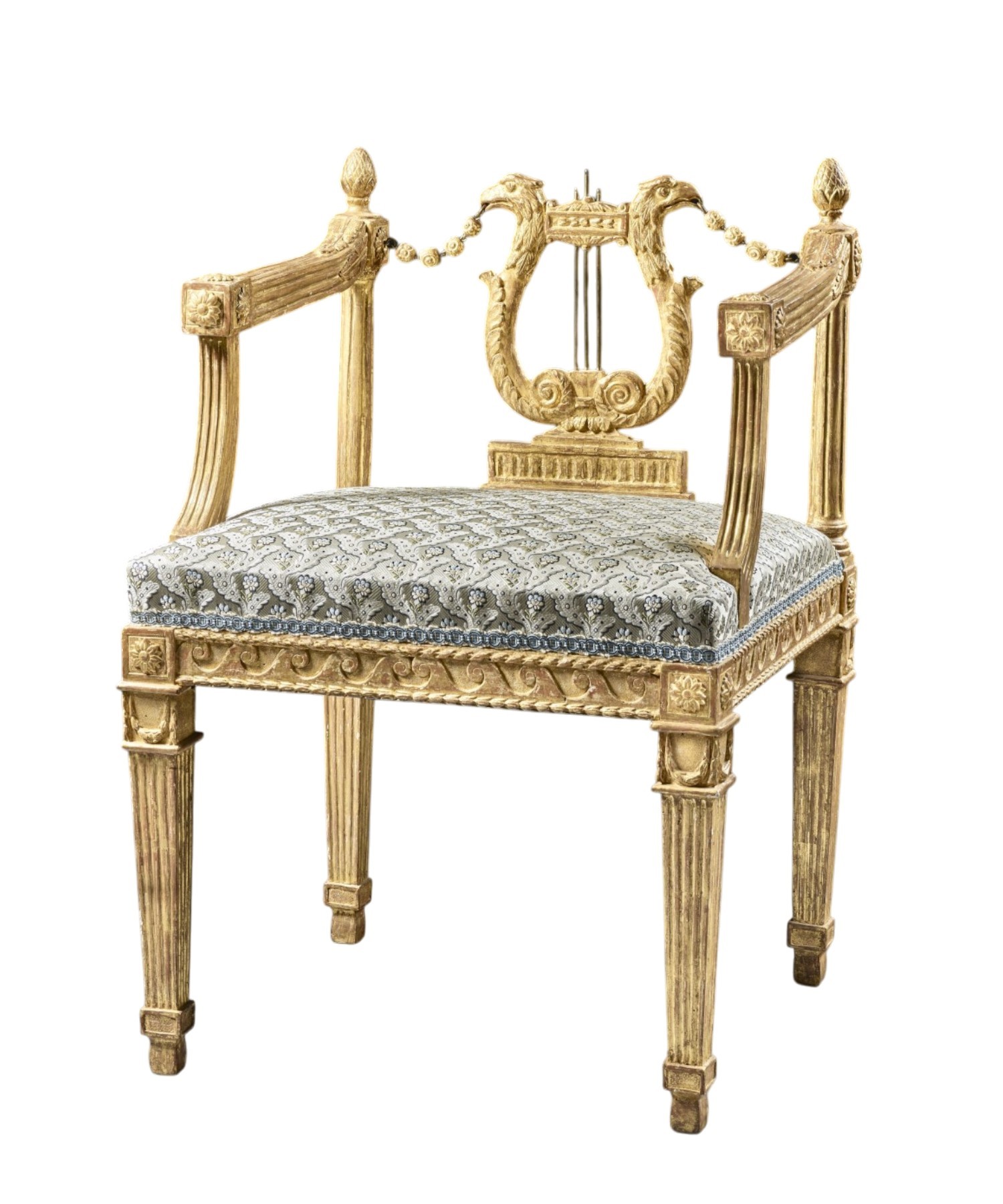
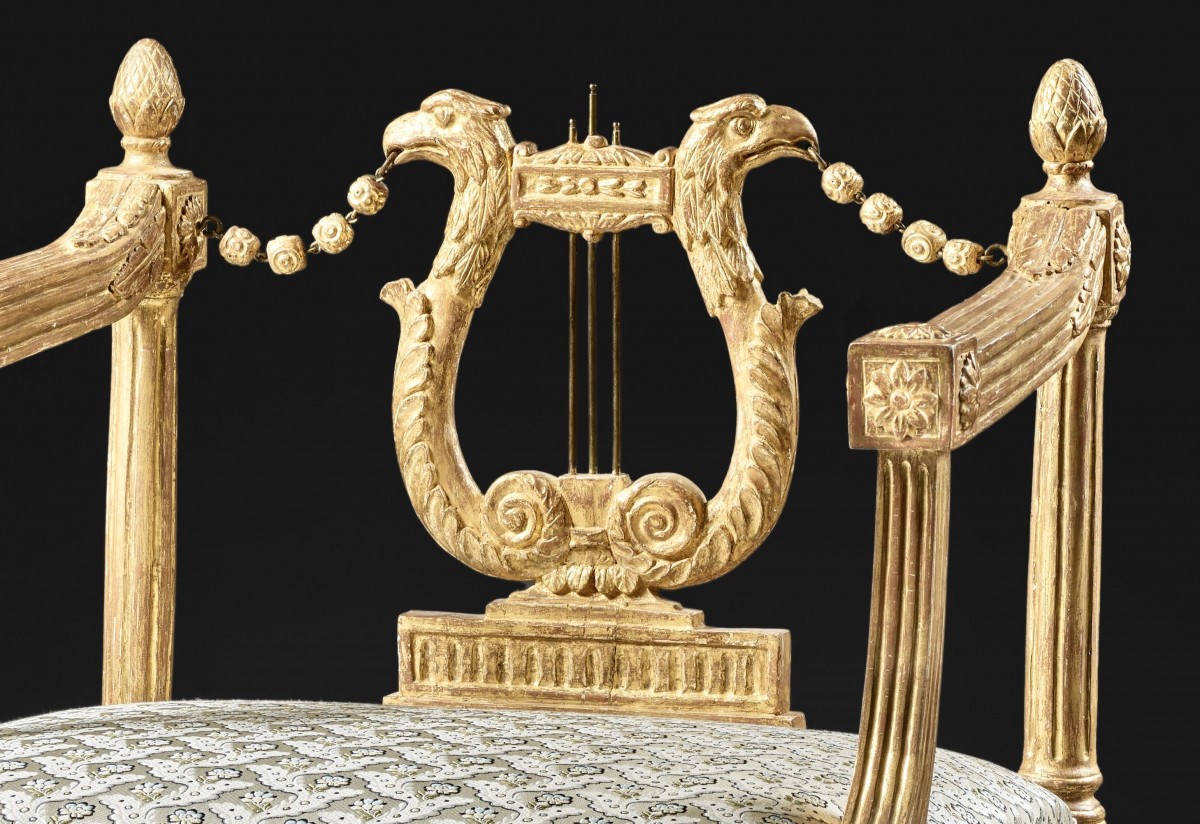
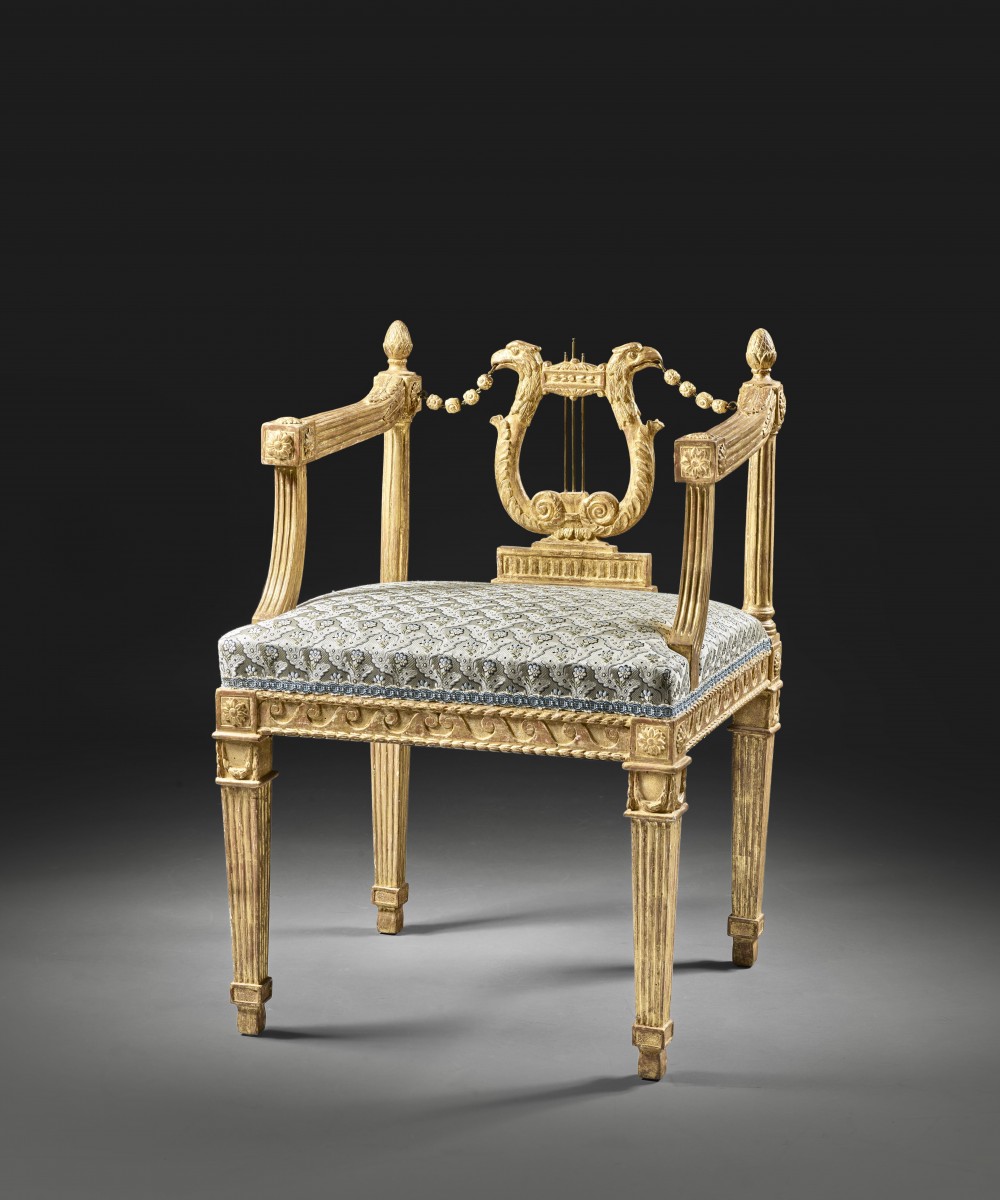
This armchair, crafted in gilt wood, features a low openwork back composed of a lyre, each handle in the shape of an eagle, the upper end of which is the head. The lower part ends in a volute, resting on a slender rectangular base adorned with a frieze of canals. The backrest is linked to the rear uprights by chains emerging from the eagles' beaks and decorated with gilt wood beads. These uprights, in the form of fluted columns, are surmounted by cubes adorned with rosettes and topped with a pinecone.
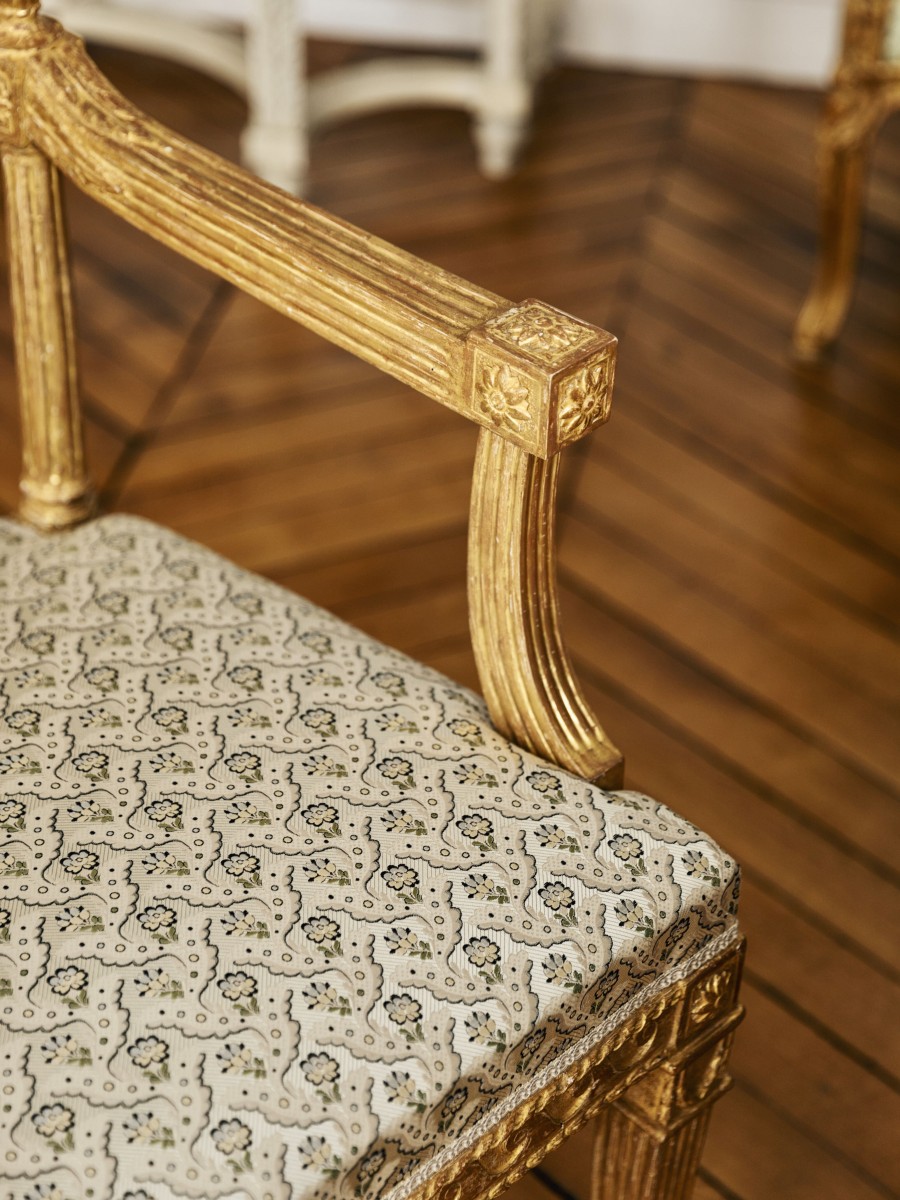
The straight, fluted armrests are linked to the uprights at the level of the cubes. An acanthus leaf adorns the connection between the two. A second connecting die is present on the front of the armrests, echoing the same decorative repertoire. The armrest brackets, also fluted, are cubic and slightly curved forward.
The belt is decorated with a wide frieze of posts, punctuated at each corner by a connecting die, adorned with a daisy flower rosette on each side. These connecting dice rise above a rectangular ring, embellished on the front with a laurel garland. The ensemble rests on four fluted quiver feet, which end in a rectangular cartouche ring set on cubic hooves.
An Italian neoclassical seat
This armchair, combining a repertoire of ornaments from the Ancient Times with a simplified overall form, is fully in line with the neoclassical aesthetic in vogue in the final years of the 18th century. Italy, with its Etruscan, Greek and Roman vestiges, was naturally one of the most fertile breeding grounds for Neoclassicism. The archaeological excavations at Pompeii and Herculaneum from 1738 onwards, and the reviews of these finds by artists and theorists from the mid-18th century onwards, led ornamentalists and men of taste to turn their attention back to Antiquity. As early as 1750, Pope Benedict XIV (1675-1758) gave a major boost to the study and conservation of ancient monuments by creating the Egyptian Museum. During this period, artists, dignitaries and men of culture all travelled to Italy to learn more about Antiquity. Overwhelmed by their own corrupt and decadent society, the philosophers of the Enlightenment set out in search of an ideal civilization, and also turned to Rome and Greece. Neoclassicism emerged as the expression of these aspirations. Structures were purified, curves replaced by straight lines, and geometric shapes dominated furniture structures.
In France, after undergoing several evolutions since the 1760s, marked by a "triumphant" style from 1770 to 1778, then a lighter aesthetic in the early 1780s, it culminated in a more severe taste in the final years of the Ancien Régime. The purer forms are then combined with ornaments that follow the antique model in a more slavish manner. Italy, with its proximity to ancient remains, was naturally sensitive to this spirit. The provinces bordering France, such as Turin, Parma and Genoa, were among the centers most open to the neoclassical forms developed in French furniture. From 1748 onwards, the Duchy of Parma, which passed to Philippe de Bourbon (1720-1765), the future Philippe I and husband of Louise-Elisabeth de France (1727- 1759), Louis XV's eldest daughter, was of prime importance in trade between the two countries. To refurbish the palace, the duke brought in a large number of pieces of furniture from Paris, and called in architect Edmond-Alexandre Petitot (1727-1801), sculptor Marc Vibert and cabinetmakers Michel Poncet, Jean-François Drugman and Nicolas Yon. Under their impetus, an important group of local craftsmen of the highest technical level was formed, spreading the Louis XV style and then the neoclassicism advocated by Petitot, and reaffirmed at the École de Dessin et d'Architecture founded in 1765. Other cities, such as Florence and Palermo, were also sensitive to the influence of the French model.
Although this chair features fluted legs surmounted by a cube adorned with a rosette, typical of French Louis XVI chairs, its aesthetics probably link it to Italian creations from the same period. Its powerful, simplified lines, wide seat resting on square legs, fluted, cubic armrests and neoclassical vocabulary can be compared to a number of chairs created in Genoa, Palermo or Florence in the final years of the 18th century. In particular, the distinctive post frieze motif on the seat crosspieces, with its broad movement ending in a volute, can be compared to that of a set of four silvered wooden armchairs in a private collection.
The lyre pattern
The lyre is a stringed musical instrument played by the ancient Greeks. Invented by Hermes, he gave it to Apollo, who became the greatest lyre player. This instrument naturally became one of the attributes of this god associated with art and music.
Finding its source in the ancient repertoire, the lyre pattern enjoyed a certain success in France in the furniture of the last years of the Ancien Régime. The carpenter Georges Jacob (1739- 1814) produced several chairs for the royal household that featured this motif. In 1788, he delivered a suite of lyre-backed voyeuses to the Comte d'Artois for the Château de Bagatelle music salon, a pair of related voyeuses to Jean-Baptiste Tourteau de Septeuil, frist valet to the King from 1779 to 1792, and a set of three lyre-backed sofas for the Comte de Provence in Versailles.
The openwork treatment of this motif on the armchair studied here can be compared with that of a set of armchairs and bergères featuring the same elements, which were once associated with Queen Marie-Antoinette's commissions at the Château de Saint-Cloud because of the spaniels' head motif on the armrests of the armchairs. It can also be compared with a later Italian armchair probably made for Napoleon, the imperial vocabulary associating sword, eagle and the latter's initial. Although not necessarily intended for a member of the royal family, the chair studied here could simply have been commissioned for a music salon.
Bibliography:
- Enrico Colle, Il Mobile neoclassico in Italia arredi e decorazioni d'interni dal 1775 al 1800, Milan, 2005, pp. 452-453, n° 107.
-Helen Costantino Fioratti, Gloria Fossi, Il mobile Italiano dall’antichità allo stile Impero, Florence, Giunti Editore, 2004.
-Svend Eriksen, Early Neoclassicism in France, London, Faber & Faber, 1974.
-Hector-Martin Lefuel, Georges Jacob, ébéniste du XVIIIe siècle (Ed. 1923)
-Bill G.B. Pallot, Le mobilier du musée du Louvre, tome 2, Paris, Édition Faton, 1993.