Offered by Galerie FC Paris
REQUEST INFORMATION
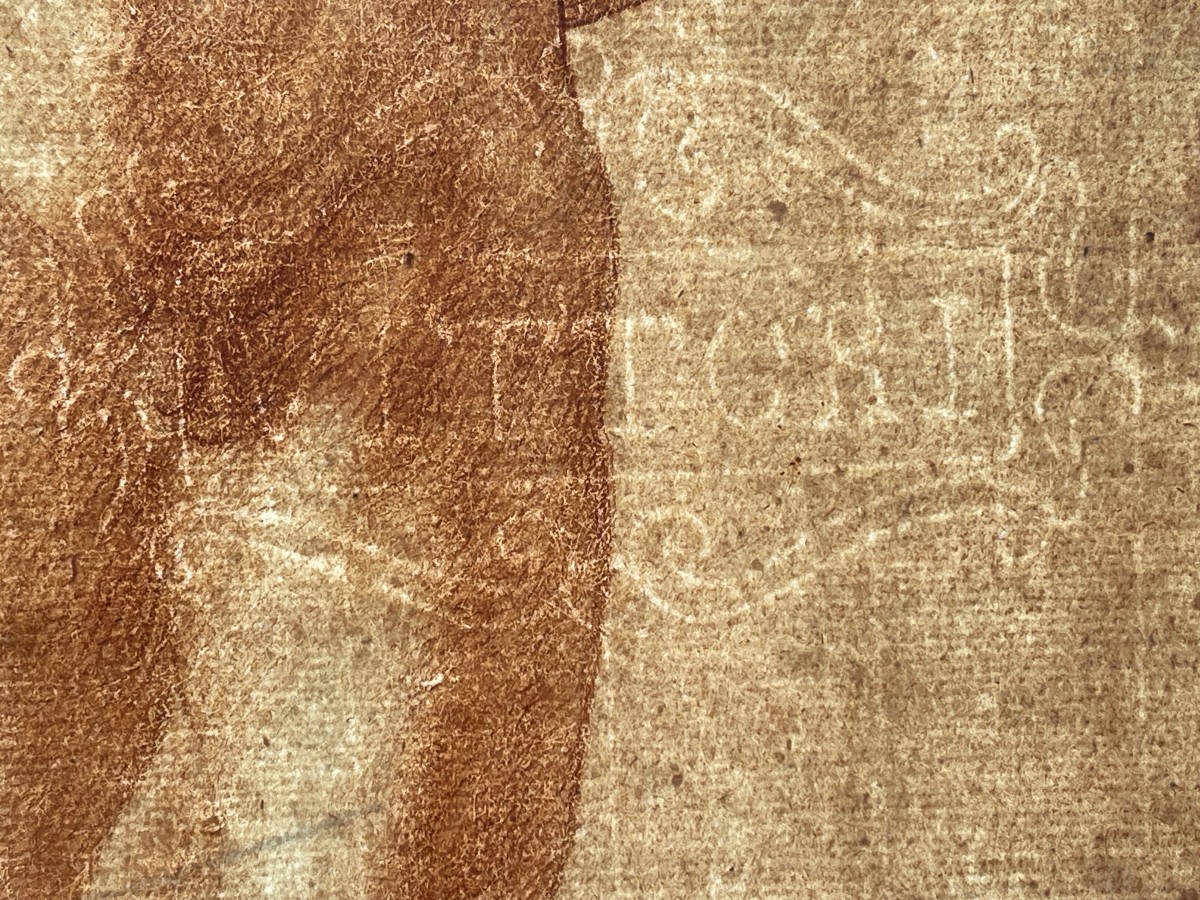

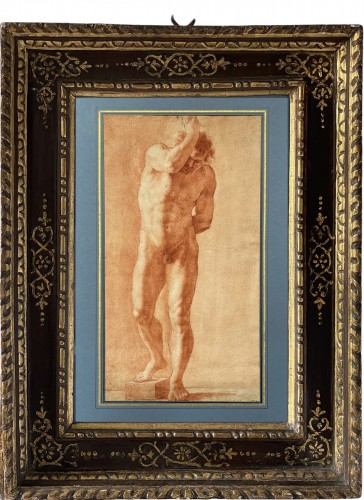
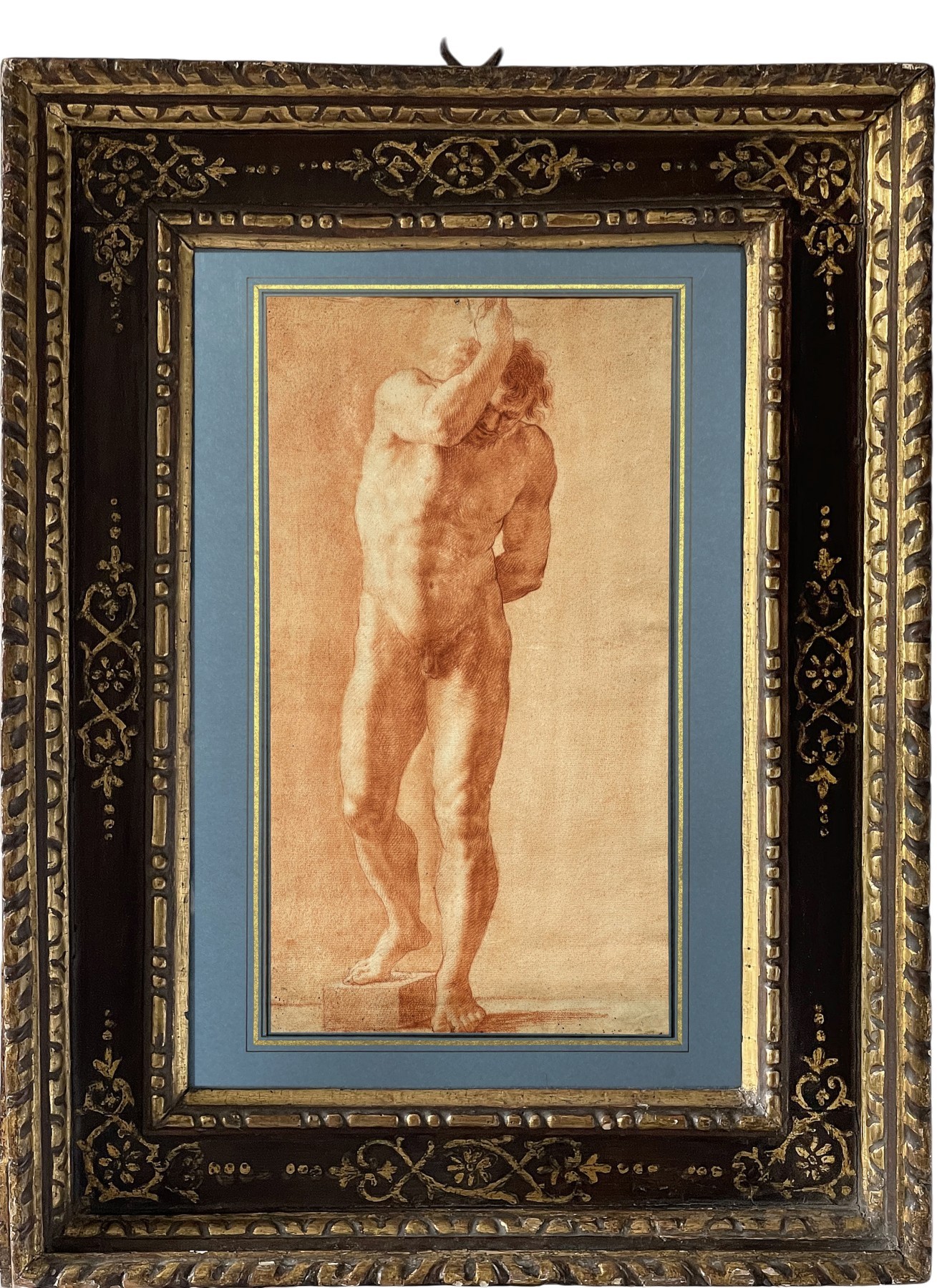
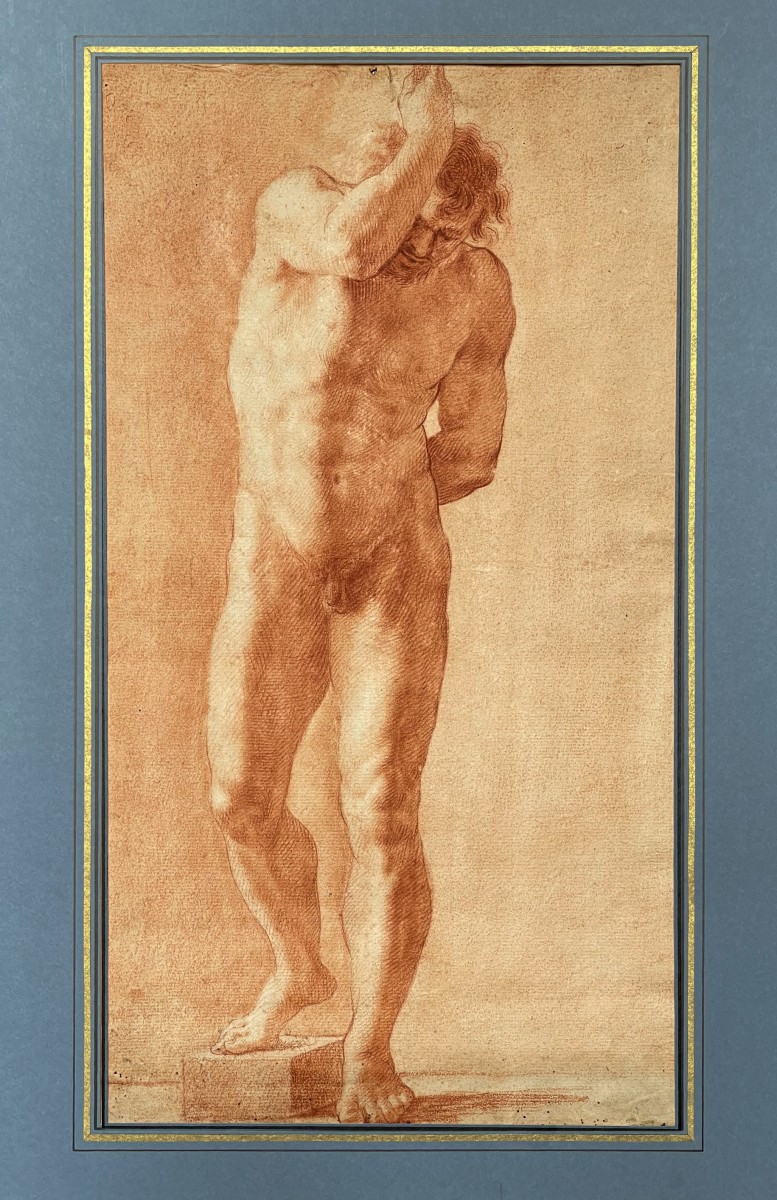
Red chalk drawing on watermarked paper “VITTORI”
Bologna, circa 1760–1780
Presented in a superb early 17th century Italian frame (so?called a cassetta) with its original hanging hook — a rare model!
Overall dimensions: 68 × 51 cm. Sheet alone: 44 × 24 cm
This study depicts a standing nude man, one foot resting on a block, the torso slightly inclined and the head lowered, partially concealed by the raised arm. The figure, captured in a pose that is both expressive and controlled, reveals a keen observation of the live model. The red chalk, applied with measured vigor, sculpts the volumes through broad, directional hatching and carefully constructed shadow passages. The musculature, powerfully modelled, unfolds in a warm light that enhances the physical presence of the body.
The whole demonstrates a deep understanding of anatomy and a search for monumentality that goes beyond a simple academic exercise to achieve a true plastic affirmation.
In the second half of the 18th century, Bologna experienced an artistic renewal led by the Gandolfi family, heirs to the Bolognese tradition of the Seicento yet open to a more modern, expressive sensibility. Ubaldo Gandolfi, a major figure of this movement, stands out for the remarkable intensity of his drawings. His academies, often executed in red chalk, are characterized by:
• Powerful, volumetric modelling
• Strongly articulated muscular energy
• Dynamic, sometimes theatrical poses
• Broad, vigorous hatching
• A warm chromatic quality typical of Bolognese red chalk
These characteristics are fully present in the sheet offered here.
Attribution to Ubaldo Gandolfi
Several stylistic elements link this study to the drawn work of Ubaldo Gandolfi:
• The anatomical vigor, typical of his academies, where muscular masses are rendered with an almost sculptural intensity
• The construction of the modelling, based on broad, directional hatching that gives the body a strongly three?dimensional presence
• The expressive pose, combining tension and balance, frequent in the artist’s studio exercises
• The warm tone of the red chalk, used to exalt the plasticity of the body and reinforce the sense of relief
These elements clearly distinguish this sheet from the more restrained classicism of 17th?century Roman artists and place it within the late Bolognese tradition, in which Ubaldo Gandolfi occupies a central position.
This drawing is very likely an academic study after a live model, produced within the context of Bolognese artistic training. However, the quality of the line, the density of the modelling, and the mastery of the pose suggest that it is a finished study, perhaps intended to inform a more ambitious composition or to serve as a model within the workshop.
It testifies to the importance of drawing in the education of Bolognese artists and to Ubaldo Gandolfi’s virtuosity in conveying the expressive power of the human body.
The “VITTORI” Watermark
Papers bearing the VITTORI watermark come from papermaking workshops active in central Italy—mainly in the regions of Fabriano and Bologna—from the 17th to the 18th century. The Vittori family belongs to the tradition of major Italian papermakers whose production circulated widely among artists in Emilia?Romagna.
Vittori watermarks generally appear as:
• A name in capital letters (VITTORI, VITTORIO, VITTORIIS)
• Sometimes enclosed in a cartouche or accompanied by Baroque scrolls
• With a broad, clearly legible script typical of high?quality Italian papers
These marks are recorded in major corpora of Italian watermarks, particularly those associated with Fabriano.
Vittori papers were widely used by Bolognese artists in the 18th century, especially in drawing studios. They appear in sheets attributed to:
• Ubaldo and Gaetano Gandolfi
• Mauro Gandolfi
• Late Crespi
• And other artists of the Bolognese school
Their supple texture and slightly warm tone are particularly well suited to red chalk and academic studies.
The presence of a Vittori watermark is a strong material indication of an Italian—more precisely Bolognese—origin, within a chronological range from 1700 to 1780. In the case of a vigorously modelled red?chalk study, this type of paper significantly reinforces the hypothesis of an attribution to Ubaldo Gandolfi or his circle.
Ubaldo Gandolfi
Ubaldo Gandolfi occupies an essential place in the last great generation of Bolognese painters of the 18th century. Born in 1728 near Bologna, he trained at the Accademia Clementina, where he absorbed the legacy of the Carracci while developing a more luminous and elegant sensibility, nourished in part by a stay in Venice.
• Origins and training: from an artistic family, he studied drawing, anatomy, and composition with renowned Bolognese masters
• Career: active mainly in Bologna and Emilia Romagna, he produced frescoes, altarpieces, and mythological scenes, distinguished by expressive naturalism and formal clarity foreshadowing Neoclassicism
• Role in the Bolognese school: with his brother Gaetano, he helped maintain the prestige of this pictorial tradition at a pivotal moment in its history
• End of life: he died in 1781 in Ravenna, leaving a substantial body of work and an artistic lineage that continued his influence
Gandolfi combines late Baroque energy with a search for purity and balance that anticipates Neoclassical tendencies. This intermediate position explains his importance in the evolution of 18th century Italian painting.
Excellent condition! Sold with a certificate of authenticity.