Offered by Artimo
REQUEST INFORMATION
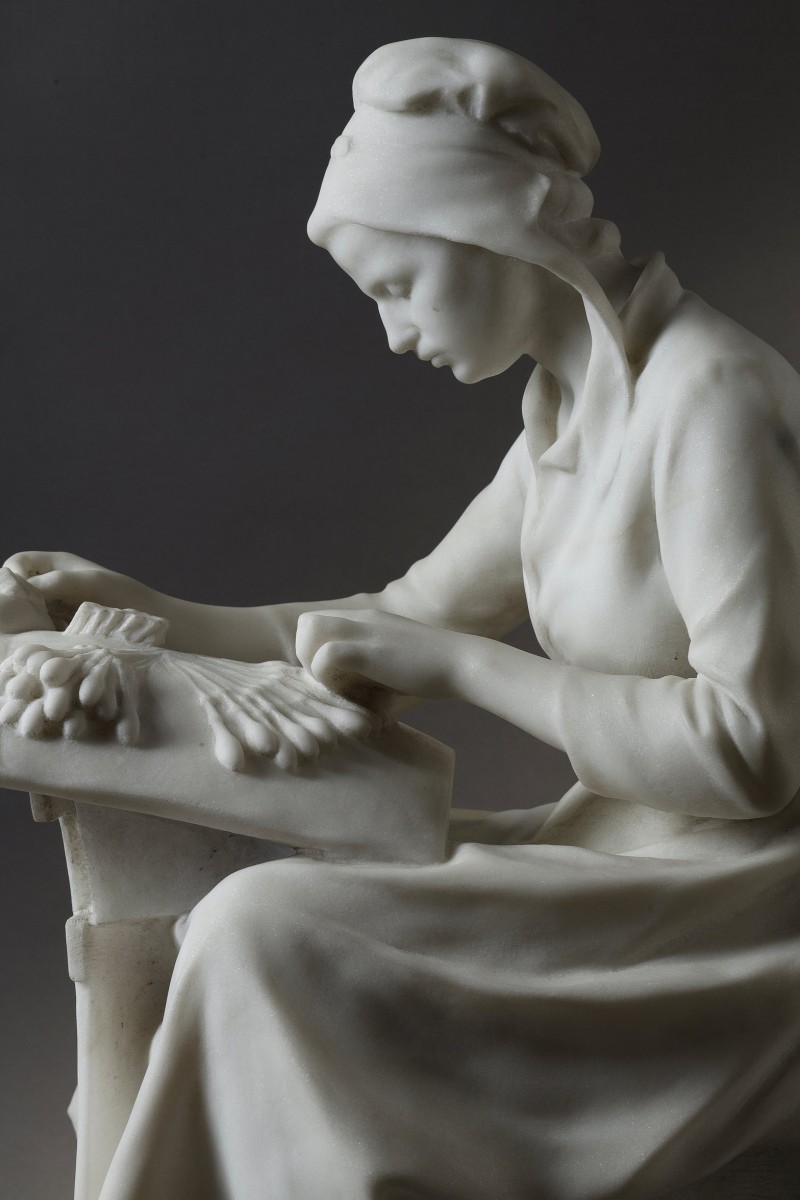
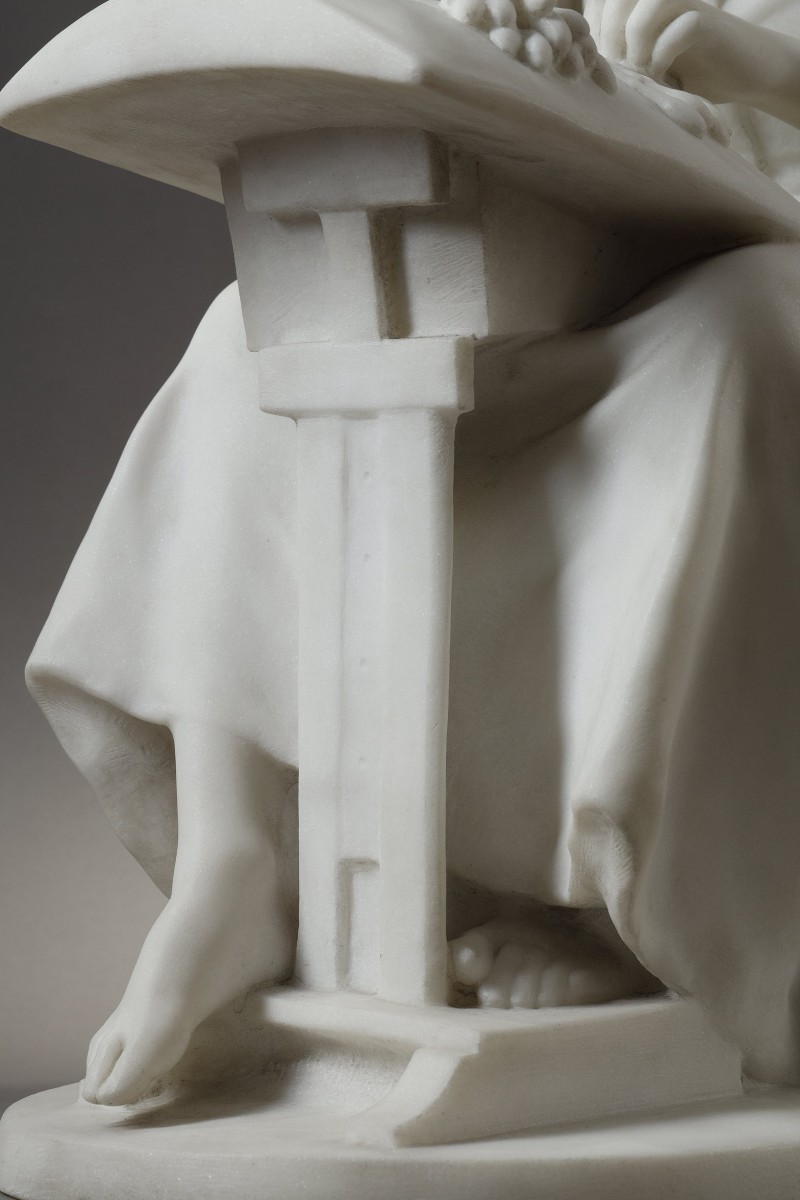
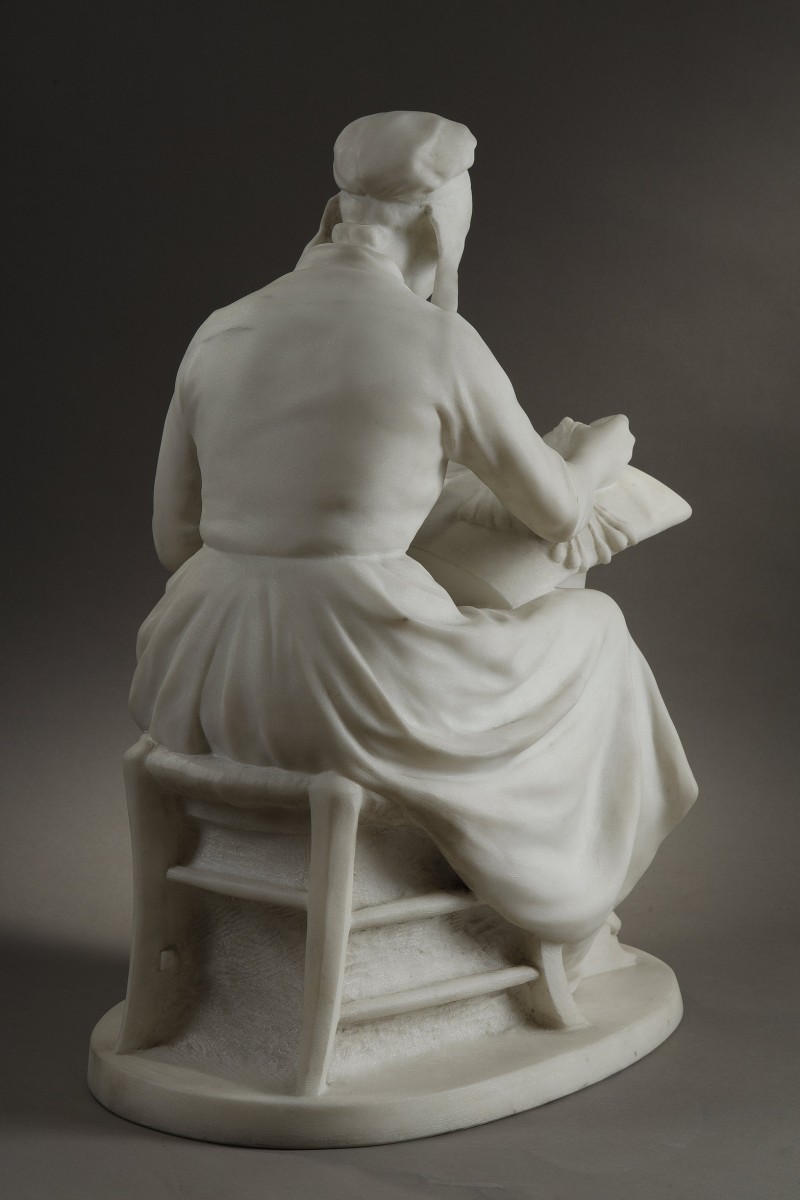

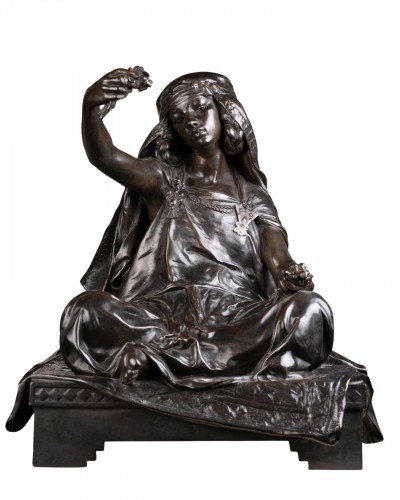
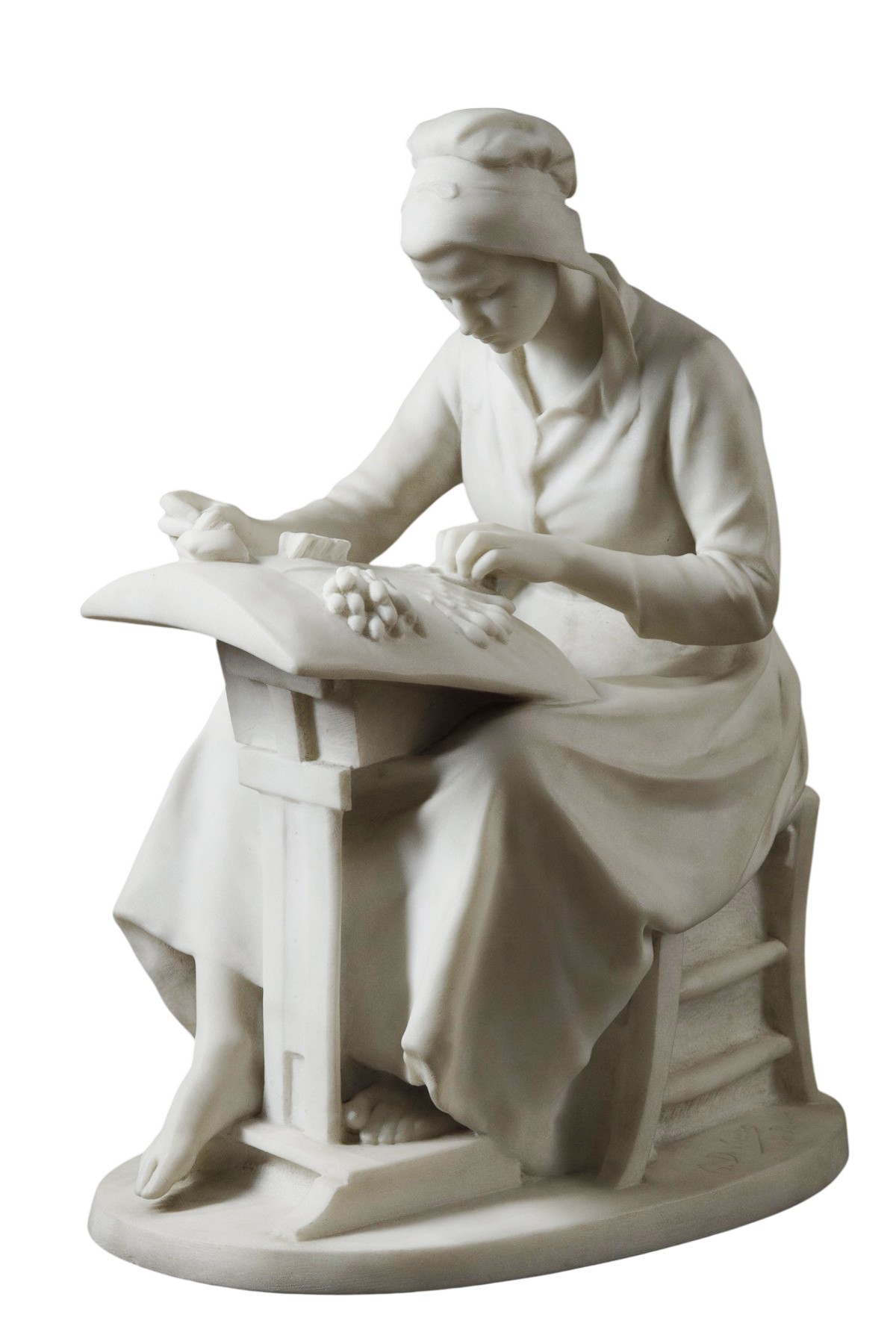
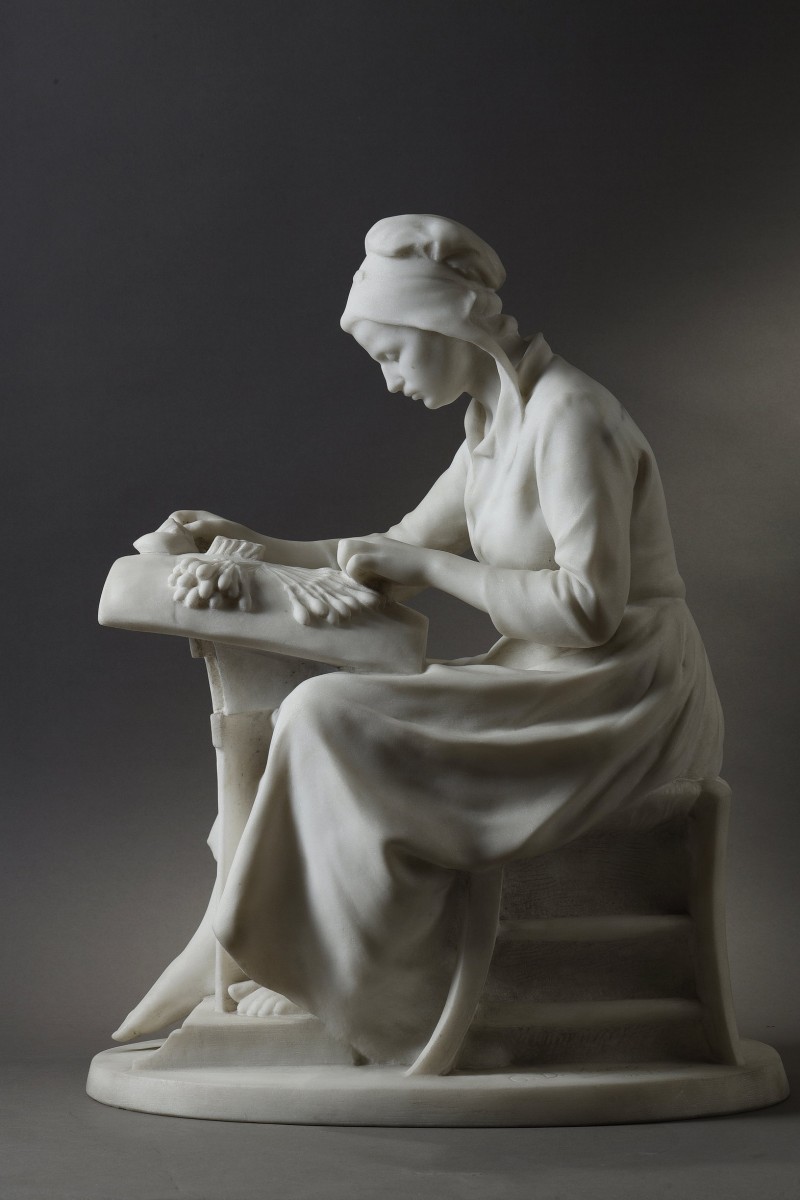
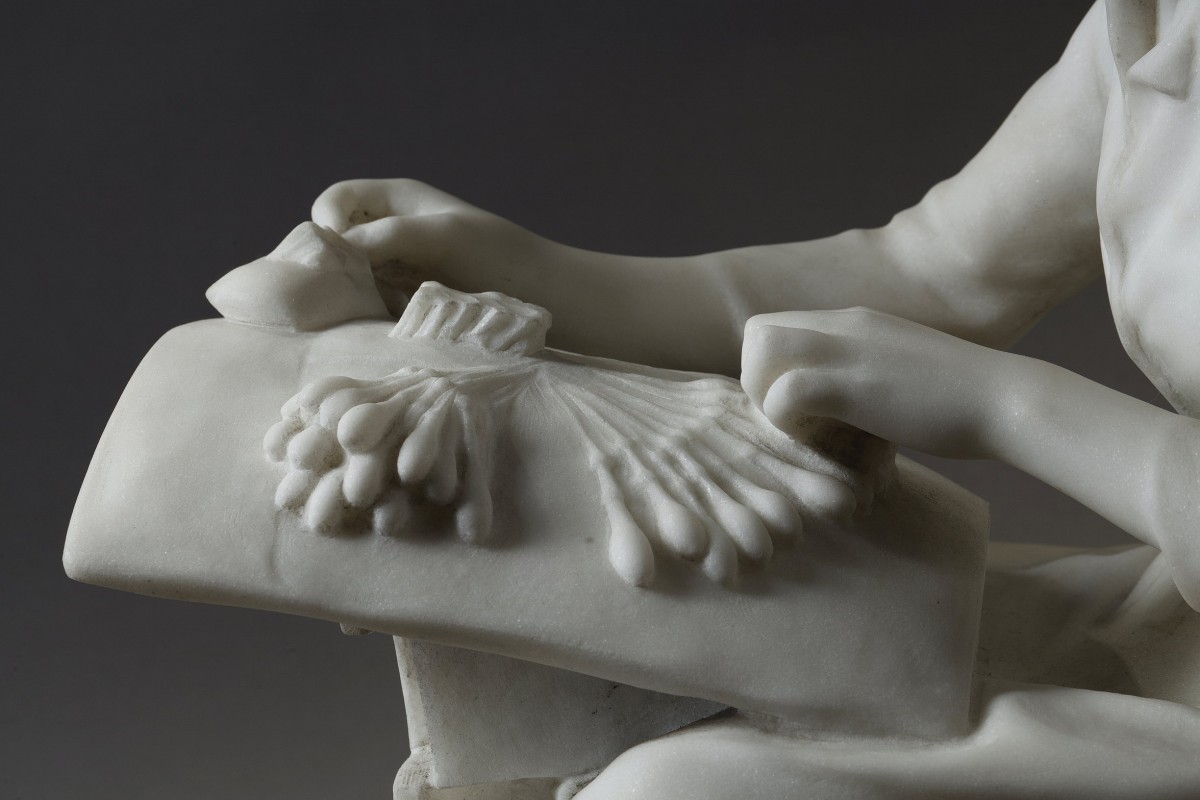
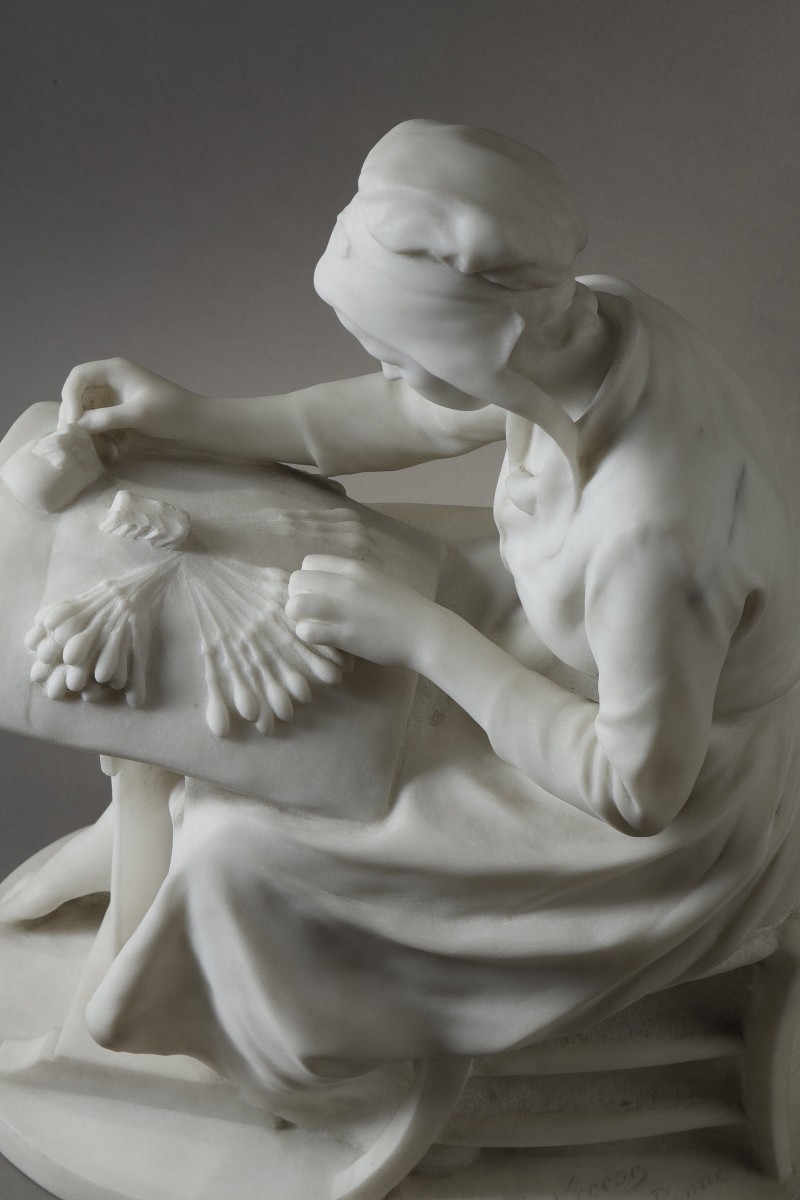
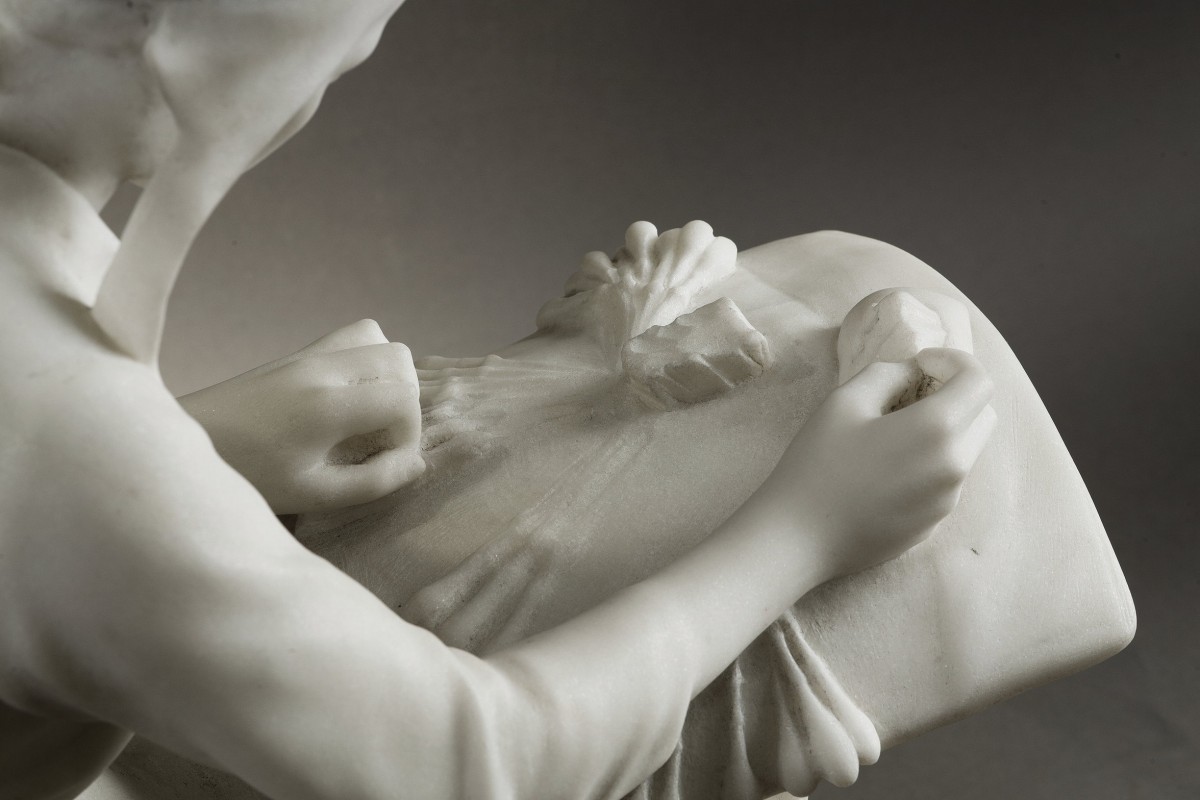
Presented in 1898, the work depicts a young woman absorbed in her task, her upper body inclined toward the cushion on which she meticulously weaves lace. Devreese captures the quiet grace of artisanal gesture, elevating the simplicity of manual labor to the dignity of a universal symbol: that of female work and inner concentration.
The original plaster (H. 55 cm), preserved at the La Boverie (inv. Sc 0359), bears the artist’s signature and corresponds to the model. Other versions are known: two uniface medals, one in gold and the other in silvered copper electrotype, produced between 1898 and 1899, are held at the Musée d'Orsay (inv. MEDOR 401–402, legend: Province de Brabant), as well as a bronze example acquired by the Museu Nacional d'Art de Catalunya during the 6th International Art Exhibition of Barcelona in 1911 (inv. 093157-N). All share the same composition: the lacemaker at work, a discreet symbol of an industrial and unified Belgium.
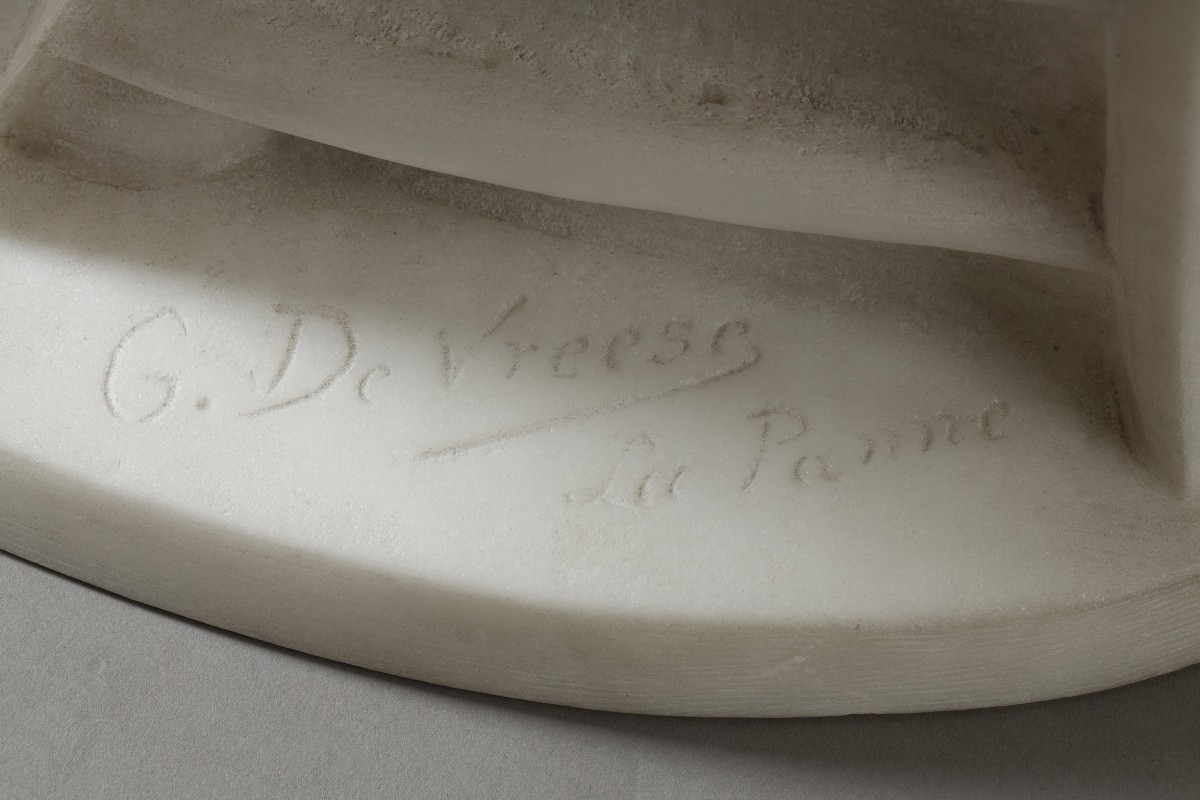
The inscription “La Panne”, engraved on the base of the present example, likely refers to the place where the model was created. Before 1900, Devreese also produced his “Fisherman of La Panne”, now held at the Musée d’Orsay (inv. RF 3205). The Lacemaker thus belongs to a Flemish cycle inspired by coastal light and everyday life, imbued with deep empathy for the working classes.
A comparative study of the sculpture and the medals suggests that Devreese conceived both versions simultaneously—not as adaptations, but as parallel explorations of the same theme in two distinct media. This approach reflects the artist’s dual identity as both sculptor and medallist, capable of bridging the rigor of bas-relief with the sensitivity of three-dimensional form. The Lacemaker perfectly embodies this productive tension—that of a poetic realism, where the most humble gesture becomes an act of creation.
Biography
Godefroid Devreese (Courtrai, 1861 – Brussels, 1941) began his training at the Academy of Courtrai before continuing at the Royal Academy of Fine Arts in Brussels from 1881 to 1886, where he studied under the sculptors Eugène Simonis and Charles Van der Stappen.
In 1884, he settled in Schaerbeek, where he lived until 1939. He travelled extensively, including to England, Spain, Italy, the Netherlands, and Paris. He gained recognition both as a sculptor and as a medallist, participating in numerous exhibitions and receiving many awards and honours. Considered in Belgium as a pioneer in the art of medal-making, he produced more than 400 medals.
Devreese collaborated with Victor Horta on several monuments. Horta also designed the plans for the studio Devreese occupied on rue des Ailes in Schaerbeek.
He also created a bronze vase (the “Vase des Bacchanales”) located on avenue Louis Bertrand in Schaerbeek, offered to the municipality by the patron Raoul Warocqué following the destruction caused by the fire at the town hall in 1911.
A street in Schaerbeek bears his name.
Delevery information :
Deliveries are offered in Belgium and Northern France.
All other deliveries are subject to a charge.