Offered by Desmet Galerie

Lorenzo Bartolini (1777-1850) and workshop
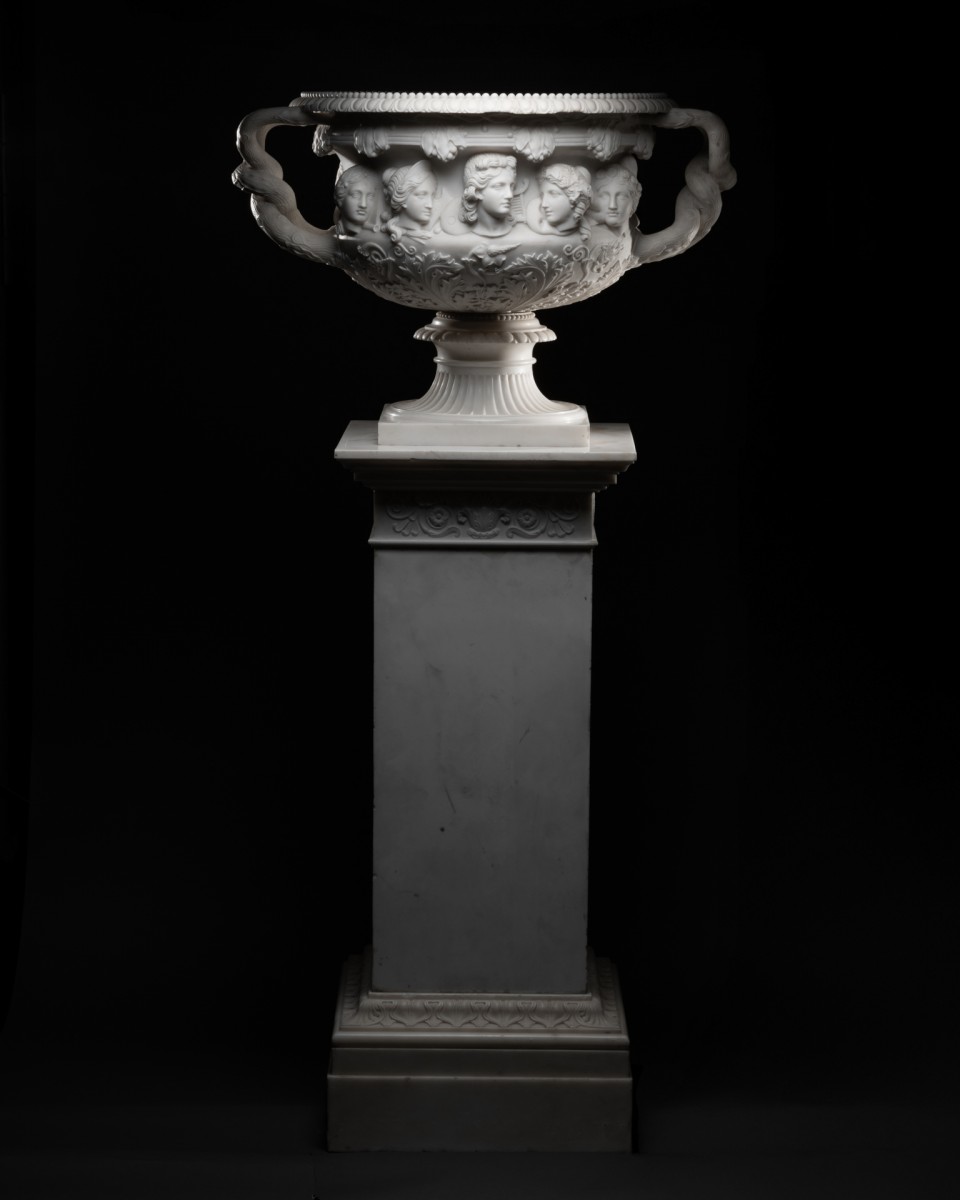
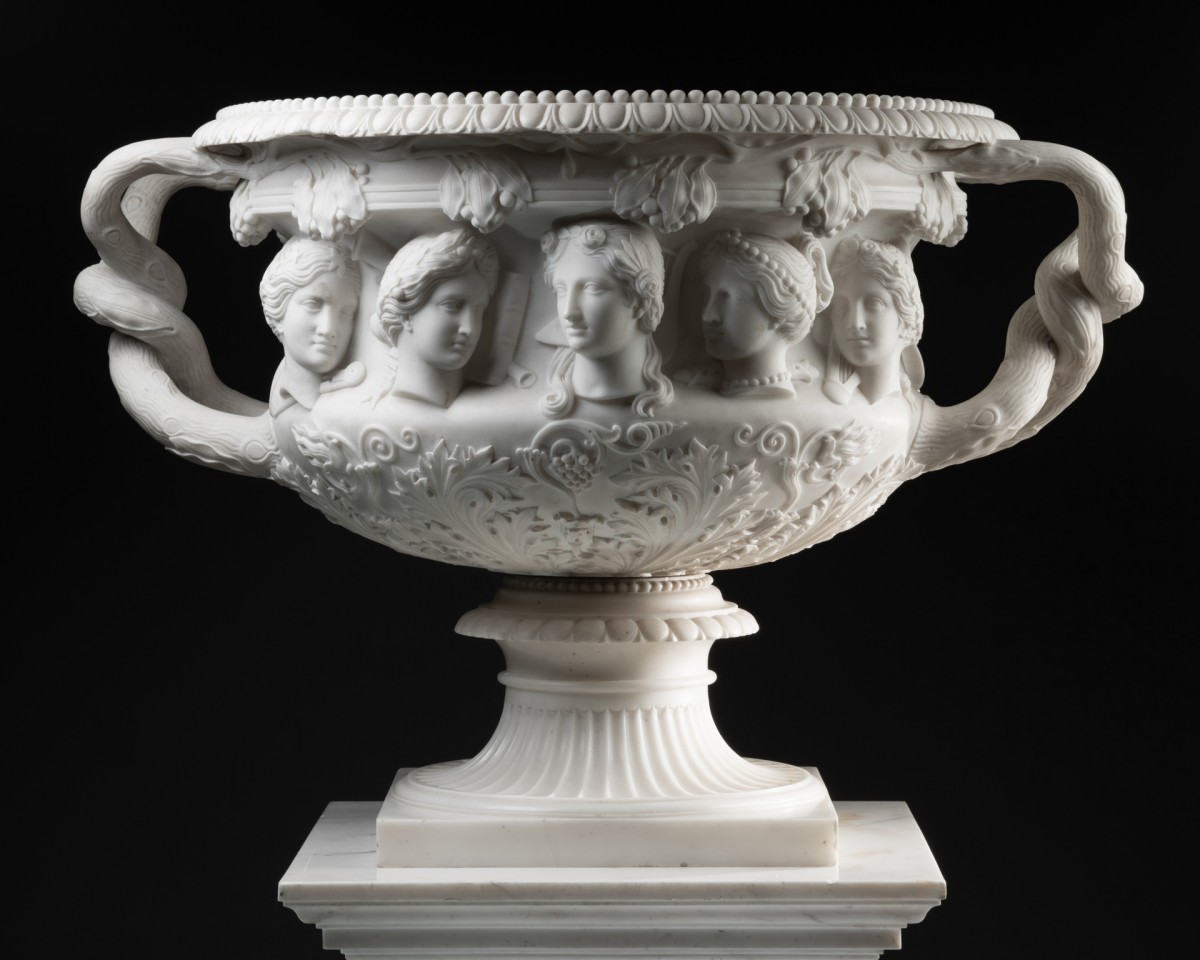
Warwick type vase: Apollo & the nine Muses
Carrara Marble
Florence, circa 1815-1830
Vase: H 51,8 x W 77 x D 58 cm
(20 2/5 x 30 1/3 x 22 7/8 in.)
Base: H 102,5 x W 55 x D 46 cm
(40 1/3 x 21 2/3 x 18 1/8 in.)
Total H: 154,5 cm / 60 4/5 inch
ART LOSS REGISTER: Ref; S00258864
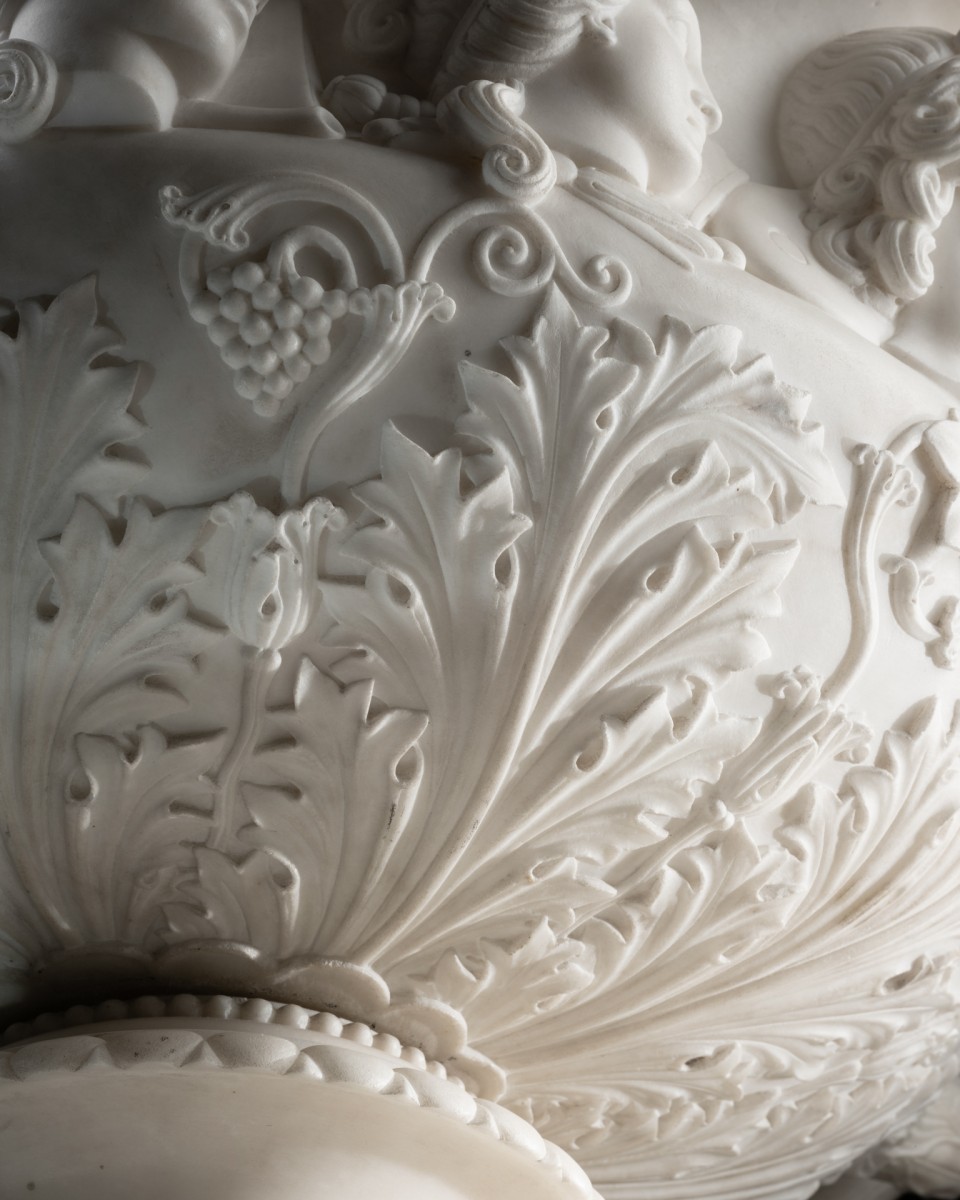
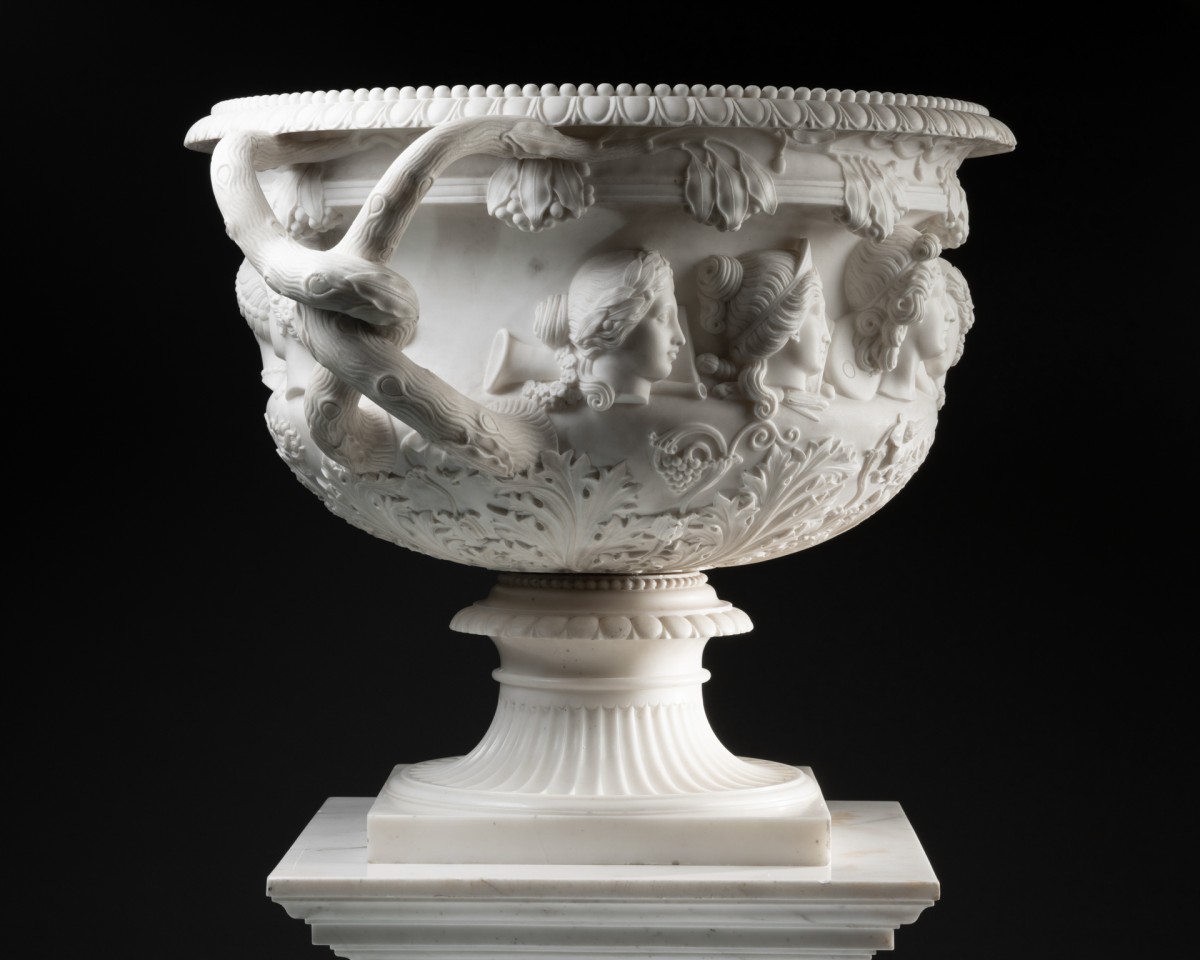
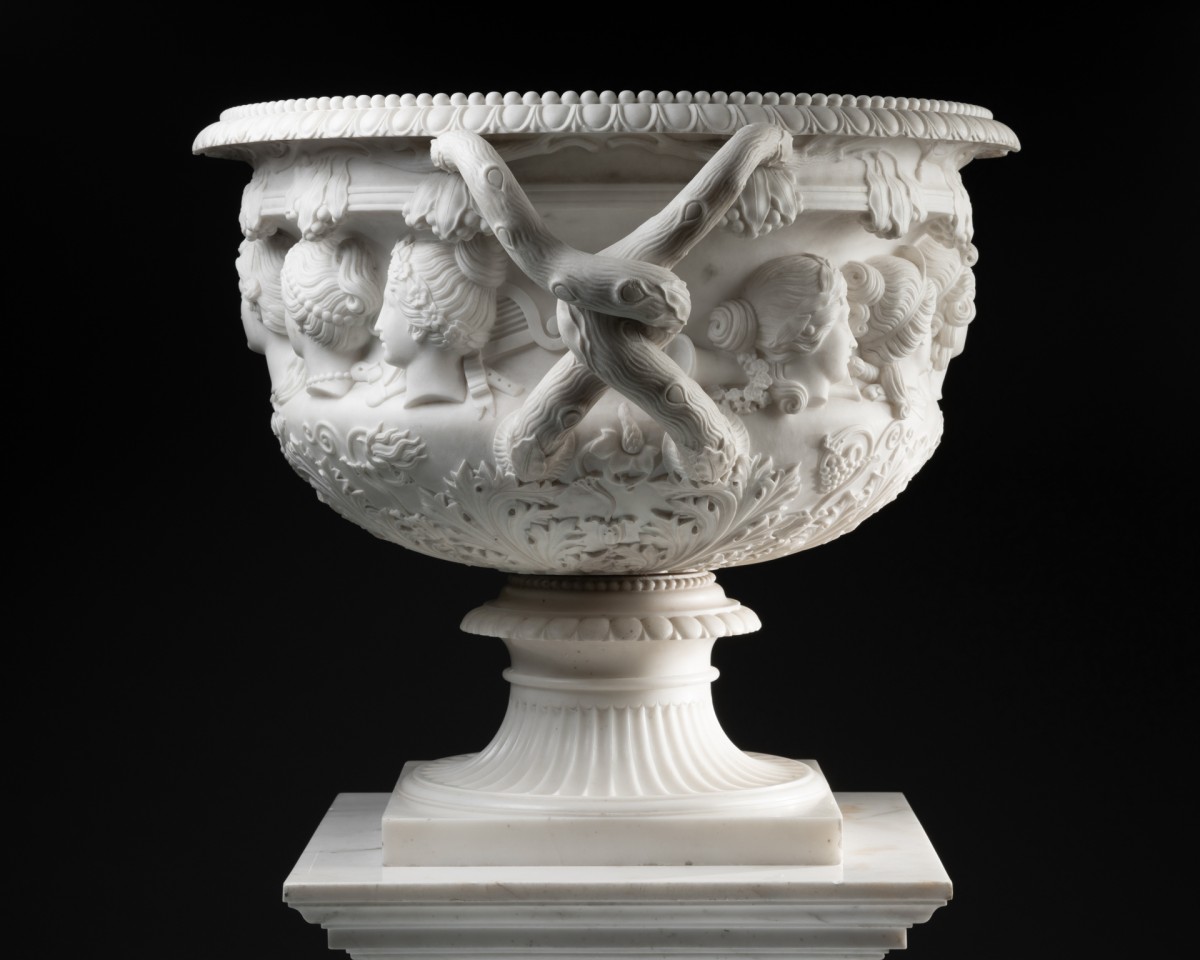
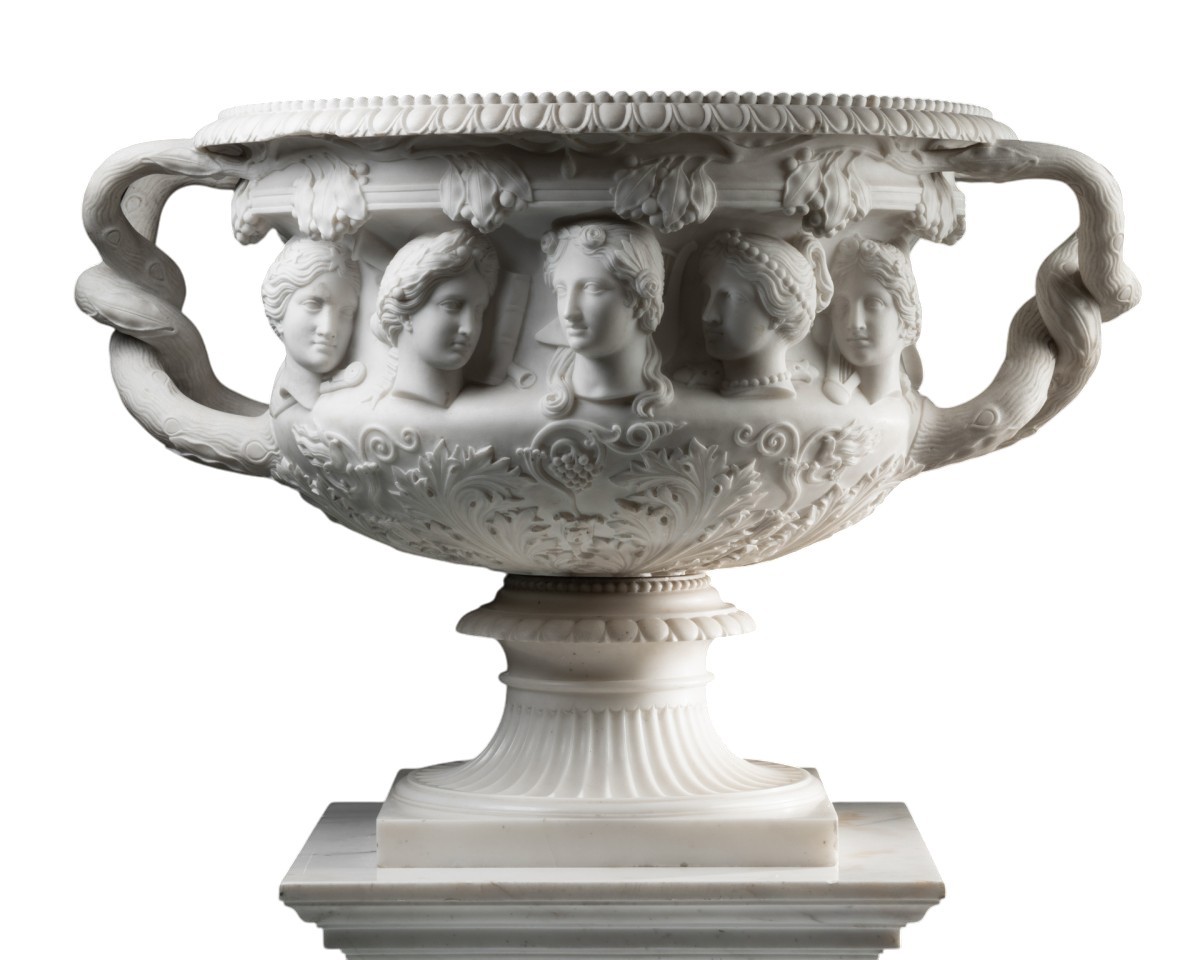
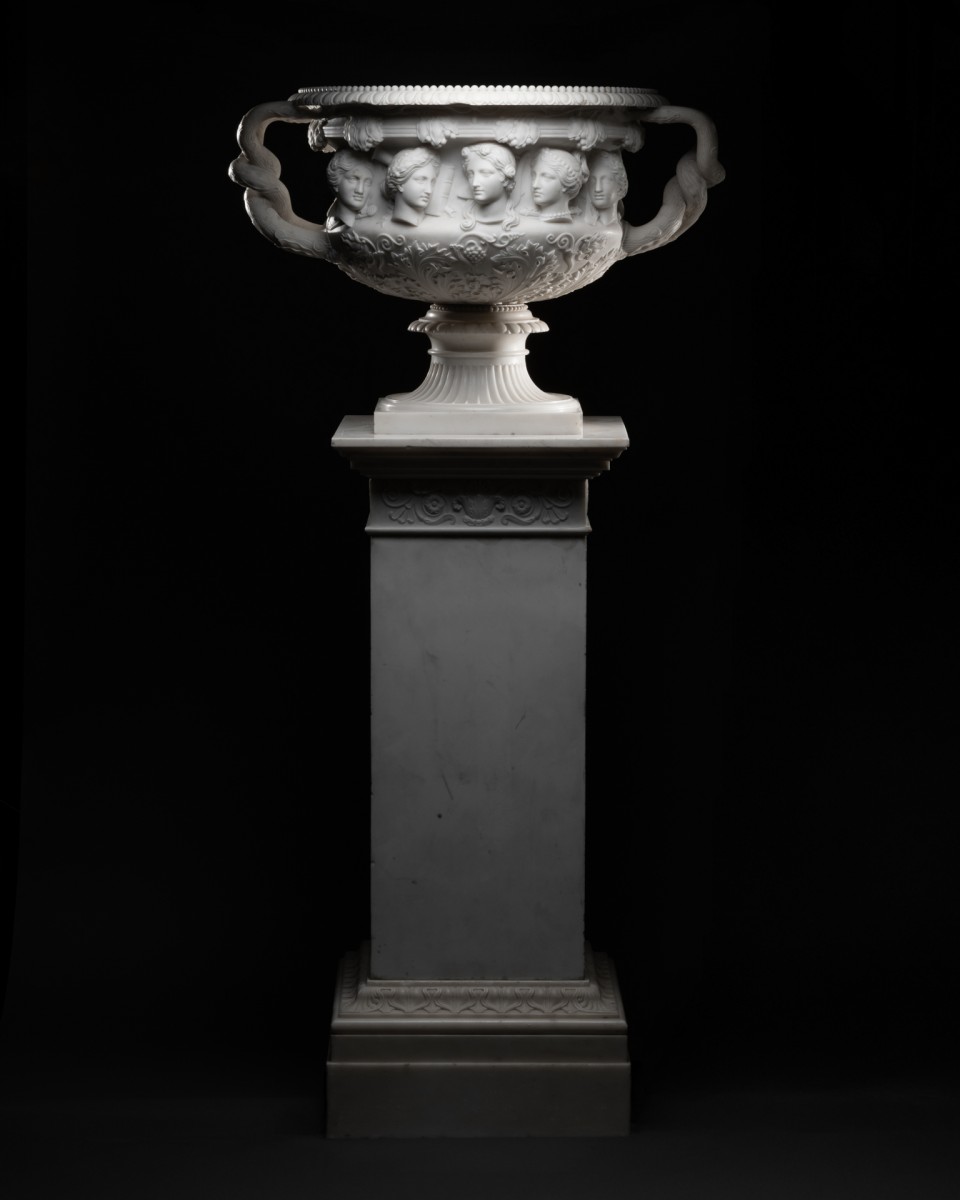
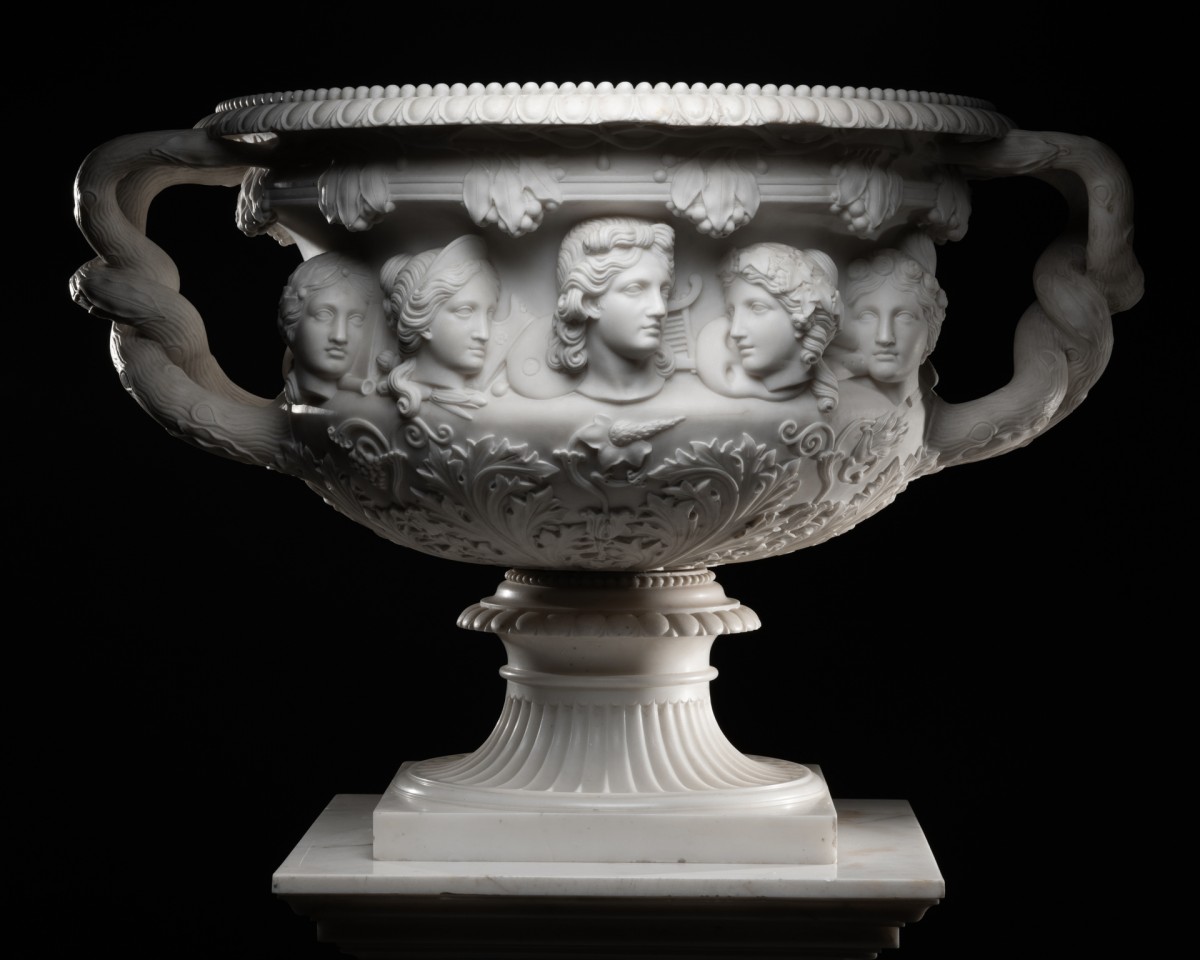
The present vase is an ambitious and exceptionally carved example of the Neoclassical enthusiasm for antiquity that flourished across Europe in the late eighteenth and early nineteenth centuries. Carved in pure white statuary marble, and raised on its original tall pedestal, it stands as a monumental reimagining of the famed Warwick Vase, the colossal Roman vessel discovered in fragments in the 1760s at Hadrian’s Villa near Tivoli. Like so many distinguished Florentine interpretations of the antique at the turn of the nineteenth century, the present work does not merely reproduce the ancient model but transforms it into a new, harmoniously ordered sculptural programme resonant with the intellectual and artistic aspirations of its age. The refinement of its carving, the sophistication of its iconography, and its consonance with securely attributed works by Lorenzo Bartolini (1777–1850) and his workshop together position the vase firmly within the sphere of Florentine Neoclassicism at its most elegant and inventive.
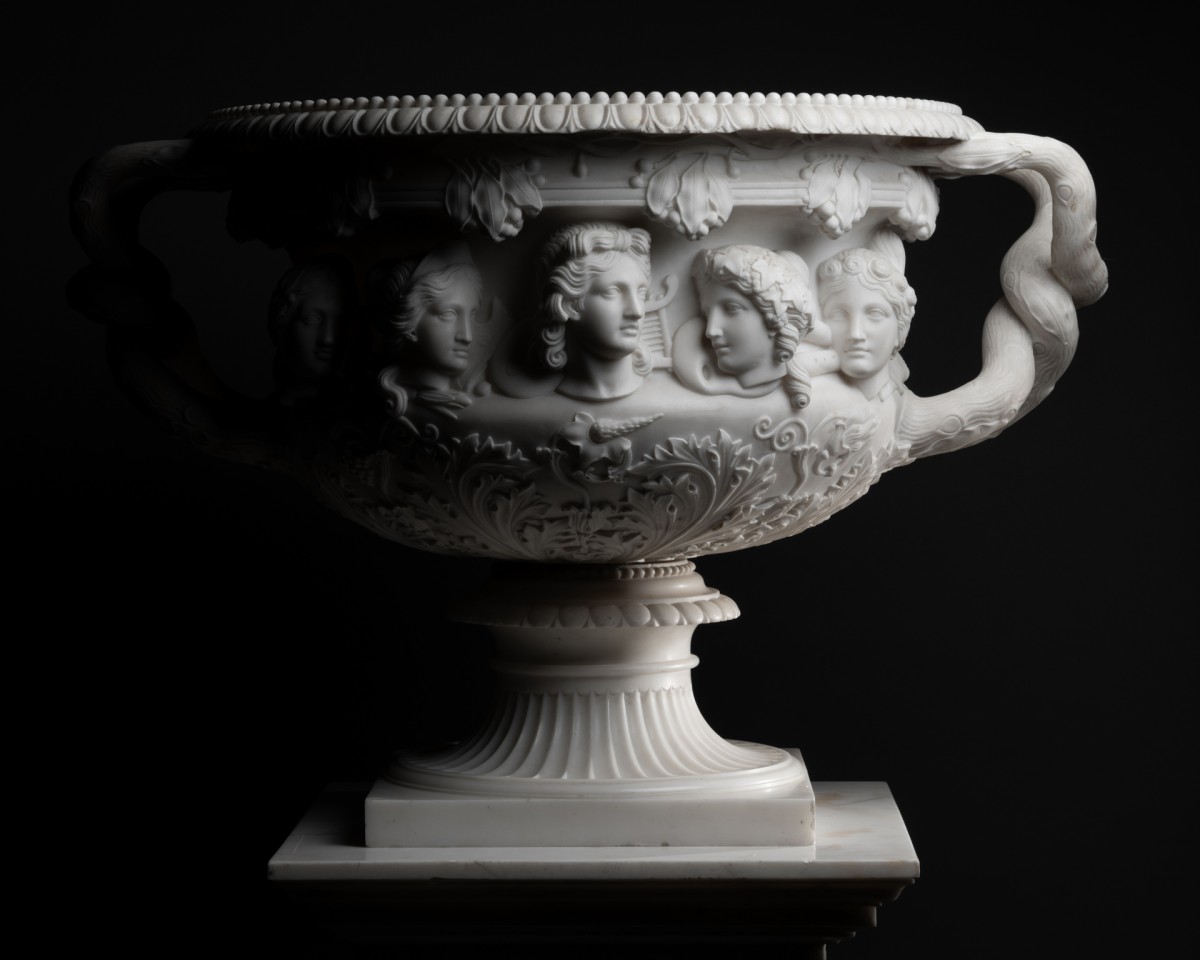
At first sight the silhouette of the vessel recalls the ancient crater form adopted by the Warwick Vase, with a deep, broadly swollen body rising from a ring of lush acanthus leaves and crowned by a thickened lip articulated with an alternating guilloche of tongue- and bead-like motifs. Yet the sculptor of the present work has refined this outline into something altogether more airy and linear. The foot is composed of a flared, gadrooned collar above a smooth torus moulding, the whole rising from the squared plinth of the pedestal. The pedestal is original to the ensemble and is conceived with the same rigor and refinement that characterise the vase itself. Its upper moulding is enriched with a lesbian kymation, the most elegant and fluid variant of the ancient Greek cyma repertoire. Distinguished by its alternating sequence of heart-shaped leaves and tightly sprung volutes, the lesbian kymatheion was prized in antiquity for its supple, almost calligraphic rhythm, and became a hallmark of Neoclassical architectural ornament during the late eighteenth and early nineteenth centuries. Its presence here is telling: unlike the stiffer egg-and-dart or bead-and-reel, the lesbian kymation is associated with works of higher ambition and a more scholarly engagement with Greek precedent. The crispness with which each leaf is undercut, and the precision of the curling volutes, correspond closely to the ornamental vocabulary found on the pedestals linked to Bartolini’s workshop - most notably those accompanying the Forbes of Pitsligo vases - and reinforce the impression that both vase and pedestal emerged from the same Florentine milieu, where architectural discipline and sculptural finesse were held in equal esteem.
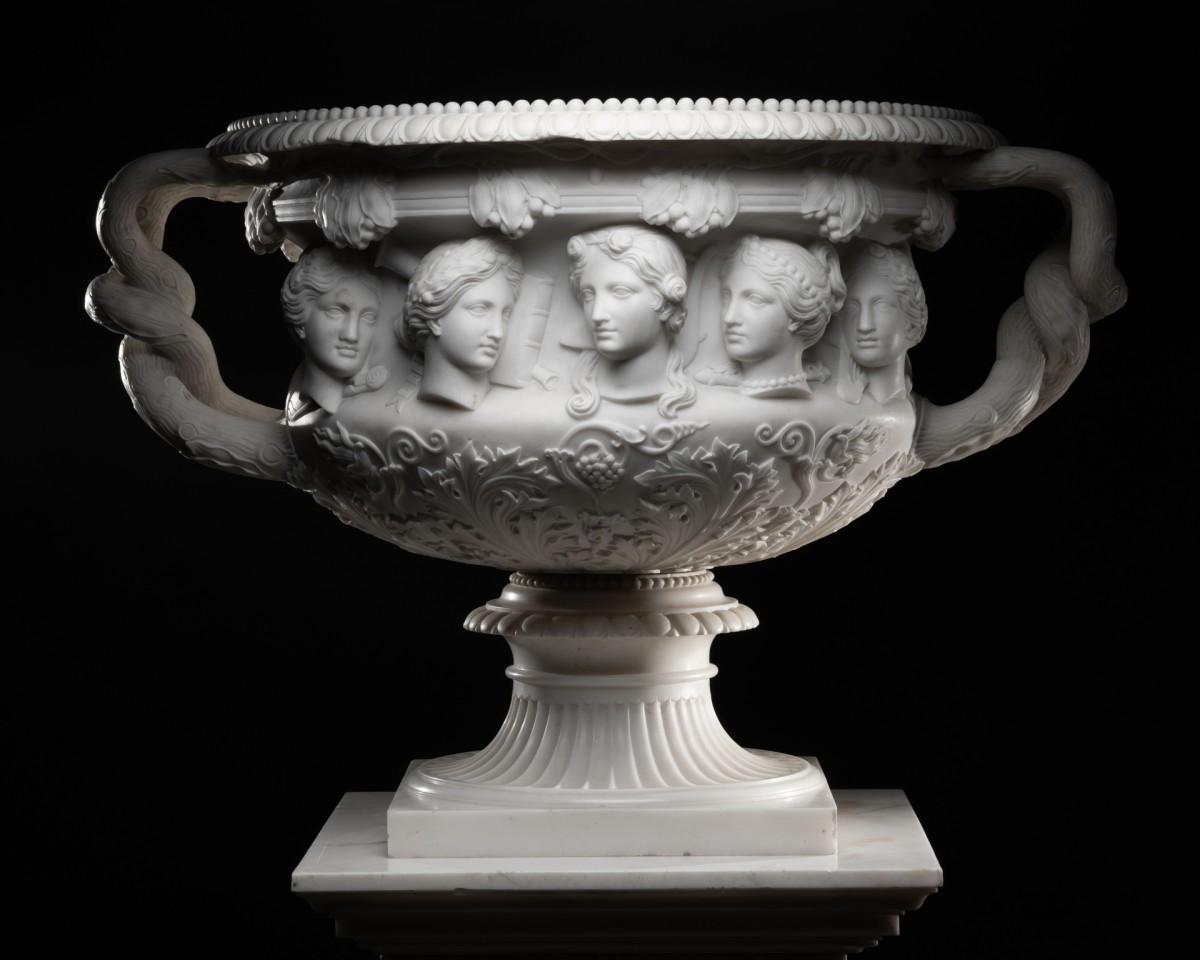
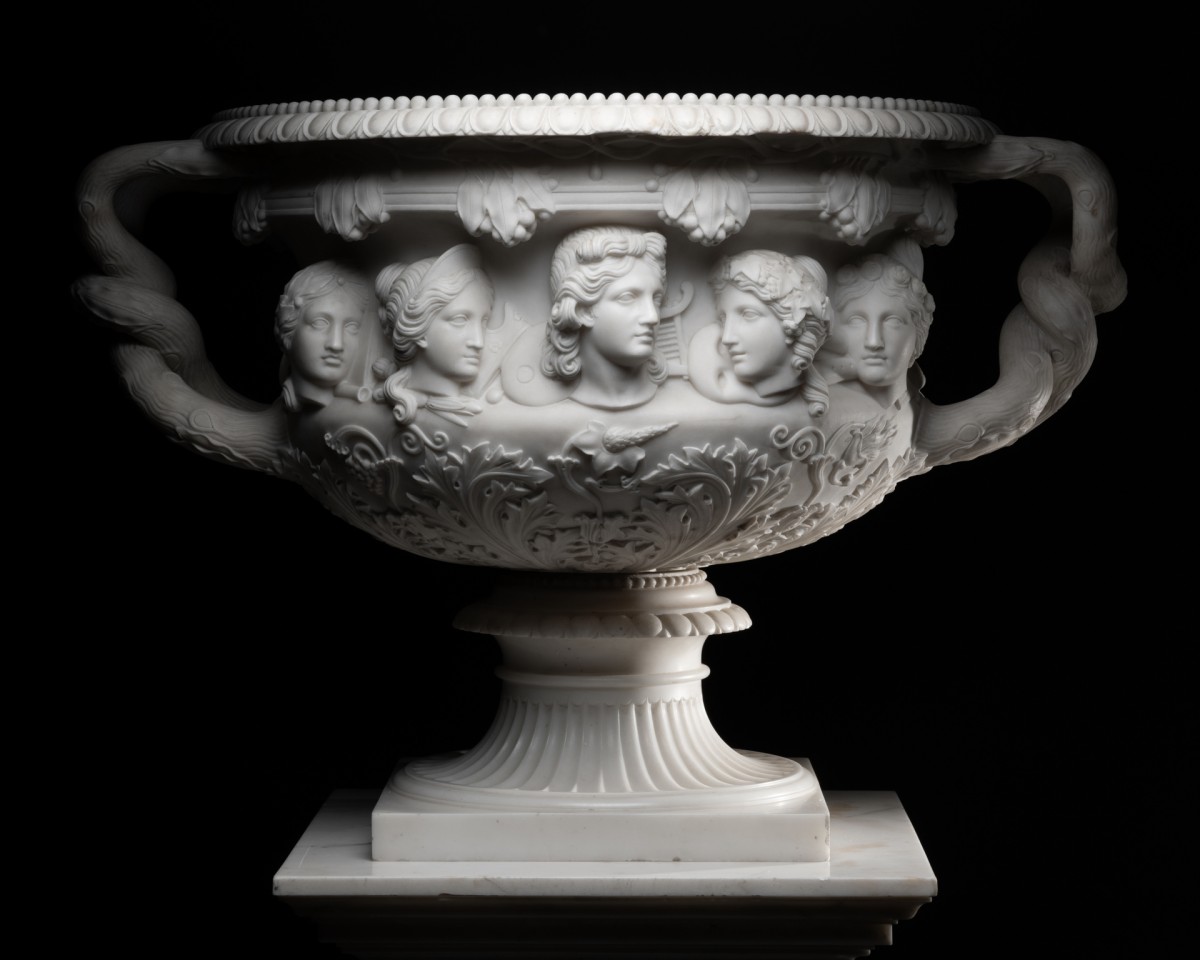
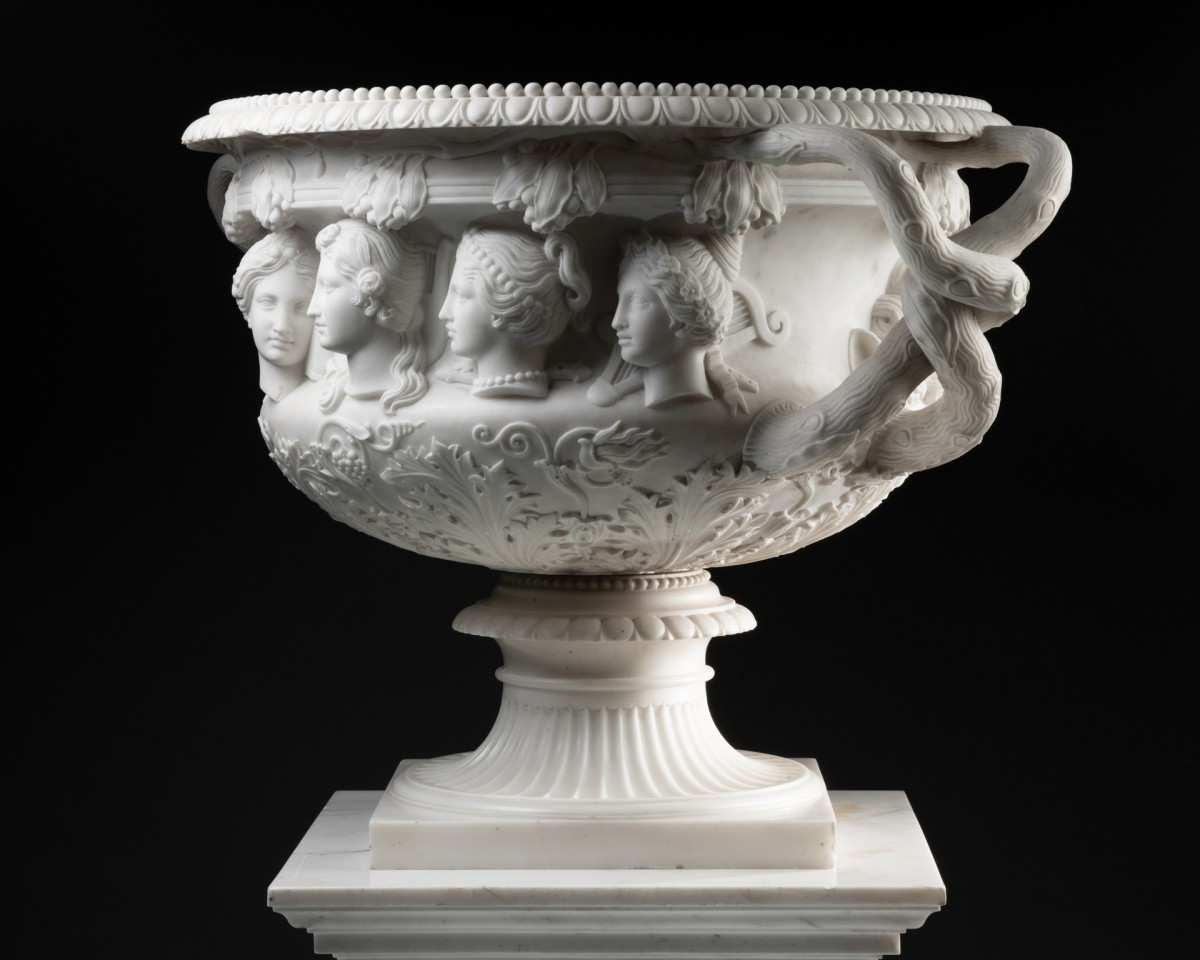
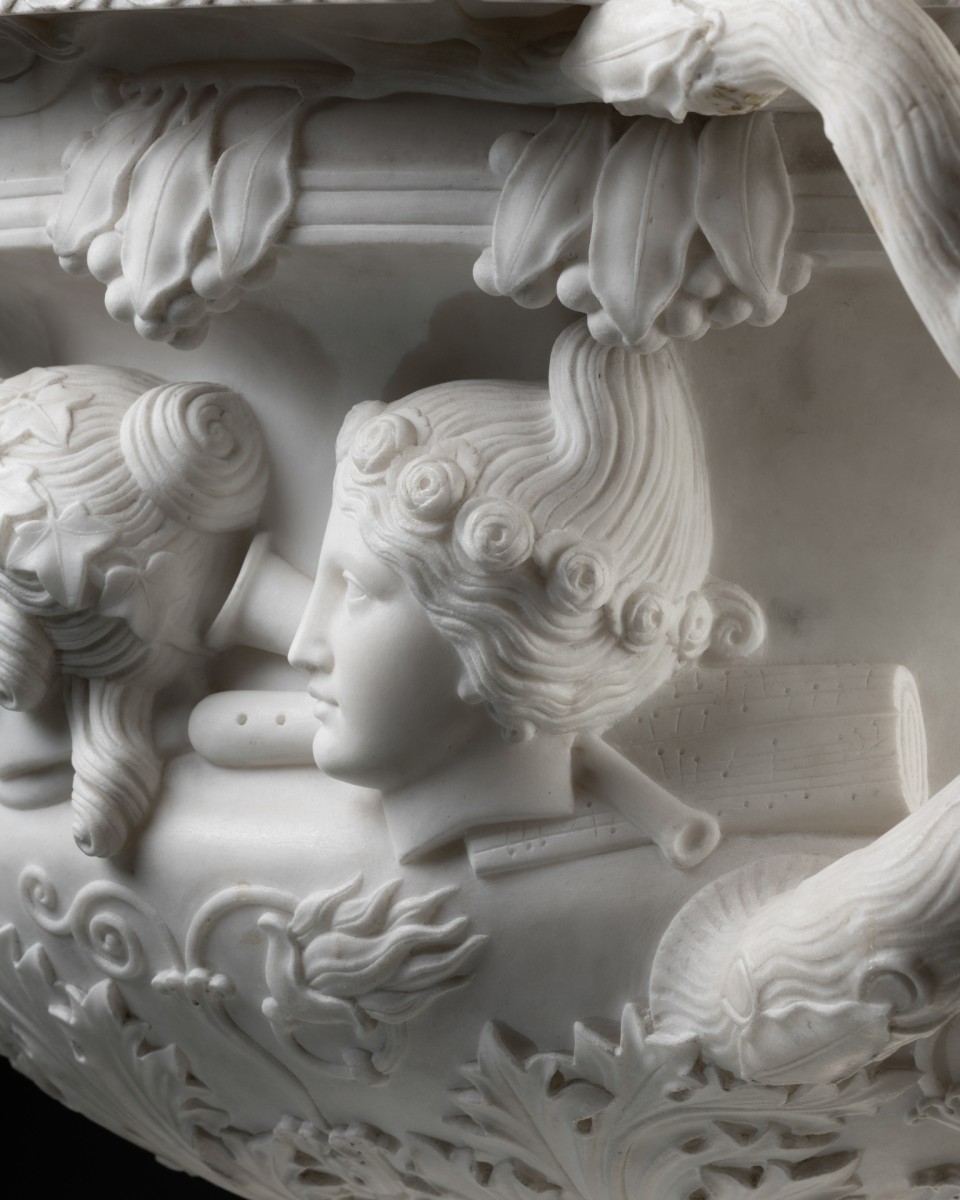
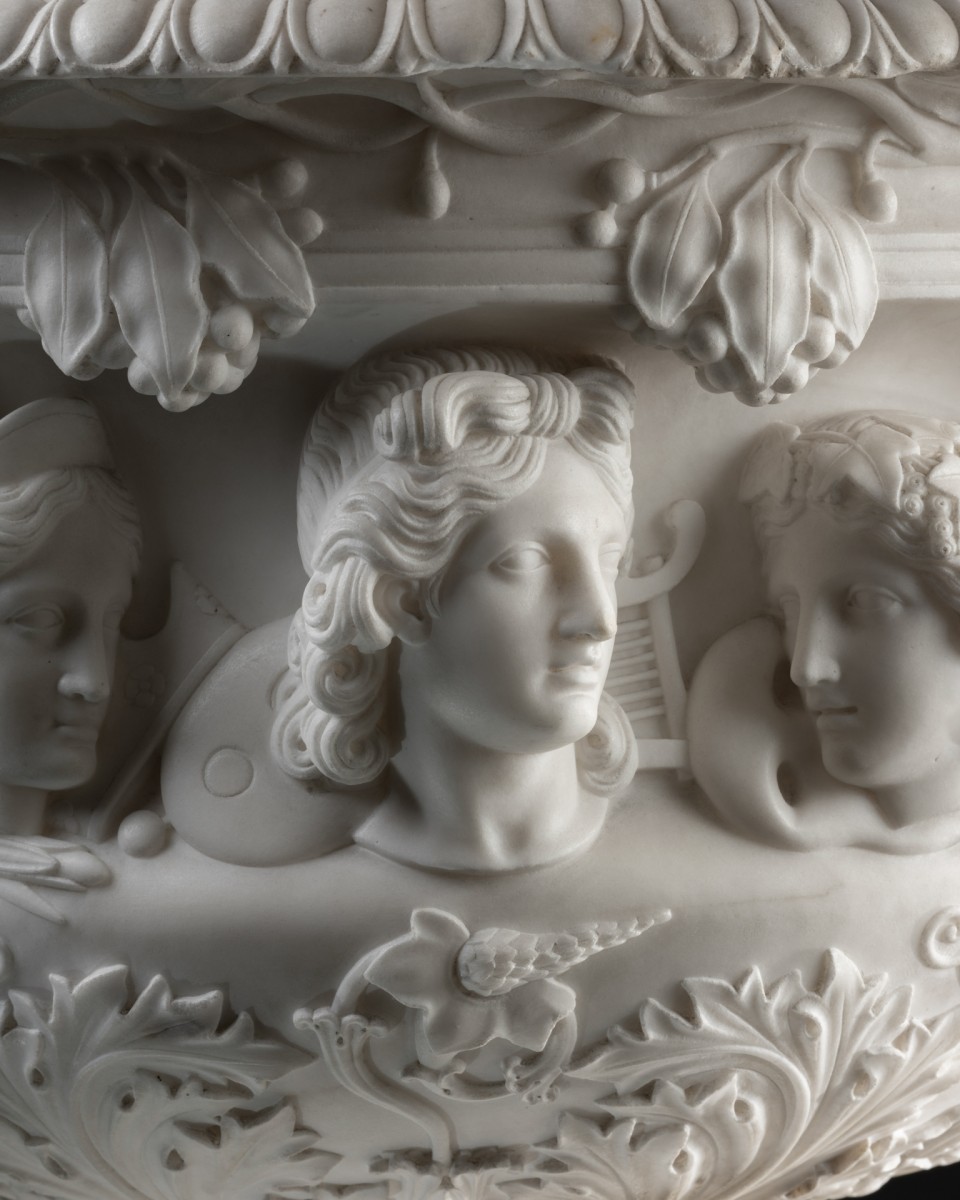
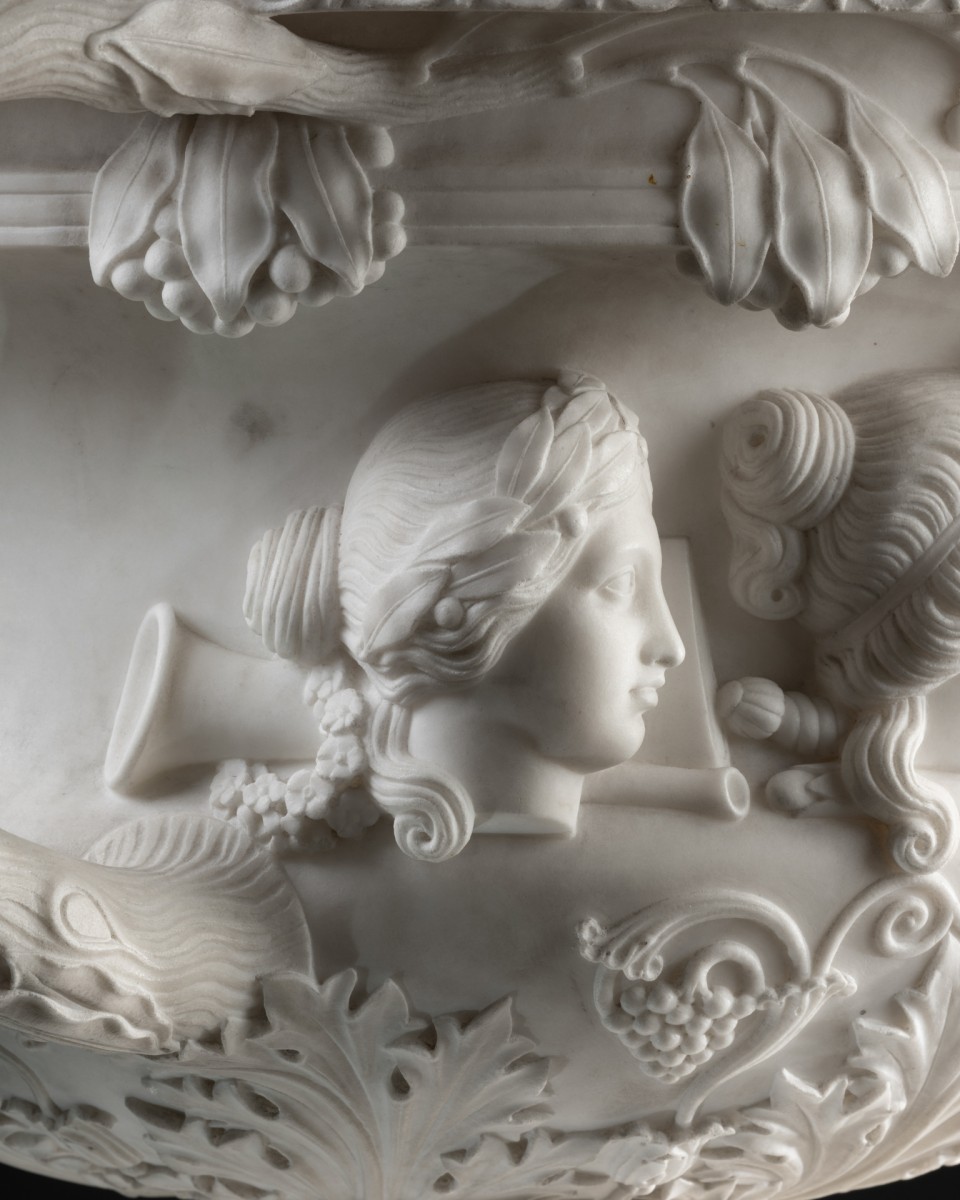
The dominant sculptural feature of the vase, however, is the astonishing frieze of heads encircling its body. Whereas the ancient Warwick Vase displays a procession of heavily bearded Sileni and mask-like visages that evoke Bacchic revelry, the carver of the present example has created a serene, idealising procession of youthful male and female heads, each accompanied by attributes emblematic of artistic endeavour. This departure from Dionysiac antiquity towards Apollo and the Muses was already anticipated in the Pitsligo vases, where the designer transformed the antique Bacchic cycle into a Neoclassical celebration of the liberal arts. The present vase adopts this same intellectual conceit and develops it further, arranging its figures in a sinuous, rhythmically balanced sequence: some crowned with laurel, others wreathed in flowers, others adorned with a simple band, necklace, or fillet, and one singled out by the radiance of stars in her hair. Their attributes - lyres, flutes, scrolls, torches, and musical tablets - allow each to be identified through the poetic tradition that associates particular emblems with the nine Muses and their divine patron Apollo.
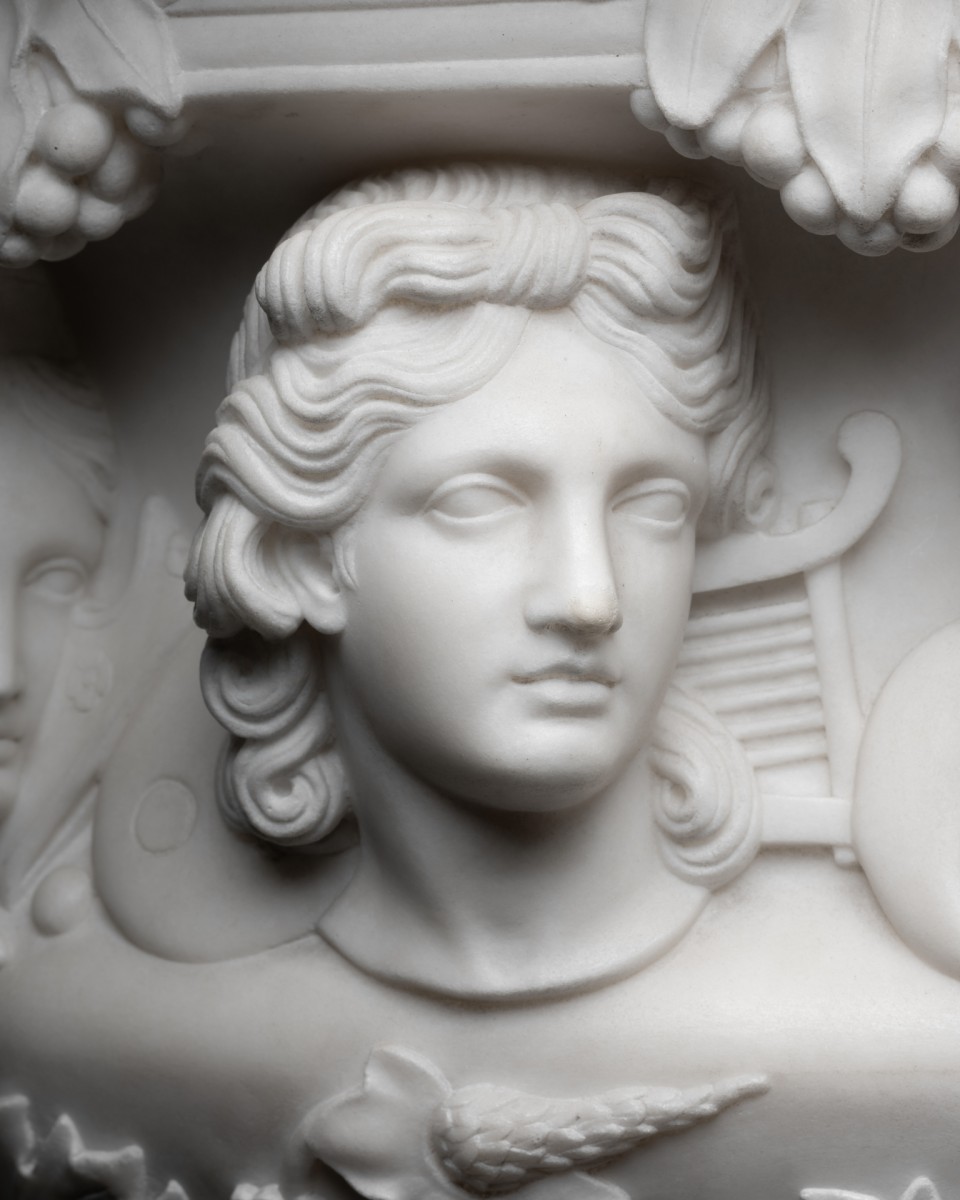
The central male head, distinguished by his youthful yet authoritative features, flowing hair, and the lyre positioned behind his shoulder, is almost certainly intended to represent Apollo Musagetes, the leader of the Muses. His physiognomy is characteristic of Florentine Neoclassical ideal heads: the smooth planes of the cheeks, the straight Grecian nose, the gentle articulation of the eyelids, and the elegantly modelled masses of hair all recall portraits from the Bartolini circle. The gaze is serene and unfocused, conveying not narrative tension but divine contemplation. Around him are arranged at least eight female companions, each a refined variant of the ideal female type cultivated in Tuscany during the early decades of the nineteenth century.
Among these, several can be plausibly identified. The figure with stars in her hair and a globe marked with scientific or celestial diagrams behind her shoulder is clearly Urania, Muse of Astronomy. Her calm, upward-tilted expression reinforces the celestial symbolism. Another, crowned with ivy leaves and accompanied by a lyre, corresponds to Erato, the Muse of lyric and love poetry. A third holds a scroll, indicating Clio, Muse of History, while another with a tablet incised with musical notation evokes Euterpe, Muse of Music. A figure with a floral wreath and a flute suggests Terpsichore or Calliope, depending on whether one emphasises dance or epic poetry; the sculptor here seems to have blended the iconographic attributes with a freedom typical of post-Piranesian Neoclassicism. The presence of these figures, each radiant with idealising beauty, imbues the vase with a metaphoric richness far beyond antiquarian reproduction. It is a philosophical vessel, celebrating the arts as harmonious emanations of divine order.
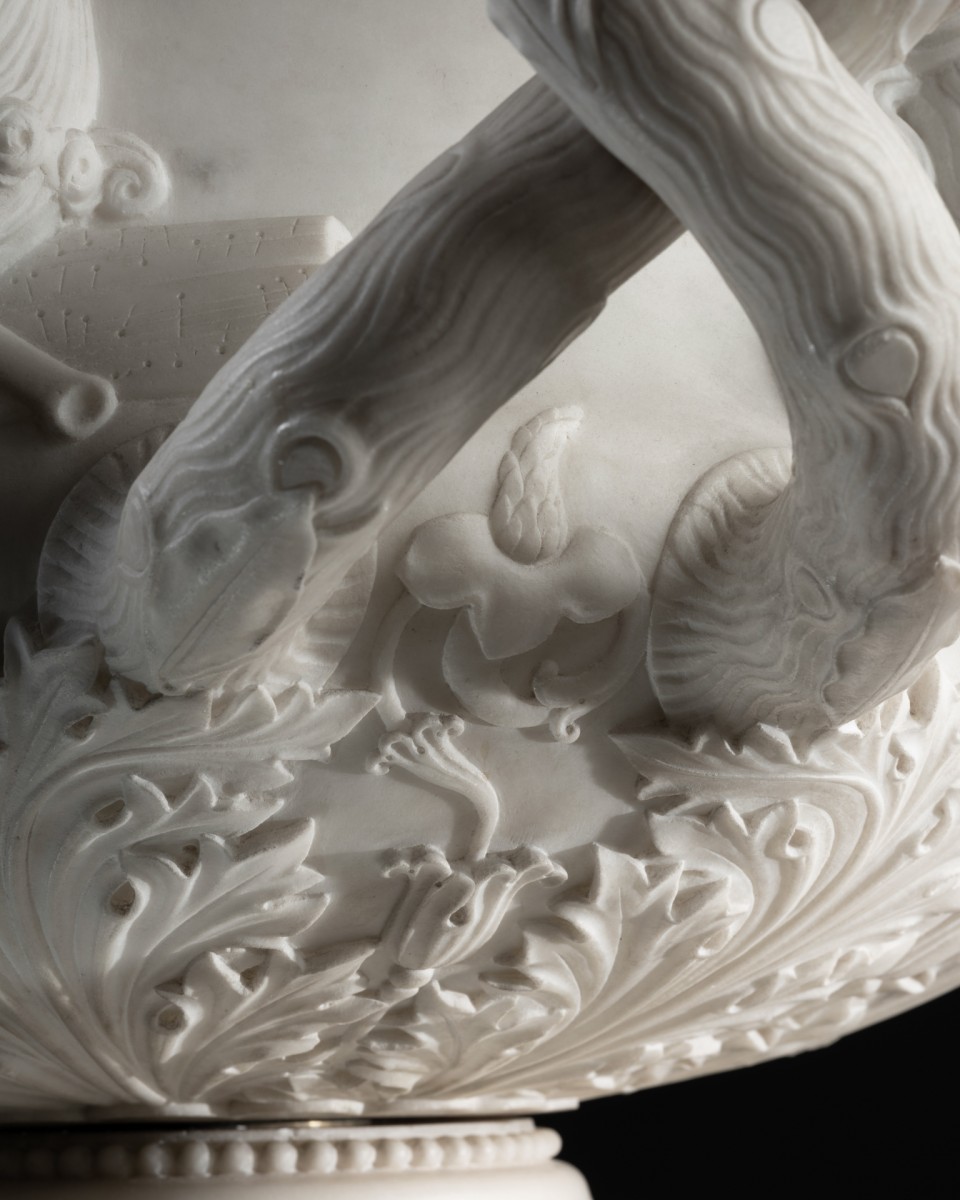
Below the heads unfolds a luxuriant zone of vegetal ornament associated in antiquity with abundance but reframed in the present context as a symbol of intellectual flourishing. Grapes, acanthus leaves, scrolling tendrils, and small flames - possibly alluding to the light of inspiration - animate the lower register. The acanthus, in particular, is carved with extraordinary delicacy: each leaf is undercut, its tips precisely curled, its veins sharply incised, recalling the virtuoso carving of Bartolini’s documented ornamental work and matching closely the foliage on the Pitsligo vases. The technical finesse is characteristic of Florentine studios, where specialised intagliatori were employed to articulate such botanical details to a jewelled degree of precision.
Perhaps the most striking ornamental innovation appears in the handles, elaborated as knotted, twisting wooden boughs whose sinuous lines encircle the upper body before looping back to the rim. Their surface is carved with a naturalistic grain, subtly undulating and gently polished, giving the impression of living wood transmuted into marble. This choice is at once organic and architectural: the handles appear almost structural, supporting the vessel while binding together its frieze of heads. Such serpentine, muscular handles bear close comparison with Florentine reinterpretations of antique forms recorded in the first decades of the nineteenth century, and they recall the “exceptional elegance and delicacy” that Sir Timothy Clifford has noted in ornaments associated with Bartolini’s workshop. Their technical sophistication - especially where the branches twist over one another, leaving undercut passages of surprising depth - further supports this attribution.
The upper border of the vase, composed of alternating ovules and darts, is crisply drafted and impeccably regular, the product of a trained studio hand deeply versed in architectural ornament. The same can be said of the anthemion frieze and mouldings of the pedestal. Comparable pedestals accompany the Pitsligo vases, which were attributed to Bartolini when exhibited by the Tomasso brothers and later sold in London. This correspondence strengthens the that the pedestal of the present vase is original to the ensemble and emerged from the same Florentine circle.
The relationship between the present vase and the Piranesian visual tradition deserves particular mention. Giovanni Battista Piranesi, commissioned by Sir William Hamilton to reconstruct the ancient Warwick Vase, produced engravings that became touchstones for later generations of sculptors. While Piranesi’s restoration emphasised muscularity, theatricality, and archaeological authority, the Florentine sculptors who followed adapted his forms to the refined sensibilities of the late Enlightenment and the early Romantic era. The present vase, in translating the Bacchic drama of the antique into a harmonious procession of Muses, exemplifies this transformation: antiquity is not merely revived but moralised, intellectualised, and aestheticised. This process, visible also in Paul Storr’s silver-gilt versions and in the bronze purchased by George IV, situates the present work within a pan-European dialogue where artists reinterpreted the antique according to contemporary ideals of beauty and virtue.
The stylistic consonances with the Forbes of Pitsligo vases are unmistakable. The treatment of the heads - their oval crania, straight noses, gentle mouths, and the deeply drilled pupils - matches the physiognomic style described in the Pitsligo examples. The handling of hair, alternating between tightly curled locks and wavy, ribbon-like strands, is identical in spirit. The ornamental vocabulary is equally close: the same palmettes, the same swirling acanthus, the same florid grape clusters appear here with comparable crispness. Even the composition - spacing of heads, integration of attributes, and positioning of vegetal ornament - follows the same studio logic. The present vase, however, distinguishes itself by an even more assured harmony of line and a greater refinement of detail, suggesting the hand of a leading modeller within the Bartolini workshop, possibly working for an elite international clientele in the late 1810s or 1820s.
Lorenzo Bartolini’s studio was renowned for its ability to reconcile an almost purist Neoclassicism with a softness and naturalism that anticipated later developments in Tuscan sculpture. In portraits, ideal heads, and decorative works alike, Bartolini fostered a manner that balanced clarity of contour with tender modelling, giving his figures a sense of inner life rarely achieved by stricter classicists. The heads on the present vase exemplify this quality: though idealised, they are not anonymous; they appear contemplative, alert, and individually characterised. Their surfaces are treated with a velatura - a soft, matte sheen - typical of Bartolini, which avoided the high polish favoured by Roman studios in favour of a more subtly light-absorbing finish.
The scale and ambition of the work further support an attribution to Bartolini’s workshop. Only a handful of Florentine studios at the time possessed the labour force and technical expertise required to produce such a complex object: the modelling of numerous heads, the translation of relief into deep carving, the integration of attributes, and the ornamental base all required coordinated, highly skilled hands. The Pitsligo vases, of comparable ambition and complexity, provide a direct precedent. The resemblance is not merely stylistic but conceptual: both vases reinterpret the Warwick model into a philosophical celebration of the arts, transforming antiquarian interest into a distinctly modern poetic statement.
As an object, the present vase would have appealed strongly to the cultivated connoisseurship of the early nineteenth century, particularly among British and European travellers undertaking the Grand Tour. The taste for such monumental reinterpretations of antiquity was widespread in aristocratic collections, as evidenced by the acquisition of similar vases by George IV, the circulation of Storr’s silver-gilt versions, and the keen interest of collectors such as Sir William Burrell. The present work, by virtue of its sculptural excellence and intellectual programme, fits seamlessly into this cultural landscape.
In conclusion, the present vase represents a distinguished and highly coherent work of Florentine Neoclassicism, fully consonant with the ornamental, technical, and intellectual traits of the workshop of Lorenzo Bartolini. Its exceptional quality of carving, its poetic reinterpretation of the Warwick Vase, and its close relationship to the Forbes of Pitsligo vases make it not merely a decorative object but a significant artistic statement. It stands as a testament to the creative vitality of early nineteenth-century Tuscany, where the antique was not merely copied but re-imagined, becoming a vessel - literally and metaphorically - for the ideals of beauty, knowledge, and artistic harmony.
Delevery information :
We can arrange shipping.