Offered by Cristina Ortega & Michel Dermigny
REQUEST INFORMATION
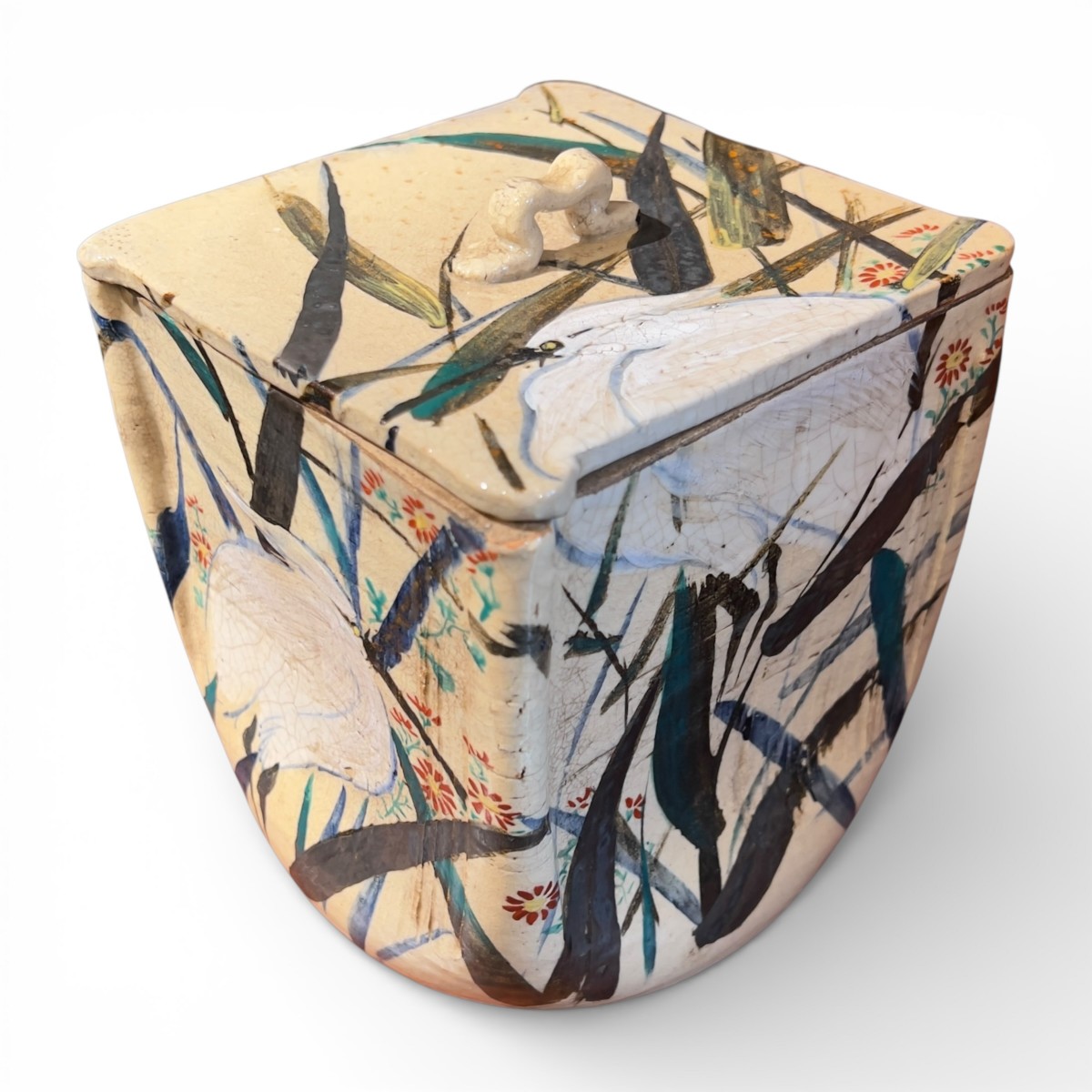
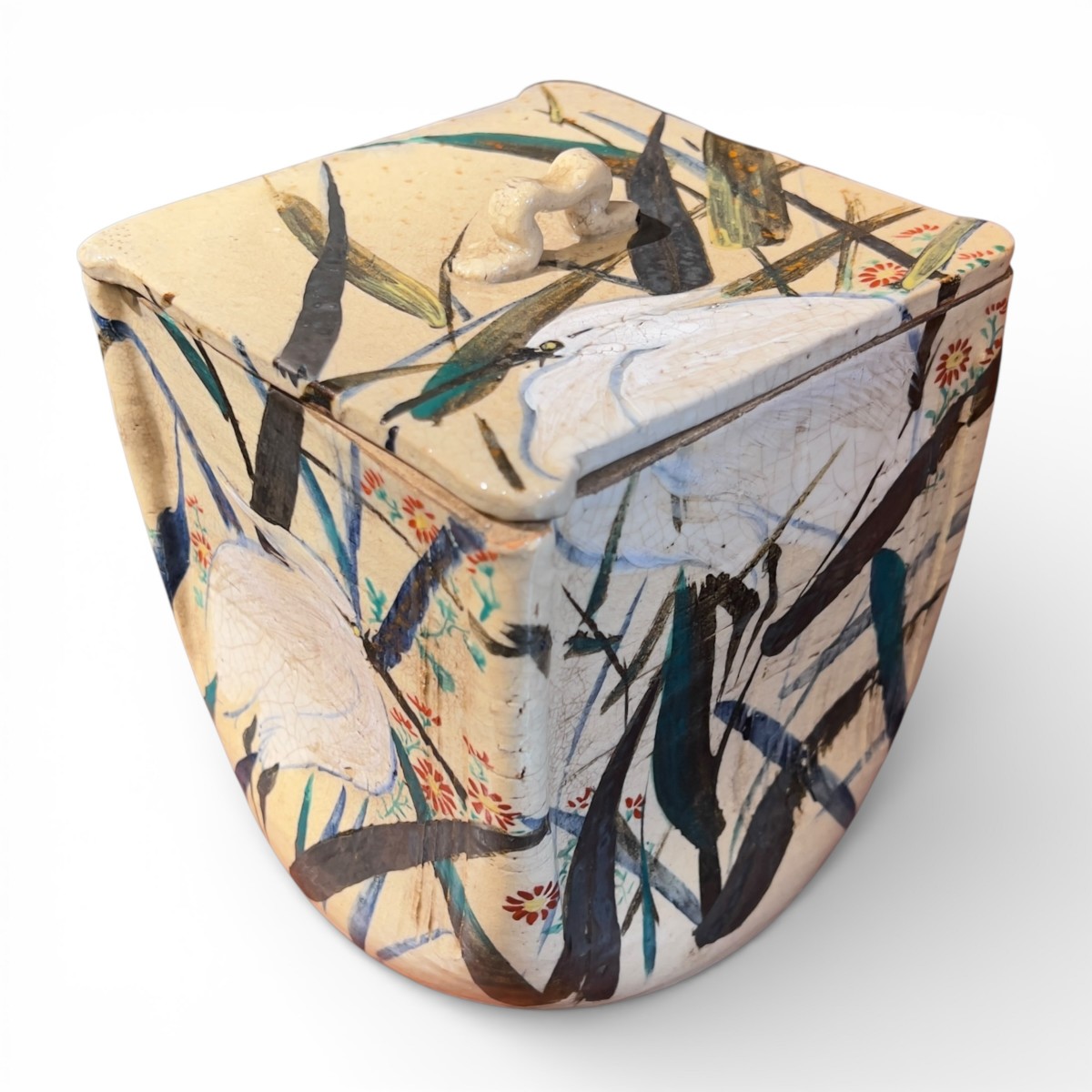

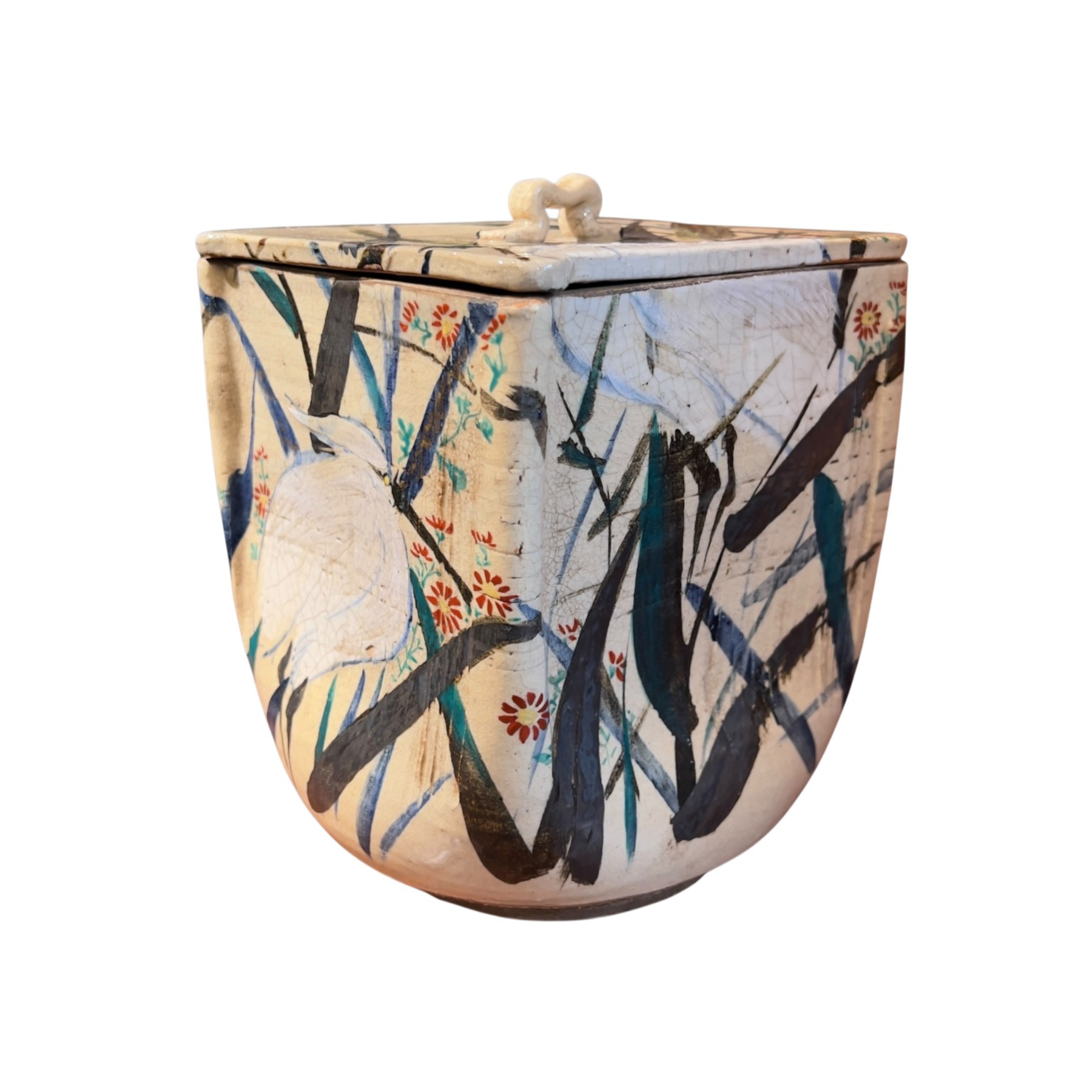
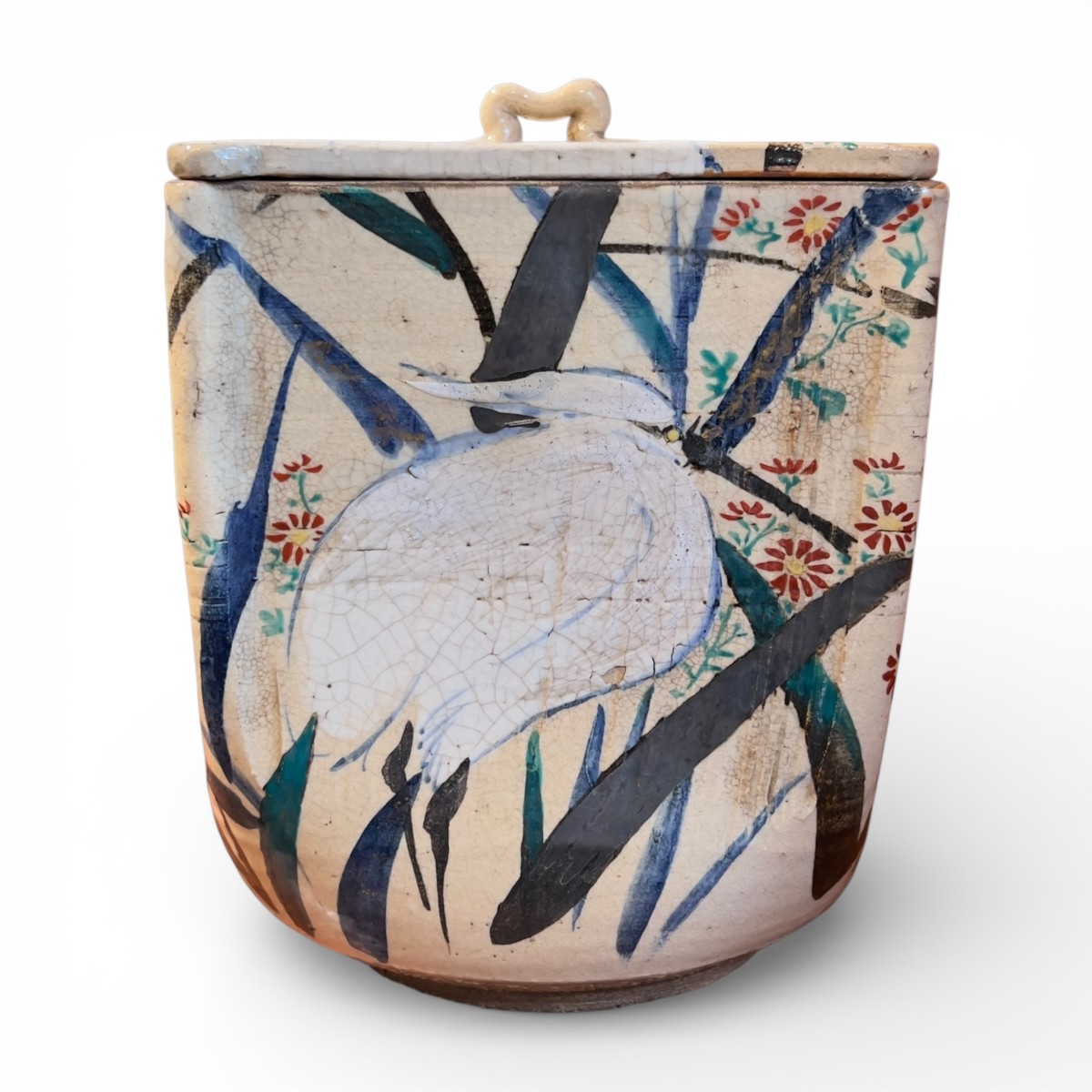
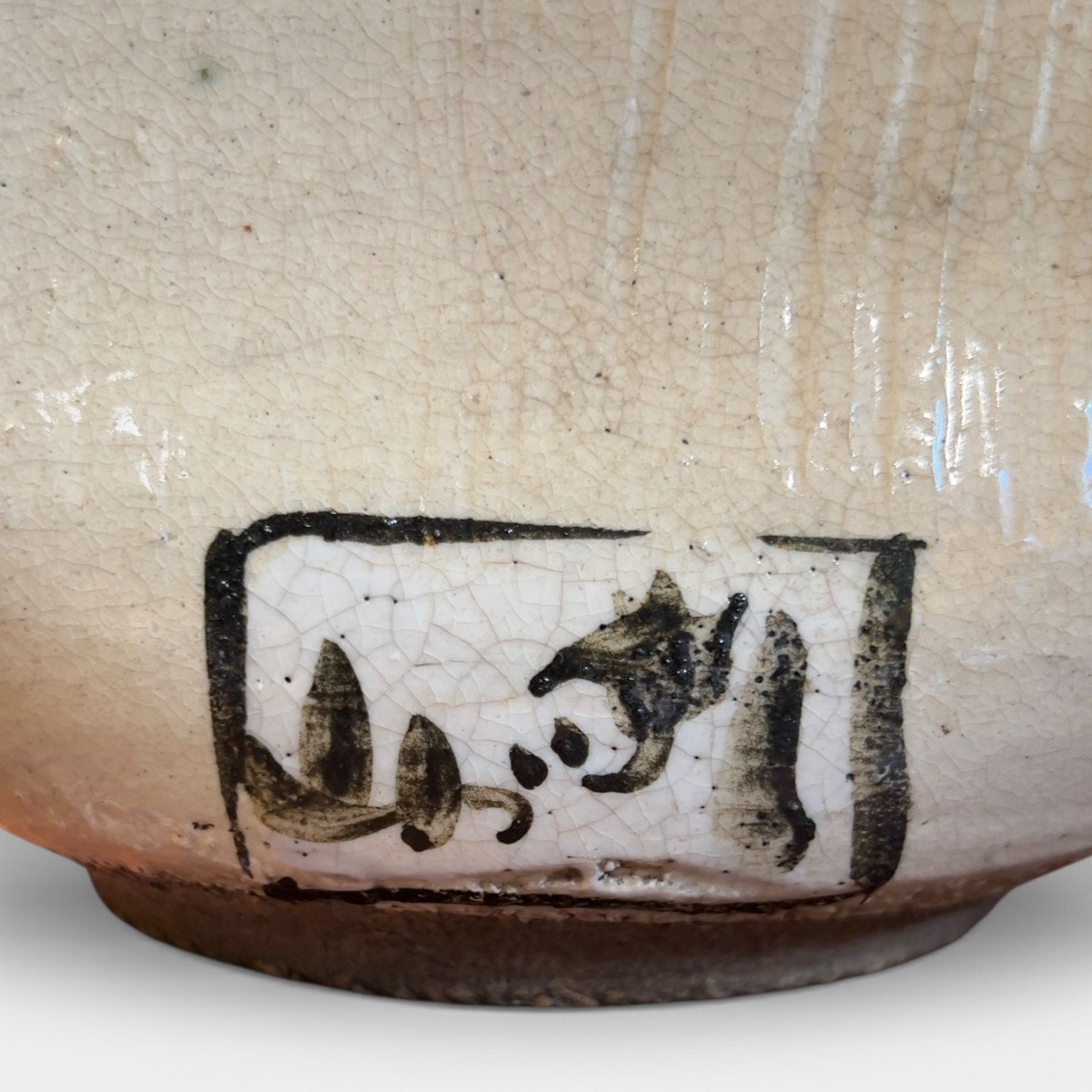
A rare tea ceremony water jar of exceptional artistic quality, bearing the signature ?? (Kenzan) within a rectangular cartouche. The piece is attributed to Miura Kenya (????, 1821–1889), the sixth bearer of the Kenzan name, a major figure in Meiji-era Japanese ceramics.
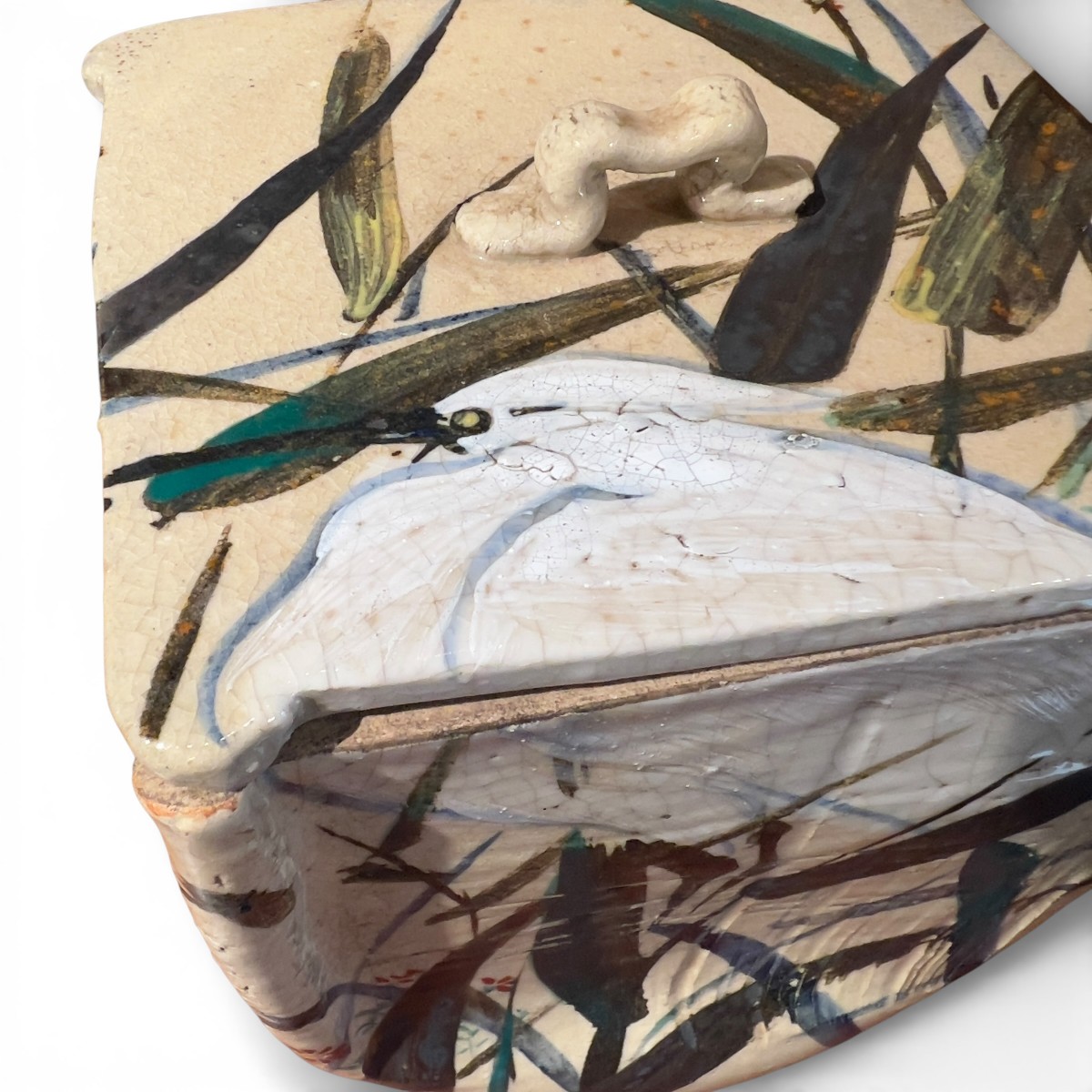
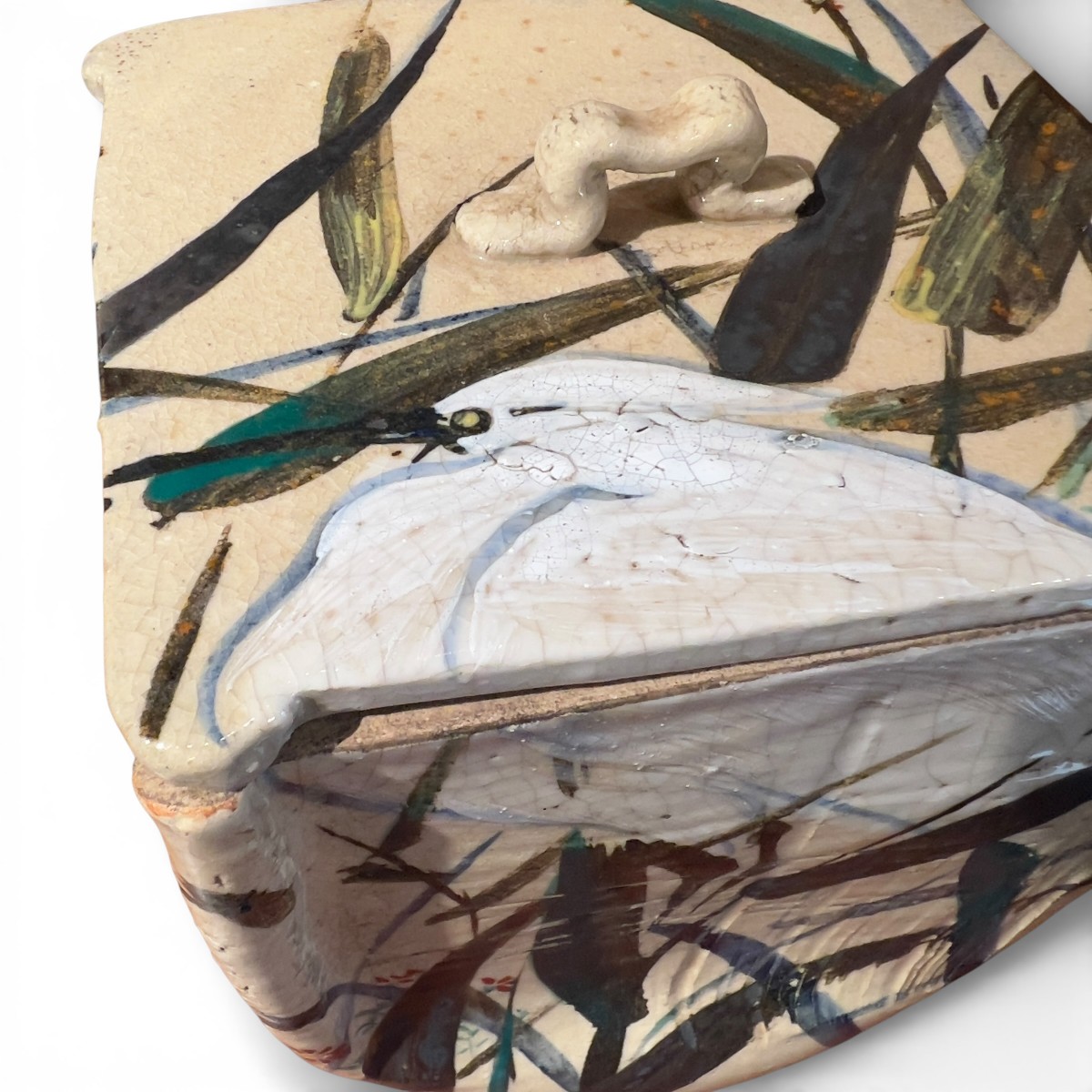
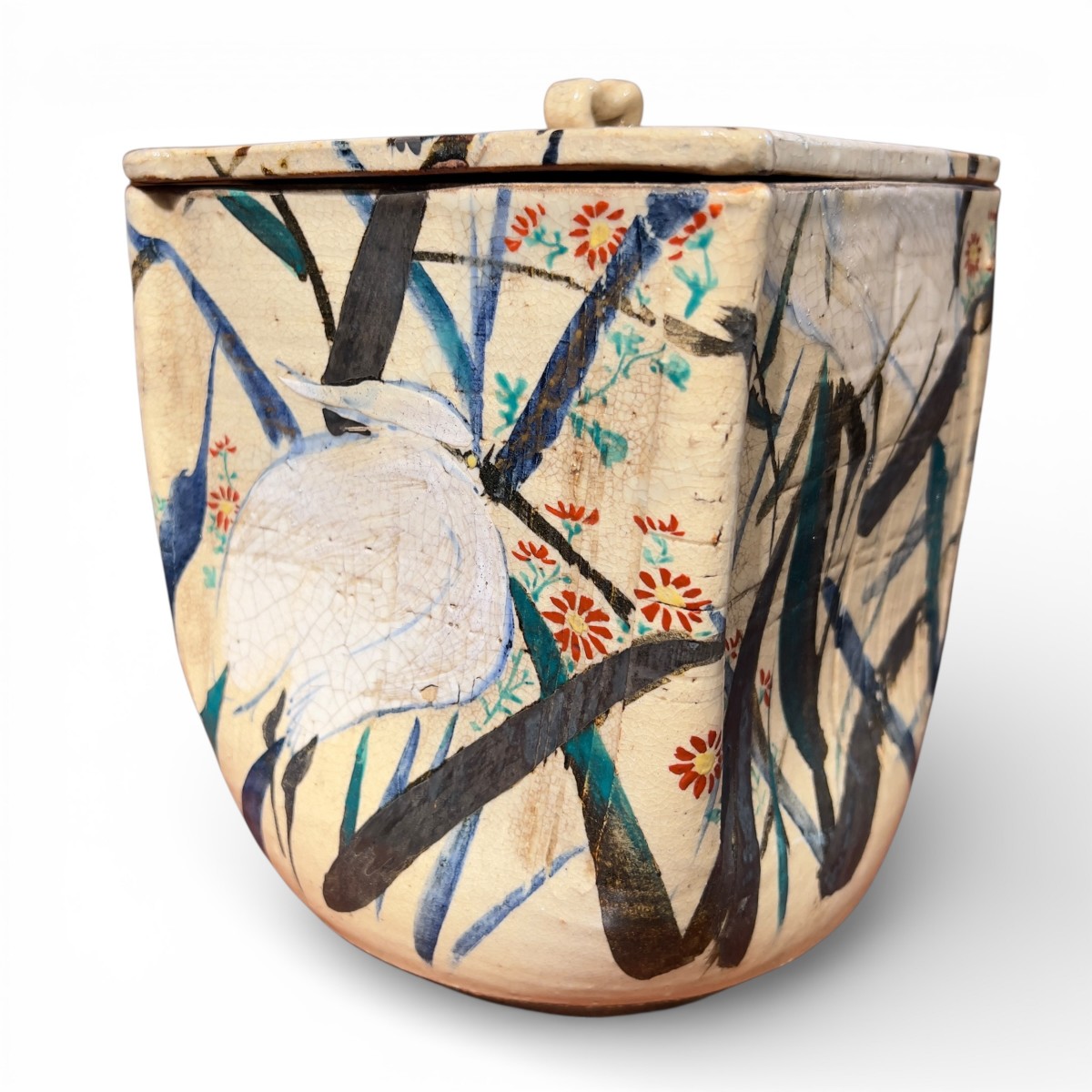
This mizusashi (??) is a covered water jar used in the chanoyu tea ceremony. It was used to store fresh water for filling the kettle or rinsing the bowls. The body is nearly cubic with slightly rounded corners, achieved by wheel throwing followed by hand shaping to create the characteristic angles—a more demanding technique than slab construction, as it preserves the organic continuity of the wall while giving it an architectural rigor. The flat lid, with a matching glaze, is surmounted by a hand-modeled looped knob.
Dimensions
Height: 20 cm — Width: 15 cm — Depth: 14 cm
Technique and Materials
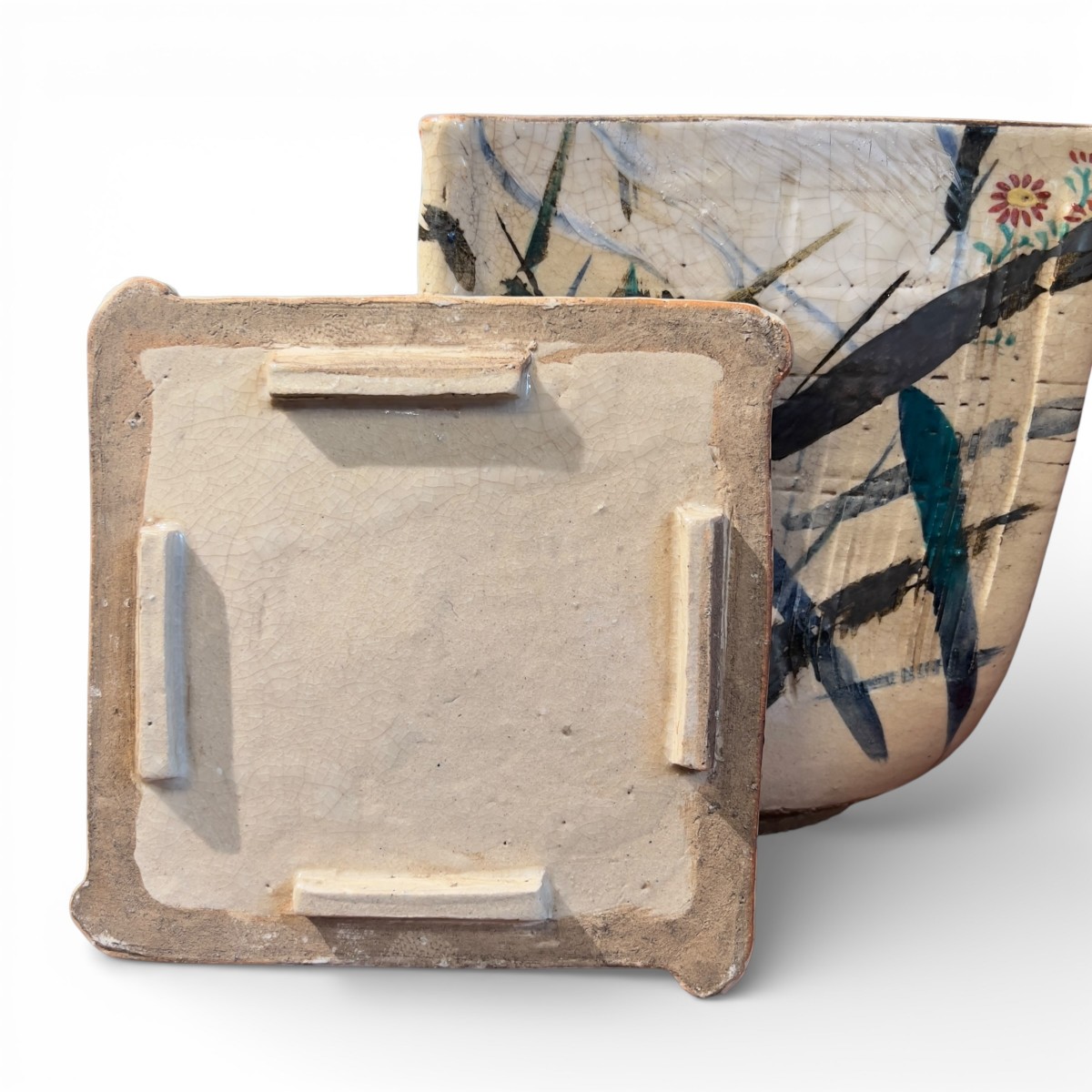
Body in wheel-thrown and shaped stoneware, covered with a white slip (kohiki) forming the painted surface. Polychrome decoration applied with a brush, both under and over the glaze, using cobalt oxides (gosu blue), copper oxide (green), and iron oxide (red and black). Transparent feldspathic glaze over the white slip, exhibiting a dense network of crackles (kanny? ??). Unglazed foot (kodai) in granular stoneware, with traces of spiral throwing visible at the base.
Decoration
The decorative composition is the most remarkable element of this piece. Two large white egrets (shirasagi ??) move within a vegetal landscape composed of bamboo stalks drawn with cobalt oxide, black iron branches, teal foliage, and small red and yellow flowers—chrysanthemums or autumn wildflowers. The design is entirely free, spontaneous, and of first-rate calligraphic quality: each brushstroke is deliberate, without hesitation, in the grand pictorial tradition of the Rimpa school.
The composition is designed to be viewed diagonally, from the corner of the piece: the first egret, at rest, occupies the left side of the body; the second, in motion, crosses the junction between the body and the lid, deliberately transgressing this structural boundary. This device—rare in ceramic production—reveals an artist who conceives of the object as a complete 360-degree sculpture, and not as a vessel to which decoration is applied.
Signature
The signature ?? (Kenzan) is painted in iron oxide within a framed rectangular cartouche on the lower side of the body. The script is in a semi-cursive style (gy?sho ??), simple and confident. This type of rectangular lateral seal is characteristic of the production of Miura Kenya and his immediate circle.
Attribution and Dating
The piece belongs to the Kenzan school, Edo-Tokyo lineage. The stylistic and technical criteria—the mastery of the turned and distorted angular form, the expressive spontaneity of the brushwork, the repertoire of egrets and water herons among the documented favorite motifs, the characteristic polychromy, the authentically aged craquelure, and the diagonal compositional design—converge on an attribution to Miura Kenya (Kenzan VI, 1821–1889) or an artist from his immediate circle, active in the 1850s–1880s. The piece dates from the late Edo period or early Meiji era, 19th century.
Preservation Box
The piece is accompanied by a high-quality wooden box, made after its creation (atobako) by a Japanese connoisseur who recognized its value. The box has a separate compartment for the lid, a rare feature that testifies to the care taken in its preservation. The inscription reads: "Mizusashi with a plume—possibly from Kenzan." This cautious attribution is typical of the intellectual honesty of cultivated Japanese connoisseurs.
Condition
Good overall condition, consistent with the age and use of a tea ceremony piece. Natural cracking. No repairs.
Historical Context
Ogata Kenzan (1663–1743) was one of Japan's greatest ceramicists, founder of a revolutionary style combining pottery and painting in the Rimpa tradition, an artistic movement initiated with his elder brother, the painter Ogata K?rin. After his death, the Kenzan name became a dynastic mark passed down through several generations of potters. Miura Kenya (????), the sixth holder of the title, was a singular figure of the late Edo period: potter, carpenter, shipbuilder, and samurai, he embodied to the very end the Japanese ideal of the accomplished man in multiple disciplines. His rare and sought-after ceramic works combine the gestural freedom inherited from Kenzan I with a naturalistic sensibility influenced by the painter Tani Bunch?.
Delevery information :
A special care is given to packing. Bigest pieces are crated.
All our shippings are insured with tracking.
As we do a lot of shippings, we do have very special rates. Please inquire!