Offered by Costermans Antiquités
REQUEST INFORMATION

Old Masters paintings, 16th, 17th and 18th furnitures and works of art
A painter of landscapes, religious subjects and genre scenes, Jacob Grimmer was born in Antwerp around 1526. A contemporary of Pieter Brueghel the Elder, Jacob Grimmer served his apprenticeship in Antwerp under Gabriel Bauwens, Mathys Cock and Cerstrian van Quekborn. He became a master of the Guild of Saint Luke in 1547. He undoubtedly travelled to Italy, as was customary for young painters at the time. He enjoyed great success and was regarded during his lifetime as one of the finest landscape painters.
His work marks a major turning point in the evolution of 16th-century Flemish landscape painting.
In her monograph on Jacob and Abel Grimmer (published by Renaissance du Livre, 1991, pp. 27), Reine de Bertier de Sauvigny perfectly summarises Jacob Grimmer’s contribution: ‘Jacob Grimmer created the landscape conceived for its own sake, as an entity in itself, no longer as the backdrop to some arbitrary scene. (…) He broke free from the Antwerp conception of landscape and sought to detach himself from the individual elements of the landscape in favour of an overall view. Through this distancing, he emphasised the breadth and grandeur of the space. By employing the composition of his era in a purified manner, limiting himself to the essentials, to the elementary forms of landscape and architecture, and deliberately omitting all detail, he led landscape art from Mannerism to a distilled form that would set a precedent.”
A large part of his work is devoted to depicting the seasons and the months of the year. This theme allows him to depict the life of the Flemish people in tune with the seasons: swimming in summer, winter games, and work in the fields and on the farm. He portrays the quiet everyday life, which sets him apart from Pieter Brueghel the Elder, who had a more theatrical and caricatural view of the era, painting the tragedies and miseries of the time.
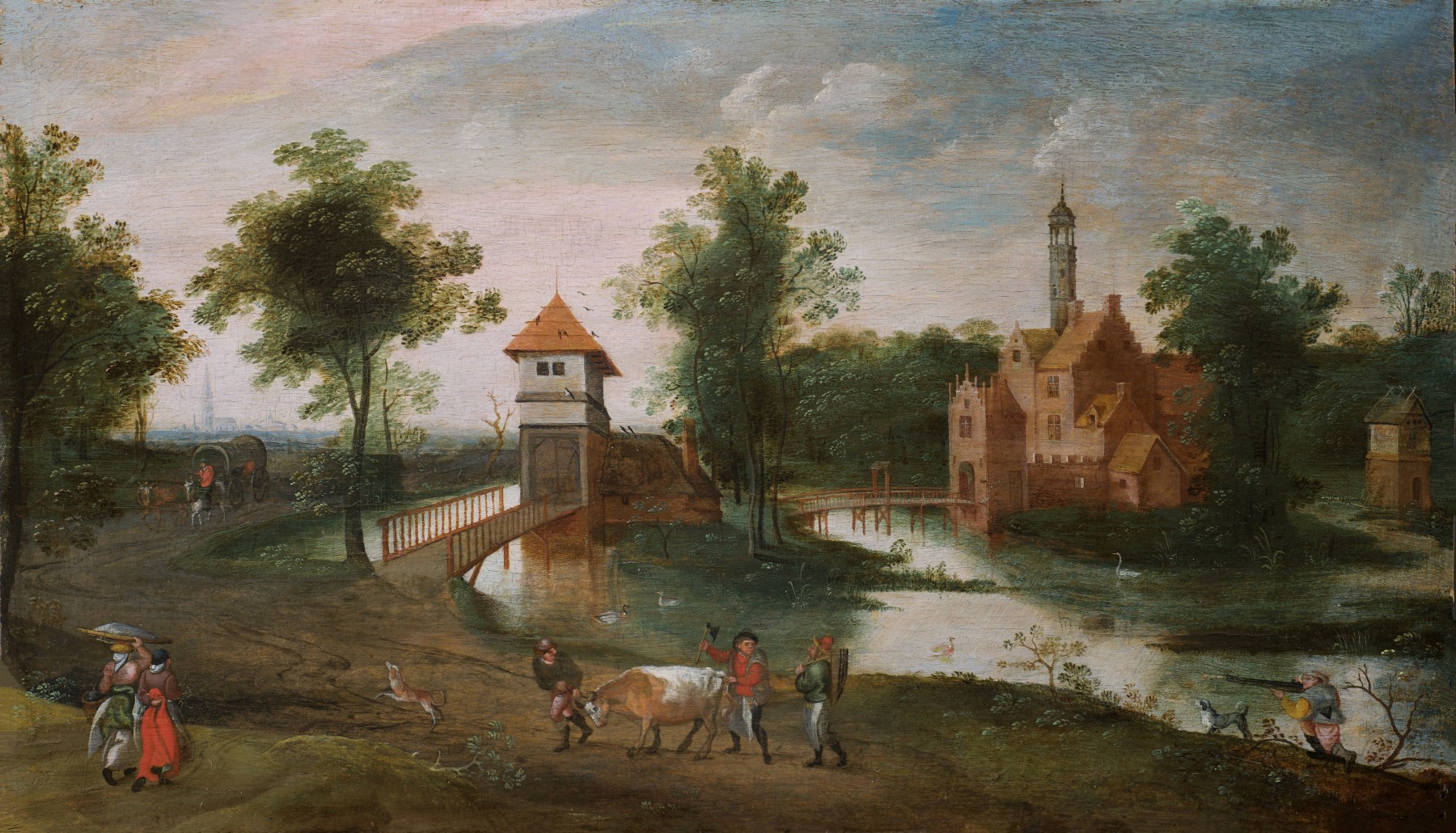
Jacob Grimmer emphasised the landscape and expanded its scope by focusing on the essentials and omitting superfluous details. He used clean lines to render the precise outlines of houses, trees and the terrain. Our painting, depicting a castle in the vicinity of Antwerp, is a characteristic work by the artist. This castle, typical of Flemish architecture, was depicted several times by Grimmer. The most important version is held at the Vienna Museum (KHMV). The painting is brought to life by figures illustrating daily life at the time, whose red clothing makes them stand out on the path. Jacob Grimmer’s talent as a colourist is also evident, as he employs subtle and deep tones.