Offered by Costermans Antiquités
REQUEST INFORMATION

Old Masters paintings, 16th, 17th and 18th furnitures and works of art
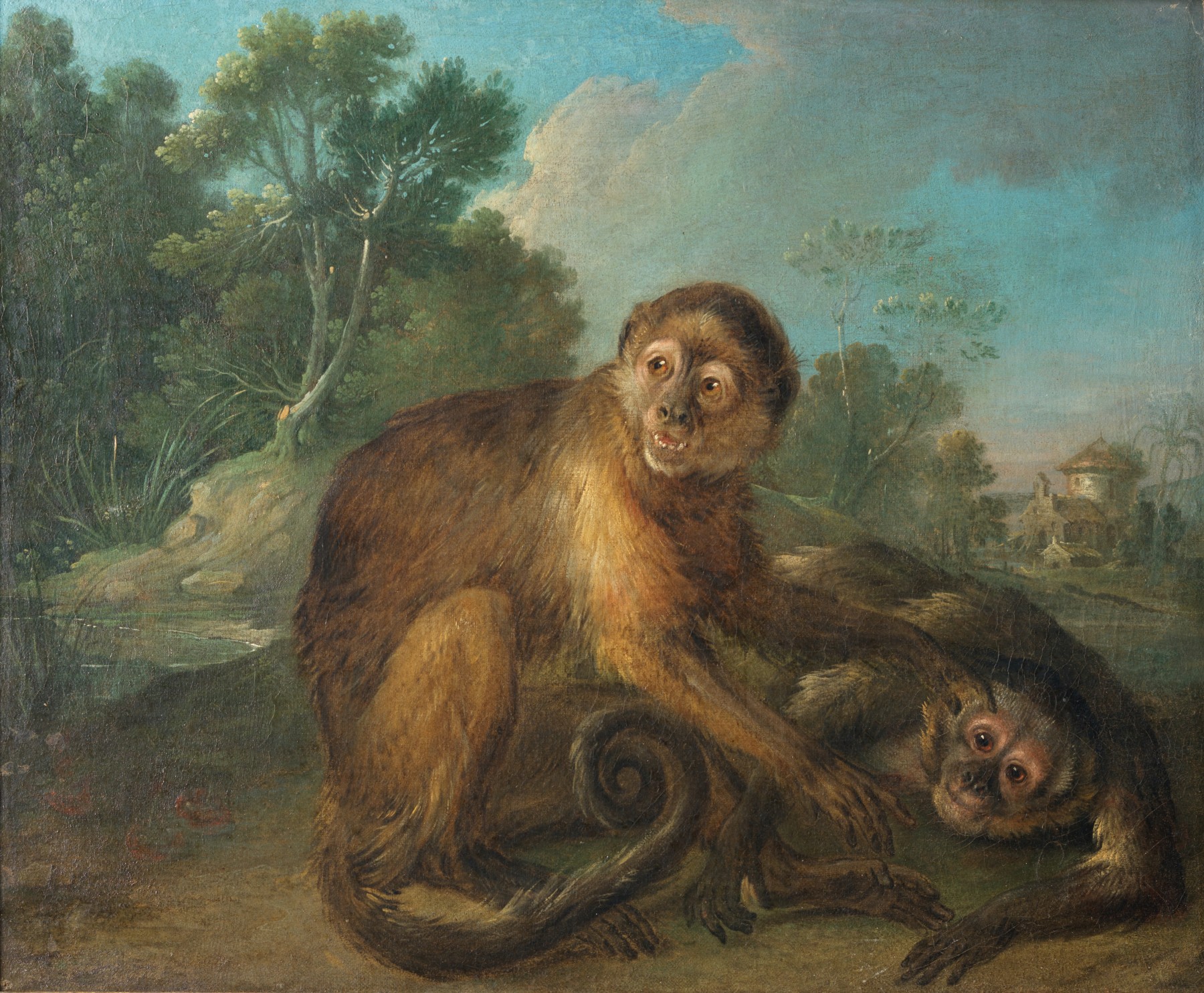
Christophe Huet offers us the depiction of a joyful, tender, and intimate animal scene. Two capuchin monkeys are playing by the edge of a pond in a forest landscape of Western appearance. The right background is animated by several buildings: a small church stands beside a large dovecote, bordered by a sheepfold.
It is not uncommon in the work of Christophe Huet to see these exotic animal species (parrots, American ducks, monkeys from America and Asia) placed within local landscapes; conversely, Western species (foxes, owls, deer) are depicted in exotic settings, surrounded by poppies, agaves, and architectural elements such as pagoda roofs.
In 1735, two years before our painting, Huet created the famous and significant series of ten large animal paintings for the Hôtel du Petit Luxembourg in Paris, commissioned by Marie-Anne de Bourbon-Condé (1697–1741). This series notably includes the “Landscape with macaque monkeys…” preserved at the Musée Condé (Ill. 1). In the 1750s, Huet exhibited several animal paintings at the Académie de Saint-Luc, earning from critics the description of being the “worthy pupil of M. Oudry.” He thus belongs to the lineage of great animal painters such as Jean-Baptiste Oudry and François Desportes, whose works he collected.
The two capuchin monkeys, imported from Central or South America, were observed and drawn by Huet at the royal menageries of Versailles, Chantilly, or Vincennes. Their gazes are directed beyond the pictorial scene, as if observing in return the privileged visitor who comes to admire and study these rare and precious animals imported from America and Asia through the trading posts of the Compagnie des Indes into European courts. A series of eleven engraved plates by Jean-Baptiste Guélard after Huet’s drawings of “singeries” is known, dedicated to “M. Delorme, Premier garçon et délivreur de la Ménagerie de Versailles” (Ill. 2 and 3).
The twisted and acrobatic poses of these playing monkeys are favorite motifs among major French ornamental artists since Jean Bérain and his grotesques, Claude Gillot, Jean-Antoine Watteau, and Claude III Audran. Following his master Audran, who created singeries for Louis XIV at the Château de Marly, Huet became the foremost specialist of his time in these depictions of monkeys playing, dancing, making music, and imitating humans even in their costumes (Ill. 3). In the very year of our painting, 1737, he produced this masterpiece of French ornamental painting for the Prince de Condé (1692–1740): “La Grande Singerie” for the grand apartments of the Princes de Condé at the Château de Chantilly (Ill. 4). Two years earlier, he painted “La Petite Singerie” in the boudoir of the Petit Château de Chantilly for the Duchess of Bourbon.
After having embodied an inferior imitation of man and symbolized the devil during Antiquity and the Middle Ages, the monkey—revered in Chinese culture—became a highly appreciated and domesticated animal among the European aristocracy of the 18th century. Albrecht Dürer owned a monkey in 1521, which he depicted in several compositions, including “The Virgin with the Monkey” (1498). Philip IV of Spain collected paintings of monkeys in a gallery at the Prado. Our painting embodies, in the art of the reign of Louis XV, the taste for exoticism, entertainment, and play so cherished by this society.
Works by Christophe Huet in museums:
Musée Condé
Hôtel de Rohan-Strasbourg
Château de Champs-sur-Marne
Musée des Arts Décoratifs
National Gallery of Art
Birmingham Museum of Art