Offered by Richard Redding Antiques
REQUEST INFORMATION

Leading antique and fine art gallery, specialises in the finest French clocks.
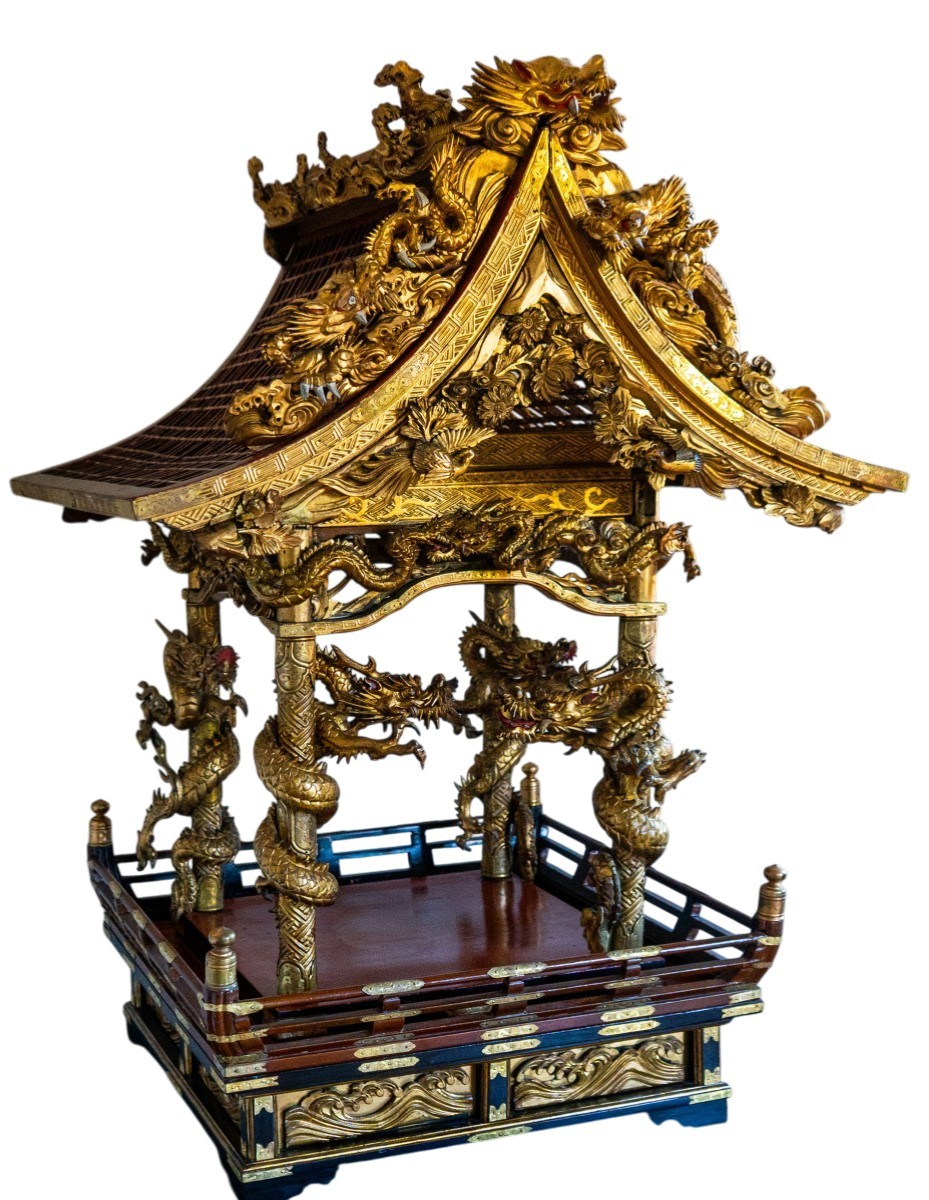
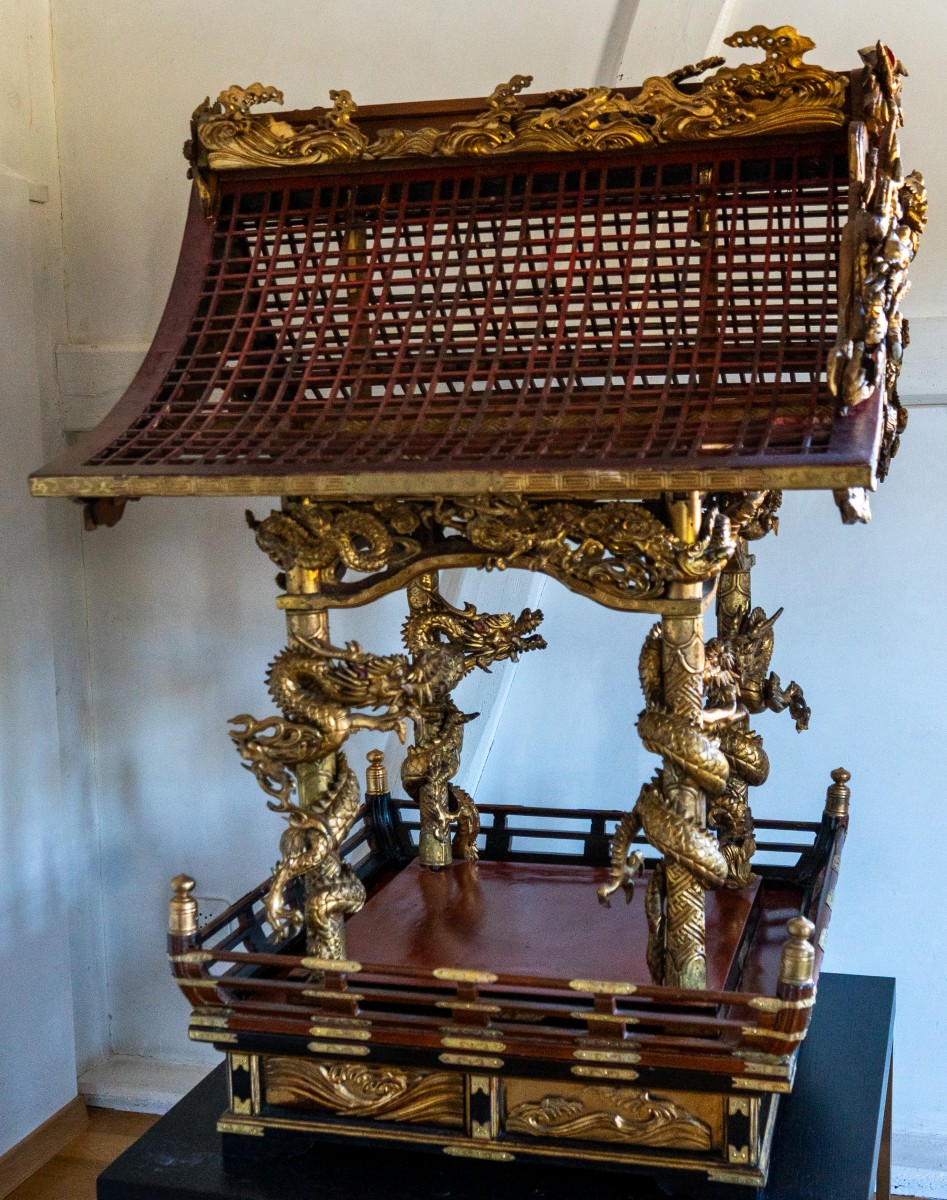
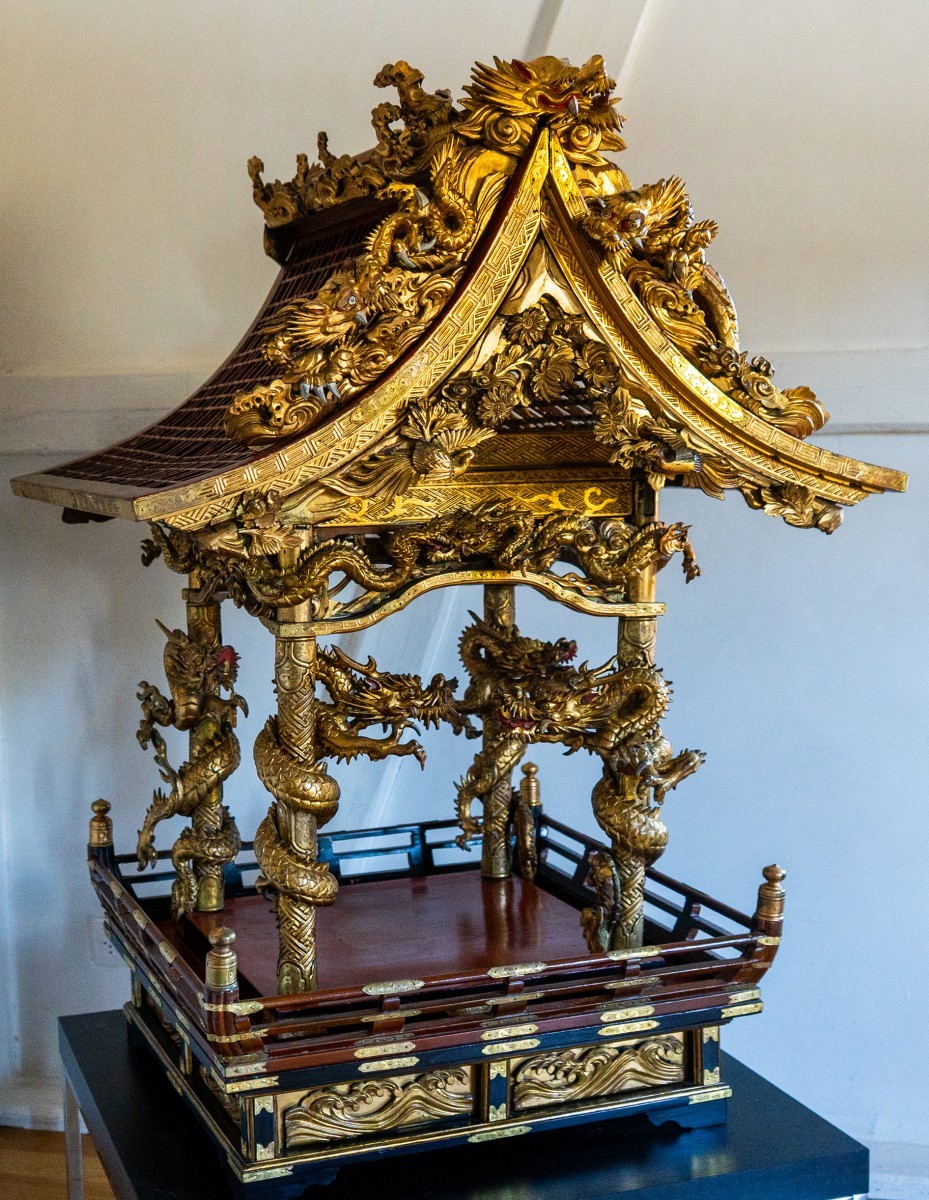
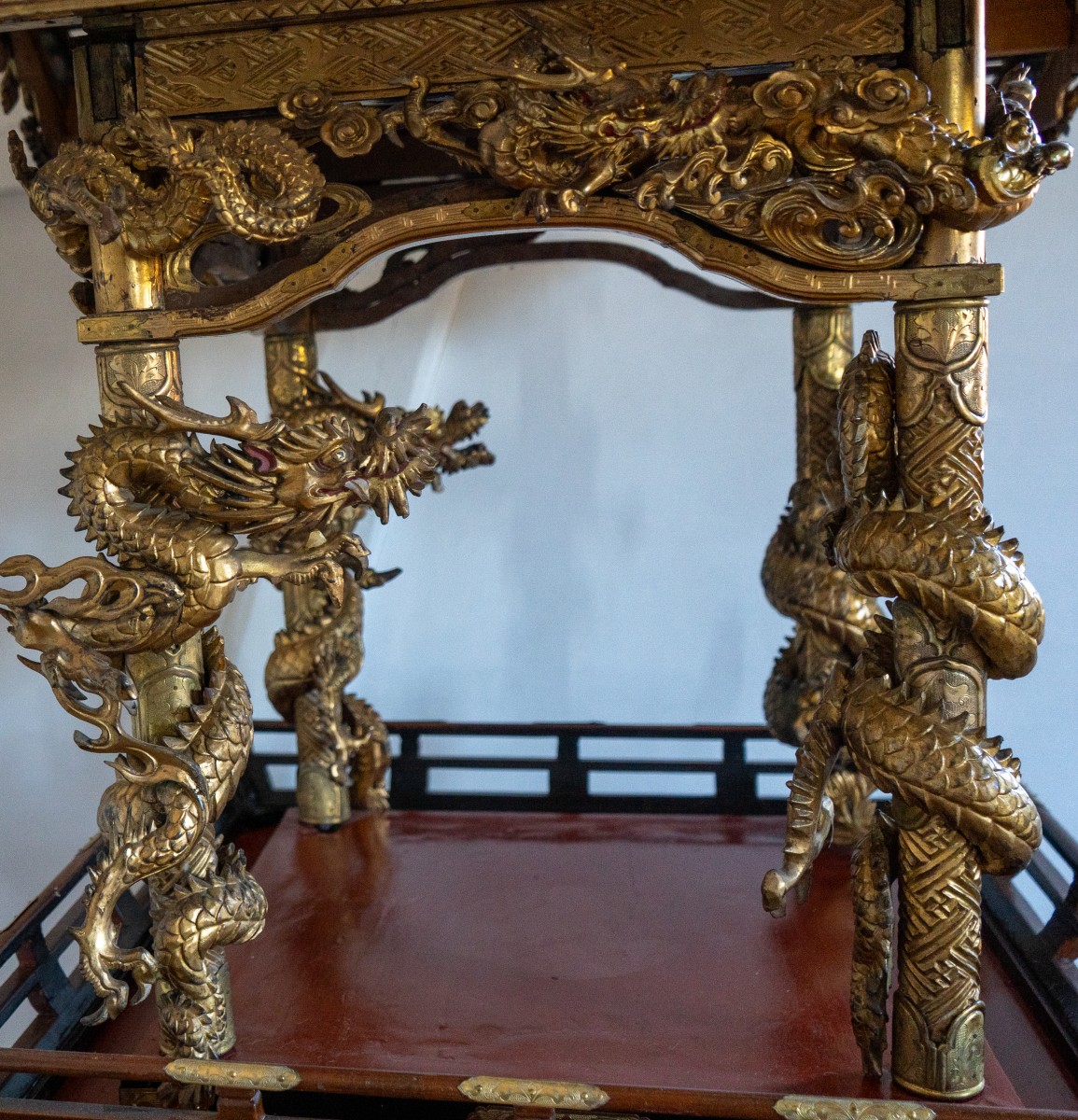
A Japanese Edo Period gilt and lacquered carved wood portable Buddhist shrine, known as a KyKyoden-zushi, inscribed in ink on the underside in ancient Japanese characters. Of architectural form and shaped as a temple, it has a trellised roof with curved gable ends above circular pillars at each corner that rest on a square balustraded platform with gilded finials at each corner, centred by a circular raised podium above a square base decorated with gilded waves. The ridge of the roof, fascia and gabled ends are adorned with auspicious Buddhist motifs including dragons, a phoenix, lotus flowers, waves and with further dragons entwined around the four supporting pillars
Japan, Edo Period (1800-68)
Height 116cm, base 57cm x 57cm smallest point
This magnificent Japanese work of art is a portable Buddhist shrine, which is referred to as a zushi in Japanese and was made to house a sacred figure. This particular form of zushi is called a ky?den, which means palace. Dating from the nineteenth century, it epitomises the quality achieved by Japanese craftsmen during the Edo Period. The upper part is in the shape of a temple with a trellised roof, supported by brackets and pillars upon a balustraded platform. The dramatic roofline takes its inspiration from Mount Fuji, Japan’s highest mountain which so often features in Japanese art. Mount Fuji, together with Mount Tate and Mount Haku, are historically regarded as the country’s three holy mountains since the reach up to the heavens. In particular Mount Fuji has played a significant role in both Shint? and Buddhist beliefs, for example, in Shintoism (the indigenous religion of Japan), Mount Fuji is considered a sacred mountain and is believed to be the dwelling place of gods and spirits. It is considered a source of spiritual power and is worshipped as a deity itself. Shint? rituals and ceremonies are conducted on the mountain, particularly during New Year celebrations and other occasions. On the other hand, in Buddhism, Mount Fuji is regarded as a symbol of enlightenment and is associated with the Buddhist concept of ascension and spiritual growth.
Buddhism was introduced into Japan from mainland Asia during the sixth century and had a profound impact on all modes of cultural expression, including philosophy, literature and art. During the eighth century, numerous Buddhist temples were built across the country, often on the same sites as Shint? shrines. It was at this time that miniature portable shrines for private devotion known as zushi also began to appear. Many were much smaller than the present example, which made them eminently suitable for domestic use. Since this shrine is quite sizable it is likely that was made for an inner sanctuary of a temple hall. Such a shrine demarks a sacred space to enshrine the figure of a deity or honoured monk and, when in the most sanctified space of a temple, its sacredness is amplified.
In terms of its design, it compares very closely with another KyKyoden-zushi, now in the British Museum, London (object no 1893,1101.21), which is also made of lacquered and gilded wood and features a similar shaped trellised roof, comparable balustrades around the shrine’s base as well as dragons and other Buddhist symbols and motifs around the roof. The British Museum’s shrine was made during the Edo Period (1800-68) and according to a translation of an inscription on an interior panel, it was made in Nagoya, Owari Province. It is possible that the present shrine originates from the same region. The British Museum’s shrine was one of thousands of artifacts that were donated by Sir Augustus Wollaston Franks (1826-97), who served as the museum’s first Keeper of British and Medieval Antiquities and Ethnography (1866-96).
Another similar temple-shaped portable Buddhist shrine can be found in the Spencer Museum of Art at the University of Kansas. Made of lacquered, gilded as well as painted wood and dating from either the Meiji Period (1868-1912) or the Taish? Period (1912–26), its roof has curved as well as dormer gables that are commonly seen in traditional Japanese architecture, including castles, Buddhist temples, and Shinto shrines. As here, the shrine is empty inside. However, in the 1920s when displayed in Spooner Hall on the University of Kansas campus, the Spencer Museum shrine had additional rooftop ornaments and railings around the dais, while the pillars were also covered with curtains.
Thus, although the shrine in the Spencer Museum no longer has additional ornaments, we can assume that as here and like the portable shrine in the British Museum, it originally would have been adorned with auspicious Buddhist motifs. Here, these motifs include dragons, phoenixes, lotus flowers and waves. In Japanese art and culture, dragons and phoenixes have often been depicted together as symbols of harmony and auspiciousness as well as a sign of strength and passion. In Japanese mythology, dragons are diverse legendary creatures that combine native legends with stories from China, Korea, and India. In Japanese mythology and folklore, dragons are revered as powerful, wise, and benevolent guardians of humanity. They are often depicted as guardian spirits and are said to protect people from universal dangers, impart wisdom, and bring good fortune and wealth. Dragons are also associated with strength, courage, and happiness, and are said to offer these things at important life turning points.