Offered by Richard Redding Antiques
REQUEST INFORMATION

Leading antique and fine art gallery, specialises in the finest French clocks.
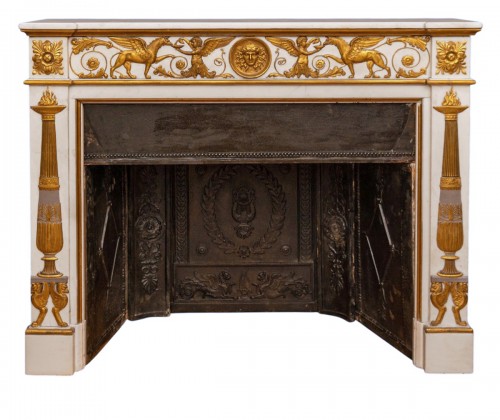
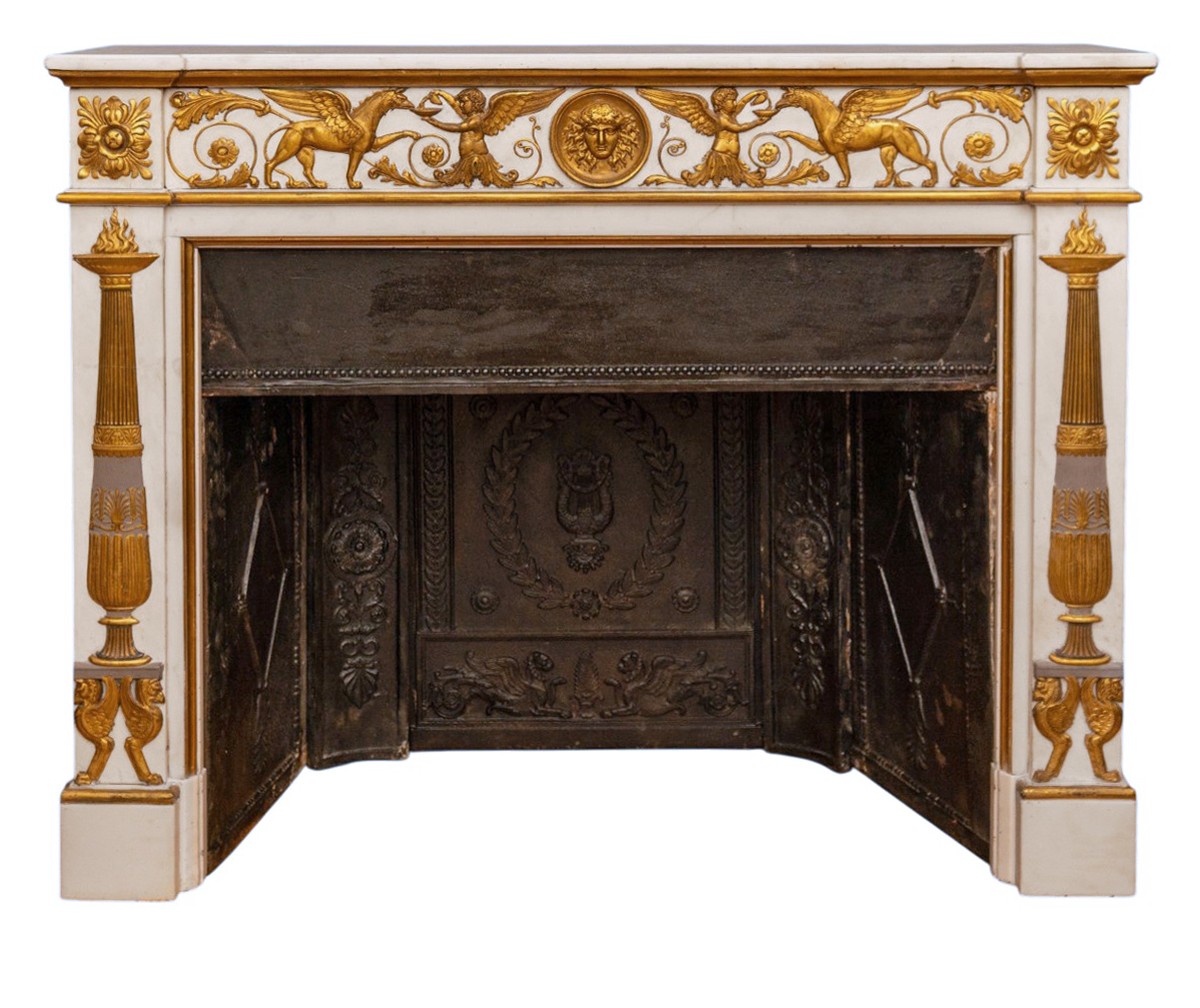
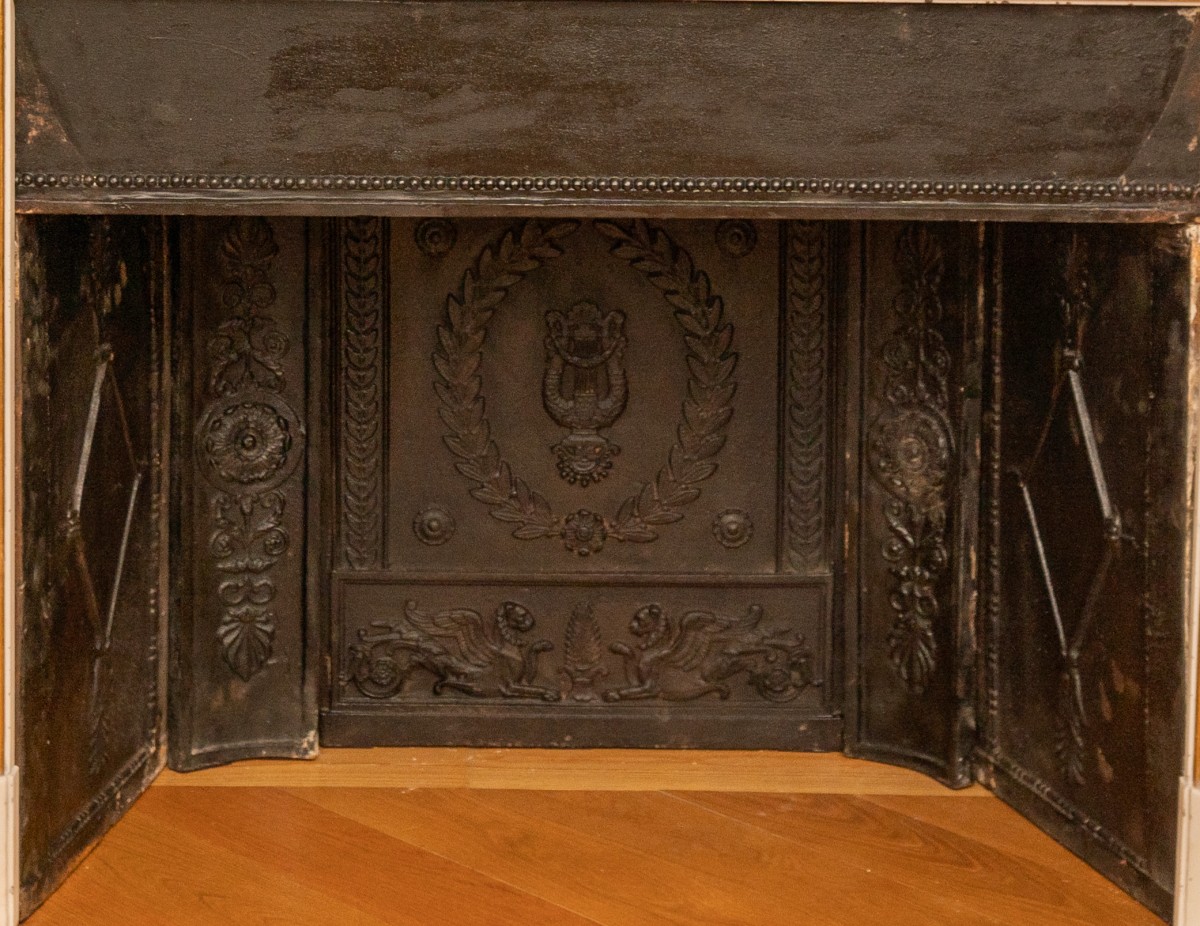
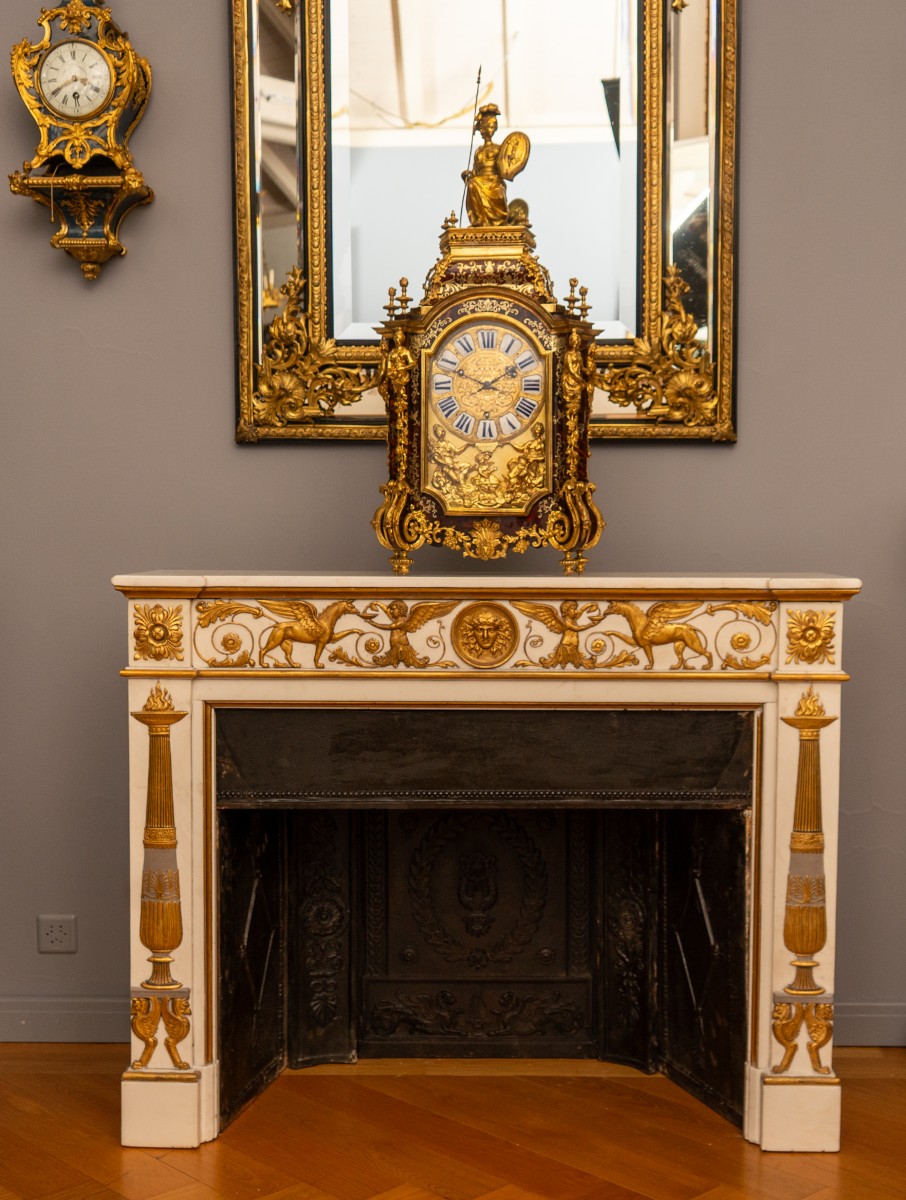
A very fine French early nineteenth century Consulat gilt and white painted marble fireplace, after designs by Charles Percier and Pierre François-Léonard Fontaine, the rectangular breakfront shelf protruding over corner blocks centred by gilded rosettes, between which is a frieze centred by a circular medallion enclosing a magnificent Medusa mask head, flanked either side by two winged genies with their upper body arising from foliate rinceaux, each outwardly facing and pouring wine or water from a small vessel into a cup which they offer to a winged griffin, each of the standing mythological beasts resting a paw on a scroll enclosing a rosette. The flat faced jambs each mounted by a flaming torchère, with a part-fluted stem above an anthemion ring above further anthemion motifs and a fluted lower body and circular fluted base upon a plinth supported on a pair of outward facing caryatid monopodia winged griffins. The jambs on raised square footblocks. The inner cast iron fireback centred by a laurel leaf wreath enclosing a lyre above a pair of recumbent griffins, flanked by rosettes and scrolled anthemion cartouches
Paris, date circa 1800-05
Height 105cm, width 133 cm, depth 37 cm.
Literature: Percier and Fontaine, “Recueil de Décorations Intérieures”, first published in 1801, pl. 12, illustrating a design for a chandelier (of which there is an executed example in the Musée des Décoratifs Arts, Paris), which includes a ring of griffin-shaped candle holders. Olivier Lefeuel, “Percier et Fontaine” in “Connaissance des Arts”, Paris, 15th June 1954, no. 28, p. 34, illustrating a design for the Emperor’s bedroom Aux Tuileries du temps de Napoléon’, which includes a frieze above the door featuring very similar winged griffins, scrolls and rinceaux. And p. 35, illustrating a page from a set of designs by Charles Percier and Pierre François Léonard Fontaine for the Russian Tsar of work in the Louvre and Tuileries, showing a woman’s bedroom with a torchère of comparable overall form.
This imposing fireplace features many of the motifs and decorative elements that prevailed during the French Consulat. The period, spanning the years 1799–1804, sits right between the French Revolution and the Empire period, when Napoleon Bonaparte was crowned Emperor of France. During the Consulat, decorative elements were marked by a sober and disciplined Neo-classicism that reflected a return to order after the Revolution. Ornamentation drew heavily on ancient Greek and Roman models, favouring clarity, symmetry, and symbolic restraint rather than excess. Common motifs included torchères, laurel wreaths, palmettes, rosettes and simple floral garlands, along with mythological figures and beasts such as griffins and Medusa masks as featured here. Political symbolism remains present but measured, with references to the Roman Republic such as fasces, medallion profiles and eagles. Materials and colours reinforce this austerity, using mahogany, marble, and restrained gilt bronze, combined with a palette of whites, stone tones and occasionally deep greens and Pompeian red, creating an overall impression of rational elegance and controlled authority.
The Consulat style was largely defined by the architects and ornemanistes Charles Percier (1764-1838) and Pierre-François-Léonard Fontaine (1762-1853), whose close collaboration reshaped the French decorative arts during the early years of the nineteenth century. Deeply influenced by their training in Rome and by archaeological studies of antiquity, they promoted a rigorous Neo-classical language based on clarity, proportion, and historical reference. As official designers to Napoleon Bonaparte, they created interiors, furniture, and decorative programs that expressed order, stability, and republican ideals through sober architectural forms, low-relief ornament, and carefully chosen classical motifs. Their influential designs and publications, notably their Recueil de Décorations Intérieures, first published in 1801, helped create the Consulat style while laying the groundwork for the more monumental Empire style that was to follow.
This elegant fireplace embodies many of the decorative elements that Percier and Fontaine promoted in their designs. The overall design of the torchères, for instance, closely relate to a Bacchic candelabra dating from the 2nd century AD that was excavated near Naples in 1777 and sent to Paris in 1798. Likewise, Percier and Fontaine often integrated genies arising from rinceaux as well as scrolling arabesques, inspired by Antique prototypes. Griffins commonly also featured within their designs; these fabulous mythical beasts with the hind part of a lion and heads, claws and wings of an eagle, came to symbolise the combined qualities of a lion and eagle, namely courage and watchfulness. Like the fireplace itself, the cast iron fireback features motifs that were favoured by Percier and Fontaine, such as the central laurel leaf wreath centred by a lyre which, among many examples, appear in a design for a small Parisan salon and significantly as part of a frieze for a fireplace (reproduced respectively as plates 7 and 14 in their Recueil de Décorations Intérieures).