Offered by Tobogan Antiques
REQUEST INFORMATION
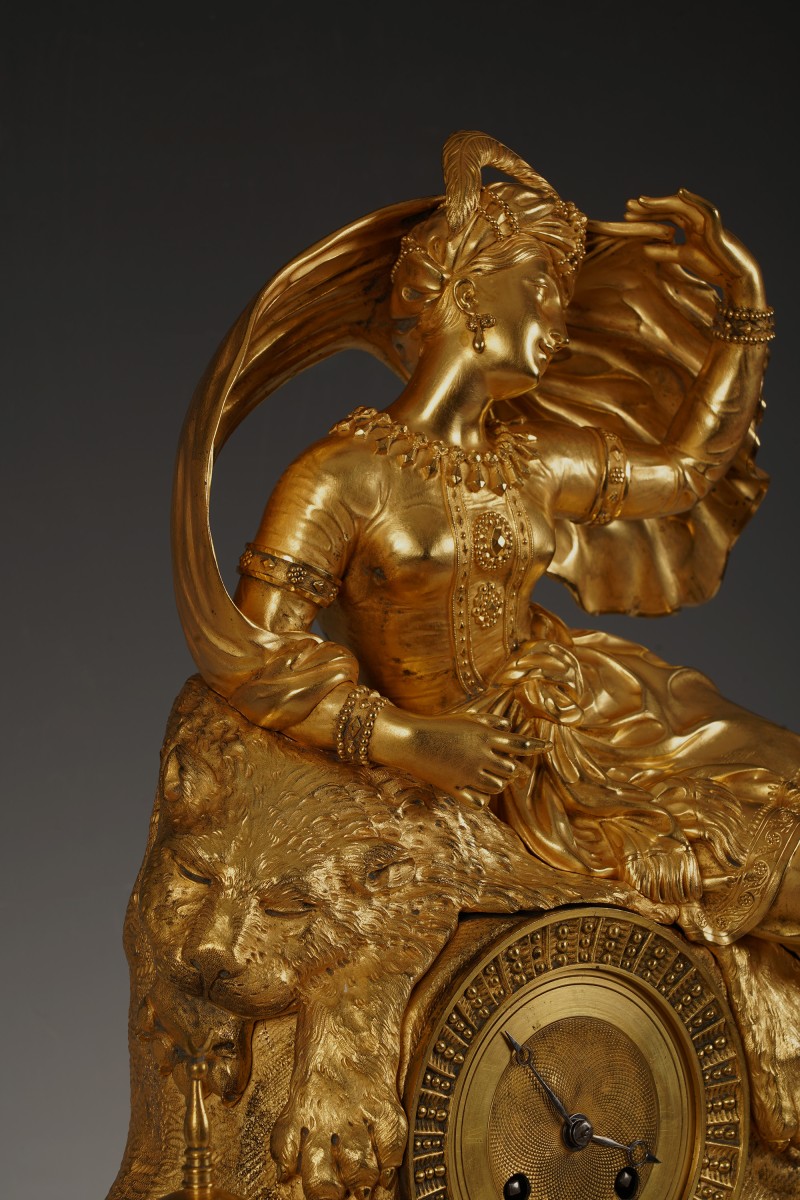
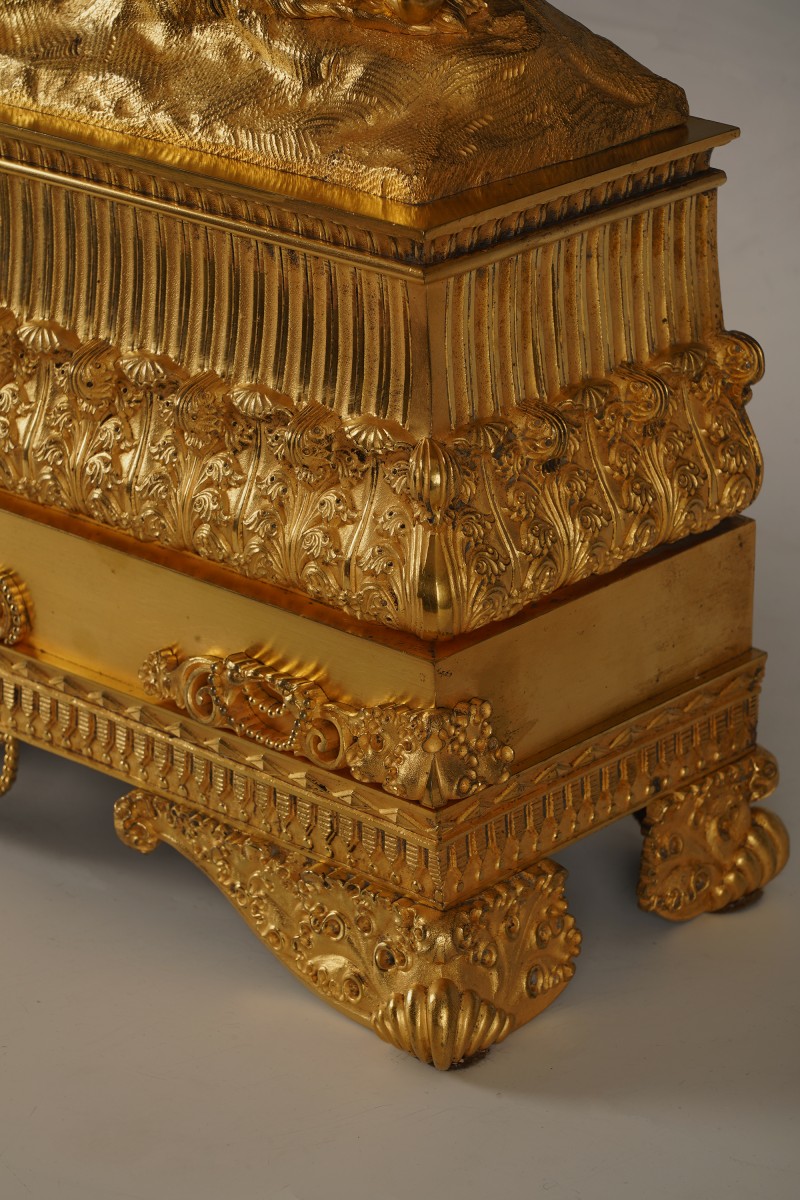

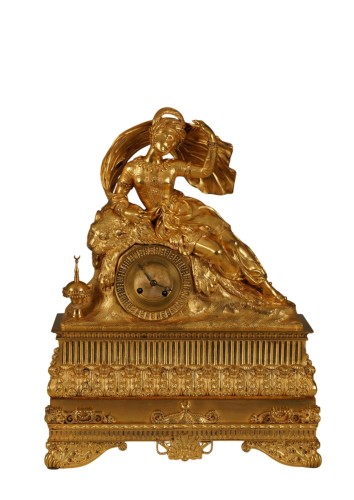
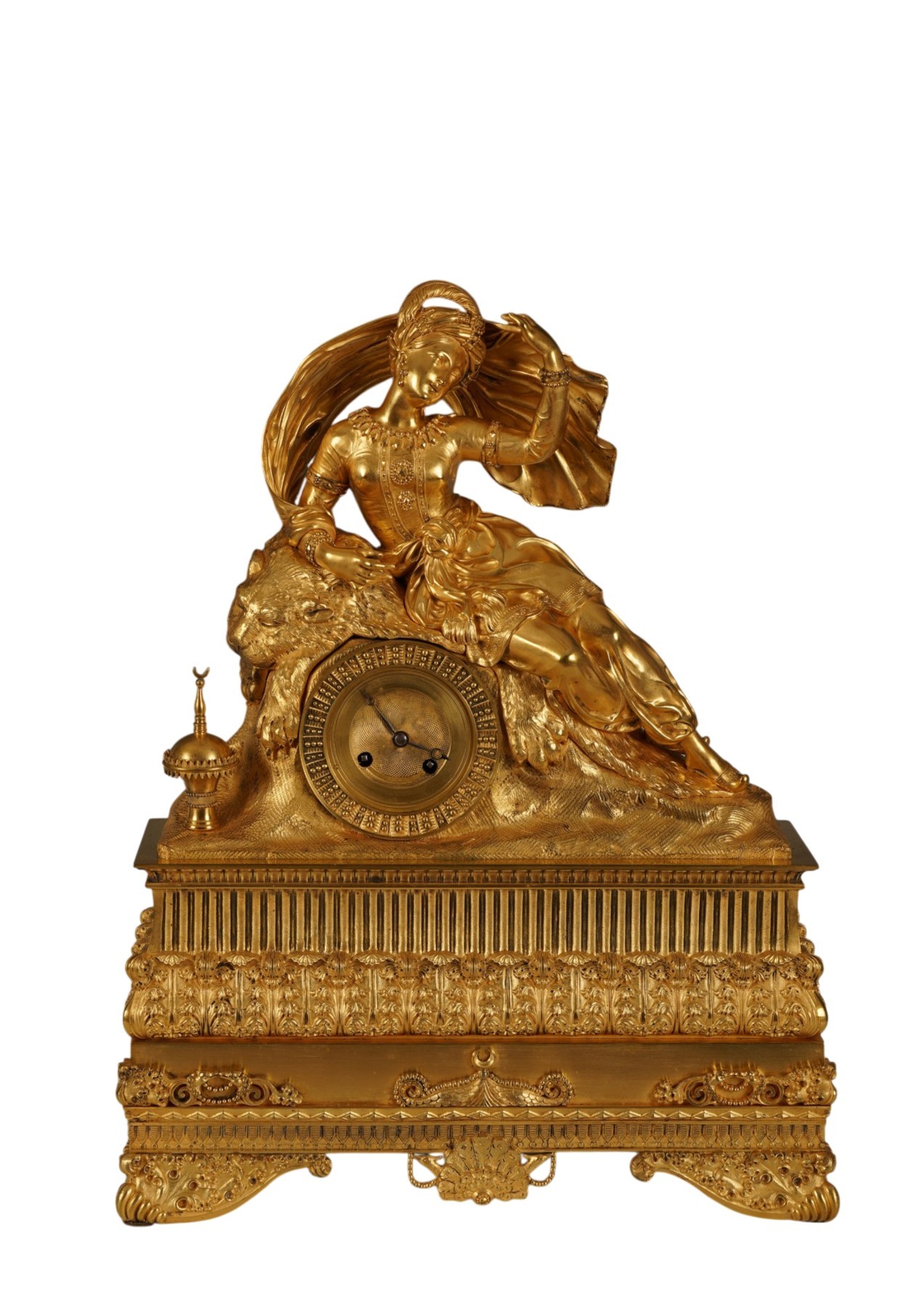
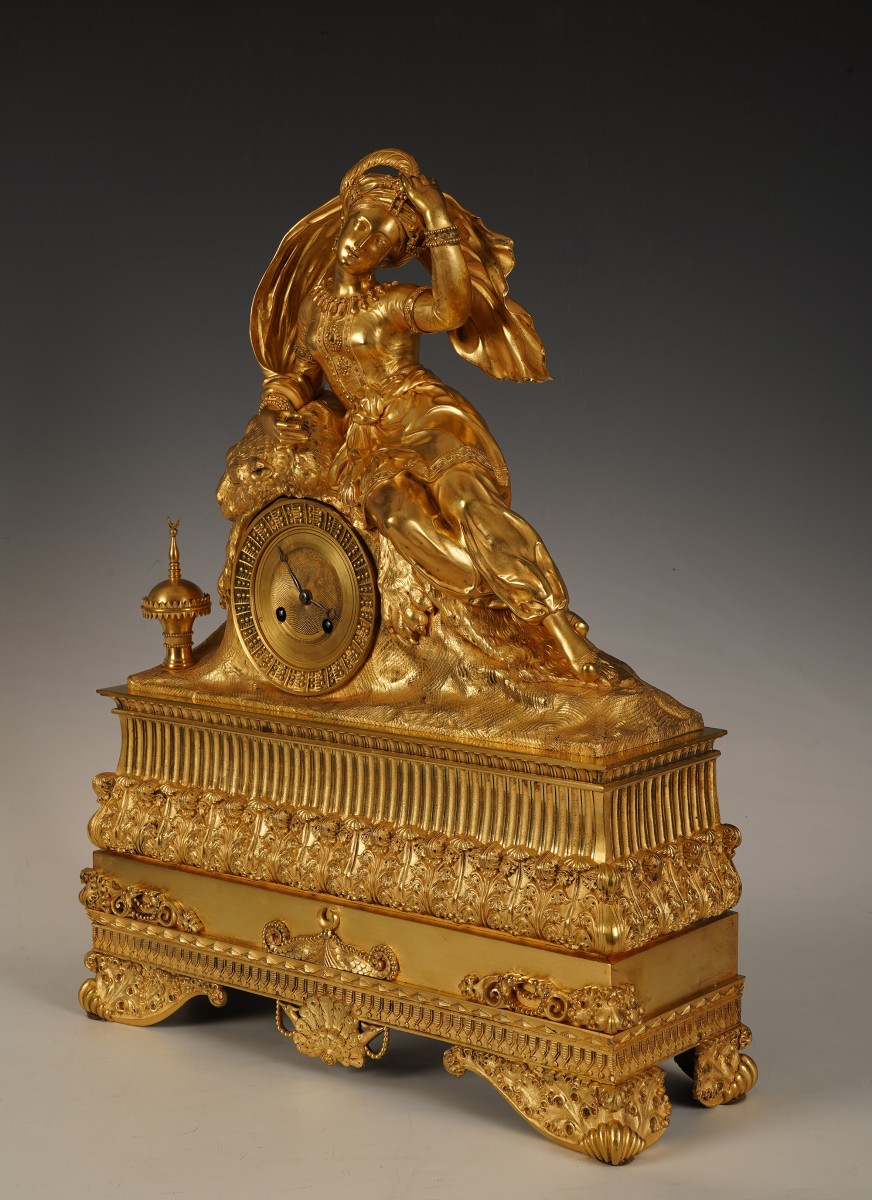
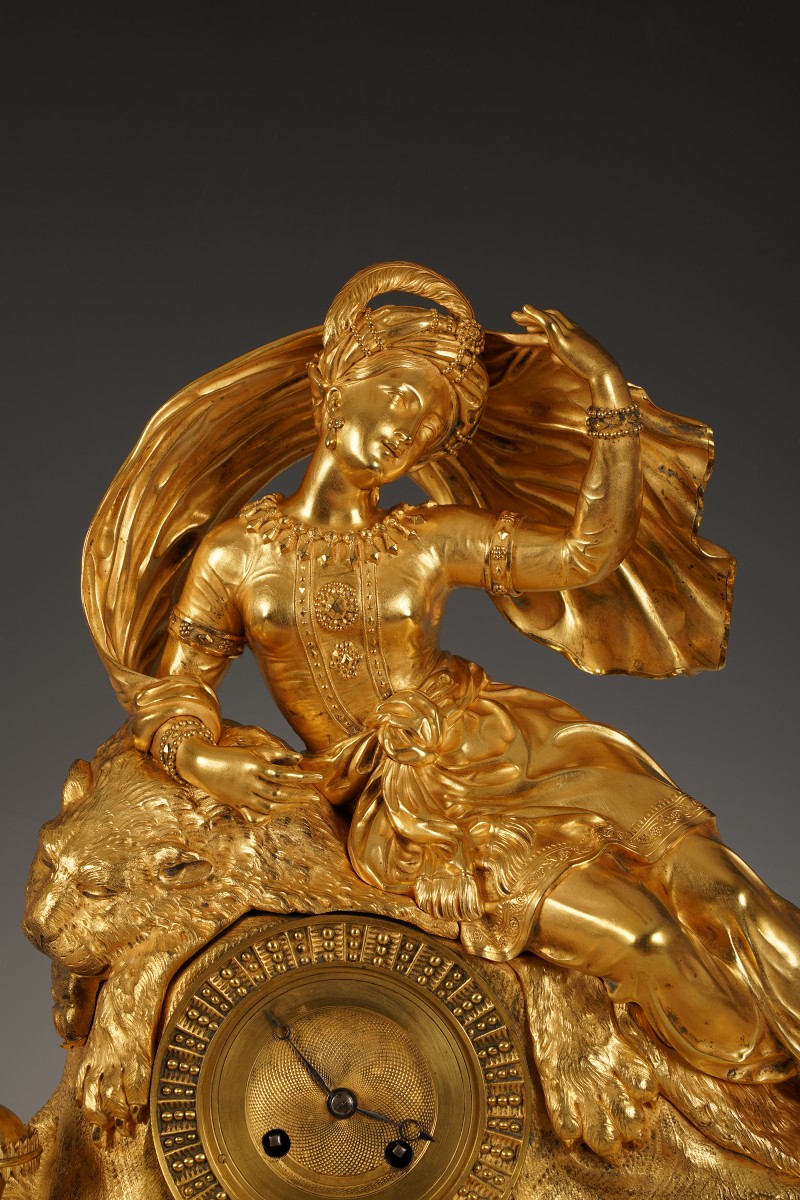
A rare Restoration-period clock in finely chased gilt bronze, depicting a sultana in the manner of an odalisque. The figure wears a turban adorned with an aigrette, gracefully holding a long veil knotted at her waist, and is elegantly dressed in a Turkish-style embroidered costume. Adorned with beaded and faceted jewellery, she is half-reclining on a lion's skin on which she leans, revealing beneath the pelt a circular engine-turned dial and, to her left, a perfume burner (cassolette) topped with a crescent moon. The plinth features a rectangular base with a perimeter band of brushed fluting, scrolling acanthus leaves, and a central crescent moon framed by scrolls, supported on curved, scroll-chased feet joined by an openwork apron centred on a radiating fan flanked by beaded garlands.
CONTEXT
The rise of Orientalism at the turn of the nineteenth century brought about a profound shift in the French decorative arts, replacing the light, fanciful turqueries of the Ancien Régime with an aesthetic imbued with Romanticism and learned exoticism. Sparked by the Egyptian campaign (1798–1801) and continually revived during the Restoration by philhellenism and the capture of Algiers in 1830, this enthusiasm permeated literary and visual creations throughout the period, from Victor Hugo's
Les Orientales to major works by Eugène Delacroix and Jean-Auguste-Dominique Ingres. Under the reign of Charles X, Parisian bronze-founders and gilders seized upon this repertoire of escapism and a dreamt-of harem East to renew the iconography of the figural clock.
RELATED WORK
The idealised treatment of anatomy, the twist of the torso, and the sophisticated interplay of drapery resonate with La Grande Odalisque, painted by Jean-Auguste-Dominique Ingres in 1814 (Paris, Musée du Louvre, inv. R.F. 1158), a seminal work that durably established the canon of Eastern beauty bedecked in jewellery and silks. This iconographic paradigm pervaded the entire nineteenth century, from Eugène Delacroix's Women of Algiers in Their Apartment (1834, Paris, Musée du Louvre, inv. 3824) to Auguste Renoir's Impressionist interpretations, whose Odalisque (1870, Washington, National Gallery of Art) and Parisians in Algerian Costume (1872, Tokyo, National Museum of Western Art) perpetuate this staging of nonchalant femininity amid sumptuary surroundings.