Offered by Galerie Ekinium
REQUEST INFORMATION
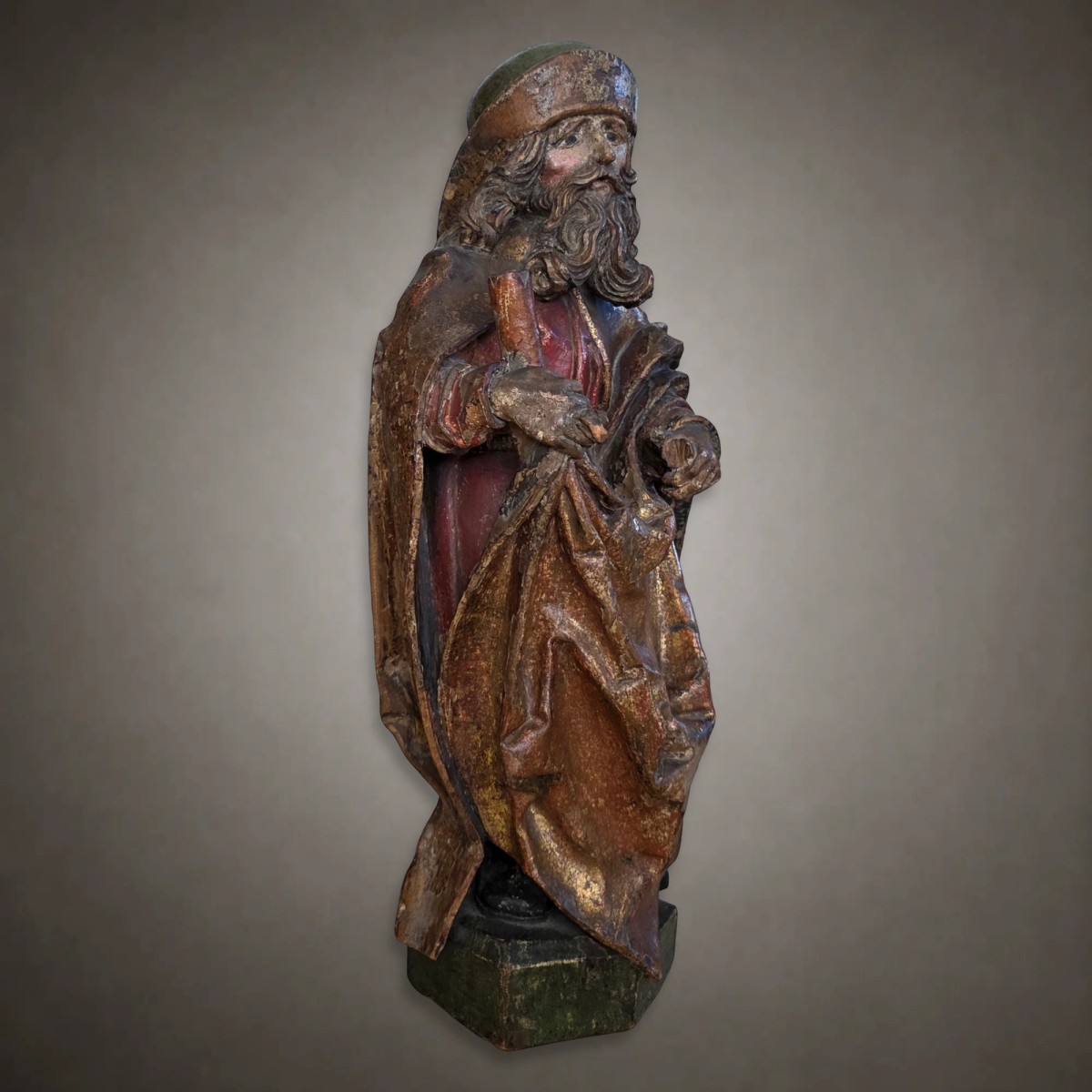
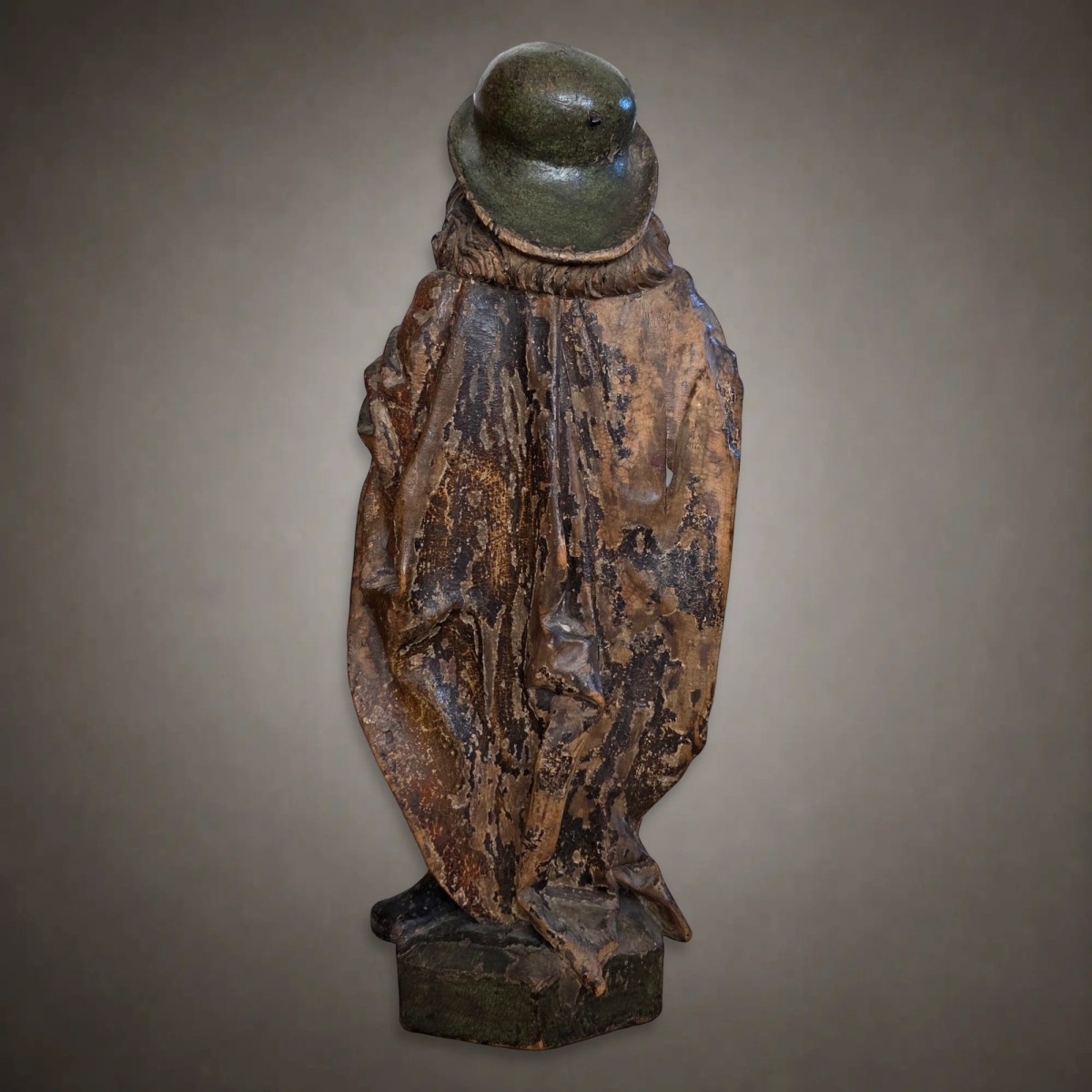

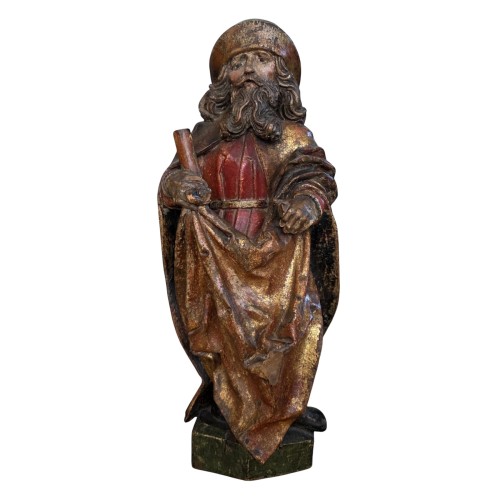
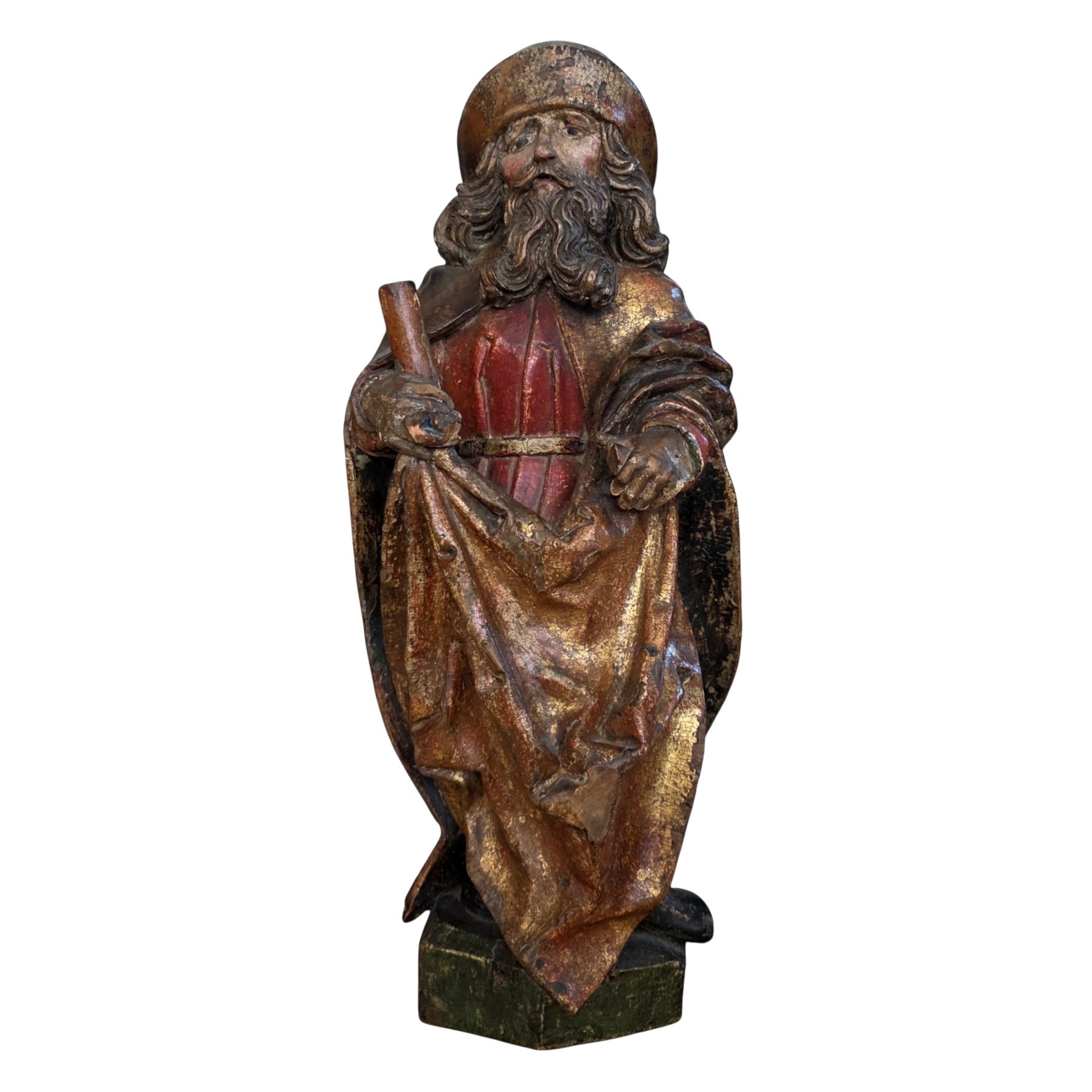
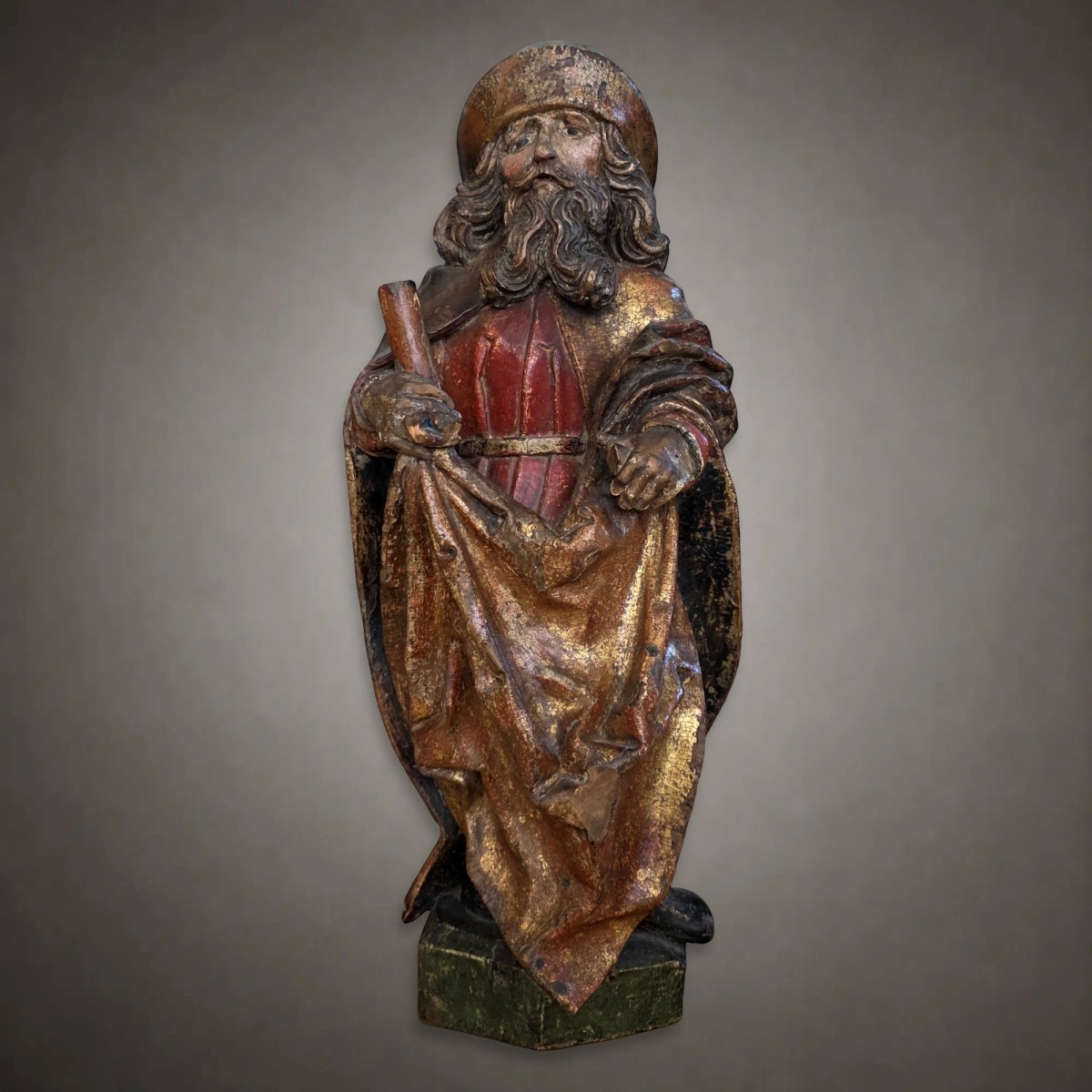
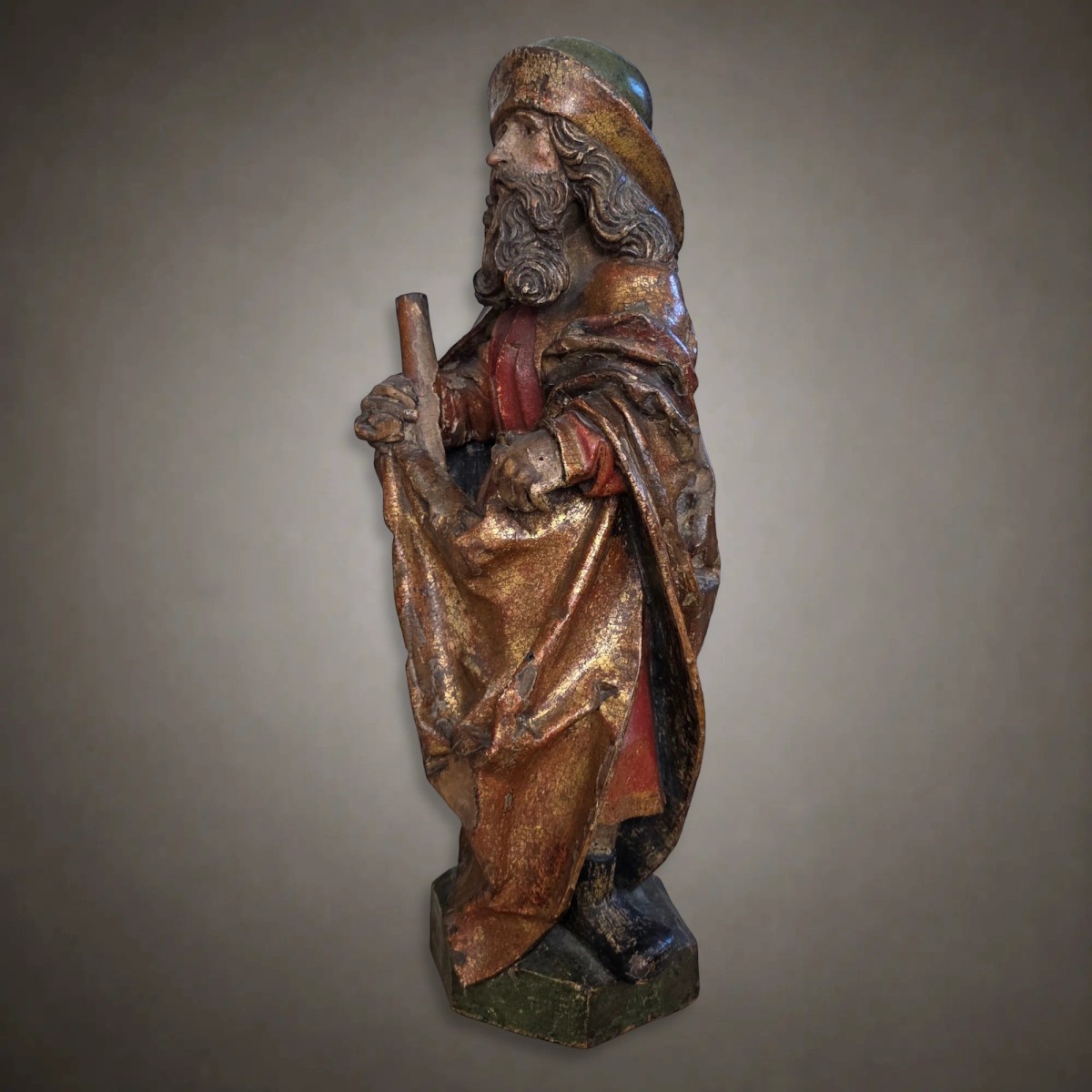
This polychromed and gilt limewood sculpture depicts Saint James the Greater as a mature man, identifiable by his broad pilgrim hat and the fragment of a pilgrim staff preserved in his right hand. Standing 55 cm high, it belongs to the sculptural tradition of the Upper Rhine and can be located more precisely in Basel, circa 1515 to 1520, in the workshop of Martin Hoffmann. The saint is shown standing, enveloped in a broad gilded mantle raised by both hands. His head is thrown back, his gaze directed upwards and his mouth slightly open, giving the figure a powerful expressive intensity. The deeply set eyes, thick eyelids, firmly defined bridge of the nose and beard arranged in vigorously carved locks are the principal physiognomic characteristics of the work. The facial expression, the distinctive shape of the eyes, the compact construction of the hands and the sculptural organisation of the mantle closely relate this sculpture to the Basel corpus associated with Martin Hoffmann. The convergence of these elements supports an attribution to his workshop and a date circa 1515 to 1520.
The closest comparison can be made with the Head of Saint John the Baptist in the Musée de l’Œuvre Notre Dame in Strasbourg, attributed to the workshop of Martin Hoffmann and dated circa 1515. The construction of the anatomical left eye is particularly close: the eyeball turned upwards, a thick and oblique upper eyelid, a more horizontal lower eyelid and a narrow inner corner drawn closely against the root of the nose. The Man of Sorrows in the Unterlinden Museum provides important correspondences in the technical conception of the sculpture, particularly in the treatment of the reverse, the polychromy and the raised head. The Praying Christ in the Musée de l’Œuvre Notre Dame also provides a particularly relevant parallel for the construction of the gaze and eyelids. The Saint Martin in the Unterlinden Museum and the Saint Bishop in the Musée d’Art et d’Histoire de Chaumont complete this corpus through their conception of sculpture in the round, their powerfully modelled hands and their draperies structured by deep ridges and abrupt reversals. Taken together, these comparisons place the Saint James at the heart of the Basel group assembled around Martin Hoffmann and support its attribution to the master’s workshop.
Provenance: former collection of Professor Rudolf Schnellbach, director of the Badisches Landesmuseum in Karlsruhe.
Complete documentation and study available on request.
Delevery information :
Shipping is carried out after full payment has been confirmed, including all applicable fees (customs, transport, insurance).
Risks related to transportation are transferred to the buyer once the artwork is handed over to the carrier.
The buyer may take out additional insurance to cover transport.
We are committed to packing each artwork with the utmost care to ensure optimal protection.