Offered by Galerie Nicolas Lenté
REQUEST INFORMATION
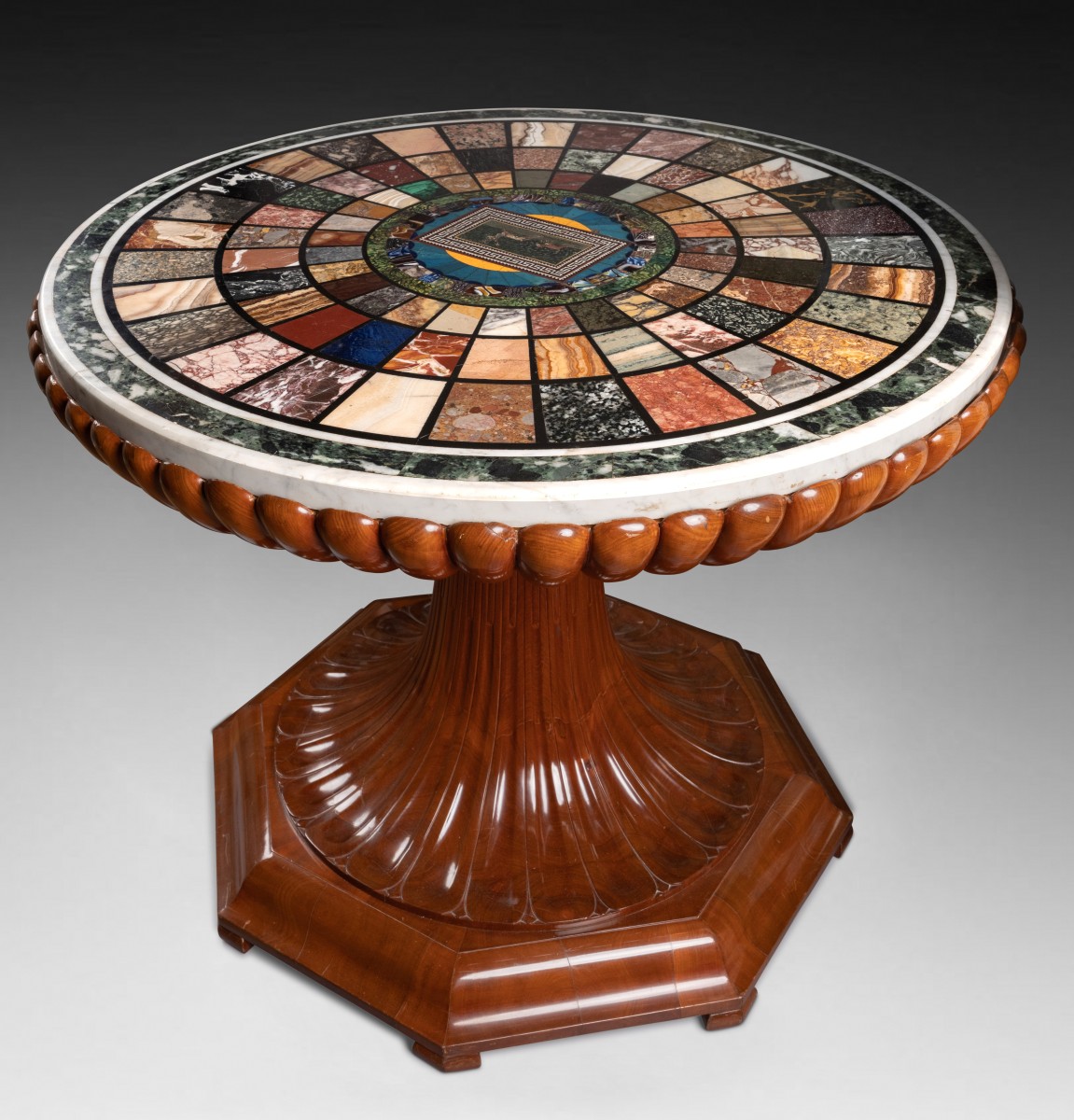
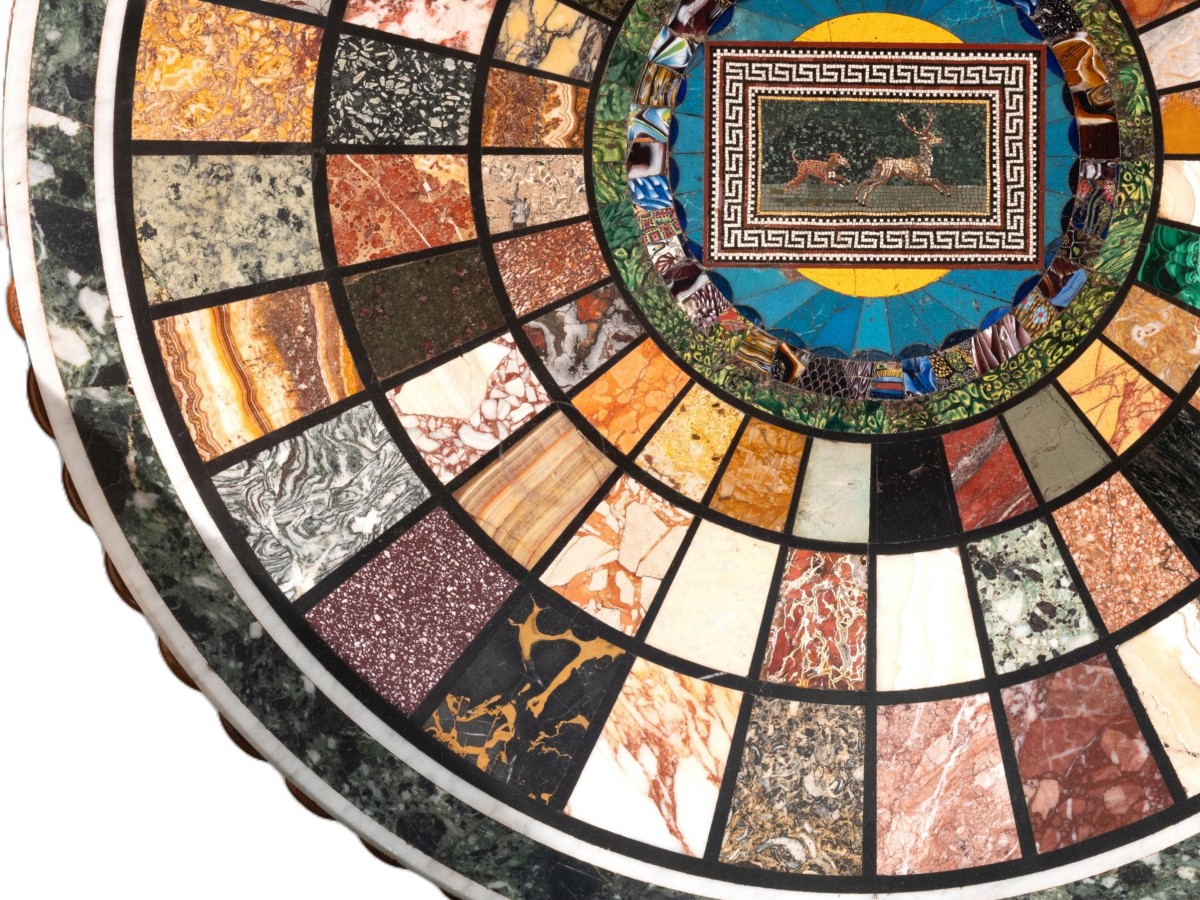

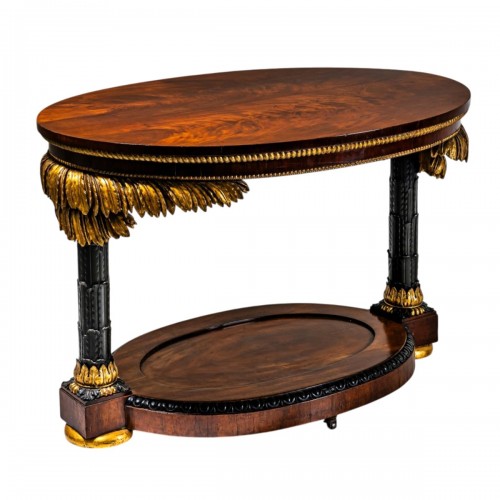
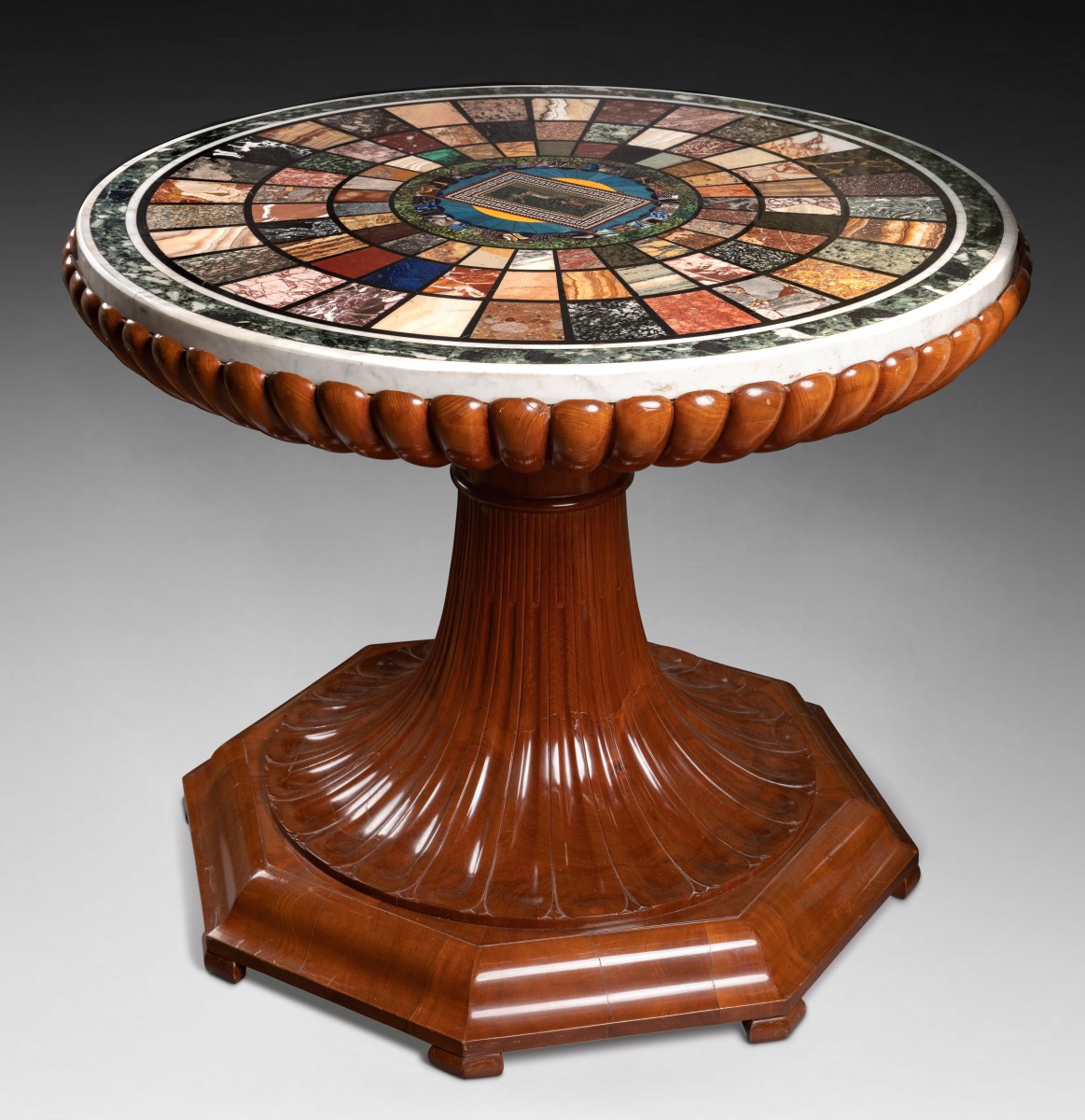
A Mahogany and Mahogany-Veneered Centre Table
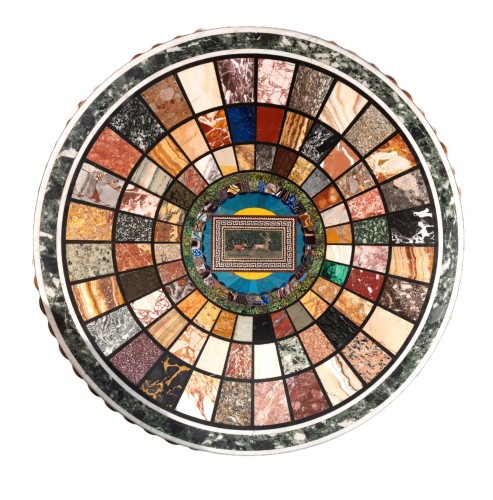
With a Specimen Marble, Hardstone and Ancient Glass Top Centred by a Roman Micromosaic
Rome, Italy, first third of the 19th century
Attributed to Francesco Sibilio
Height: 77 cm
Top thickness: 4 cm
Top diameter: 94.5 cm
An impressive centre table comprising:
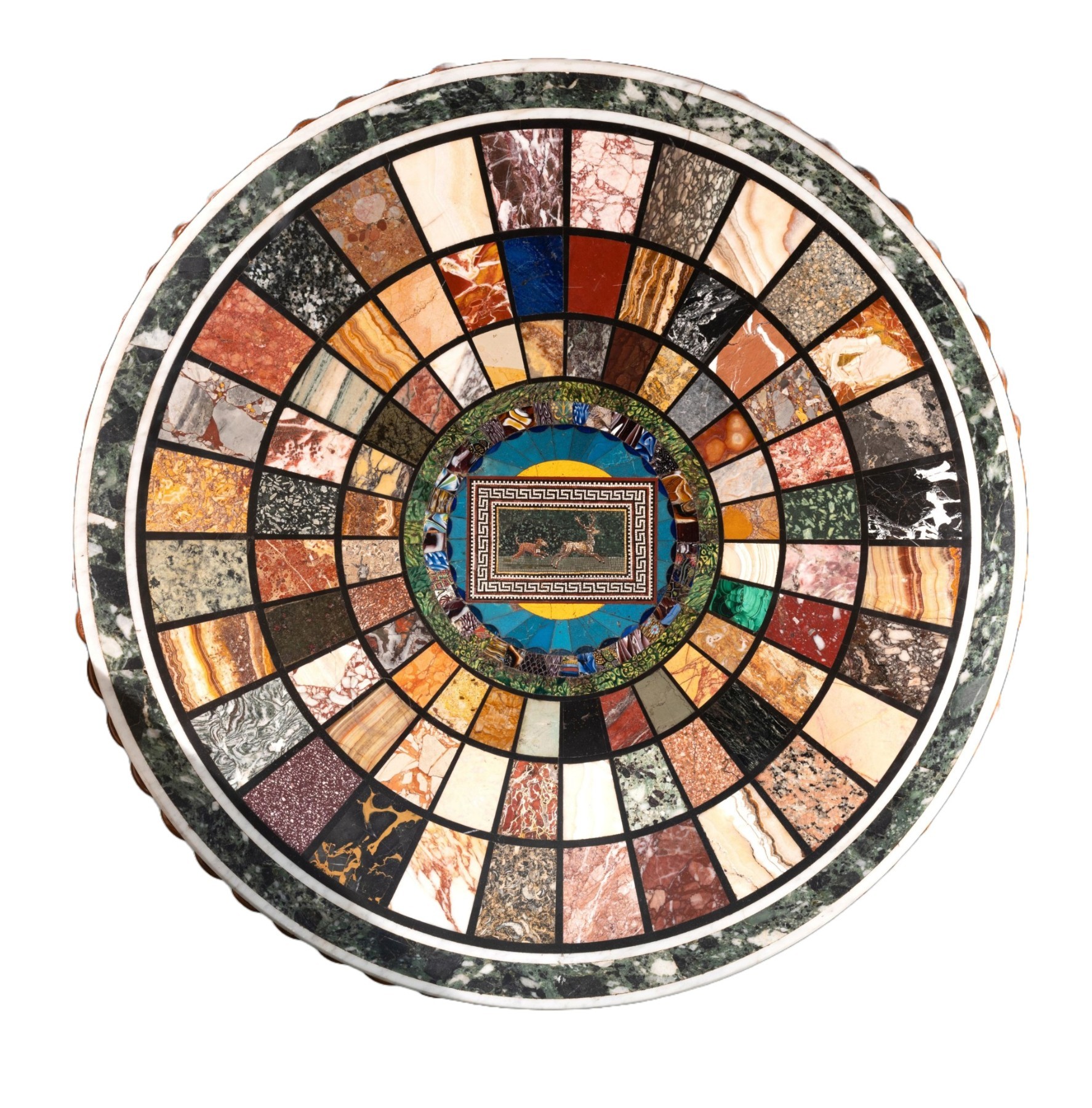
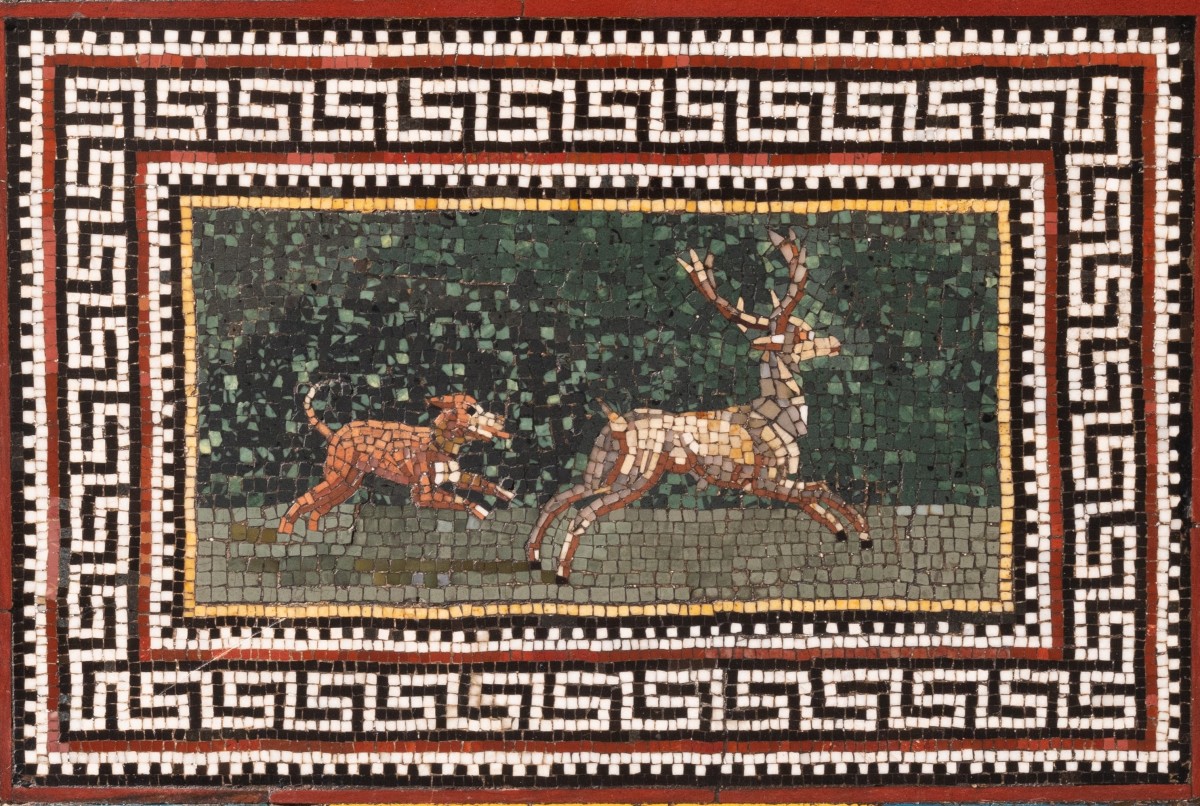
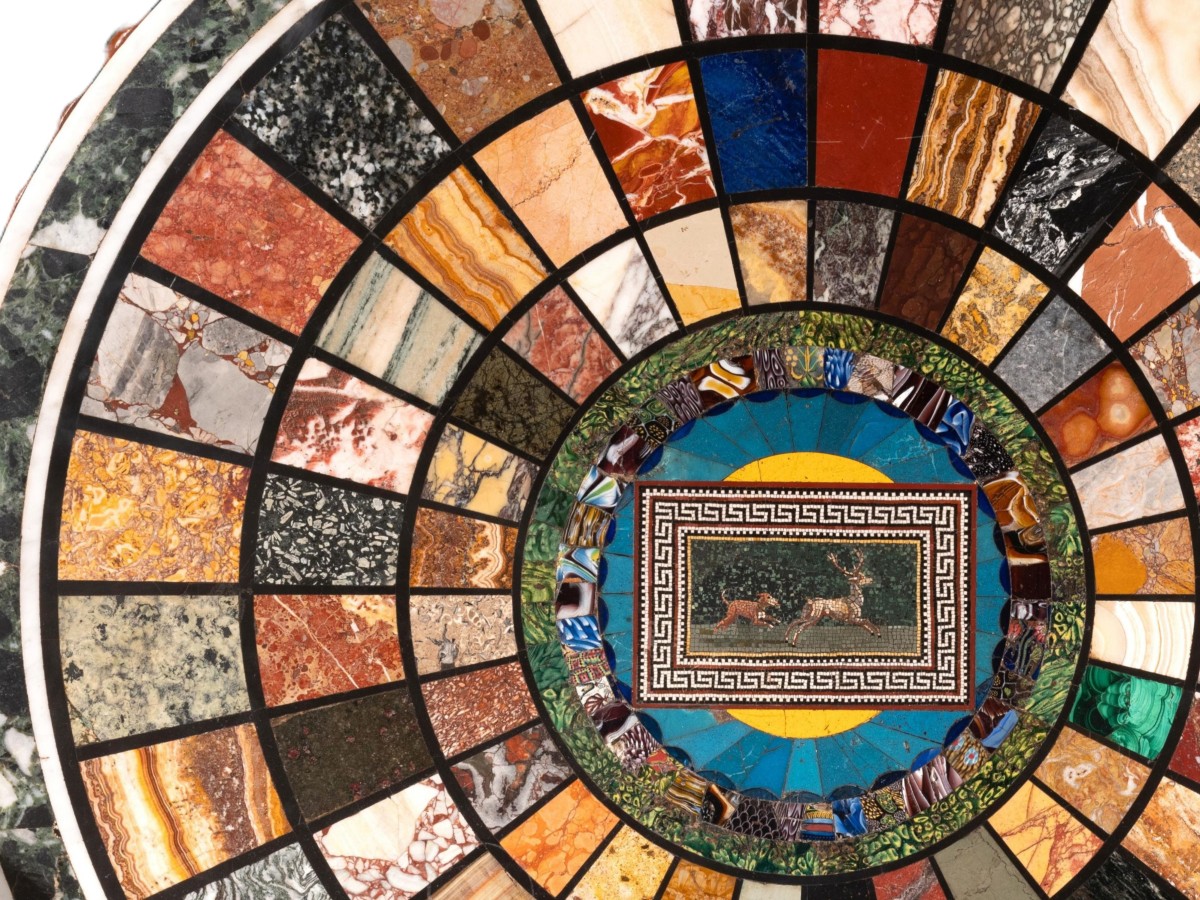
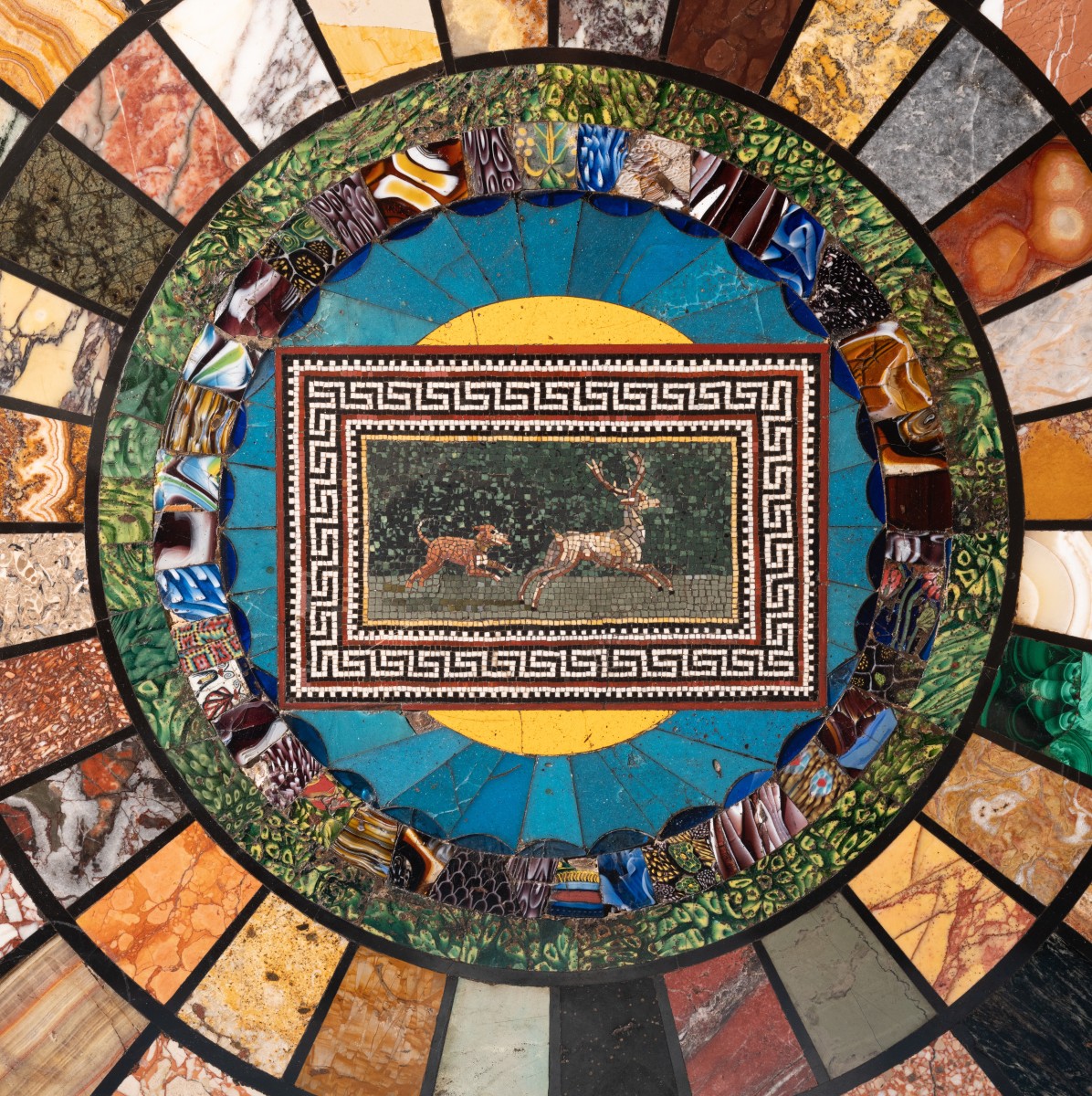
A circular white Carrara marble top inlaid with a band of verde di mare marble and 84 hardstone specimens, divided by radiating strips of black marble. At the centre, a Roman micromosaic depicting a stag pursued by a hound is framed by blue and yellow glass-paste tesserae and two concentric bands of ancient glass fragments, including reticelli, murrina and millefiori, dating from the 1st century BC to the 1st century AD.
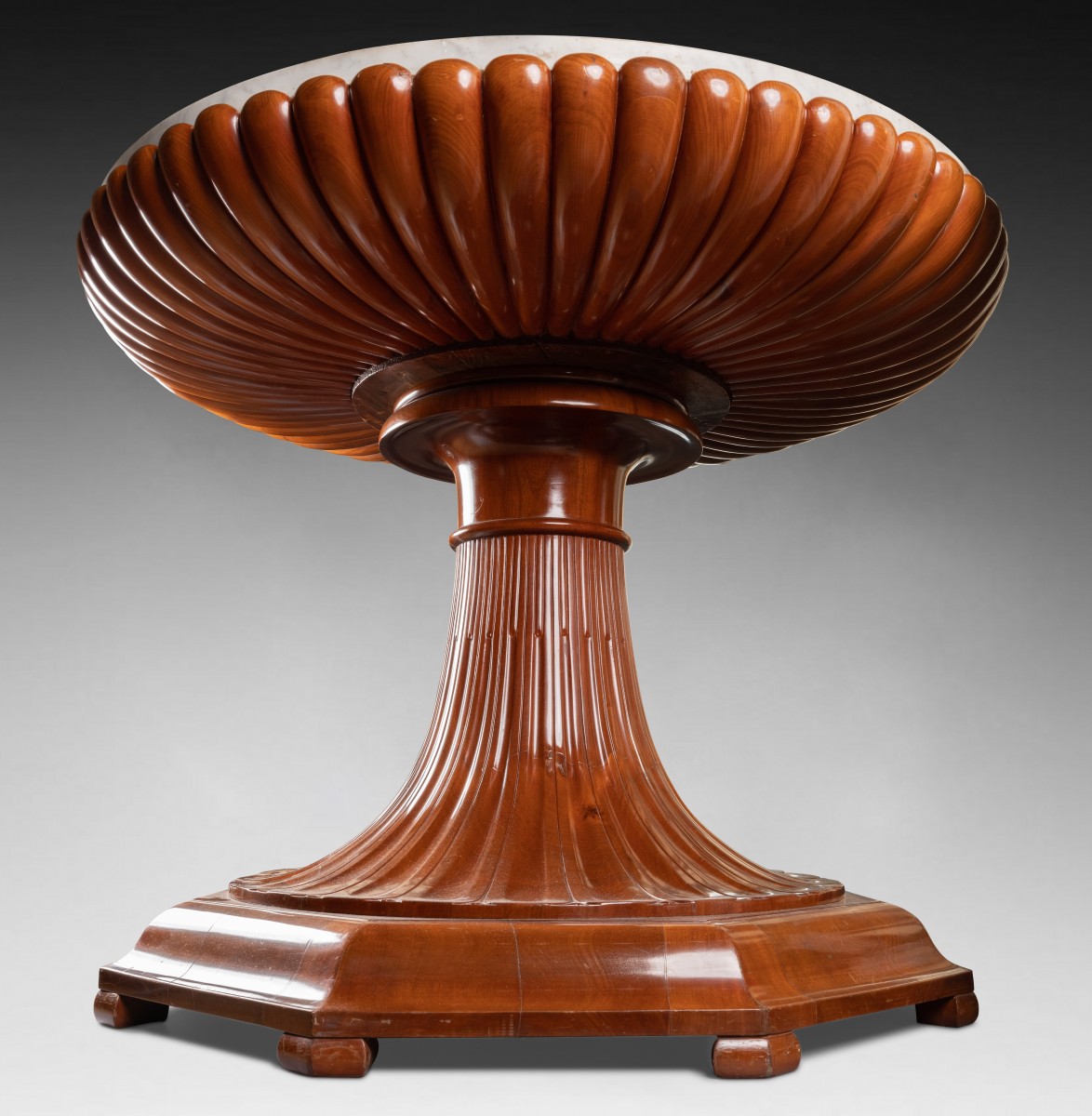
A carved mahogany pedestal with a gadrooned frieze and a spreading, flower-shaped stem, raised on a moulded octagonal base.
The specimens include porphyry, agate, lapis lazuli, malachite, jasper, Portoro marble, Grand Antique marble, brocatelle, granite and alabaster.
Some specimens—including cipollino, Egyptian red porphyry and Greek green porphyry—were recovered from excavations, their original quarries having fallen out of use in antiquity.
Historical Context
The materials and craftsmanship of this table place it within a distinguished group of furnishings and decorative objects produced in Rome during the first half of the 19th century, inspired by a renewed fascination with antiquity and archaeological discoveries. Specimen marble and marble marquetry tops became a speciality of Roman workshops, encouraged both by the steady supply of ancient marbles recovered from excavations and by the patronage of wealthy, cultivated travellers visiting Rome on the Grand Tour.
A number of Roman craftsmen specialised in marble objects, particularly table tops inlaid with specimen marbles, hardstones and micromosaics. Among them, Francesco Sibilio distinguished himself through his use of ancient glass marquetry—the technique employed on the present top. He was also the first craftsman to combine ancient glass tesserae with marble specimens in his table tops.
Francesco Sibilio
Francesco Sibilio was a marble craftsman, antiquarian and dealer in ancient marbles and glass paste. He is thought to have trained at the celebrated Studio del Mosaico della Reverenda Fabbrica di San Pietro, established around 1756 under papal patronage. Micromosaic production was introduced into the workshop in 1795, some twenty-five years after the technique’s rediscovery.
Micromosaic objects enjoyed immediate success. Jewellery, boxes of every description and small pictures became highly fashionable. Their subjects frequently drew on antiquity, featuring architectural capricci, Roman ruins and celebrated monuments such as the Colosseum, the Temple of Vesta and the Pantheon.
In the early 19th century, Sibilio helped foster the taste for collecting marble specimens and incorporating hardstone and semi-precious stone inlays into furniture and decorative objects.
The first half of the century marked a golden age for the study and collection of specimen marbles. Many important collections were assembled during this period, and Sibilio is regularly recorded as a supplier, notably in the catalogue documenting the sale of Francesco Belli’s collection to Count Stefano Karoly in 1842.
An Innovative Technique
Sibilio’s interests extended beyond marble to antiquities more broadly. He pioneered the combination of micromosaics, marbles, semi-precious stones and ancient glass tesserae seen in this spectacular top. He collected fragments of ancient glass and repolished them to reveal the richness of their colours.
His skill brought out an appearance and depth in the glass reminiscent of agate. Most of these fragments date from the 1st century BC to the 1st century AD. Some originated as glass plaques or inlays intended to imitate marble or semi-precious stones, such as porphyry and agate. Others came from glass vessels and tableware. These generally curved fragments were heated and flattened under a press before being reused.
Close examination reveals that the glass fragments are secured with metal, which reflects the light and lends the glass an iridescent effect. Sibilio brought this technique to an exceptional level of refinement.
The substantial white marble slab is also recessed to accommodate the various inlays, enhancing the depth of the composition.
Related Works
Only six table tops are securely attributed to Francesco Sibilio, most of them signed. Four examples may be cited:
A top signed and dated 1824, 67.5 cm in diameter. Casa d’Aste Babuino, Rome, 9 April 2019.
A top signed and dated 1824, 82 cm in diameter. Christie’s, Paris, 28 November 2017, lot 722. Private collection.
A top signed and dated 1823, 64 cm in diameter. Christie’s, London, 15 December 1994, lot 244, and Christie’s, London, 30 September 1999, lot 128. Illustrated in Alvar González-Palacios, “Lavori di Sibilio”, L’armadio delle meraviglie, Milan, 1991, fig. 51. Private collection.
A top dating to circa 1825, attributed to Francesco Sibilio, 67.5 cm in diameter. The Collection of Mr Edric Van Vredenburgh, Sotheby’s, London, 6 June 2006, lot 98.
The central composition of the present top bears a close affinity to Francesco Sibilio’s work, supporting its attribution to him. Its technical mastery and harmonious combination of specimen marbles, glass fragments and an ancient micromosaic reflect his talent and inventiveness. This spectacular piece brings together more than 2,000 years of Roman craftsmanship.
Comparative Bibliography
González-Palacios, A., “Marmi, Pietre e Vetri: Lavori di Sibilio”, Casa Vogue Antiques, March 1991, no. 12, pp. 84–89.
Newby, Martine S., “Francesco Sibilio and the Reuse of Ancient Roman Glass in the Nineteenth Century”, Annali, 16th AIHV Congress, London, 2003, p. 401.
Delevery information :
We organize the shipping and delivery of our artworks worldwide, working with specialized fine art carriers as well as DHL Express for the secure shipment of small and medium-sized works (up to 120 cm).
Each artwork is carefully packed and shipped in a custom-made transport crate to ensure optimal protection. All shipments are fully tracked and insured.
We pay the utmost attention to every stage of the shipping process to ensure fast, reliable delivery. Shipments via DHL Express are generally dispatched within approximately 7 days of purchase.
All of our artworks can be viewed at our Paris gallery and may also be collected in person.