Offered by Galerie Sismann
REQUEST INFORMATION

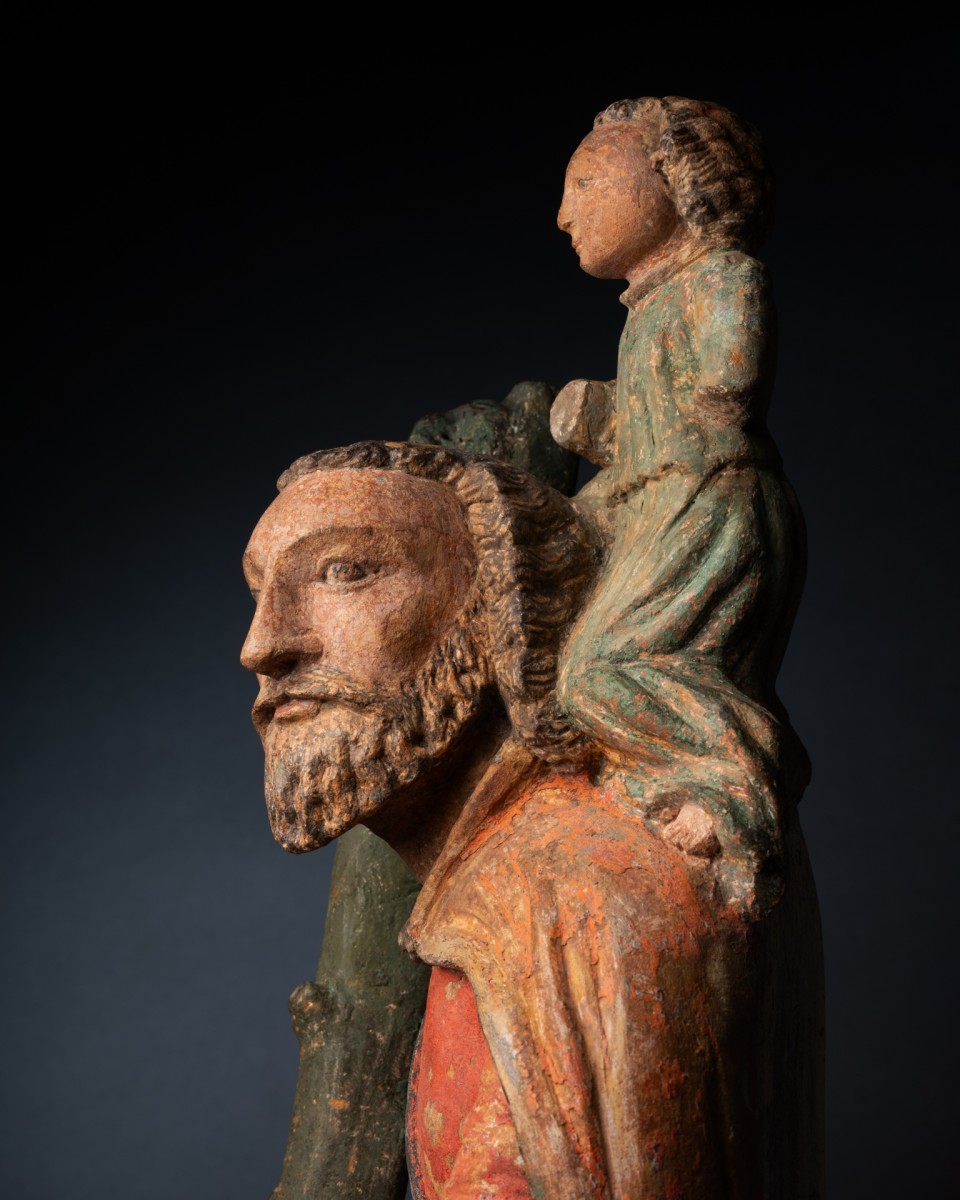
An emblematic figure of medieval popular devotion, Saint Christopher occupies a unique place in the Christian imagination. As the protector of travelers, invoked against the perils of sudden death, he enjoyed a remarkably widespread cult by the close of the Middle Ages. The frequent presence of his image in churches, often positioned near entrances where it could be readily seen by the faithful, corresponds to a deeply rooted belief that catching sight of the saint’s likeness during the day sufficed to ward off peril until nightfall. This protective function accounts for the considerable proliferation of his iconography.
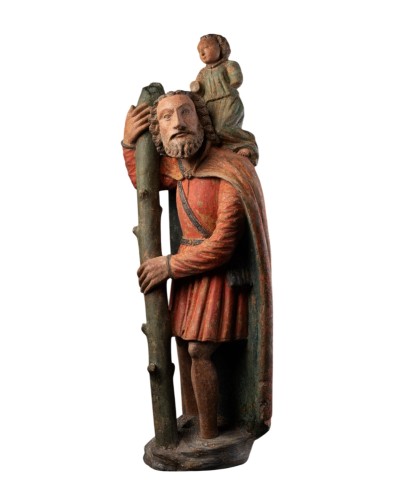
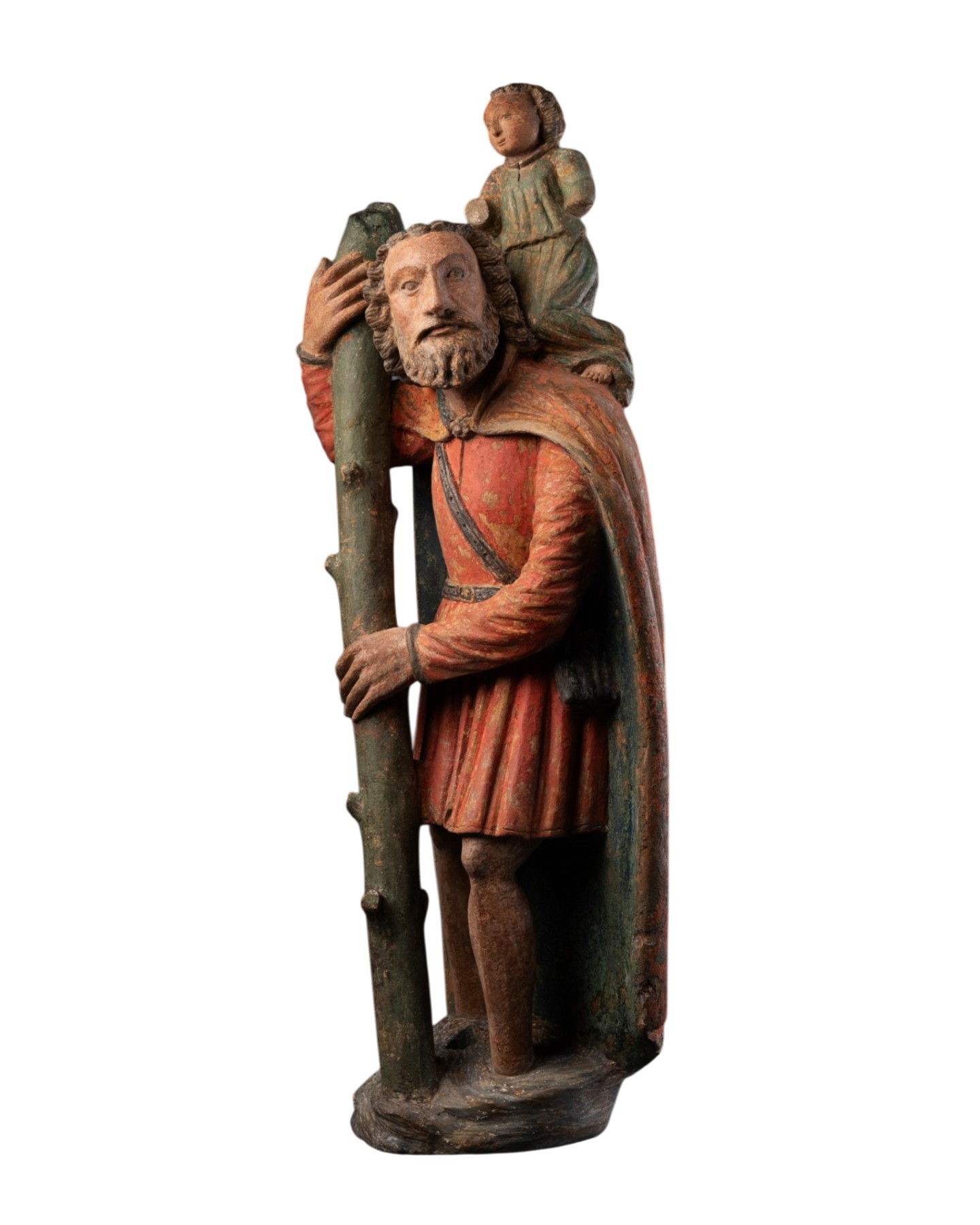
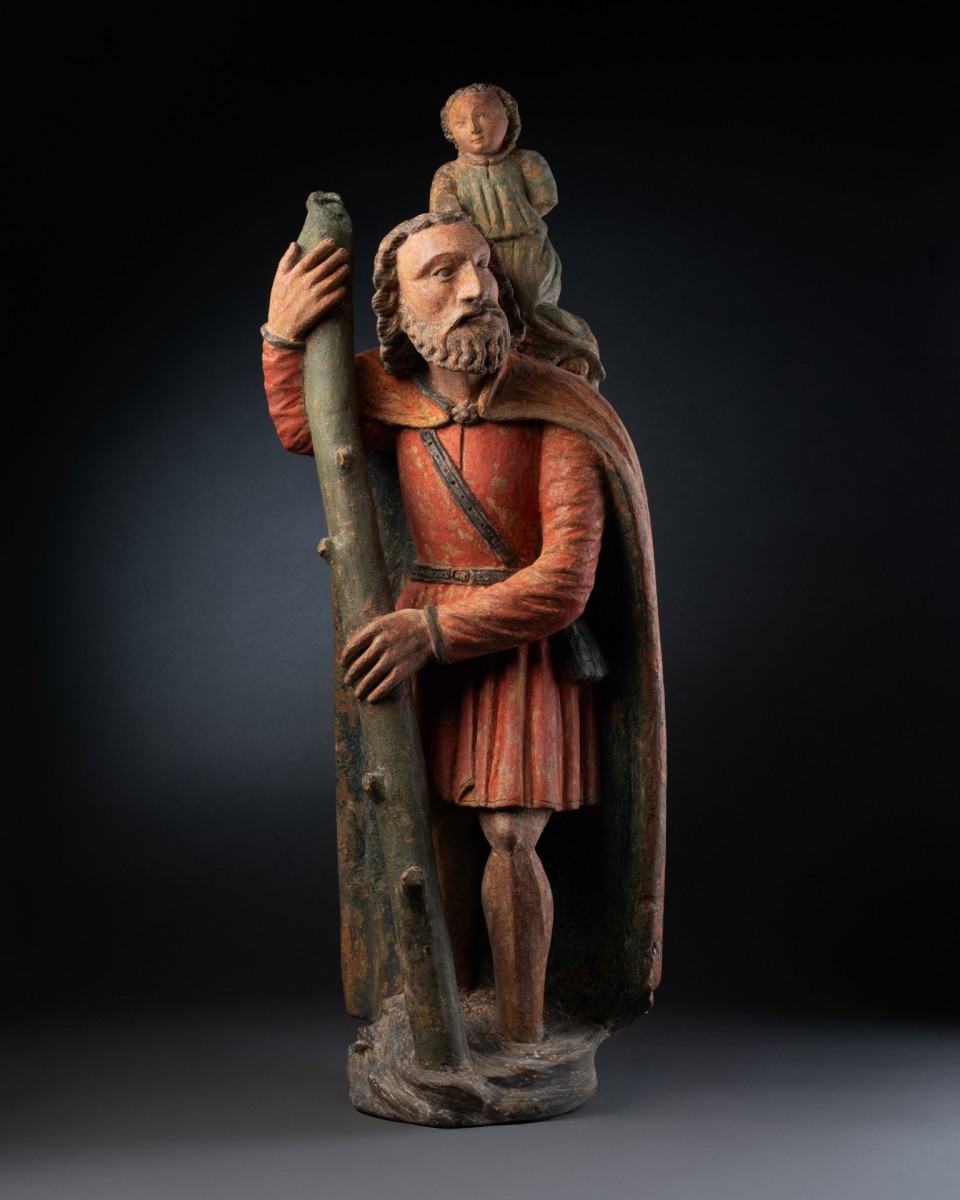
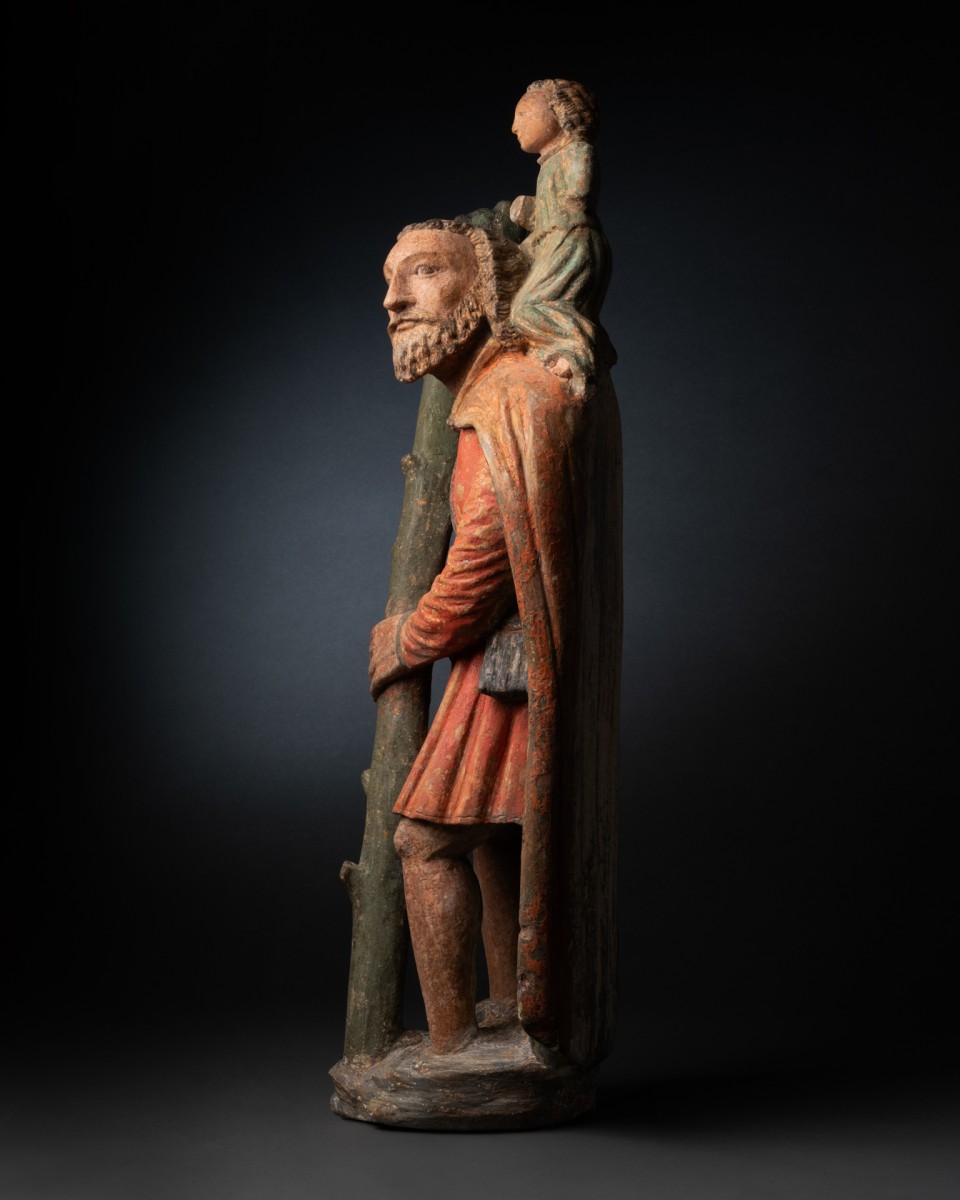
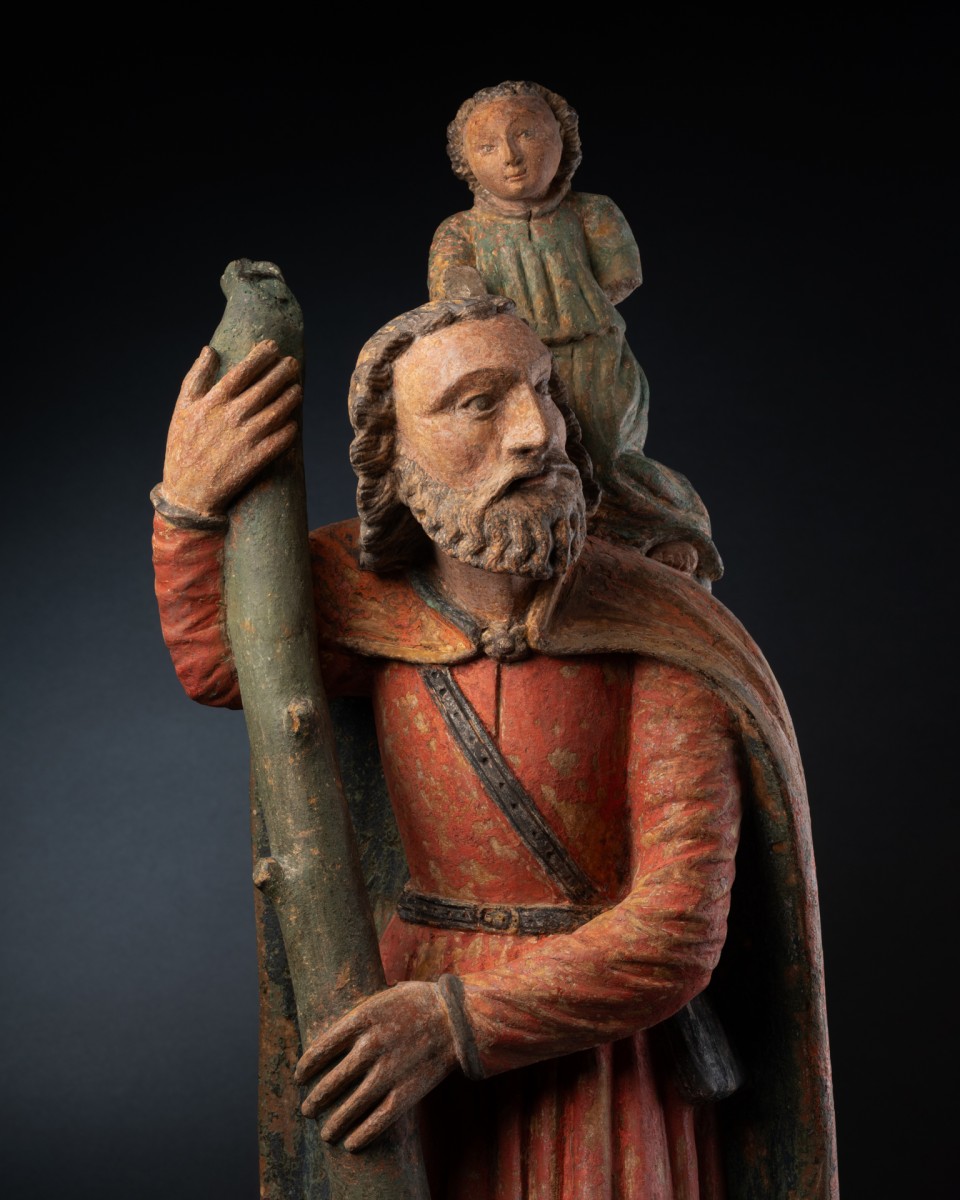
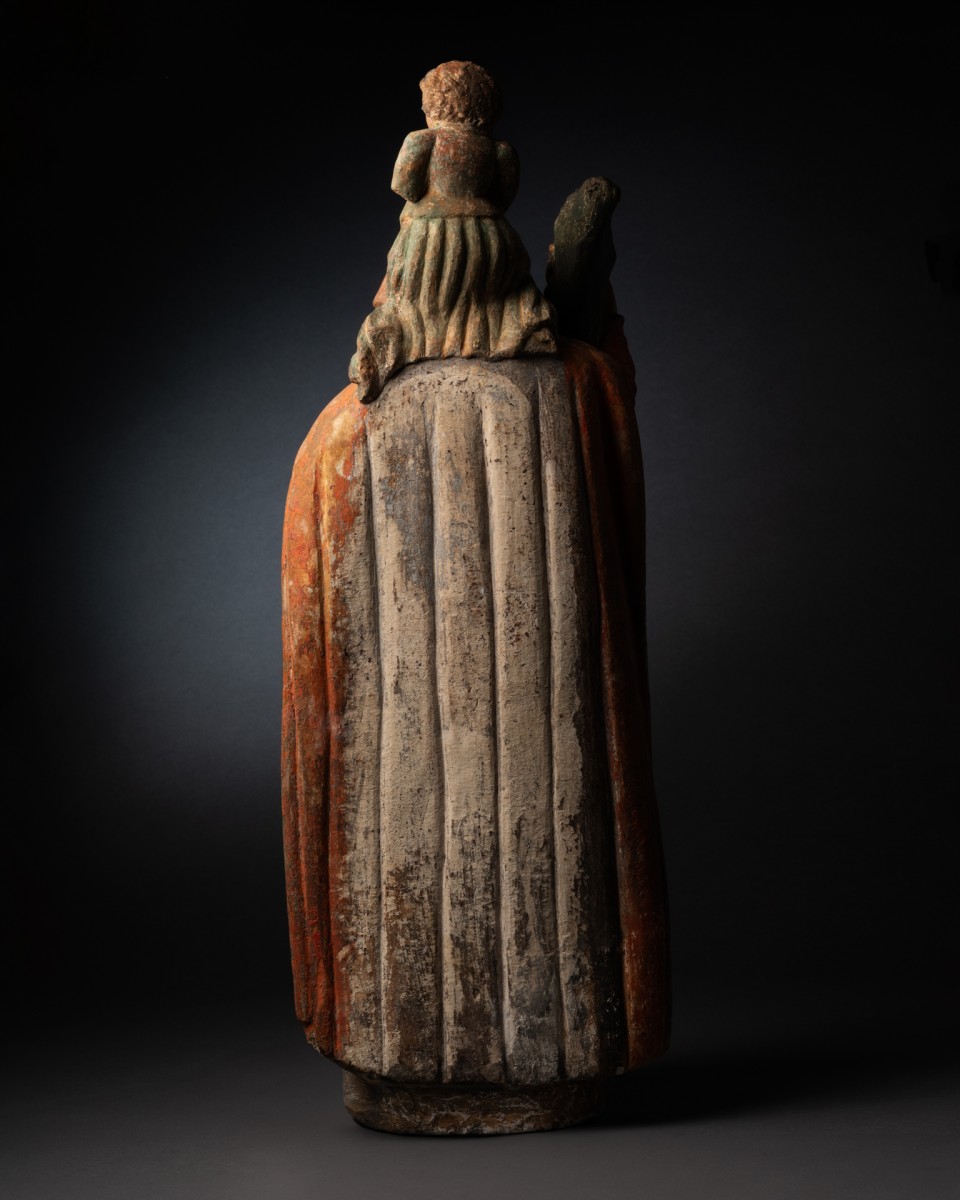
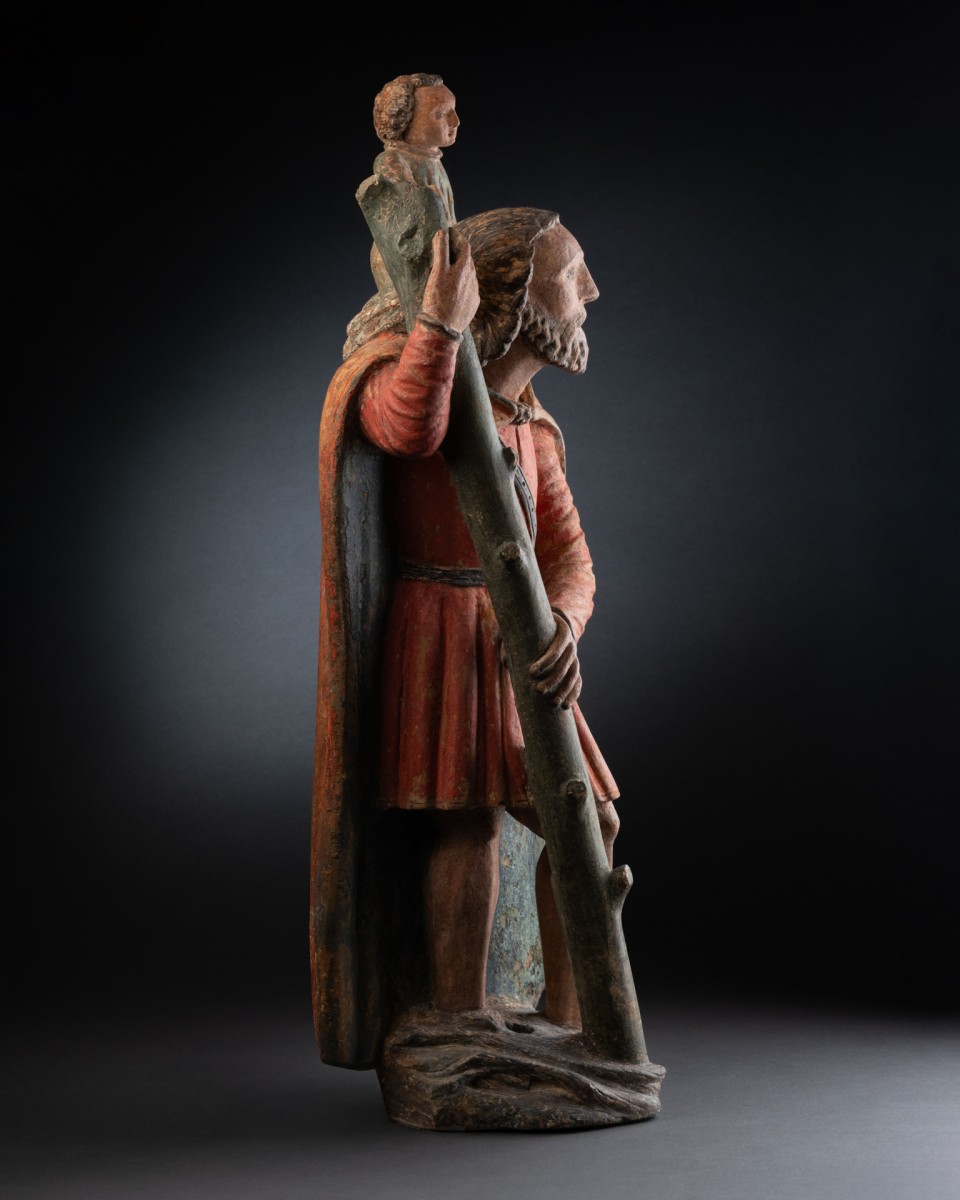
The sculpture presented here follows the traditional schema of the saint bearing the Christ Child on his shoulders. Christopher is depicted standing, dressed in a short red tunic belted at the waist and partially covered by a mantle whose folds fall back soberly into a cape. He leans upon an imposing, knotted staff grasped with both hands, its strong verticality structuring the entire composition. Perched upon his left shoulder is the Christ Child, whose small silhouette contrasts sharply with the bearer’s robust stature. Together, they evoke the central episode of the saint’s legend. According to tradition, Christopher was a man of extraordinary size and strength. Desirous of entering the service of the most powerful ruler, he pledged himself first to a king, then to the devil, before realizing that Christ alone possesses true power. A hermit subsequently advised him to put his strength to use by helping travelers cross a dangerous river. One day, a young child asked to be carried to the opposite bank. Christopher placed him on his shoulders and stepped into the currents, steadying himself with his heavy staff. Yet with every step, the child’s weight grew increasingly heavy, threatening to overwhelm him. Having successfully reached the far shore, Christopher expressed his astonishment to the child, who then revealed that he had not merely carried a small traveler, but Christ Himself, bearing the weight of the entire world. As proof, he instructed the saint to plant his staff in the earth, where it immediately blossomed into leaf.
This foundational episode, which earned Christopher the name Christophorus, the Christ-bearer, gave rise to a well-codified iconography that is adopted within our composition and finds numerous parallels in late medieval sculpture. This is particularly evident in the Cher and Burgundy regions, specifically at Sancoins and Marmagne. Aside from featuring the same core constitutive elements of the subject ; notably the short tunic, the thick staff, and the Child seated upon the saint’s shoulders ; these examples are especially pertinent as they both exhibit a sober treatment of garments, whereas in most representations of the subject, the turmoil of the saint’s mantle echoes the turbulence of the waters. At Marmagne, the composition similarly adopts the same vertical momentum and, to a certain extent, the noticeably static conception that distinguishes our sculpture. Indeed, the motion of the crossing, usually suggested by the saint's posture or the presence of waves, gives way in our piece to a frontal figure, solidly anchored to its base. Rather than simply accompanying the stride, the staff becomes a true structural axis around which the silhouette is organized.
It is within fifteenth-century Lorraine sculpture that our work finds its most convincing stylistic affinities.
A veritable artistic crossroads, medieval Lorraine constituted a particularly active creative center whose statuary drew nourishment from exchanges with the neighboring territories of the Rhineland, Burgundy, and Champagne. These influences manifest themselves both in compositional schemata and in the treatment of figures, within a plastic idiom where formal vigor readily coexists with a deeply human expressiveness.
In this regard, the face of Saint Christopher constitutes one of the most characteristic elements of the sculpture. The prominent nose is set within a visage of assertive proportions, while the relatively small eyes are deeply recessed beneath marked brow arches. The abundant hair is arranged in thick locks swept backward, as if stirred by a gust of wind, punctuated across the forehead by a few curled ringlets that animate this mass. The beard, rendered in large, individualized locks, further reinforces the power of the physiognomy.
This formal vocabulary finds echoes in several fifteenth-century works from Lorraine. The figure of Saint Eligius at Saulny presents affinities in facial construction and the vigorous treatment of volumes. Sculptures from Marville, as well as a figure of a bishop originating from the Metz Museum, also offer points of comparison for the arrangement of the hair and the characterization of the physiognomies. The parallel with the Saint Anthony at Domjulien is especially striking: it shares a comparable manner of treating the hair in thick strands and the beard in strongly individualized masses, alongside a powerful nose and small eyes. These recurrent features across several regional groups point to a shared sculptural tradition rather than a necessarily identical workshop origin [...]
What is ultimately striking is the balance between this formal vigor and the quiet gentleness of the composition. Despite his robust features, Saint Christopher’s face retains an expression that is almost meditative. The Child, smaller and delicately placed upon his shoulder, establishes a silent relationship with him that profoundly humanizes the subject. The sculpture thus seeks less to illustrate the spectacular nature of the miracle than to restore its spiritual and emotional dimension.
An essential part of the work's appeal lies precisely in this simplicity. Unlike more narrative representations, where the river crossing and the physical exertion of the saint occupy a central role, the sculptor here favors a condensed composition stripped of all superfluous detail. The result is a singular presence in which the giant’s physical strength nearly fades away before the tenderness of his connection with the Child. A profound stillness seems to settle around the two figures, investing this devotional image with a particularly touching quality.