Offered by Galerie Magdeleine
REQUEST INFORMATION

Paintings and drawings from the 17th to the 19th century
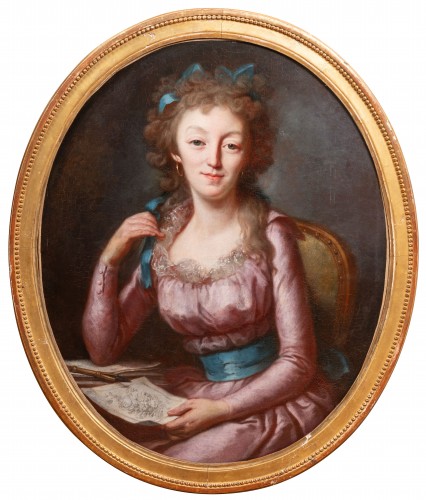
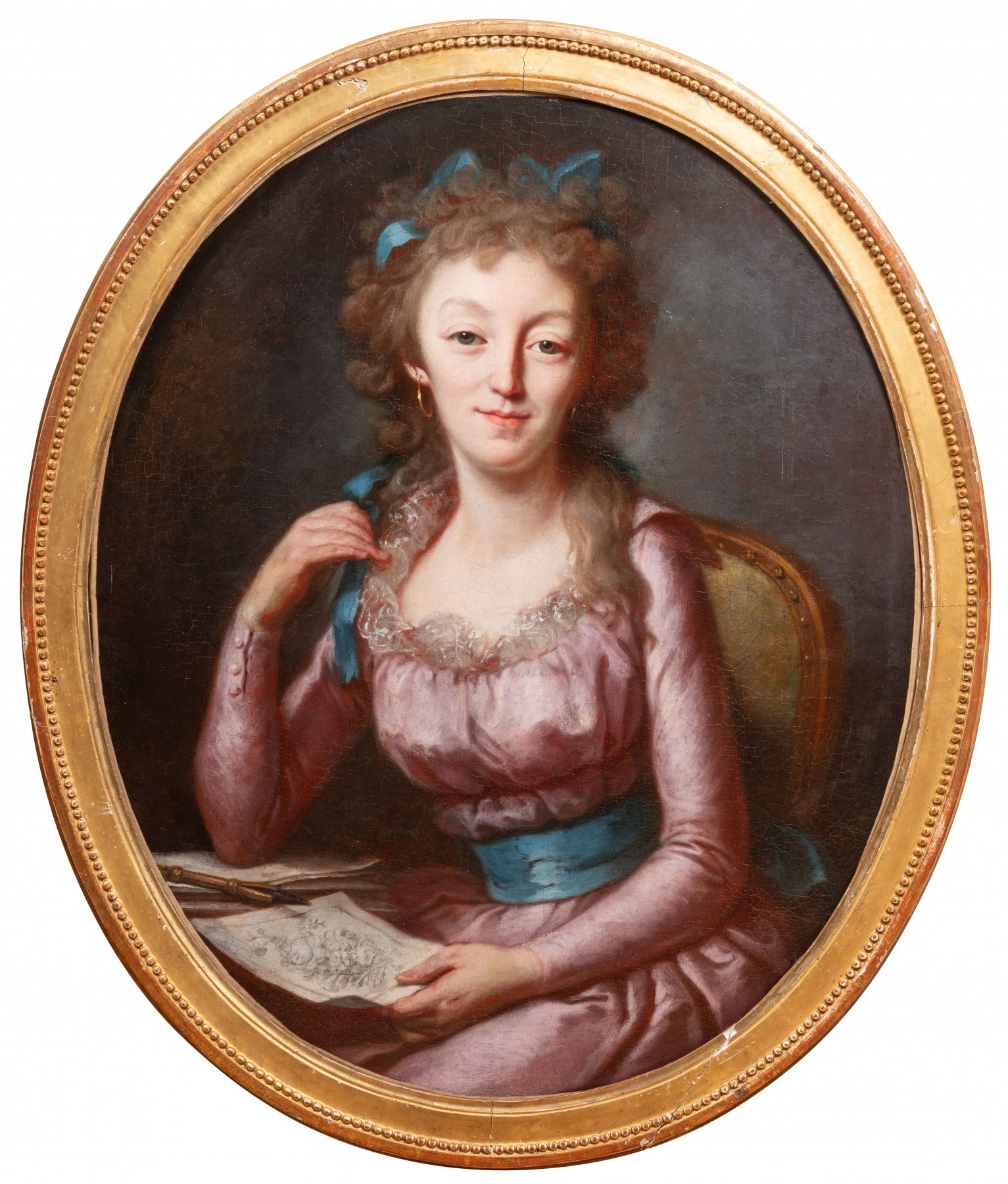
Monique DANICHE (Varallo, 1737 – Strasbourg, 1824)
Self-Portrait Drawing
Circa 1786. Oil on canvas. H: 75; W: 60 cm.
Provenance: Collection of Mme van der Marco.
Marie Monique Rose Tanisch was born in 1737 in Varallo, Piedmont. She was the eldest of eleven children born to Jean Tanisch (circa 1700–1775), originally from the Trier region, and a Tuscan mother, Rose Rossi (circa 1714–1778). The family settled in Strasbourg around 1743 and Frenchified their surname to Daniche, while retaining Tanisch in civil records, a spelling that Monique would continue to use when signing her paintings.
Their father personally trained his children in painting, and several of them became artists: Ursule (1742–1822), Antoine Clément (born in 1744), and Pierre (born in 1752). However, of the eleven children, only two were still alive when their parents died, Jean Tanisch in 1775 and Rose Rossi in 1778: Monique and her younger sister Ursule, both of whom lived with them.
The early years of the two sisters' careers were devoted to religious painting for the altars of churches in Alsace. With the dispersal of Church property during the Revolution, their practice shifted toward portraiture, and from 1790 onward Monique devoted herself almost exclusively to this genre, establishing herself as a sought-after portraitist among Strasbourg's elite. Ursule, of whom no signed work is known to date, appears to have served as her elder sister's assistant, helping her with her work. The two women lived and worked together in Strasbourg throughout their lives, never married, and do not appear ever to have left Alsace.
On August 28, 1784, François Charles de Weittersheim, major in the La Marck regiment, granted Monique Tanisch a three-year lease on Rue Brûlée, at an annual rent of 450 livres, beginning on Michaelmas (September 29). The lease was renewed. In 1789, the sisters were still living at the Hôtel Gallahan, at no. 18 Rue Brûlée. This residence, as it stood in 1784, had been rebuilt around 1770, with an elegant façade preceded by a small garden overlooking the Quai Lezay-Marnésia. The fact that such a residence was rented by two unmarried women living solely from the proceeds of their art speaks volumes about their social standing.
Luttringer established that the Daniche sisters employed a domestic servant and lent money to third parties, a practice that presupposes substantial personal capital.
Dated circa 1786, the self-portrait coincides with the moment when Monique Daniche fully asserted her independence, both artistic and financial.
Two years after signing the lease on Rue Brûlée, at the height of a reputation that ensured her financial comfort, the artist chose to depict herself not in a domestic setting, but at work, holding a drawing pencil. This choice was far from insignificant. To paint oneself drawing was to claim a status: that of a woman practicing an intellectual profession and earning her living from it, in a society that confined almost all women to economic dependence. Such a degree of autonomy was truly exceptional for a woman of that period.
Unmarried (marriage would have entailed the legal dissolution of her independent professional activity), Monique Daniche was in control of her studio, her commissions, and her finances. The self-portrait captures her image at the precise moment when this independence had been achieved: a recognized painter who, free to make her own choices, immortalized herself in the practice of her art.