Offered by Antiquités Philippe Glédel

18th Furniture, country french furniture
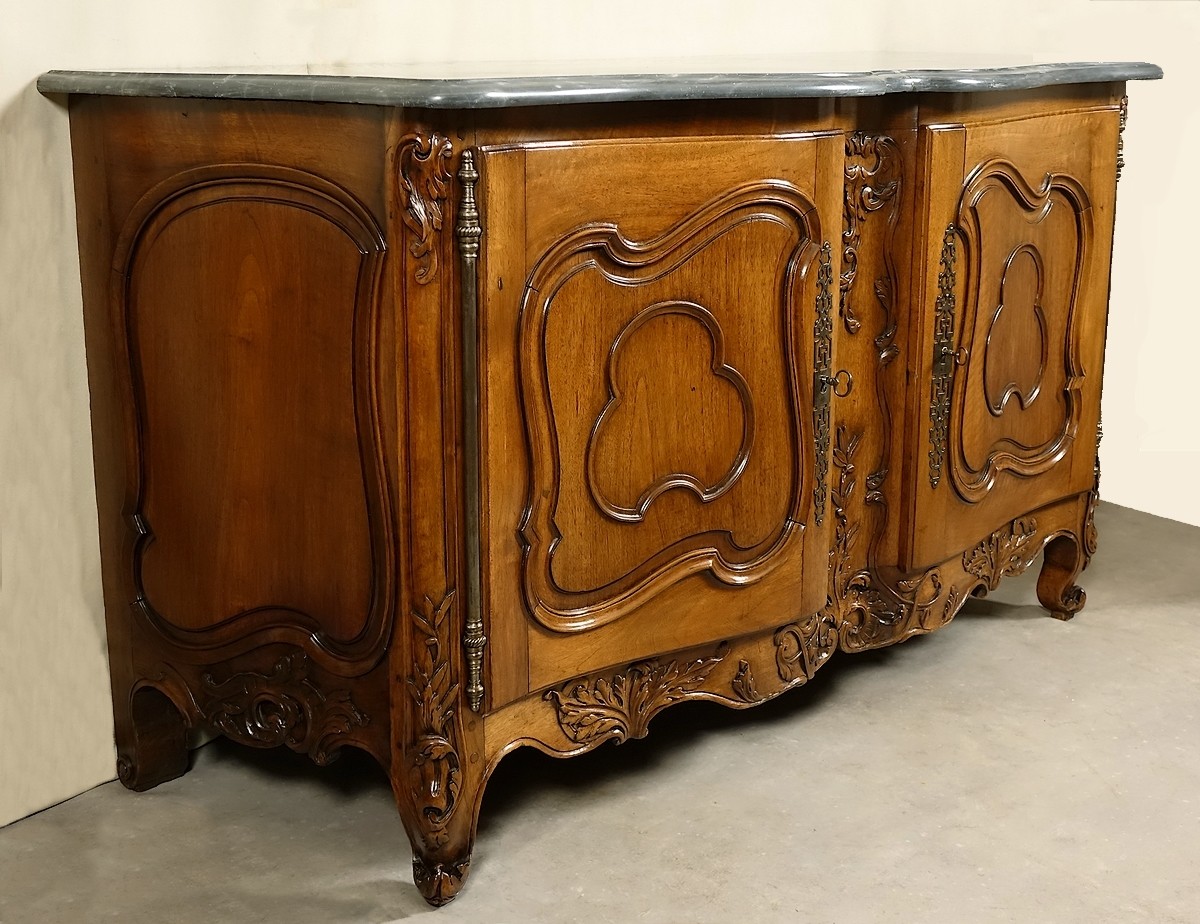
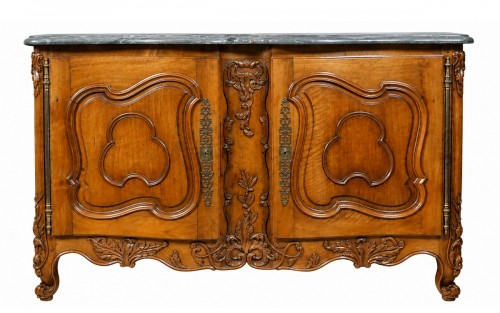
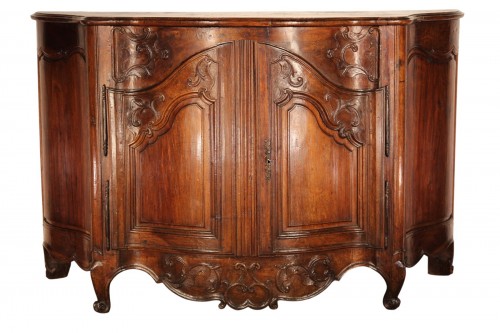
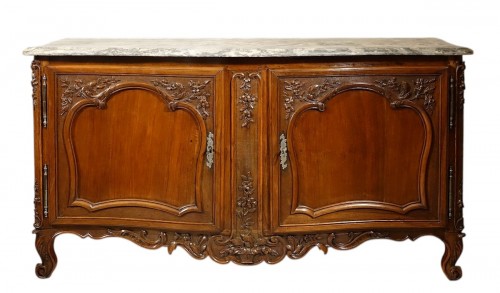
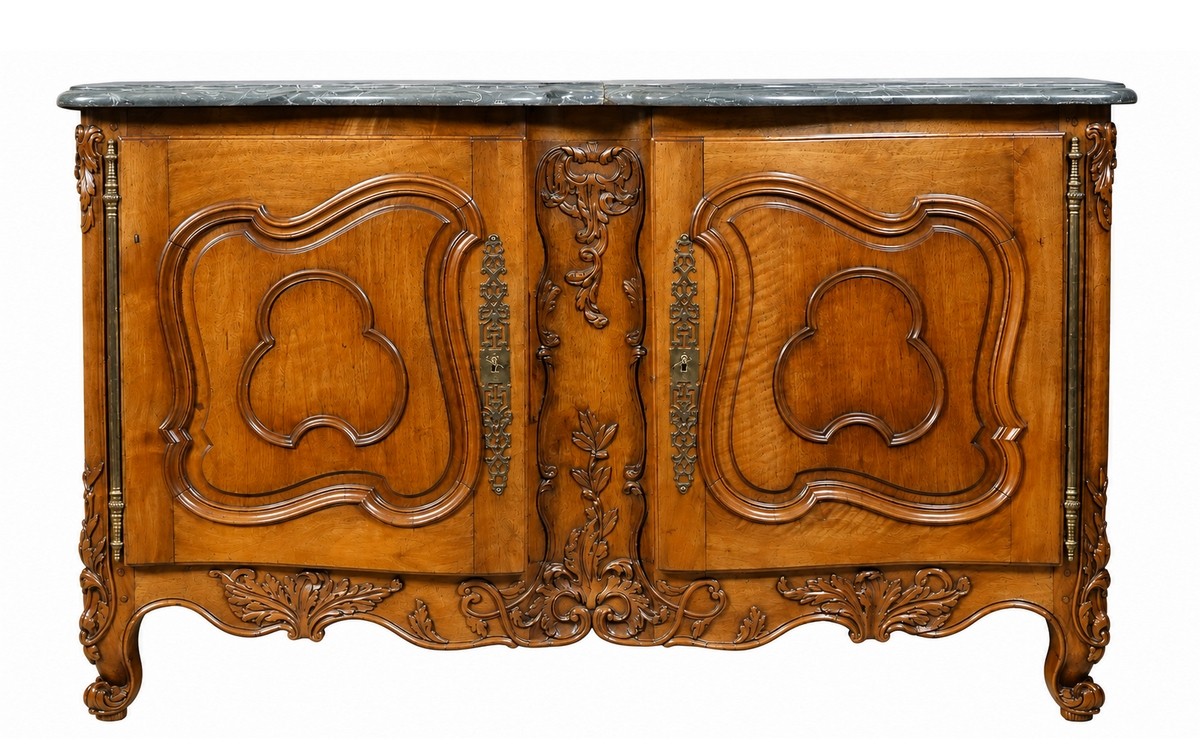
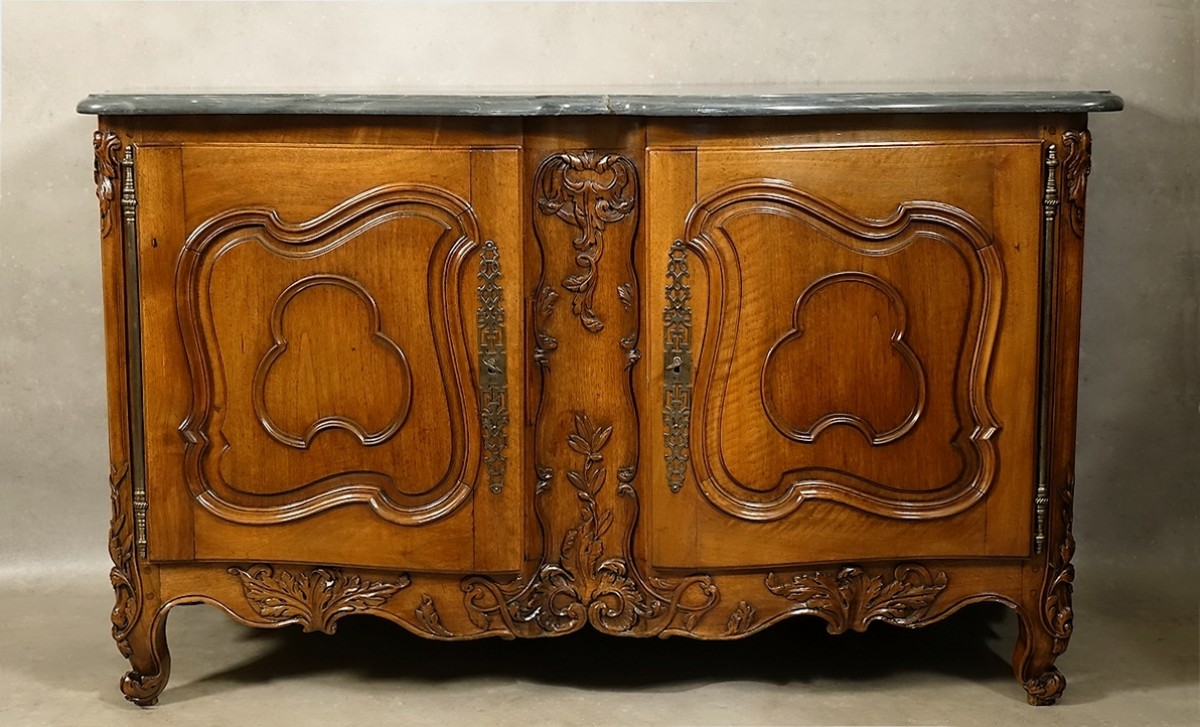
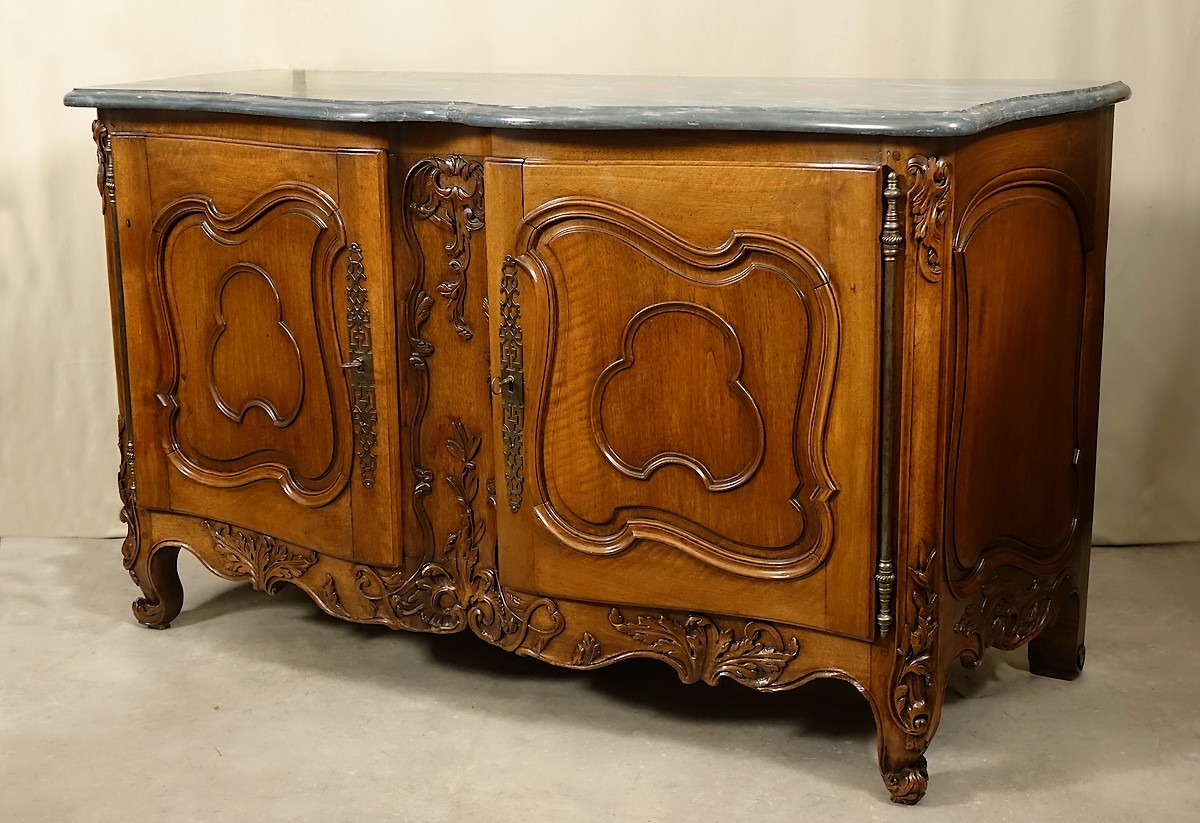
Important ceremonial sideboard, known as a credence, in solid molded and richly carved walnut, curved on all sides, with a serpentine front, topped with Bleu Turquin marble.
Nîmes – Bas-Languedoc – Mid-18th century.
A large Languedoc hunting sideboard in solid walnut
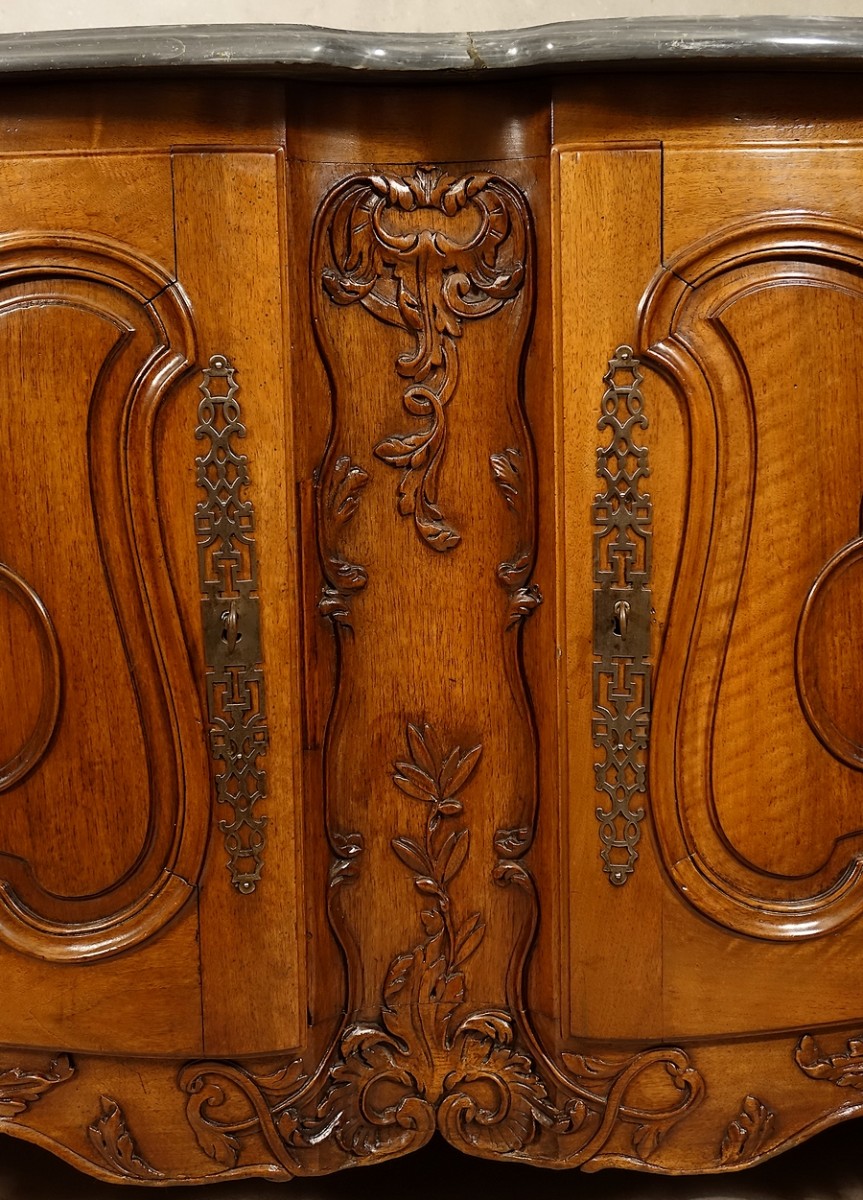
By virtue of its dimensions, the amplitude of its curves, the strength of its moldings and carved decoration, its original Bleu Turquin marble top, and finally its exceptional serpentine front, this large sideboard belongs to a very restricted group of prestigious Southern French furniture from the 18th century. Its distinctive feature is immediately apparent in the façade, animated by alternating curves and counter-curves forming a crossbow profile, with a wide fixed central stile of strongly concave form.
In the 18th century, this type of furniture could be referred to as a bas d’armoire, buffet à pierre, or buffet de présentation; today it would more commonly be called a hunting sideboard, while in Provence it is known as a credence. Intended for an important dining room, it could accommodate silverware and regional faience and, depending on its use, serve for the presentation of game. Its two broad doors are separated by a substantial central fixed stile, a construction particularly well suited to the width of the piece and preventing excessive movement of the doors.
This exceptionally rare example unquestionably represents one of the most ambitious expressions of Provençal and Bas-Languedoc sideboard furniture. Although perhaps less easily attributable between the two major centers of Arles and Nîmes than an armoire or commode, the comparisons gathered in the documentation and the combination of its characteristics favor an attribution to Nîmes.
Reference furniture
Provençal sideboard of the Comte de Brancas – L’ESTAMPILLE 157b
Nîmes enfilade (sic) – Kohn sale, March 26, 2004 – lot 117
A ceremonial piece of furniture
The supple amplitude of the curves of the façade, continuing along the sides, gives the piece a particularly spectacular architectural presence.
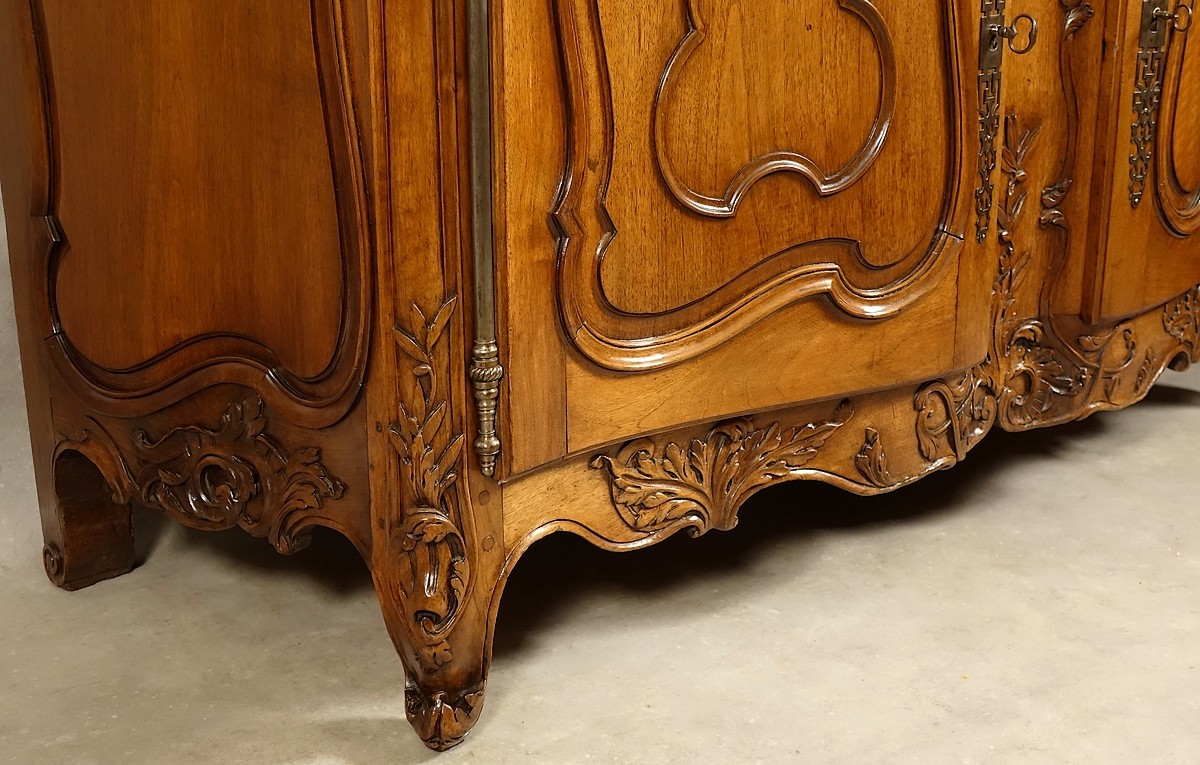
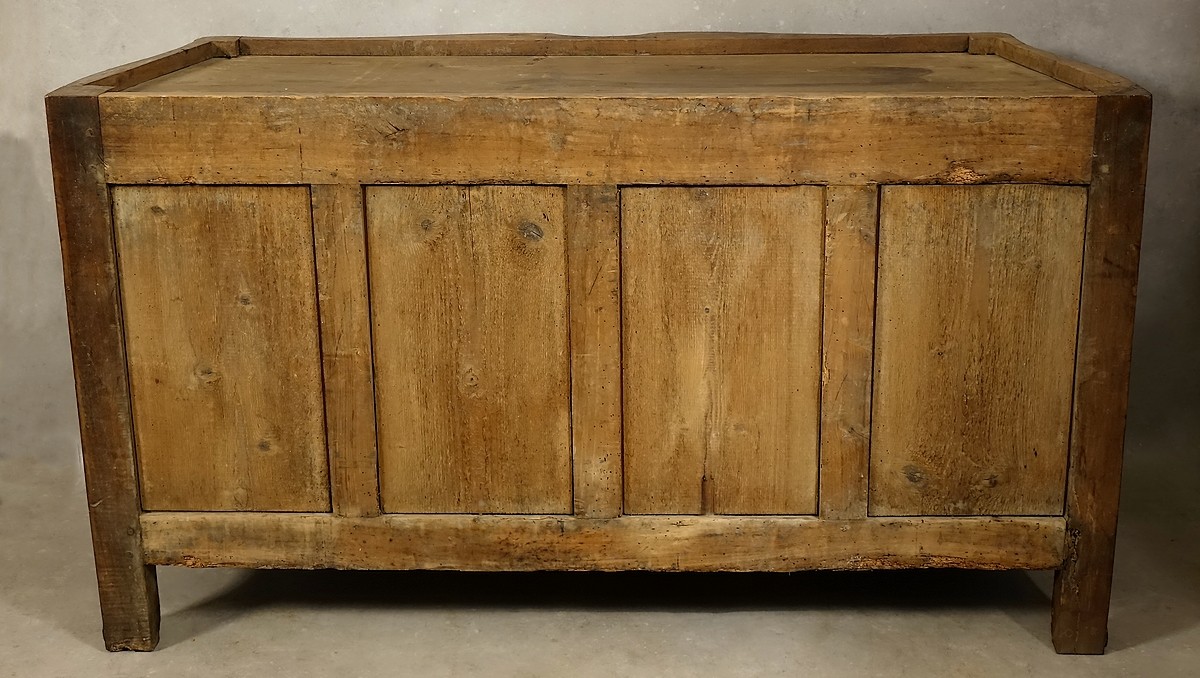
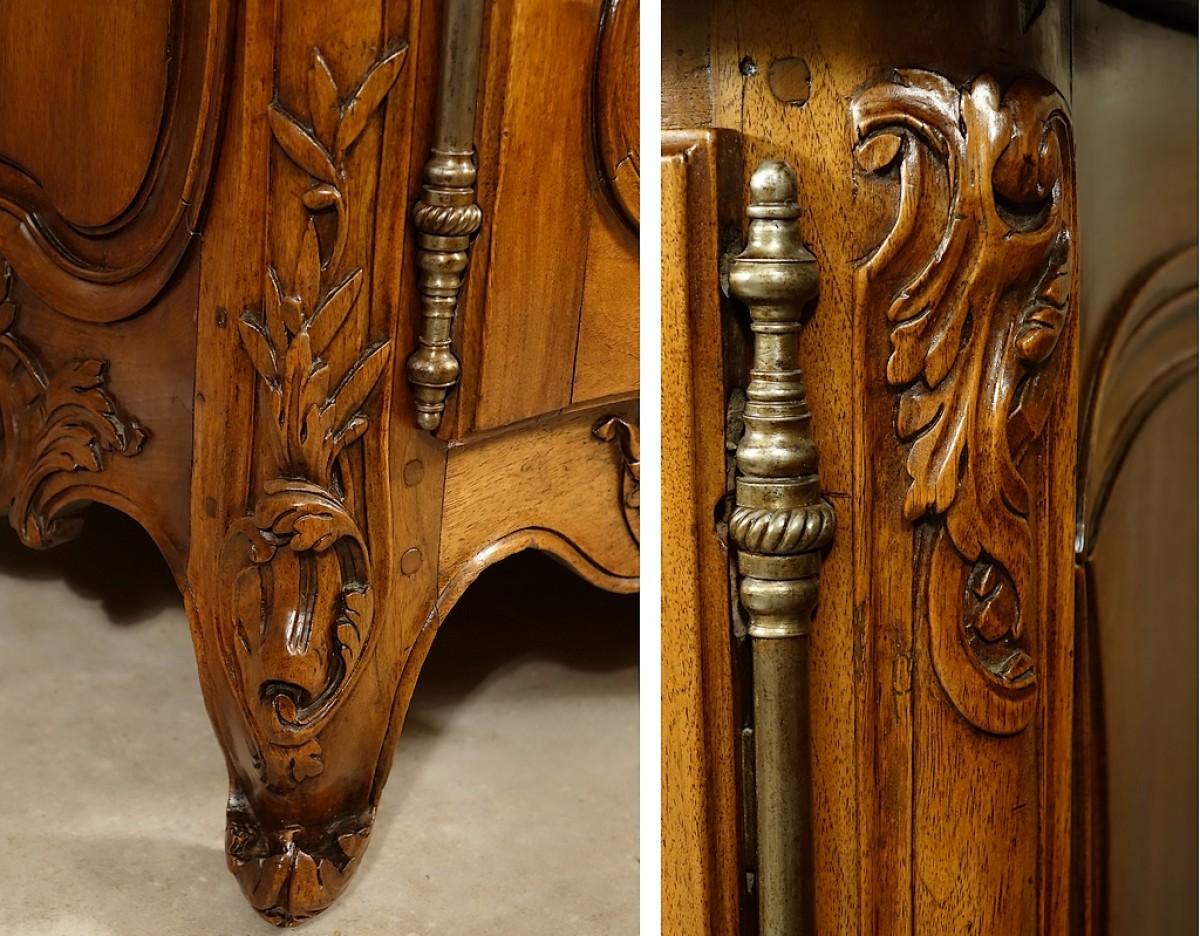
The walnut is of very fine quality and the sections of timber are remarkable, notably those of the uprights (8 cm at the front and up to 13 cm at the rear) and the curved rails (cut from timber 9 cm thick).
The two doors are structured with large-frame quatrefoil moldings, whose design gracefully follows the overall movement of the façade and is echoed by the asymmetrical moldings on the sides. These moldings extend both horizontally and vertically, the latter feature being particularly exceptional and found only on ceremonial furniture. The front panels are additionally recessed with multilobed moldings of distinct outlines, accentuating the impression of depth.
The carved ornamentation combines Rocaille cartouches, palmettes, floral drops, veined leaves, leafy scrolls, pendant motifs, and C- and S-shaped scrollwork. Despite its abundance, the decoration is perfectly distributed, rhythmical, clearly defined, and never overloaded.
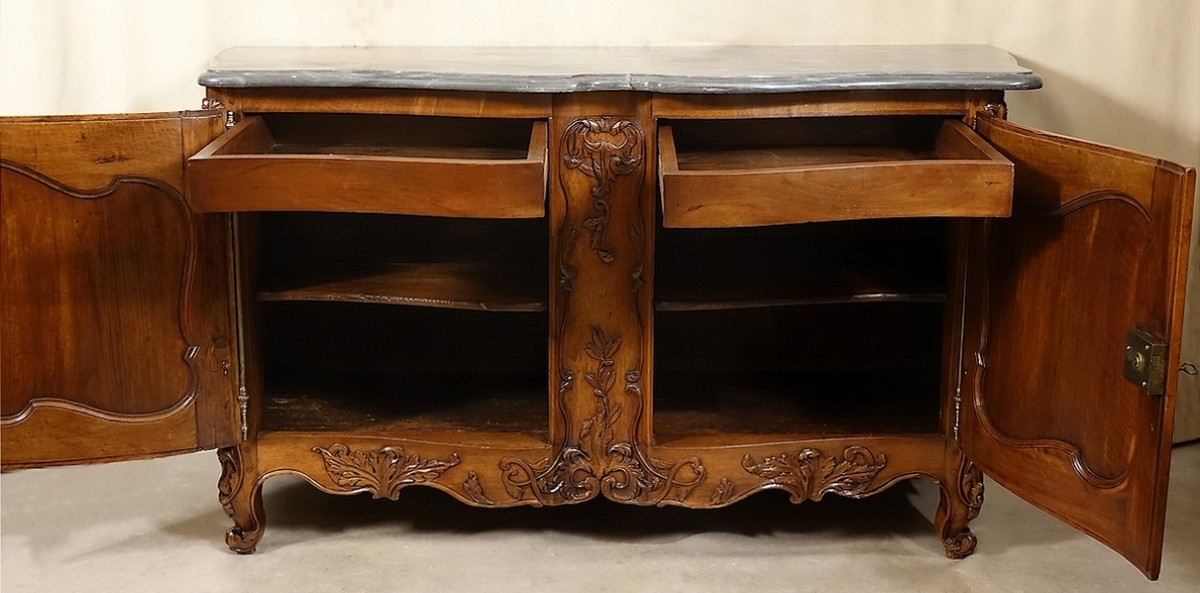
The interior is particularly refined, with two broad frieze drawers slightly recessed beneath the upper rail and curved to the same profile, as well as waxed inner door panels with similarly shaped rails. It was customary to leave the doors wide open during meals, as with Parisian hunting sideboards.
The construction is of high quality: overlay doors — whereas many large Southern French sideboards have inset doors — perfectly executed joints and pegging, and substantial iron fittings. All visible parts are in solid walnut, while all secondary panels are in fir, as on most fine Provençal furniture.
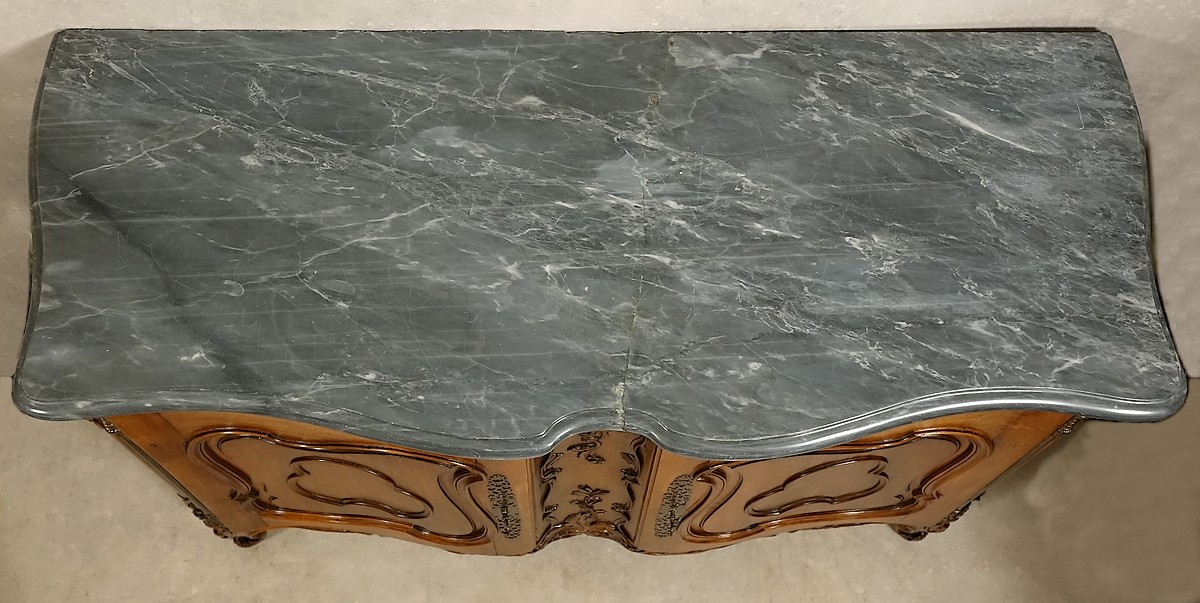
Original Bleu Turquin marble
The sideboard is topped with a superb Bleu Turquin marble slab, 30 mm thick, following the curves of the furniture. Its edge is molded with a substantial bec-de-corbin profile, and the whole weighs approximately 100 kg. The rear edge is chisel-cut, while the hand-polished edge retains the slightly undulating surface characteristic of antique marble. The stone has an old fracture — occurring at the center of the piece, as is often the case over time with large sideboards — restored in a manner that is both structurally sound and visually discreet.
Condition and dimensions
The piece has been preserved in an exceptional original state, made from walnut heartwood of the finest quality, which has protected it from wood-boring insects.
No significant restoration to report.
An ideal piece for storing cutlery in its broad drawers, with ample storage capacity designed for large dinner services. An internal partition divides the storage space.
Completely serviced and finished with a very high-quality traditional filled wax polish.
Dimensions: 102 cm high × 180 cm wide × 73.5 cm deep.
Marble dimensions:
Length: 180 cm at the rear and 163 cm at the front.
Width: 73.5 cm at the maximum curve and 68 cm at the sides.