Offered by Galerie Eric Beaumont
REQUEST INFORMATION

Flemish and French paintings from the 17th, 18th, 19th and 20th centuries
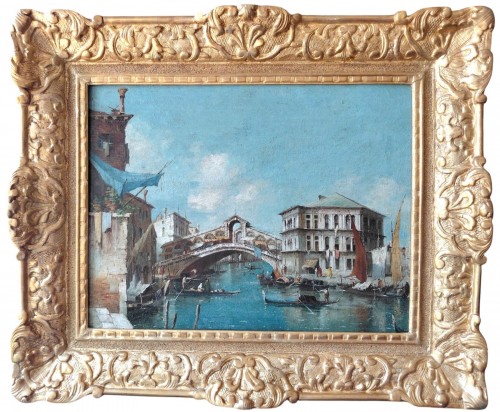
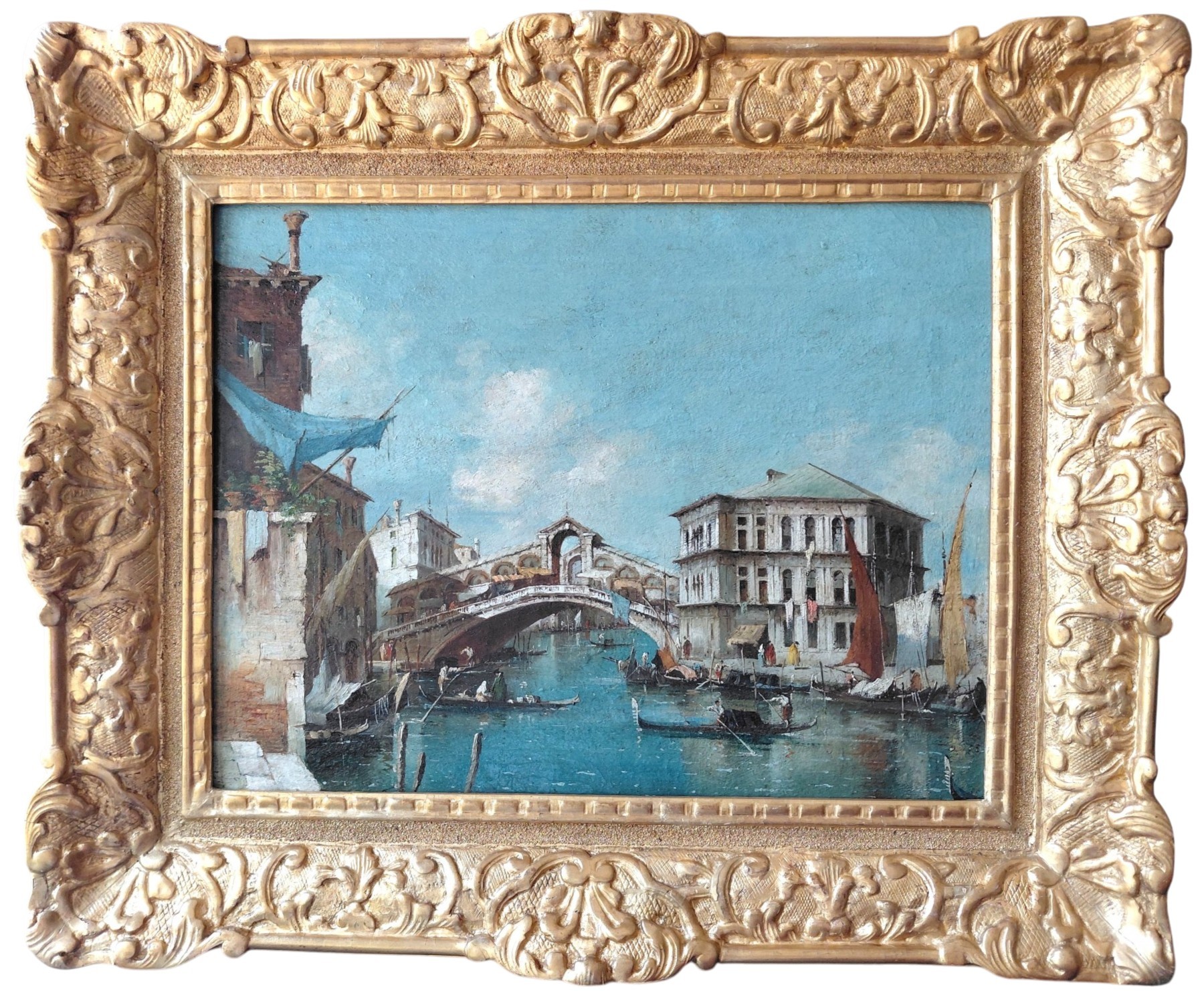
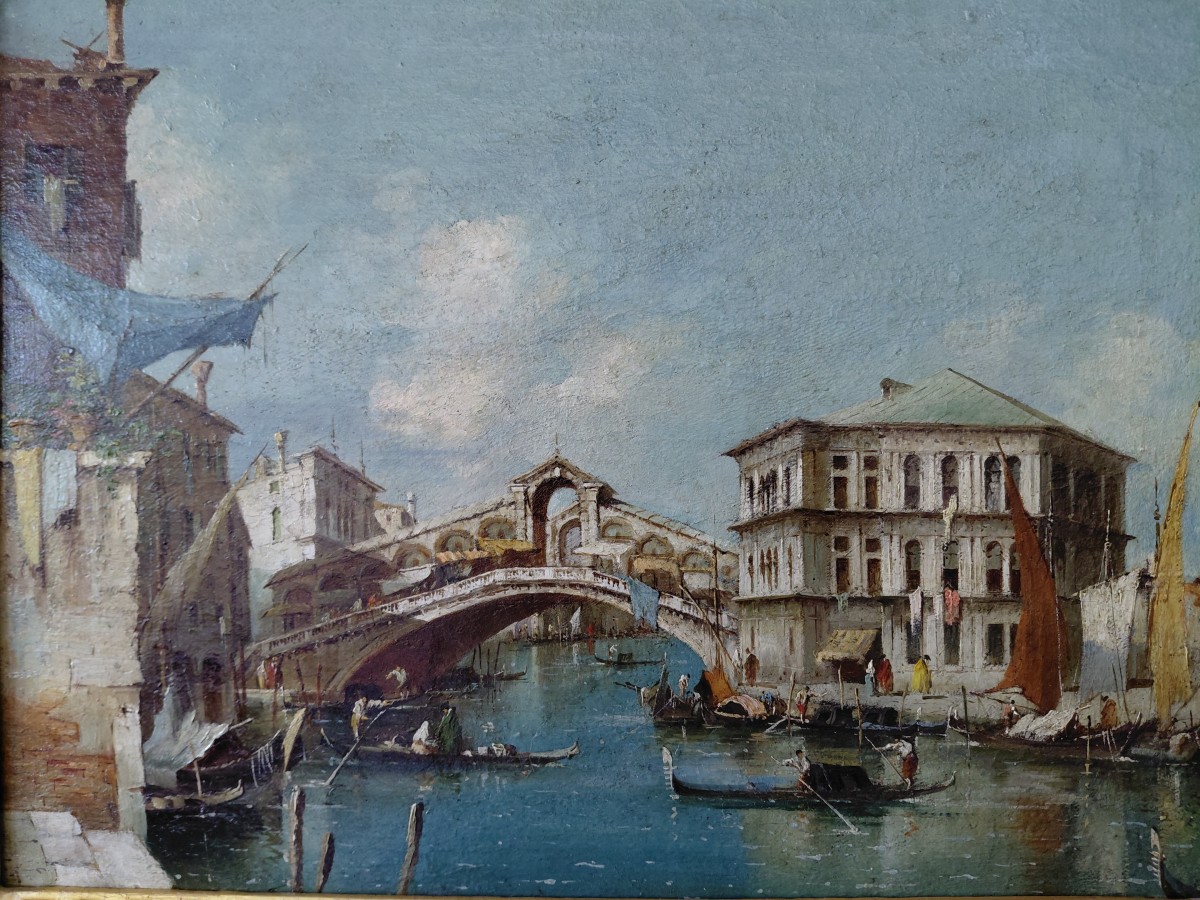
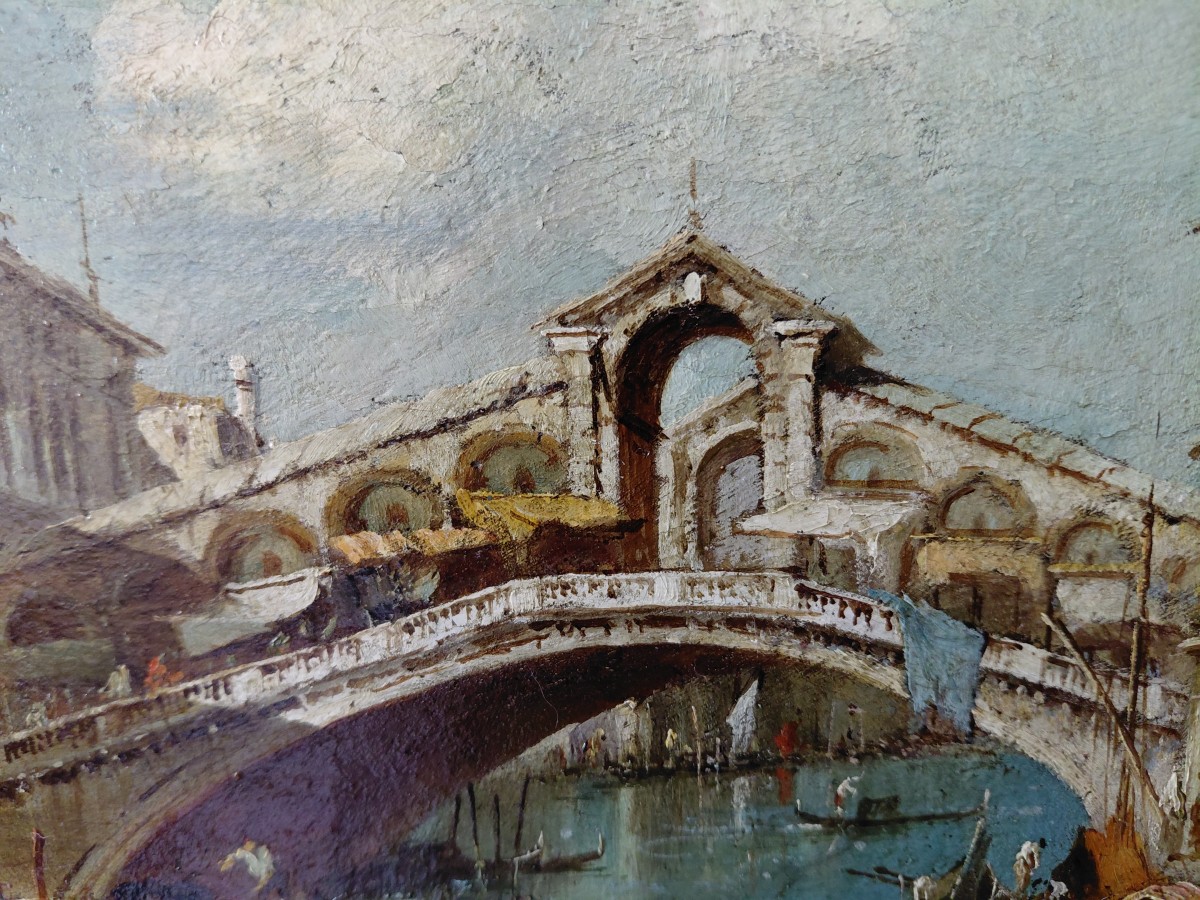
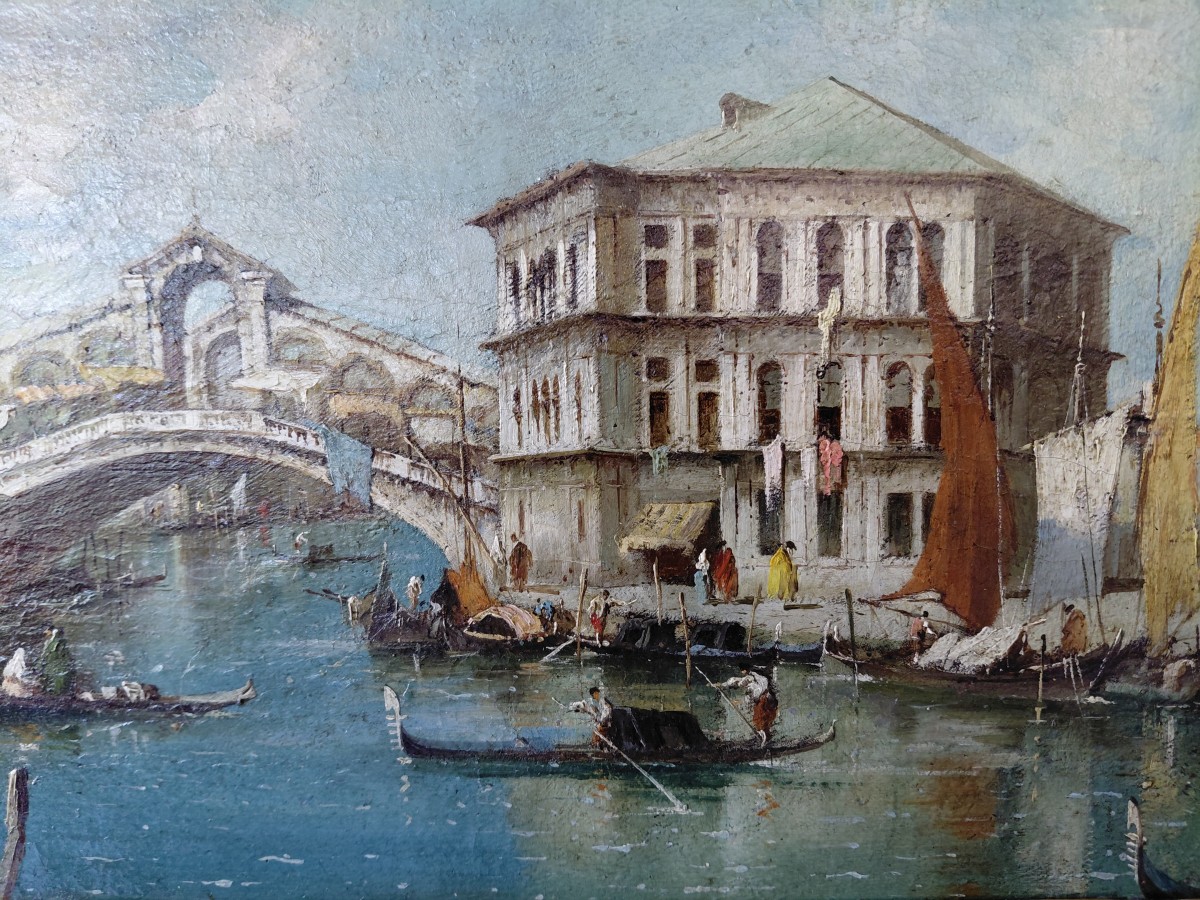
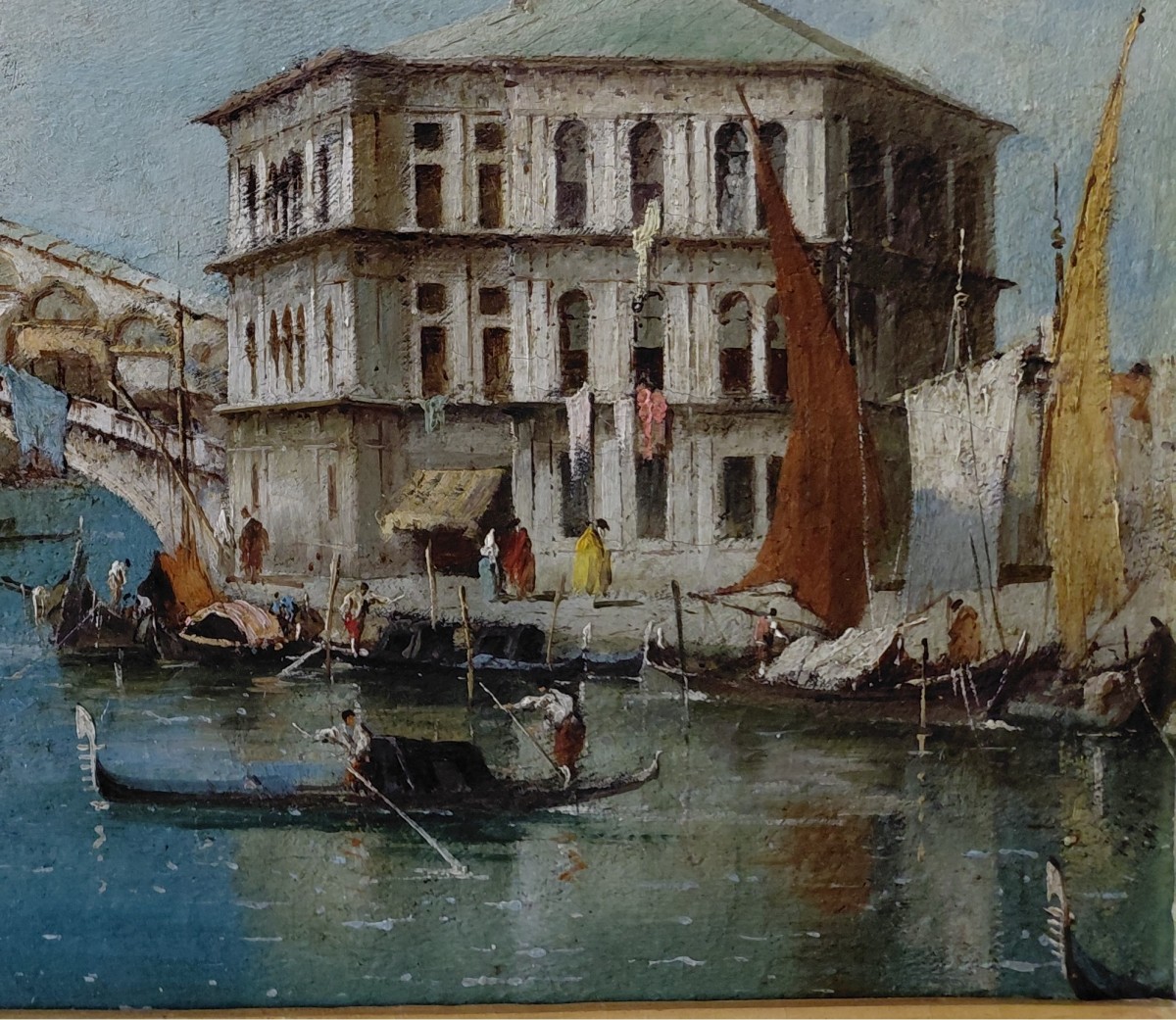
Oil on canvas depicting a "View of the Rialto Bridge and the Palazzo dei Camerlenghi in Venice"
Venetian School, late 18th/early 19th century; follower of Francesco Guardi
37.5 cm x 47.5 cm
18th-century carved and gilded wood frame
This work, created by a Venetian painter following in the style of Francesco Guardi, depicts the famous Rialto Bridge and the Palazzo dei Camerlenghi. The view draws inspiration from the artistic output of the renowned painter Francesco Guardi (Venice, 1712–1793).
The painting features luminous tones and scattered touches of color and white that make the waters of the Grand Canal shimmer, evoking the bustling activity of the crowds and gondolas.
The Rialto Bridge:
The name "Rialto" derives from the Latin *rivus altus*, meaning "deep channel" or "deep river."
The bridge's origins date back to around 1172. Like most bridges in Venice at the time, the first Rialto Bridge was constructed of wood.
To connect the two banks, a pontoon bridge made of moored boats was initially built. The architect was Nicolo Barattieri—the same man who, that same year, erected the two columns in the Piazzetta San Marco, topped respectively by statues of Saint Theodore and the Lion of Saint Mark. This makeshift solution was intended only to be temporary, so a decision was made to build a permanent bridge.
In the early 16th century, the Republic sought to rebuild the structure and solicited designs from Sansovino, Palladio, and Michelangelo; however, following a competition, the project was entrusted to the aptly named Antonio da Ponte, who oversaw the bridge's reconstruction in Istrian stone between 1588 and 1591.
Like any architectural structure in Venice—from the humblest house to the grandest palazzo—it follows the same fundamental construction principle: starting by driving wooden piles into the lagoon's mud to form the building's foundations. It rests on a single large arch with a span of 28 meters, built upon foundations comprising 6,000 wooden piles. Its distinctive "circumflex" shape originally allowed tall ships to pass underneath.
Thus, in the 14th century, the Rialto Bridge became the hub of an open-air exchange where shares in ships were traded; this facilitated the growth of a merchant fleet and the fourfold expansion of the Venetian Arsenal, a project led by the city authorities.
Named after the Rialto district on the left bank, it served as the only link between the two halves of the city—connecting the *sestieri* (districts) of San Polo and San Marco—until the 19th century.
The current bridge, featuring a single 48-meter arch spanning the Grand Canal, offers three pedestrian walkways: one in the center—flanked by two rows of shops housed within six arches on the ascent and six on the descent—and two others running along the outer sides of the shops. The three pedestrian paths converge at the center of the bridge via two larger arches.
The presence of shops makes it one of the few surviving examples of a built-upon bridge. On the reliefs on either side of the bridge, one can see the city's two patron saints, Theodore and Mark.
The Palazzo dei Camerlenghi:
The palace was built in the 15th century and completed in 1488. Between 1525 and 1528, it was enlarged according to a design by Guglielmo dei Grigi, inspired by the style of Mauro Codussi and Pietro Lombardo. It served as the headquarters for several financial magistrates—including the *Camerlenghi*, the merchant consuls, and the *supra-consuls* of the merchants—from whom it derives its name. Due to this function, the lower floor was used as a prison for those who failed to settle their debts. Its prominent location near the Rialto Bridge served as a warning to passersby. The palace currently houses the regional offices of the Italian Republic's Comptroller General.
The pentagonal palace has three stories and follows the curve of the Grand Canal. It features tall, centrally aligned windows separated by faux columns and decorated with friezes. Polychrome marble and porphyry slabs, now lost, once adorned the structure. The medallion on the façade formerly incorporated a painted Lion of Saint Mark.
In keeping with the Venetian tradition whereby magistrates left behind a religious painting and a portrait in their former office upon completing their term, the Palazzo dei Camerlenghi houses numerous works of art. At times, these paintings convey socio-political concepts of civic virtue. These works were looted during the French occupation; some eventually returned to Venice, primarily to the Gallerie dell'Accademia.