Offered by Antichità Castelbarco

Spanish school, 17th century
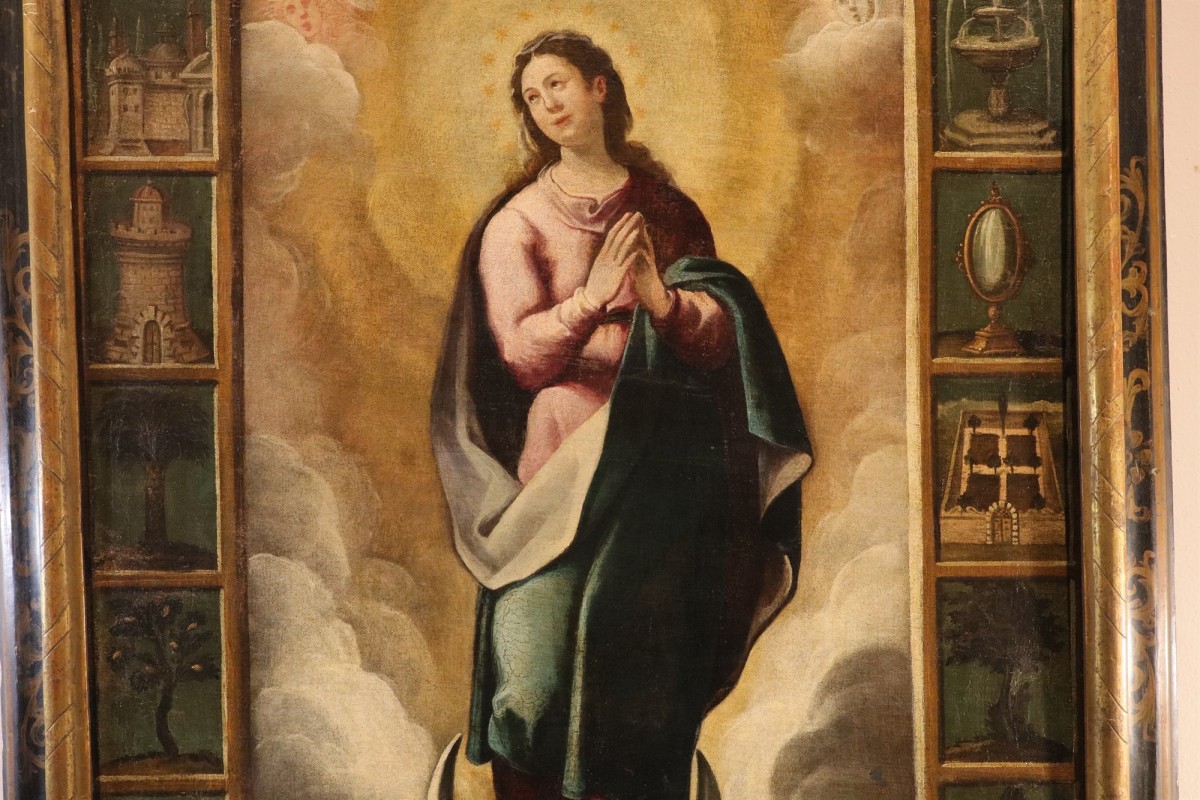
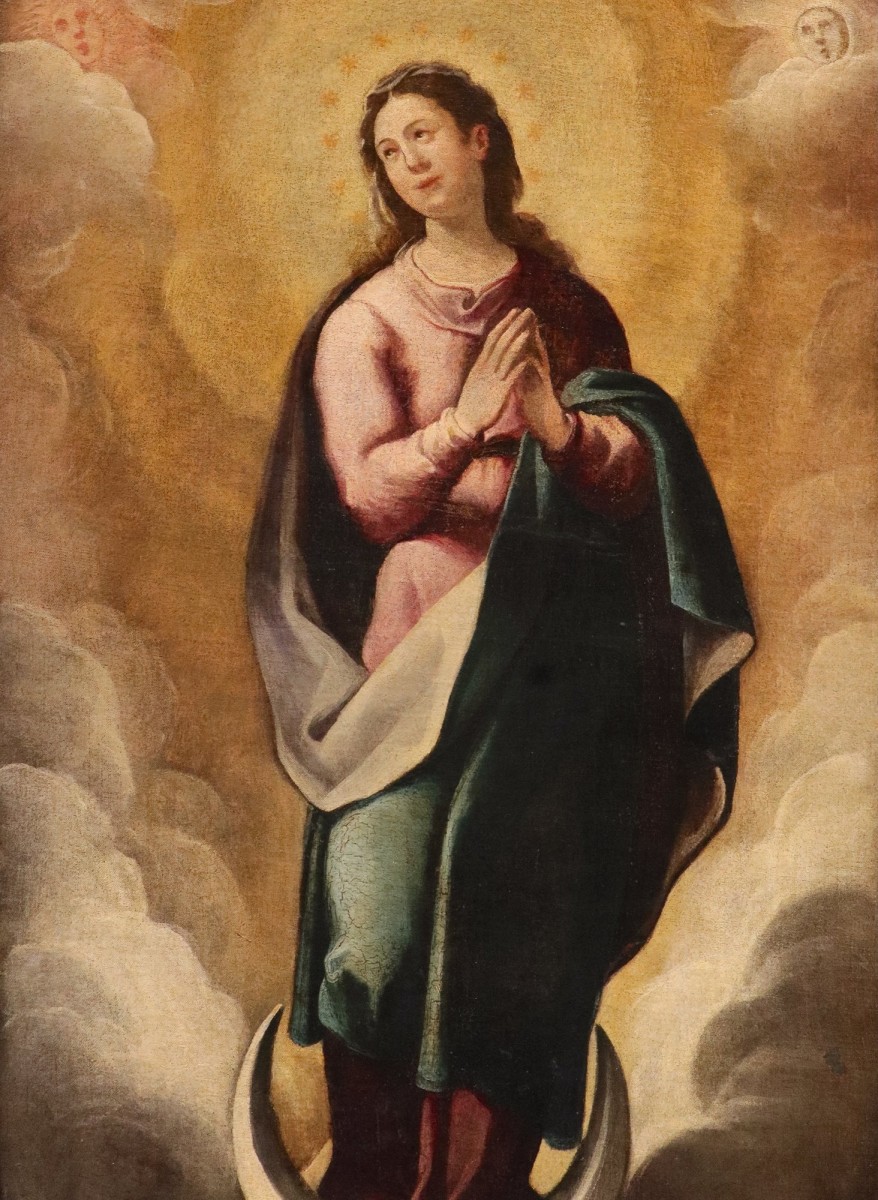
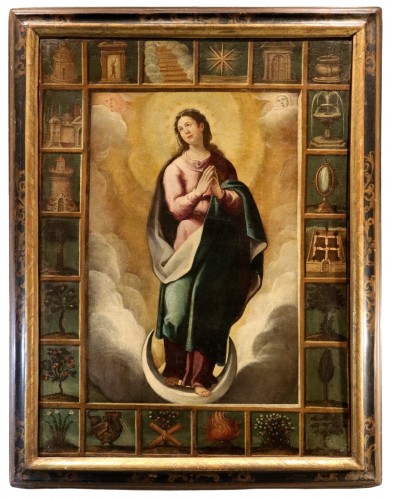
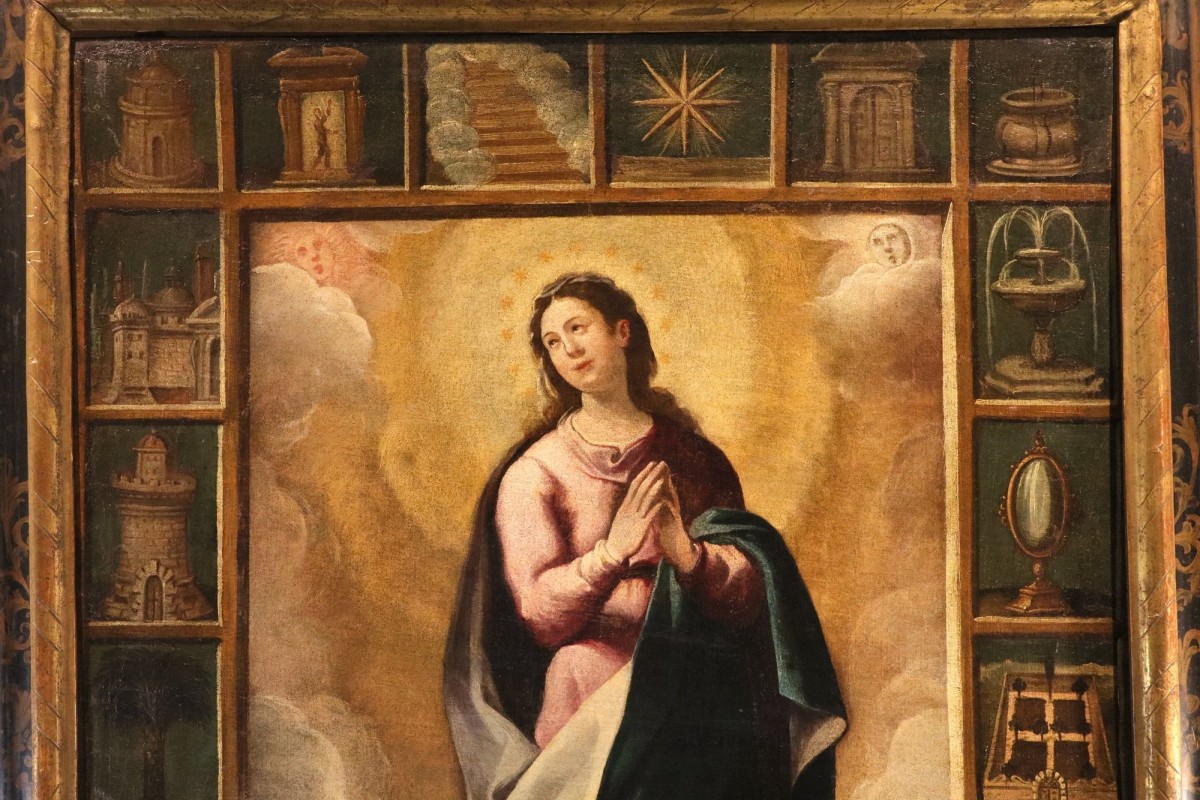
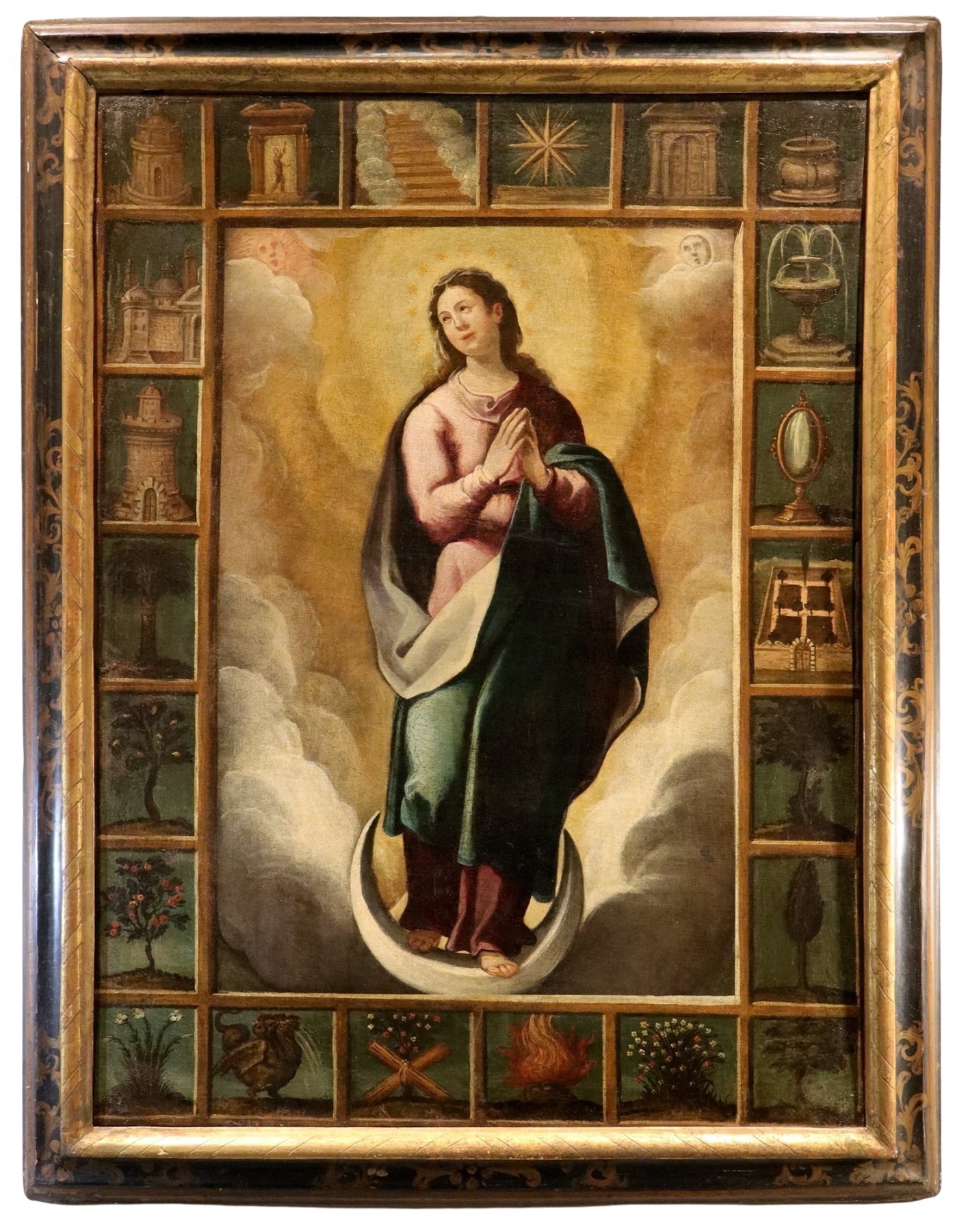
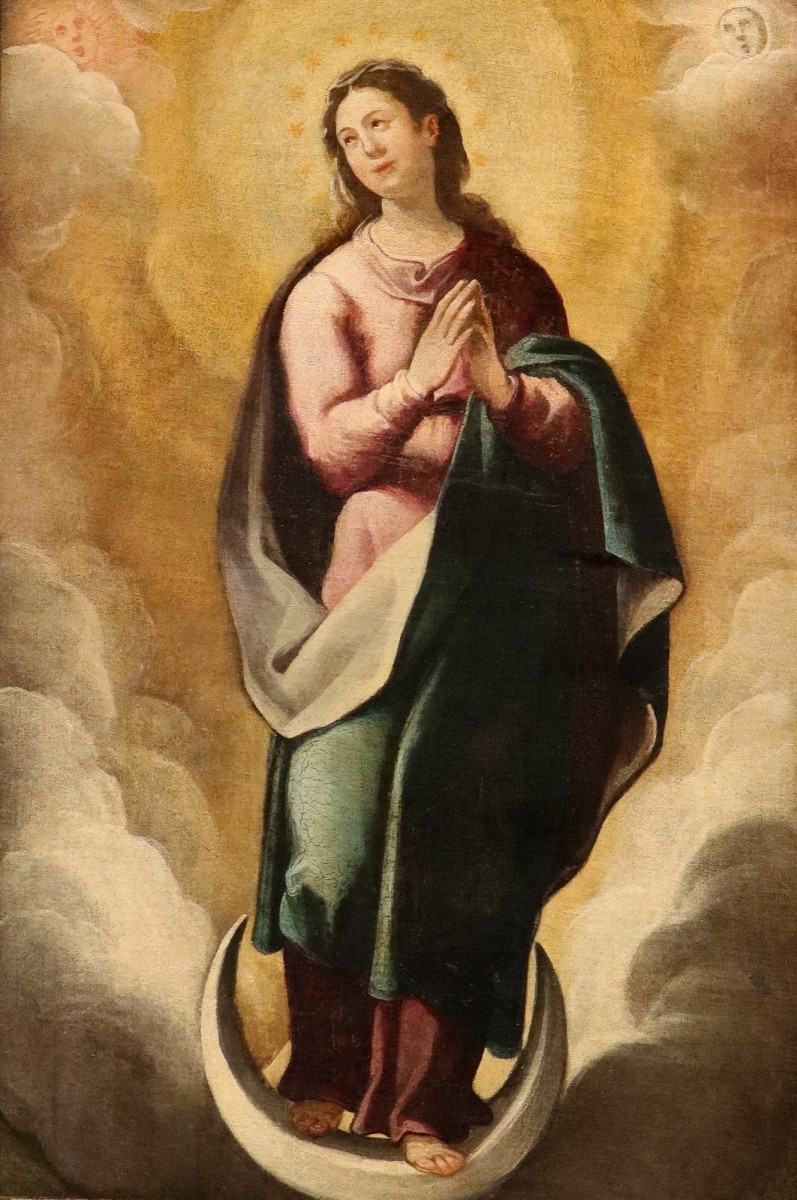
The Immaculate
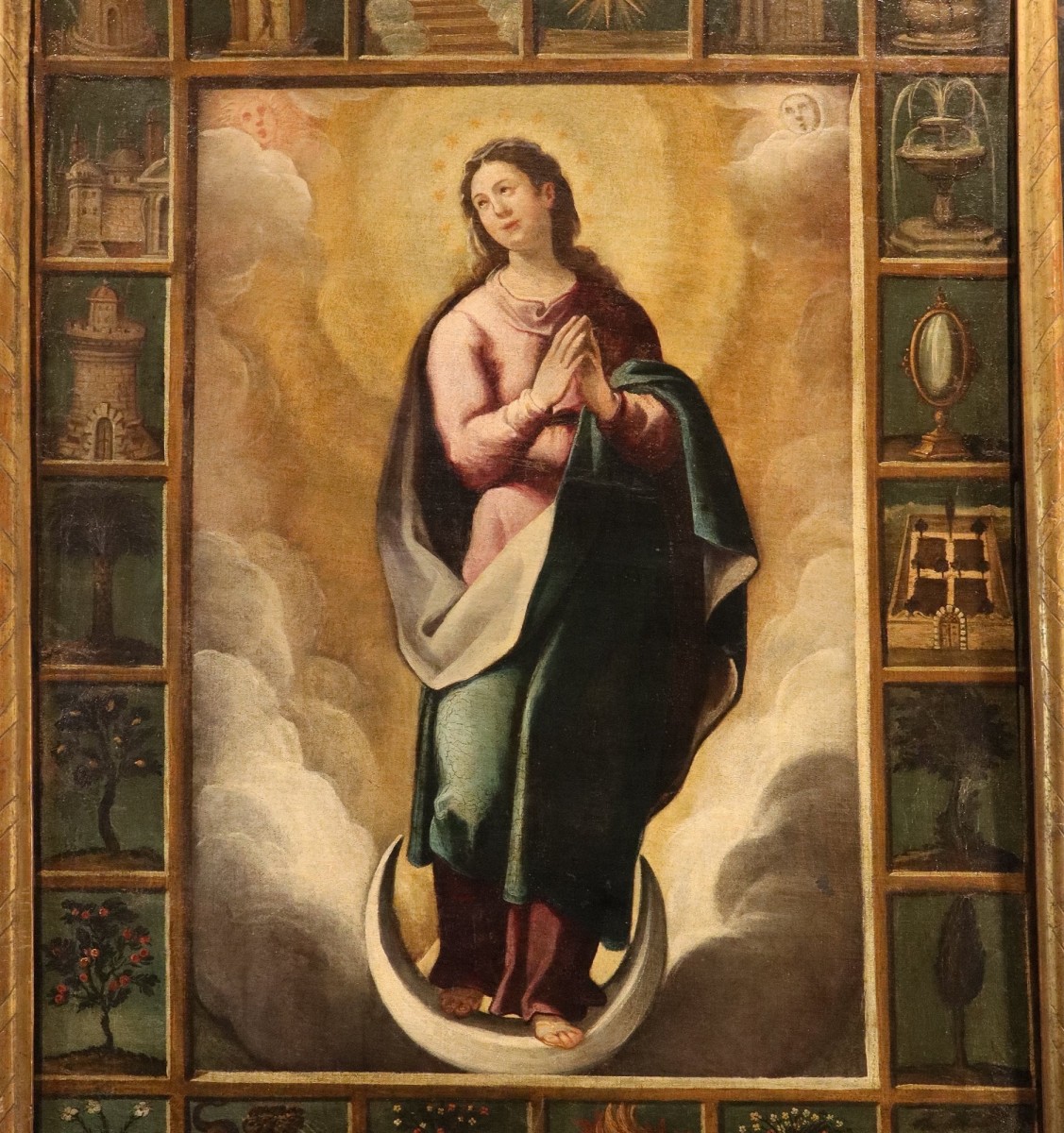
Virgin with symbols of the Litany of Loreto
Oil on canvas
101 x 76 cm. In an antique frame (slight imperfections) 117 x 90 cm.
FULL DETAILS (CLICK HERE)
This is a work of extraordinarily rich iconographic and theological content, conceived to blend the figure of the Immaculate Conception with the visual exegesis of the Litany of Loreto – that is, a series of poetic and allegorical images drawn from the Song of Songs and Marian hymns, used to describe the virtues and theological role of the Virgin Mary.
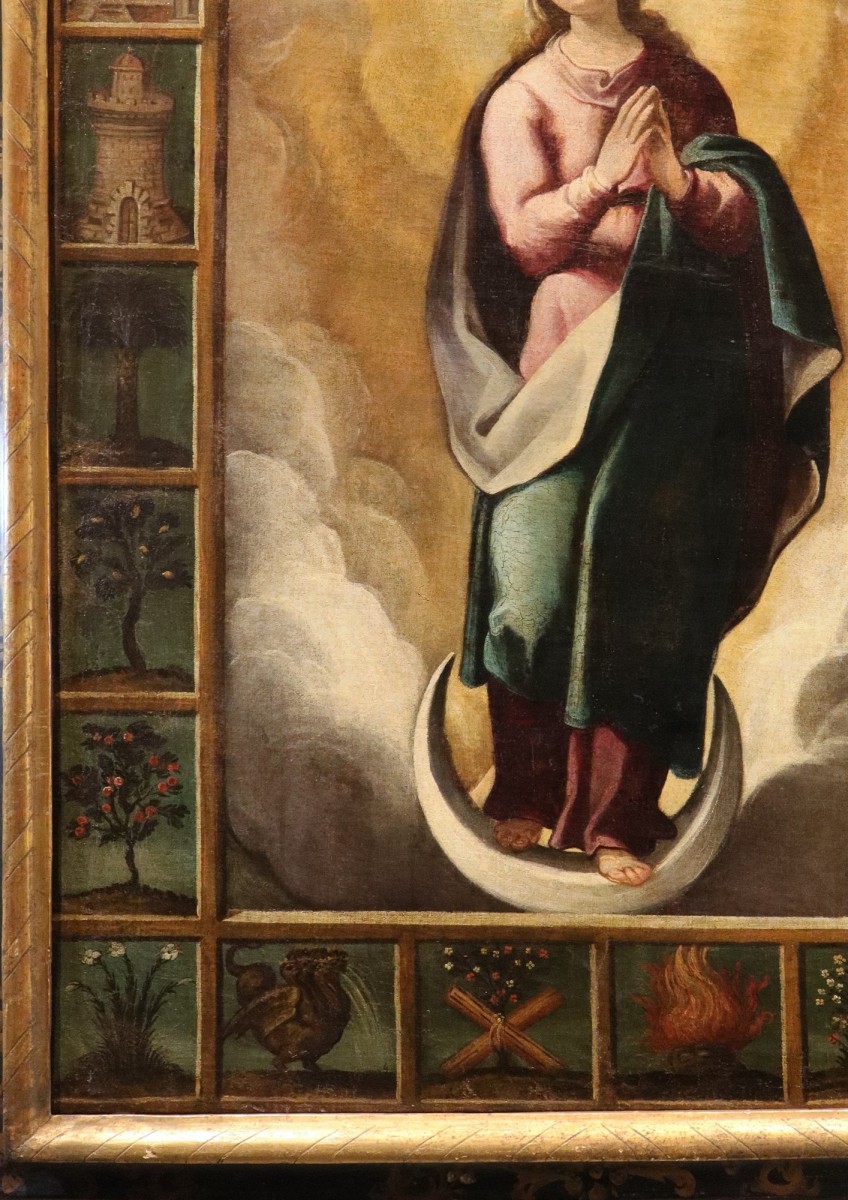
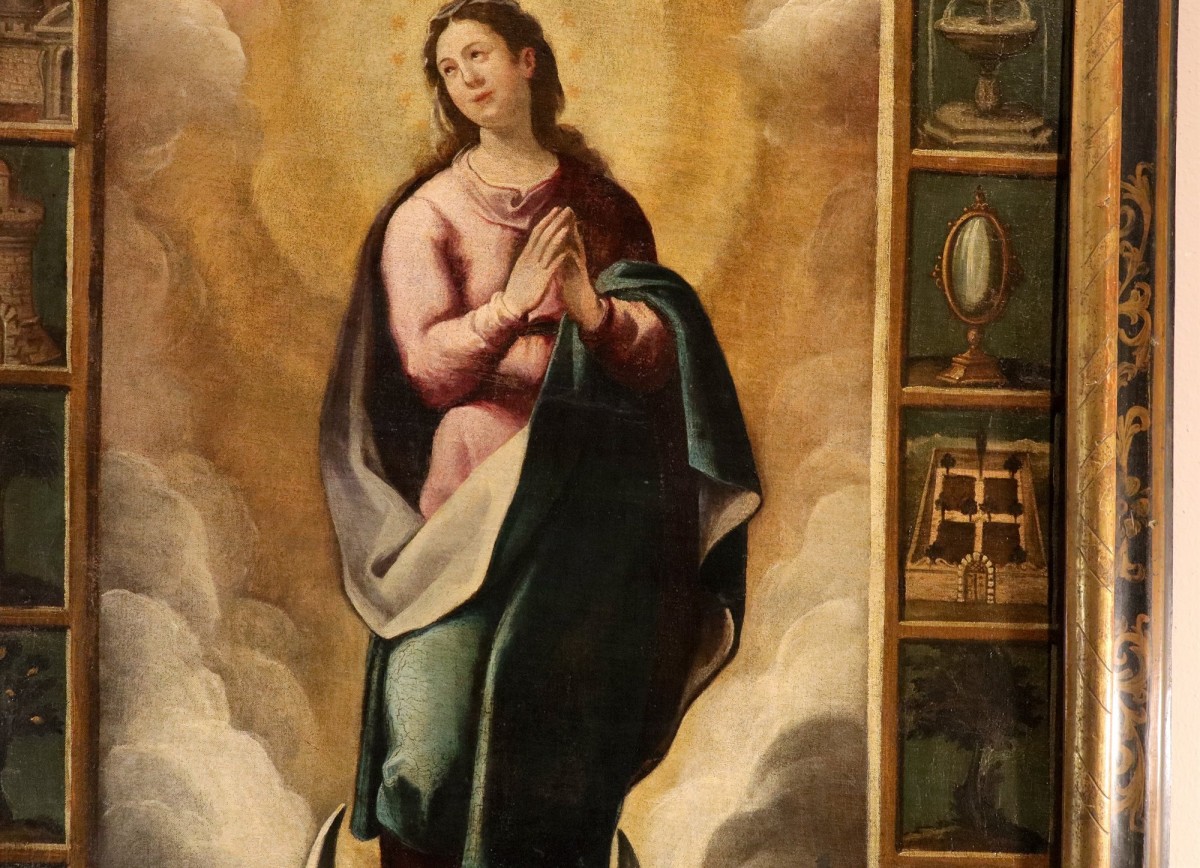
At the centre of the canvas stands the full-length figure of the Virgin Mary, crowned with stars, in a moment of prayer, enveloped in a resplendent mandorla of golden light, whilst at her feet lies a silvery crescent moon with its tips pointing upwards – an astrological symbol of purity, of the subjugation of earthly time, and of the Virgin’s triumph over sin and the corruption of the world. In the upper corners, the Sun and the Moon are repeated to emphasise her centrality in the Christian cosmos.
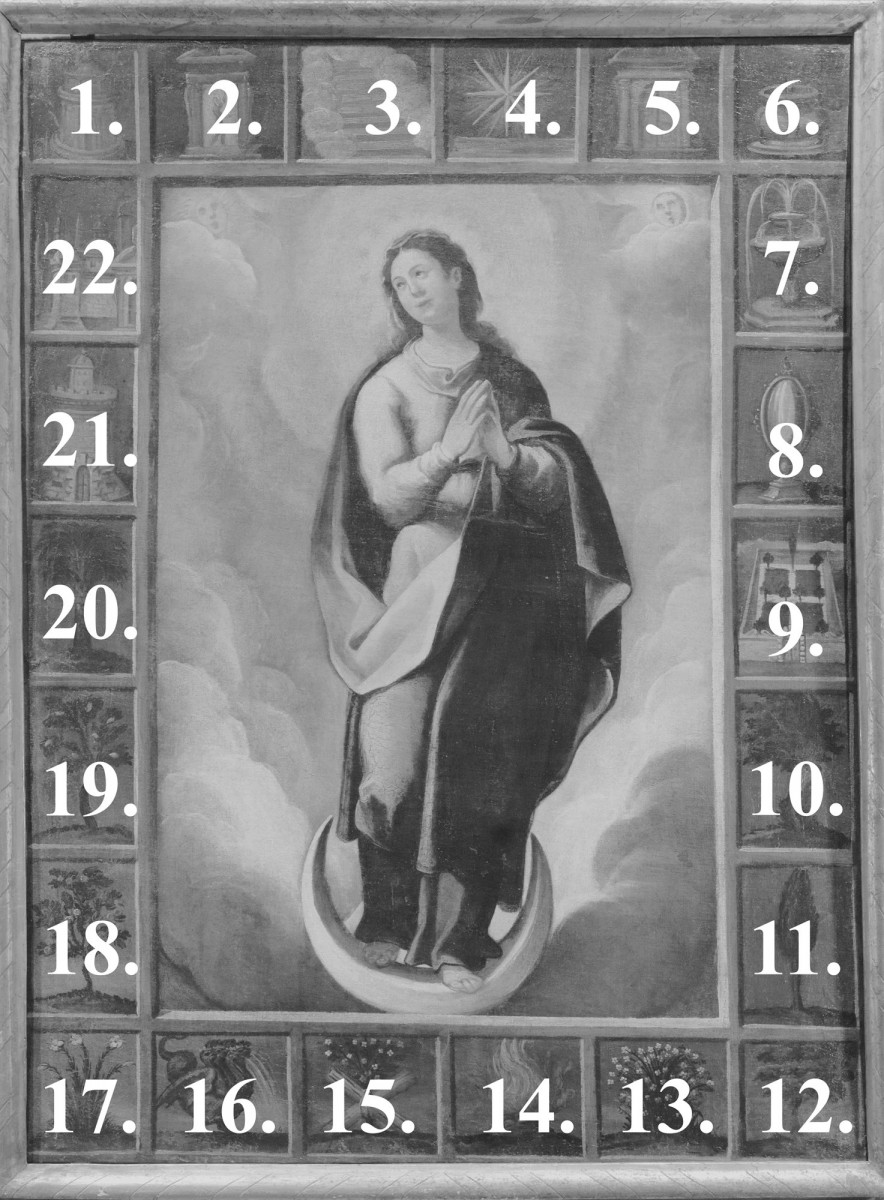
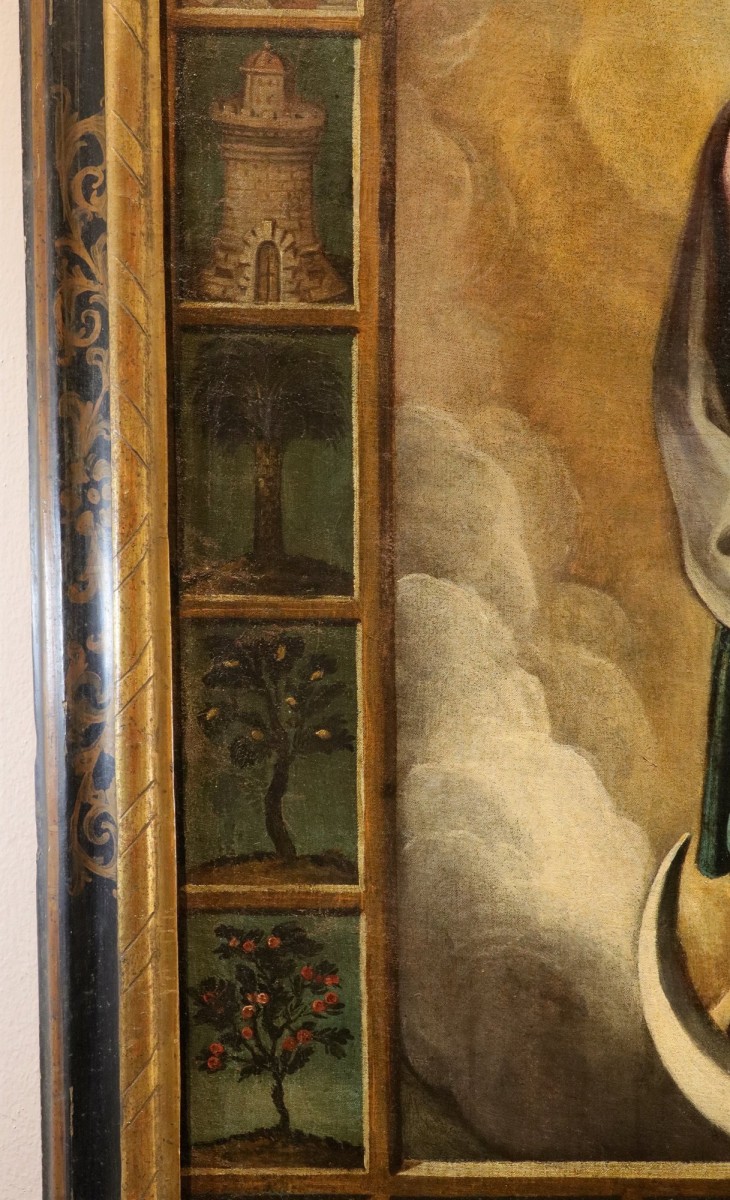
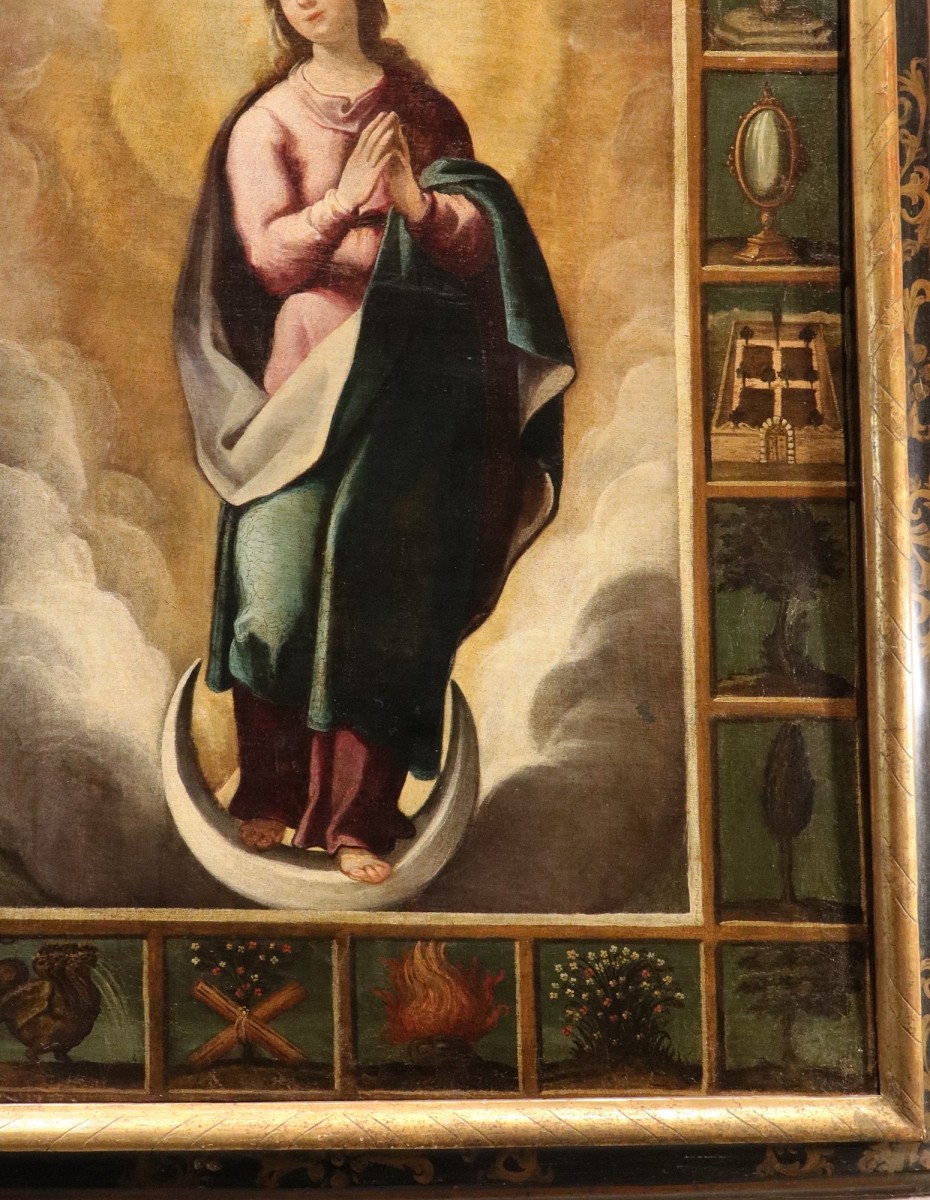
As mentioned, the distinctive feature of the painting lies in the perimeter frame with 22 illustrated panels, which transform the work into a veritable Marian theological treatise.
Analysing the panels clockwise, starting from the top left:
1. Ivory Tower (Turris Eburnea): A symbol of precious purity, innocence and inviolable chastity.
2. Gate of Heaven (Janua Coeli): A symbol of access to eternal salvation guaranteed by divine motherhood.
3. Stairway to Heaven (Scala Coeli): Representing the mystical stairway linking Earth to Paradise.
4. Morning Star (Stella Mattutina): A great, radiant star heralding the birth of the Sun of Righteousness (Christ).
5. Closed Gate (Vision of Ezekiel): A reference to her unblemished virginity, through which only the Lord passes.
6. Well of Living Water (Puteus Aquarum Viventium): An inexhaustible source of grace and spiritual purity.
7. Sealed Fountain (Fons Signatus): An emblem of pure grace and Mary’s perpetual virginity.
8. Mirror of Perfection (Speculum Justitiae): It perfectly reflects the light and will of God, without any stain of sin.
9. Enclosed Garden (Hortus Conclusus): The symbol par excellence of Mary’s perpetual virginity.
10. Olive Tree (Oliva speciosa): A symbol of peace and mercy.
11. Cypress of Mount Zion (Cipressus in Monte Sion): A symbol of incorruptibility, immortality and profound spiritual ascent.
12. Cedar of Lebanon (Cedrus Exaltata): An emblem of the Virgin’s spiritual loftiness, purity and royalty.
13. Mystical Rose (Rosa mystica): Represents beauty, royalty, purity and mystical love, identifying Mary as the most perfect flower of spiritual creation.
14. Fire of the Burning Bush: The perpetual fire signifies the foreshadowing of Mary’s perpetual virginity.
15. Tree of Life (Lignum Vitae): A wooden cross from which flowers blossom and entwine, alluding to the victory over death.
16. Dragon of the Apocalypse (multi-headed monster): Represents the defeat of evil
17. White Lily (Lilium candidum): The ultimate symbol of Mary’s purity, virginity and innocence.
18. Red carnation: Symbolises the sacred and faithful union between God and humanity.
19. Plane tree (Platanus exaltata): Symbol of Mary’s protection and maternal love, from the verse ‘I have grown like a plane tree by the water’.
20. Palm of Kadesh (Palma exaltata): Symbol of victory over sin, justice and royalty.
21. Tower of David (Turris Davidica): Symbolises Mary’s unshakeable spiritual strength against the temptations of evil.
22. Fortified City (Civitas Dei): the ‘City of God’ or the Heavenly Jerusalem, representing the Church and the womb that bore the Saviour.
Both in terms of its iconography and stylistic details, the painting belongs to the 17th-century Spanish school – the so-called Siglo de Oro – and thus displays the characteristic features popularised by great masters such as Zurbarán and Murillo; through their intense and deeply spiritual works, they contributed to the extraordinary flourishing of this particular sacred subject, which was in fact one of the most important religious themes of the Spanish Baroque.
Delevery information :
We take care of and organise the transport of the purchased works, both for Italy and abroad, through professional and insured carriers.
We take great care We personally take care of the packaging, to which we devote a great deal of care: each work is carefully packed, first with arti- cle material, then with a custom-made wooden box.
Should you have the desire to see this or other works in person, we would be happy to welcome you to our gallery in Riva del Garda, Viale Giuseppe Canella 18, we are always open by appointment only.