Offered by Desmet Galerie
REQUEST INFORMATION

Mechelen Alabaster Carver (Mechelen, circa 1600)
THE ADORATION OF THE MAGI
A monumental Mechelen alabaster relief, exceptional in scale for its type
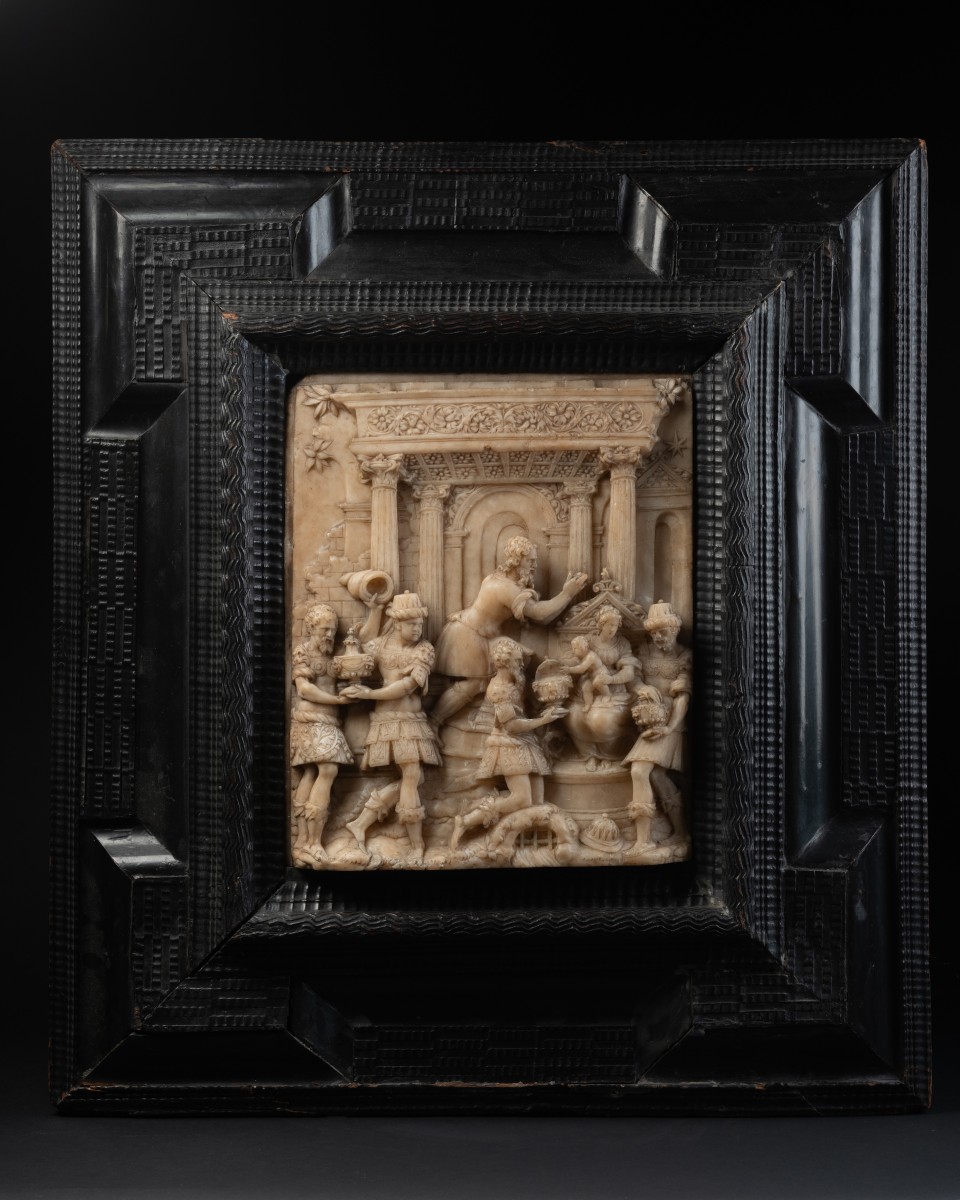
Alabaster relief, in an associated ebonized moulded frame
Mechelen (Malines), Southern Netherlands
The Adoration of the Magi
Alabaster relief: H 32 x W 27 cm
H 12 5/8 x W 10 5/8 inch
Frame
H 65 x W 58 x D 6 cm
H 25 5/8 x W 22 7/8 x D 2 3/8 inch
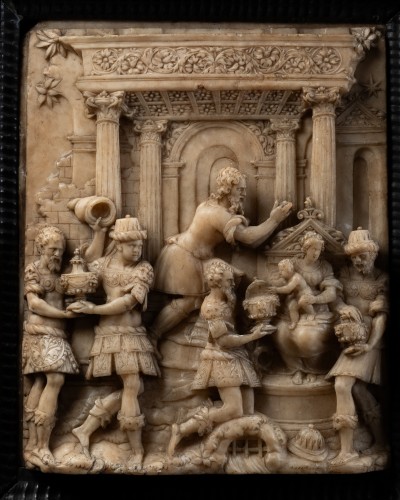
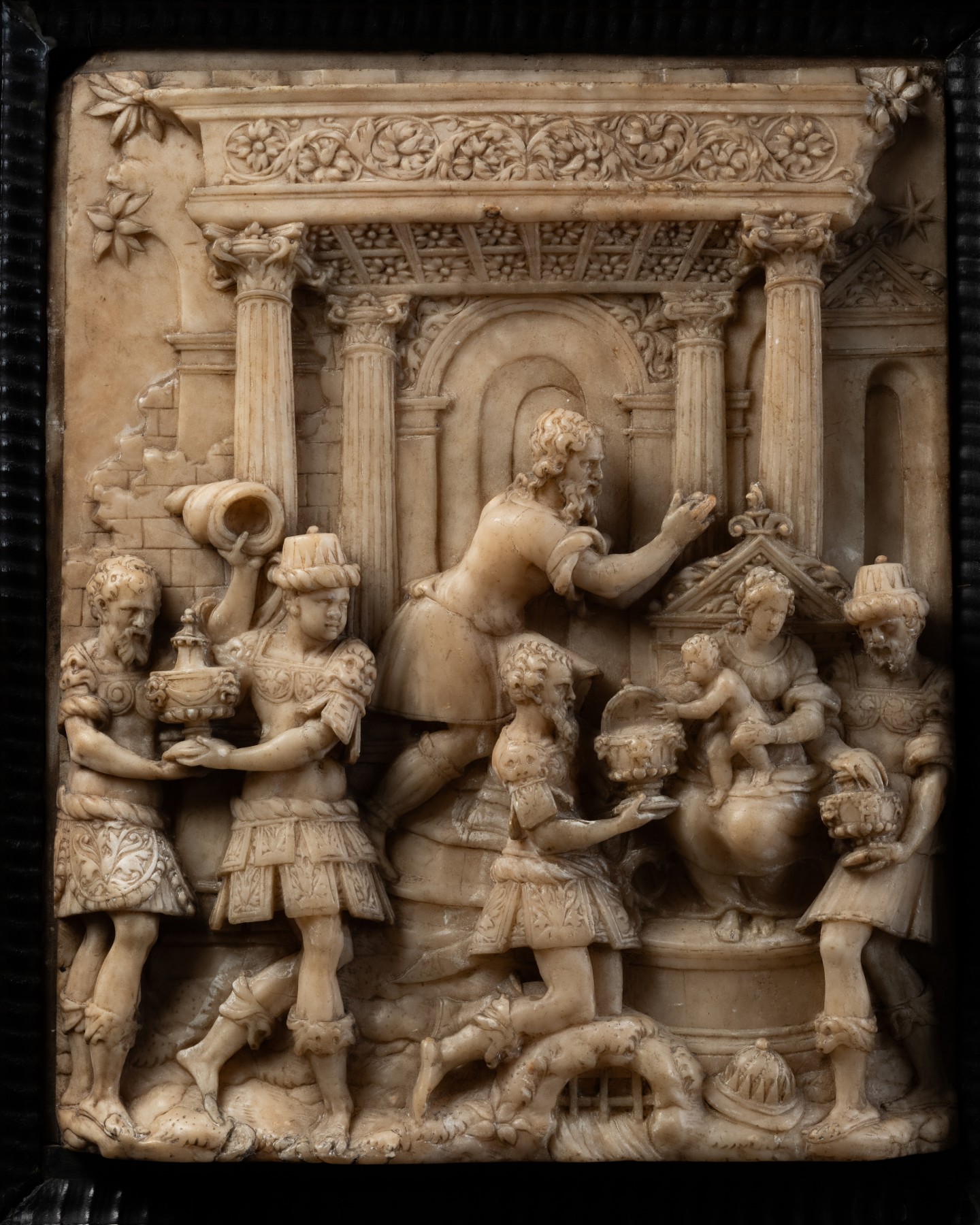
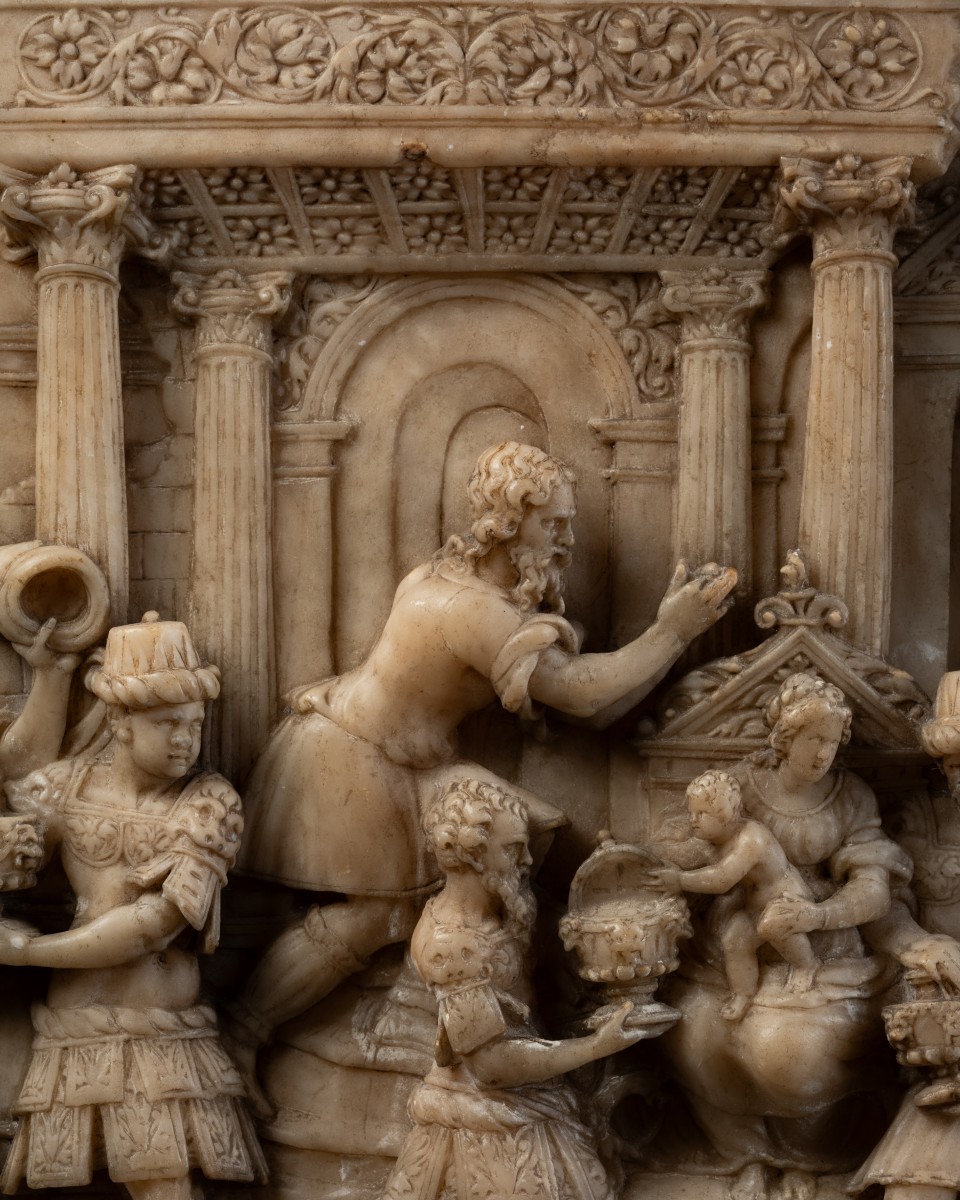
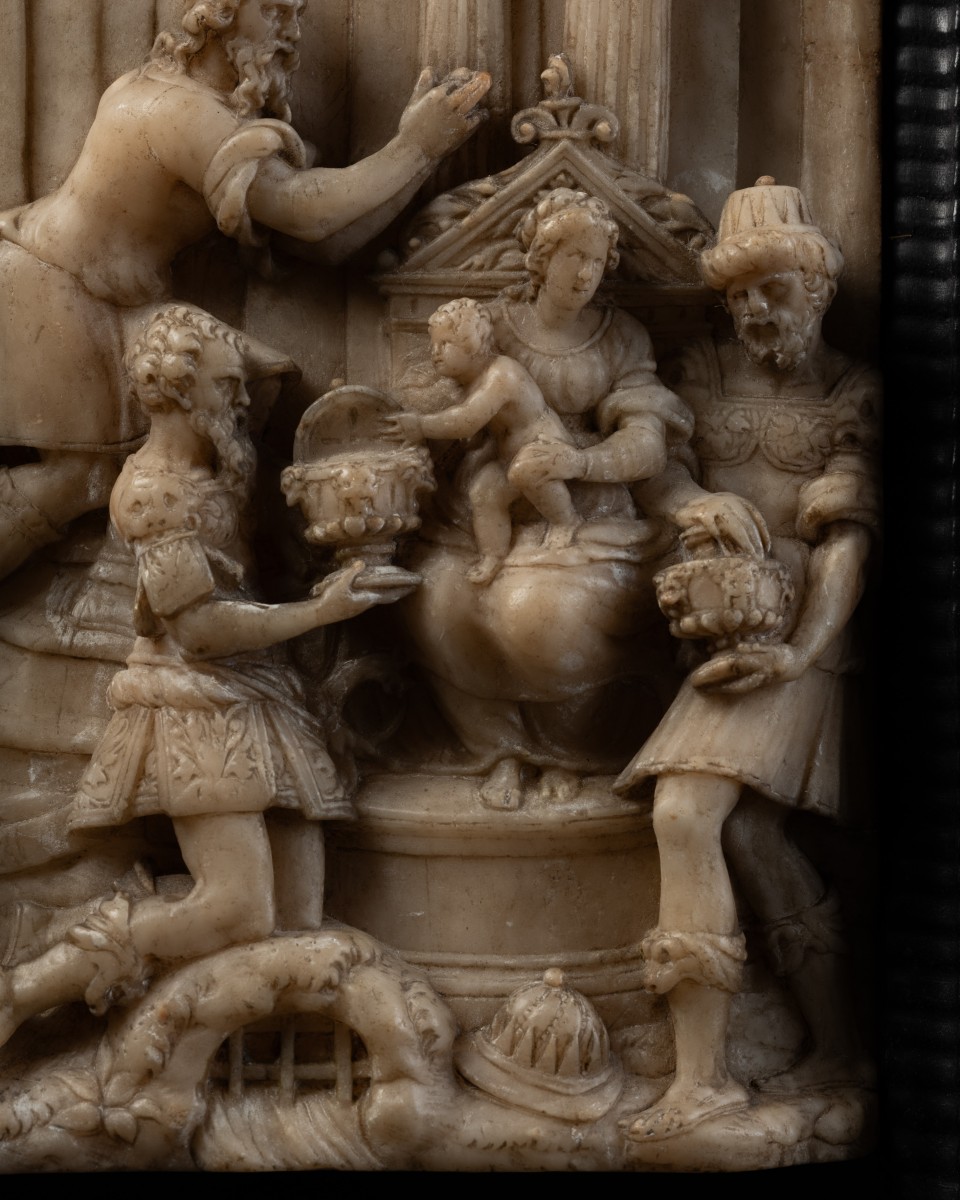
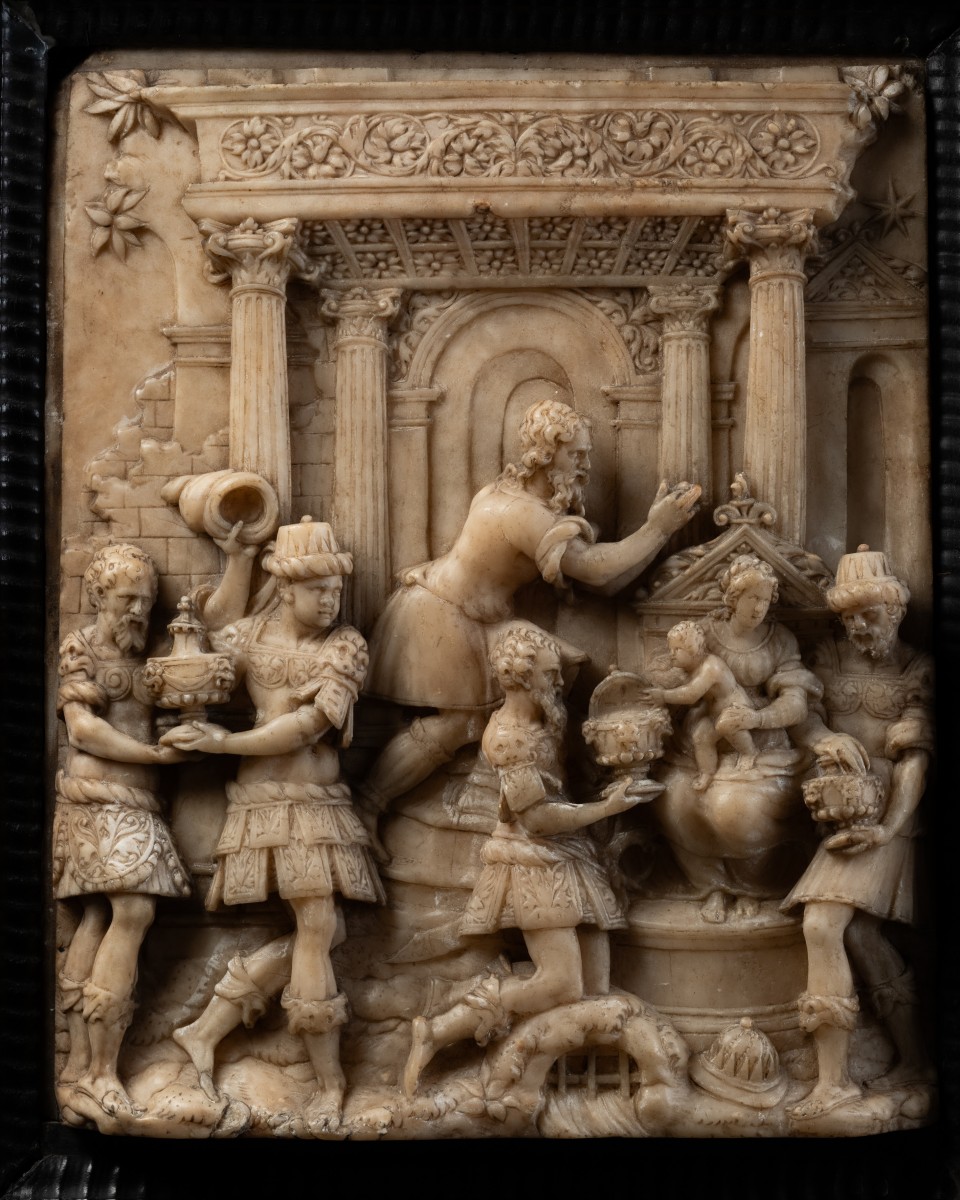
Carved in high relief from a single, exceptionally large and flawless block of alabaster, this panel presents the Adoration of the Magi as a crowded, processional pageant rather than the compact devotional grouping usual to the subject. Under a Renaissance loggia hung with a garlanded frieze and set before the ruined masonry of an older order giving way to the new, the Virgin sits enthroned with the Christ Child on her knee, attended by a great retinue of kings, pages and soldier-bearers advancing from both sides with vessels of gold. The scale of the block itself, easily the largest single element in the composition, is the first thing the relief announces about itself: this is not a cabinet miniature but a showpiece, carved by a Mechelen workshop operating at the very limit of what the material and the type would allow.
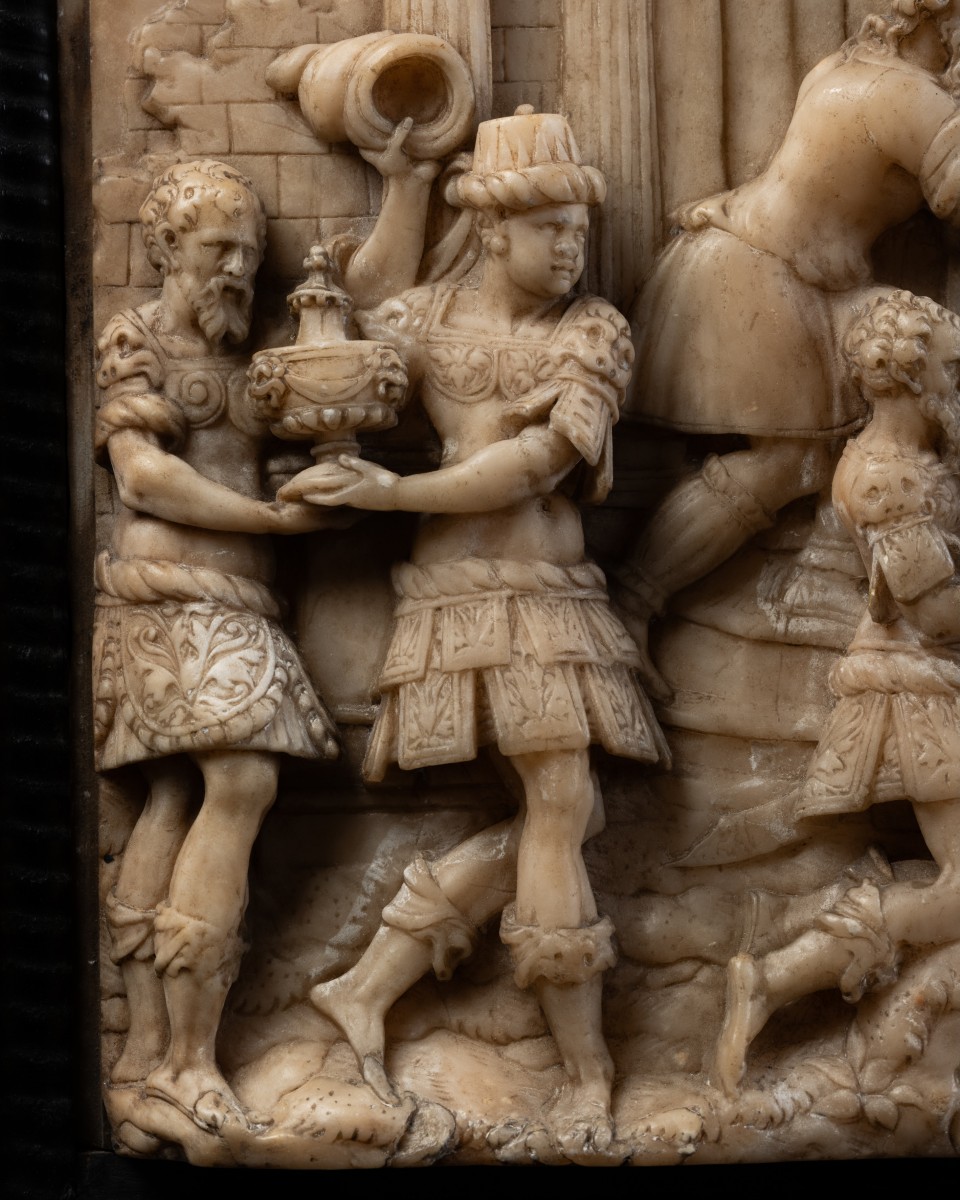
The subject is drawn from the Gospel of Matthew (2:1-12): the Magi, guided by a star, travel to Bethlehem to adore the infant Christ and present him with gold, frankincense and myrrh. The star appears here in the upper right corner of the relief, balanced at upper left by a spray of carved blossom, while the broken wall in the background - a stock device in Netherlandish Nativity and Adoration imagery - signals the crumbling of the pagan world before the new dispensation. Following a long-standing convention in Flemish printmaking and relief sculpture, the Magi and their attendants are dressed not as Near Eastern potentates but as princely soldiers in fantastical all'antica armour and plumed, turbaned headgear, an idiom that let Netherlandish carvers and printmakers dress a sacred story in the courtly, exoticised costume their patrons associated with royal magnificence.
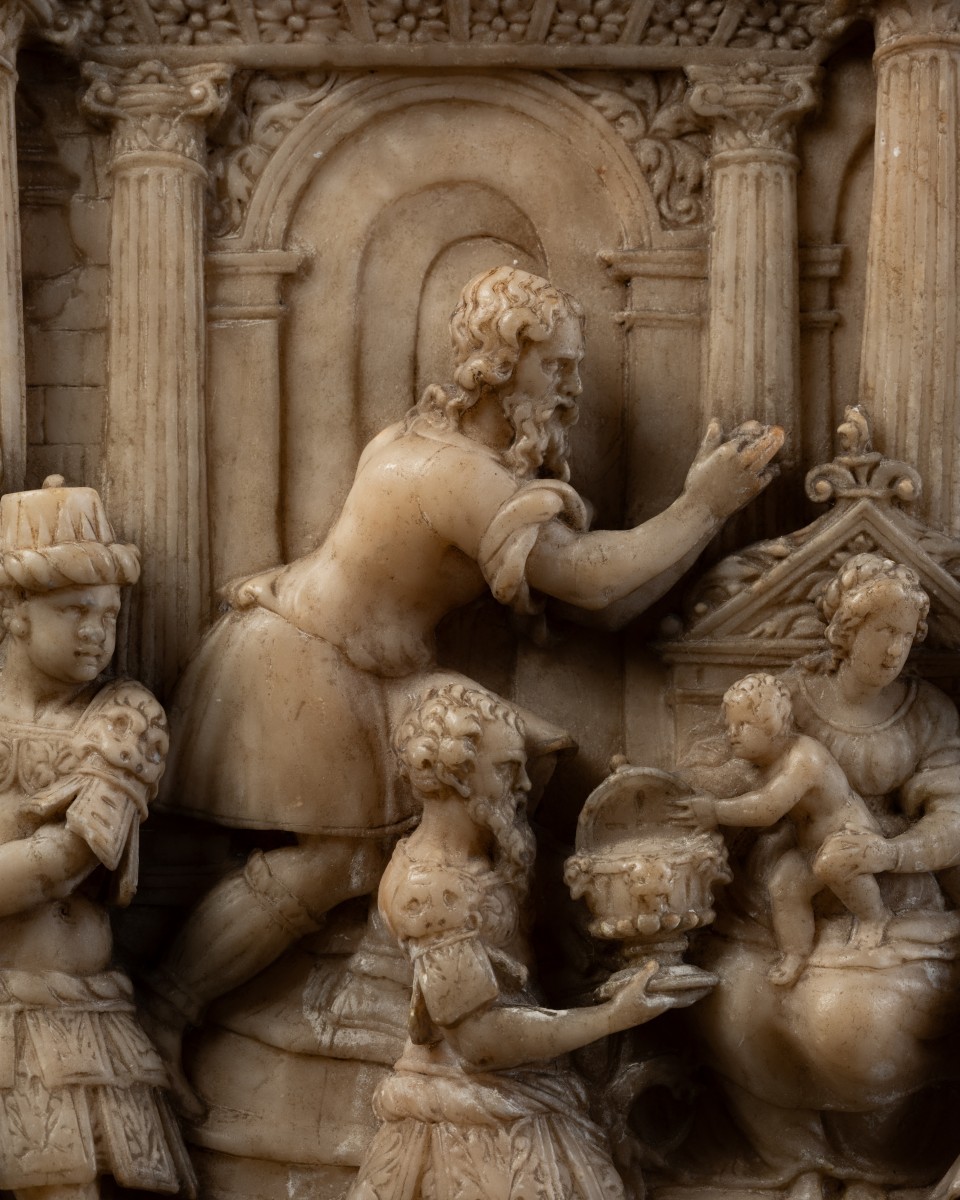
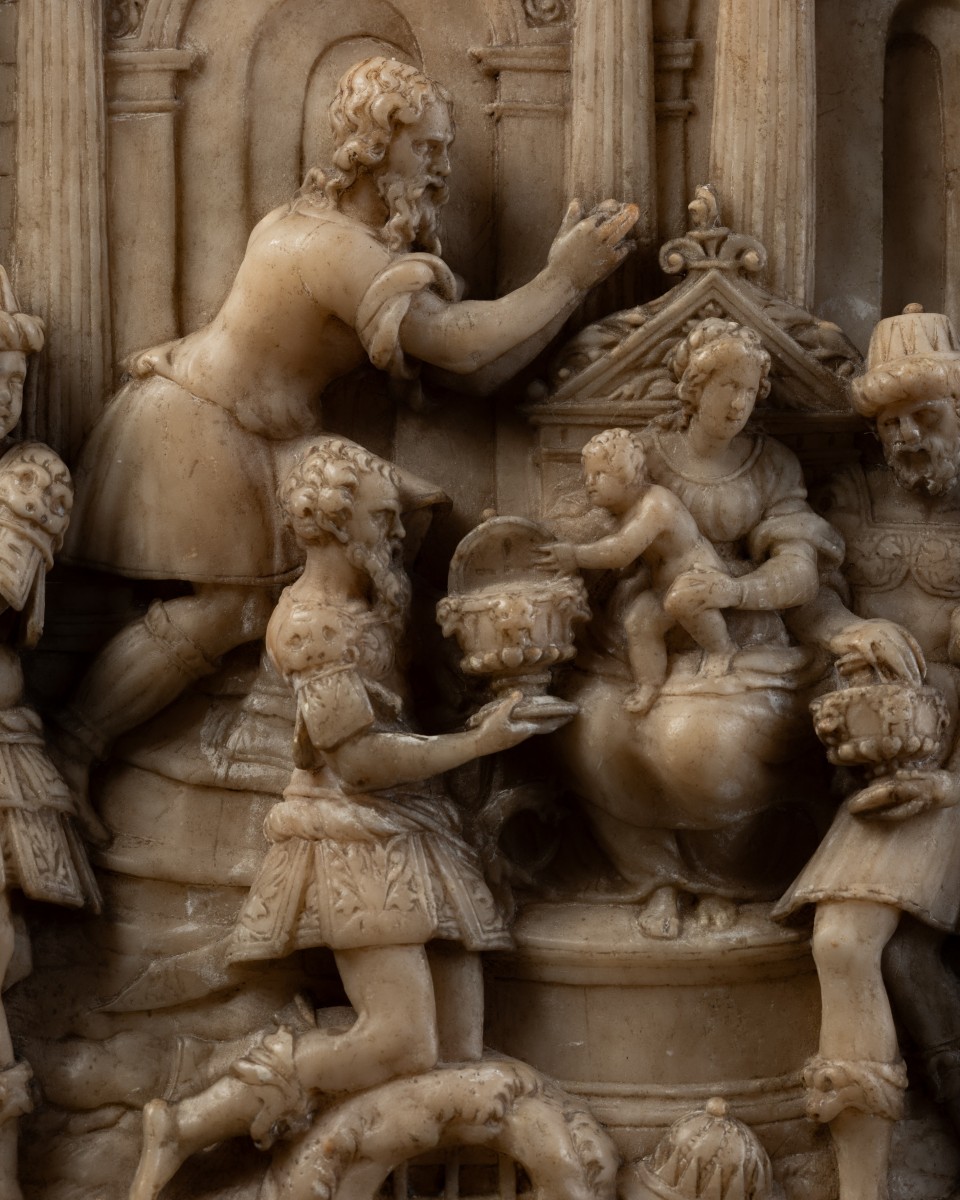
The action is arranged as a continuous frieze across the width of the panel. At the centre, the eldest of the Magi, bare-headed and bearded, steps forward with his hand open in the gesture of adoration toward a small pedimented socle on which the Virgin and Child are raised; before him, a second king kneels and presents an open casket of gold, to which the Child reaches down with both hands. Behind them, their retinue advances in procession: one bearer tips his hat above his head, another lifts a covered, footed urn and passes it forward hand to hand, while at the right a fourth attendant, richly dressed in a fitted breastplate and rolled turban, carries a covered basket and a hooded bird of the chase - an emblem, like the armour, of secular princely rank rather than an attribute drawn from scripture. At the foot of the composition a helmet, an iron grate and a small hound are set among the rocks, incidental still-life details of the kind Mechelen carvers used to fill and animate the lower register of a crowded relief.
An Exceptional Scale
Mechelen's alabaster carvers worked, by trade, in miniature. The city's carving guild was known locally as the gilde van de cleynsteeckers - the guild of the "small-carvers" - and its standard export product, the small devotional or cabinet relief, is generally on the order of 9 x 12 cm, set in a modest gilt or ebonised frame not much larger than the panel itself. A closely comparable Adoration of the Magi relief of Mechelen, circa 1600, sold at Lempertz, Cologne in 2018 measures only 12.5 x 10 cm without its frame; the Rijksmuseum's own Mechelen Adoration of the Magi, of the same circa 1600-1620 date bracket and likewise mounted in an ebony-veneered frame, measures 18 x 14.5 cm as a relief and 29 x 25.5 cm complete with frame. Even the single example singled out in the literature as unusually large for the type - a Last Supper relief prized for its scale as much as its carving - reaches only 15 x 19 cm. Against this consistent range, the present alabaster panel, at 32 x 27 cm, and its frame, at a full 65 x 58 cm, are extraordinary: several times the area of the standard cleynstekerswerk product, and larger than even the rare oversized examples recorded in the specialist literature and at auction. Very few alabaster blocks of this size, clarity and freedom from flaw would have been available to a Mechelen workshop, and fewer still would have been entrusted to a composition this ambitious.
Mechelen and the Guild of the Cleynsteeckers
Mechelen's reputation as a centre of small-scale alabaster and boxwood sculpture was established in the earlier sixteenth century, in no small part through the influence of the court sculptor Jehan Mone, and flourished through the second half of the century and the first decades of the seventeenth, sustained by a ready supply of English alabaster that reached the Continent after the Reformation ended the Nottingham carving industry and its religious market at home. Mechelen relief carvers, organised under the Guild of Saint Luke, produced biblical, hagiographic, mythological and allegorical subjects in series for private devotion and for collectors' cabinets across Europe, typically in pairs - an Adoration of the Magi with a Nativity or Adoration of the Shepherds as its pendant being among the most common combinations - each panel identified, when the gilding survives, by a workshop monogram painted onto a small cartouche at the lower edge. Documented masters of the milieu include the Tissenaken family (Tobias, active 1596-1624, and Rombout), Jaak Verhulst (1580-1643) and Hans van Haechten (active circa 1605-1620), among others whose initials appear on surviving panels without a full identity ever having been recovered. No legible monogram survives on the present relief; if one was ever painted onto the lower margin in gold, as was standard practice, it has been lost along with the rest of the panel's original polychromy and gilding, a common condition among these reliefs once their paint layer has worn away. The panel is accordingly best described as the work of an accomplished Mechelen hand of around 1600, made within the same workshop culture as the Tissenaken and Verhulst carvers, rather than attributed to a specific documented name.
The Frame
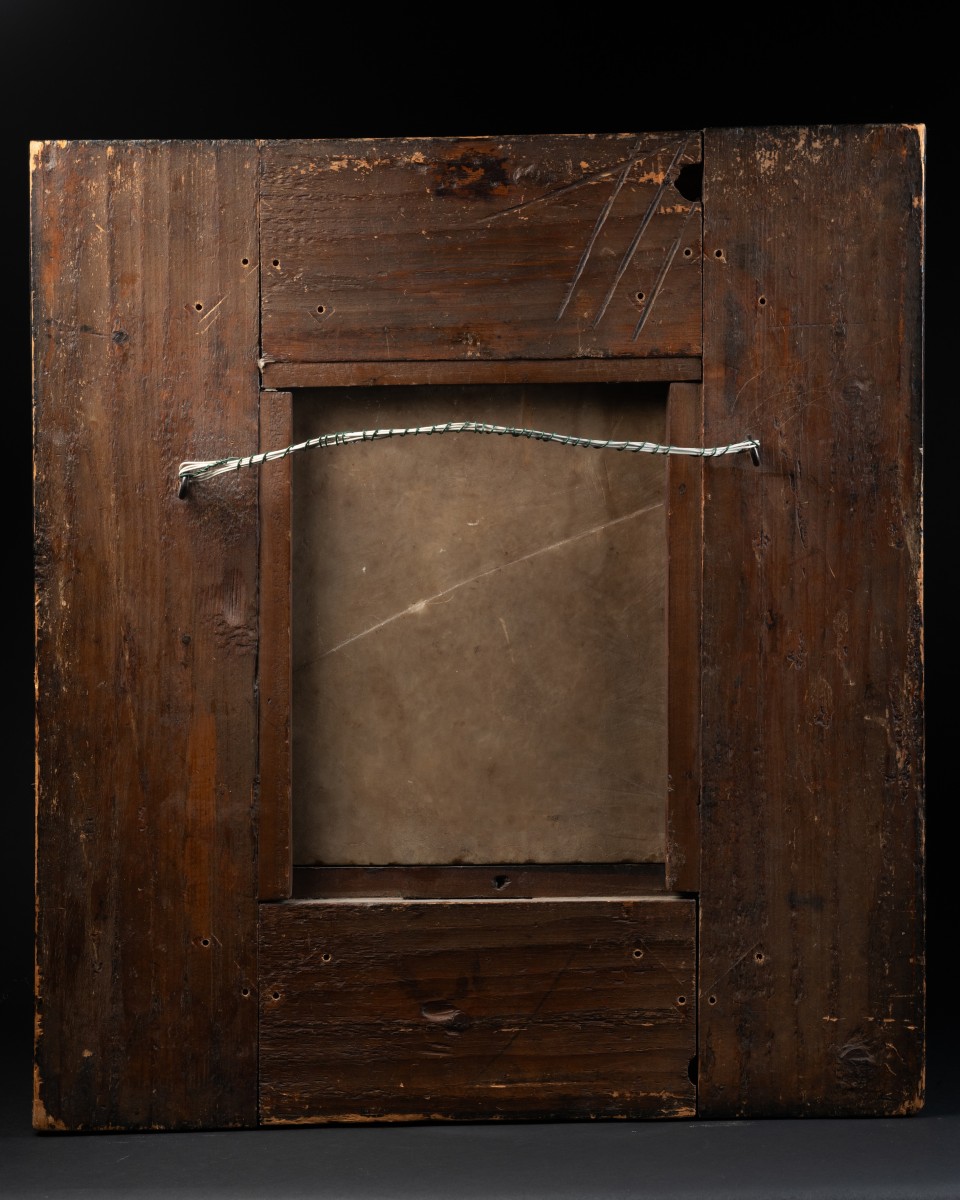
The relief is set within a moulded frame of ebonised wood, its wide, stepped profile carved with a fine reeded and guilloche ornament and set at the corners with projecting rectangular bosses - a frame type standard across the Southern Netherlands and Dutch Republic through the seventeenth century for reliefs, small paintings and prints alike, and entirely of a piece with the pairing of pale alabaster against dark ebonised wood favoured for Mechelen panels of this kind. Given the disparity in scale between this frame and the modest gilt-wood mounts typical of the smaller cleynstekerswerk product, it was very probably made expressly to house a panel already understood, at the time, to be an unusually important and large example of its type.
Bibliography
The Adoration of the Magi, Rijksmuseum, Amsterdam, object no. BK-KOG-1255-D, Mechelen, circa 1600-1620, on loan from the Koninklijk Oudheidkundig Genootschap since 1885.
The Adoration of the Magi, Fitzwilliam Museum, Cambridge, object no. M.3-1980, Malines, circa 1540.
A Mechelen alabaster relief of the Adoration of the Magi, circa 1600, Lempertz, Cologne, Auction 1108, lot 1197, 16 May 2018.
Alabaster Reliefs and Plaques From Mechelen: Renaissance Devotional Art, Proantic, online resource (consulted 2026).
Beelden en reliëf in Mechelse albast, Mignot Antiquités & Expertise, online resource (consulted 2026).
Delevery information :
We can arrange shipping.