Offered by Segoura Fine Art
REQUEST INFORMATION

Painting, furniture and works of art from the 17th, 18th and early 19th century
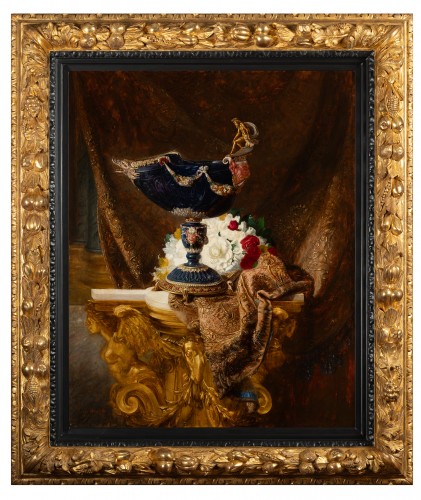
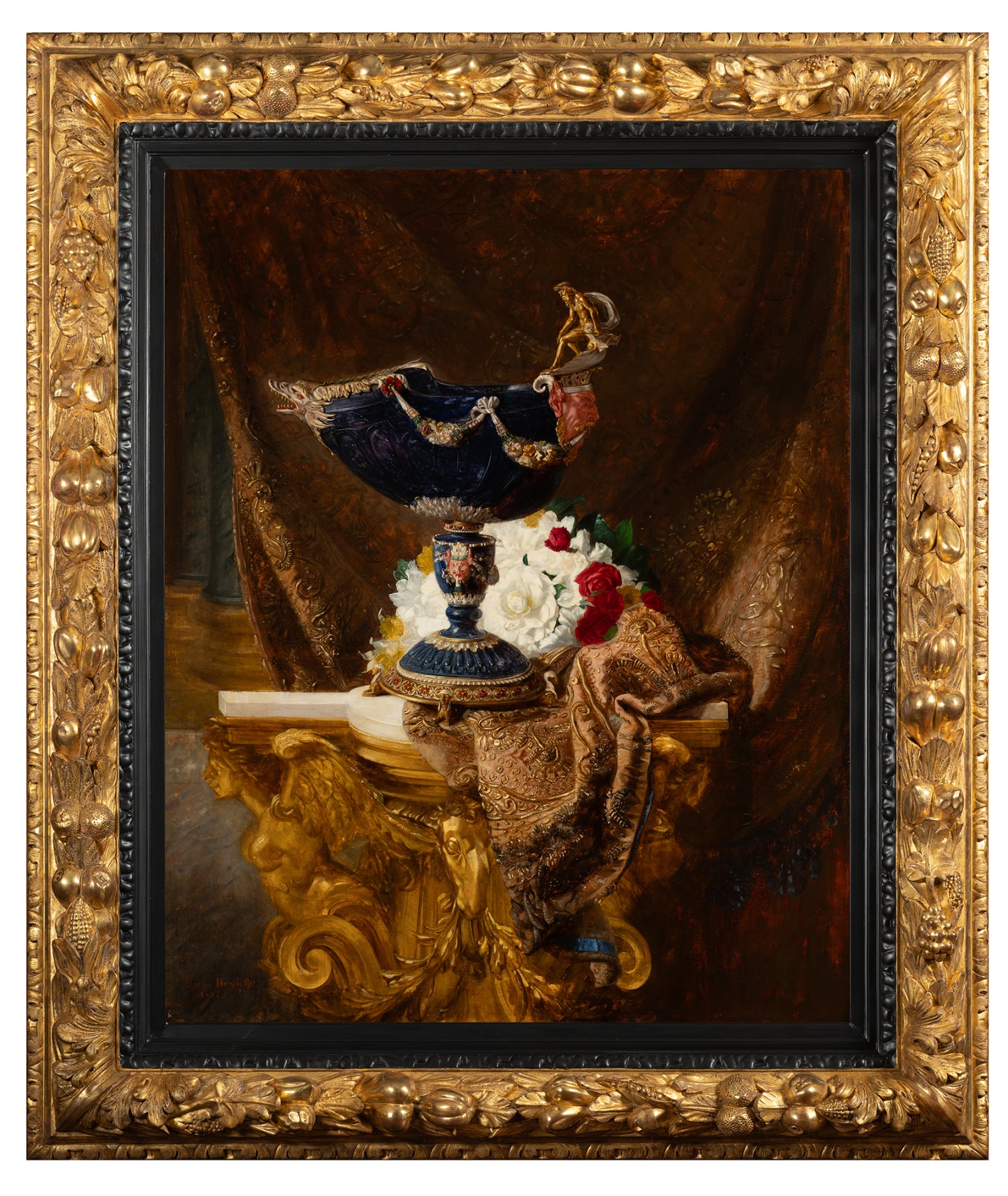
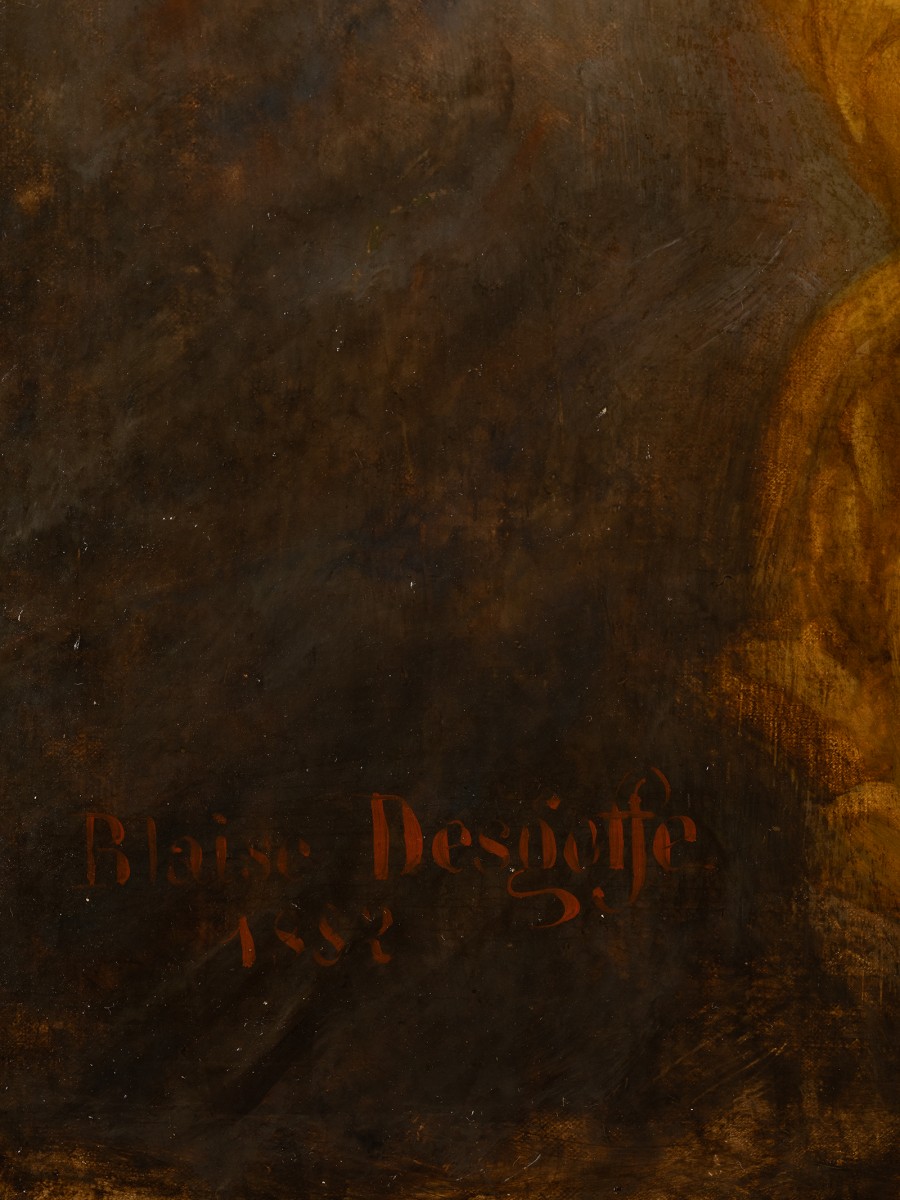
Oil on canvas, signed and dated
“Blaise Desgoffe 1882” lower left
Dimensions: 92 × 64 cm
Dimensions with frame: 119 × 101 cm
Bibliography
E. Bénézit, Dictionnaire des peintres, sculpteurs, dessinateurs et graveurs, Éditions Gründ, Paris, 1999.
Gérald Schurr, Pierre Cabanne, Dictionnaire des Petits Maîtres de la peinture (1820–1920), vol. 1, Éditions de l’Amateur, Paris, 1996.
Roger Ballu, La peinture au Salon de 1880 : Les peintres émus, les peintres habiles, A. Quantin, Paris.
William Gerdts and Russell Burke, American Still-Life Painting, pp. 135/201.
After the Hunt: William Harnett and Other American Still Life Painters, 1870–1900.
Museums
Musée de La Rochelle
Musée de Liège
Musée du Louvre, Paris
Baltimore Museum
Brooklyn Museum, New York
Metropolitan Museum of Art, New York
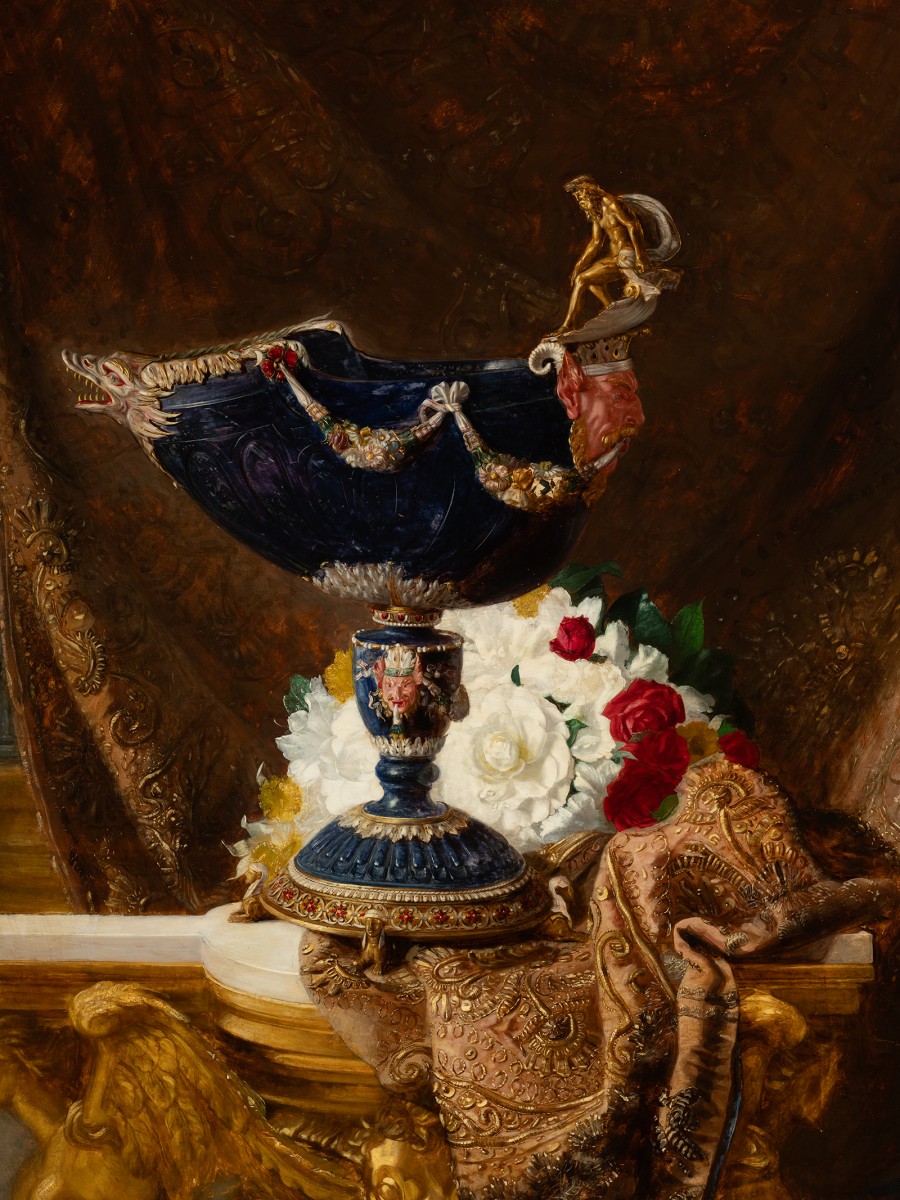
This painting is a masterpiece of technical finesse and decorative refinement. The artist depicts an extraordinarily intricate vessel in the form of a long, narrow shell, embellished with deeply carved radiating flutes.
At one end of the shell sits a silver-gilt statuette of Neptune, majestically enthroned upon a white-enamelled shell, symbolising the grandeur of the sea. Immediately below, a delicately sculpted mascaron supports garlands of polychrome flowers, introducing an element of lightness and colour.
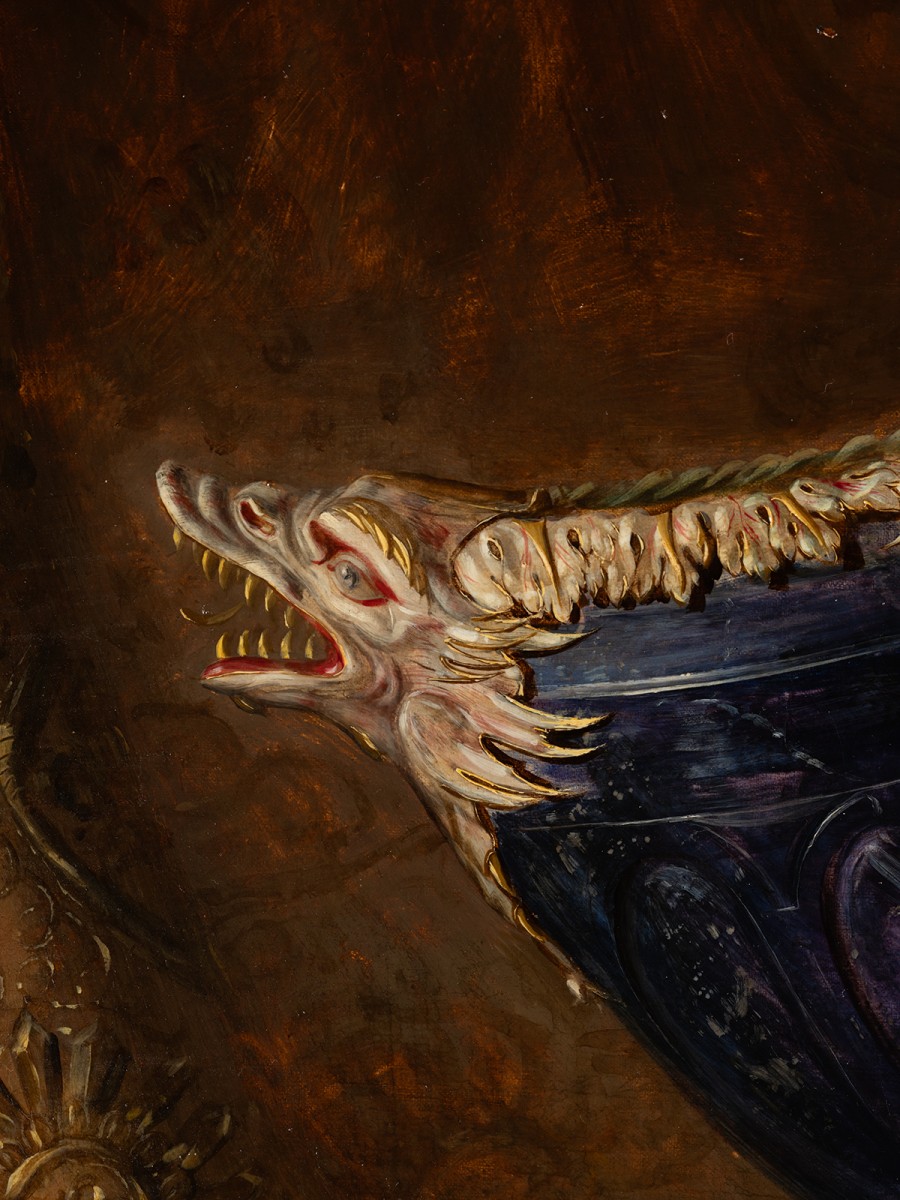
The opposite end of the vessel is adorned with the head of a sea monster in naturalistic enamel, creating a striking contrast with the delicacy of the surrounding decorative elements. The baluster stem, decorated with mascarons and enamelled garlands, further emphasises the richness of the sculptural detail and demonstrates the artist’s remarkable ability to reproduce precious materials.
The entire object rests upon an elegant base supported by four gilt sphinxes, adding both monumentality and refinement. The base is bordered with gilt decoration incorporating an openwork frieze of floral motifs in translucent enamel, further enhancing the luxurious character of the object.
The vessel itself is displayed upon a white marble console partly covered by a light brown drapery, whose restrained tones accentuate the brilliance and richness of the precious materials.
Both sumptuous and spectacular, the composition demonstrates Desgoffe’s extraordinary ability to capture light, texture and reflections, while maintaining a perfect balance between the sculptural and decorative elements.
The painting creates an atmosphere of exceptional richness and refinement. It is a remarkable example of the encounter between the art of still-life painting and the splendour of the decorative arts.
Blaise Alexandre Desgoffe
A major figure in nineteenth-century French still-life painting, Blaise Alexandre Desgoffe began his training at the École des Beaux-Arts in Paris in 1852, studying in the studio of Hippolyte Flandrin. He subsequently continued his artistic education under the celebrated academic painter William-Adolphe Bouguereau.
Although his early training was primarily directed towards history painting, Desgoffe found his true vocation in still life, the genre through which he would establish his reputation.
Desgoffe exhibited for the first time at the Salon in Paris in 1854, presenting a work depicting a game of cup-and-ball, a portrait and two studies of agate goblets. It was, however, through his successive appearances at the Salon between 1857 and 1882 that he truly distinguished himself as a still-life painter.
His extraordinary virtuosity in depicting precious objects and his striking realism attracted considerable critical admiration. Contemporary observers compared his work with that of the great seventeenth-century Dutch masters of still life, including Willem Kalf and Pieter Claesz.
Desgoffe specialised in sumptuous still lifes featuring luxurious objects and rare works of art, often inspired by the collections of the Musée du Louvre.
He devoted considerable attention to studying and reproducing objects preserved in the museum, particularly sixteenth-century works displayed in the Galerie d’Apollon and the Louvre’s collections of decorative arts. His compositions feature such objects as rock-crystal vessels, agate ewers and elaborate pieces of goldsmiths’ work.
His paintings are distinguished by an extraordinary attention to detail and an exceptional ability to reproduce the textures and optical qualities of a wide variety of materials — glass, precious metals, textiles, hardstones and gemstones.
From the 1870s onwards, he broadened his repertoire by incorporating objects of Chinese, Japanese and Greek origin, probably in response to the tastes and requests of his patrons.
Desgoffe’s talent was quickly recognised. He received numerous distinctions, including a third-class medal in 1861 and a second-class medal in 1863.
At the Exposition Universelle of 1867, he exhibited one of his emblematic works, Un coin de cabinet de Louis XVI (A Corner of Louis XVI’s Cabinet), perfectly illustrating his decorative approach and fascination with luxury and precious objects.
His technical skill was widely praised. In his account of the Salon of 1880, the critic Roger Ballu noted the public’s fascination with the astonishing virtuosity of Desgoffe’s still lifes, whose illusionistic precision was frequently associated with the tradition of trompe-l’œil.
Despite the success of his career as a still-life painter, Desgoffe was not entirely free from controversy. His strong personality and difficult relationships with some of his contemporaries contributed to tensions within the Parisian artistic community.
Nevertheless, he remained an important figure in nineteenth-century French painting. Although his reputation declined in Europe during the twentieth century, his work continued to enjoy considerable recognition in the United States, where his influence extended to painters such as William Merritt Chase and William Michael Harnett.
Towards the end of his career, Desgoffe was appointed a Chevalier of the Légion d’honneur.
He left an important legacy in the history of still-life painting. Through the perfection of his technique, his extraordinary attention to detail and his ability to transform museum treasures into spectacular pictorial compositions, Blaise Alexandre Desgoffe made a significant contribution to the development of nineteenth-century academic still-life painting.