Offered by Ars Antiqua
REQUEST INFORMATION

Old Masters paintings, furniture, sculptures and modern art
Stefano Camogli, known as Il Camoglino (c. 1610 – ?)
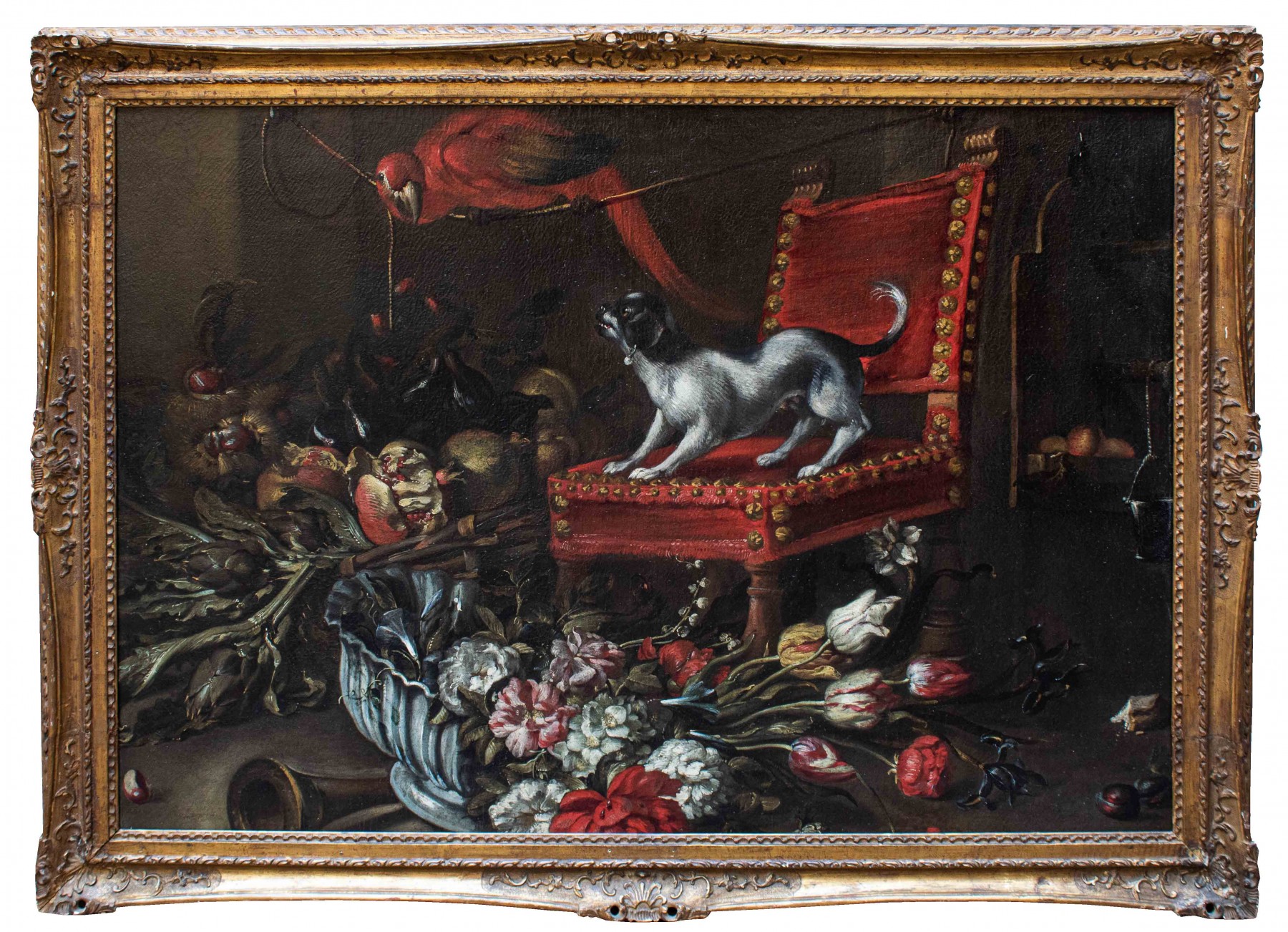
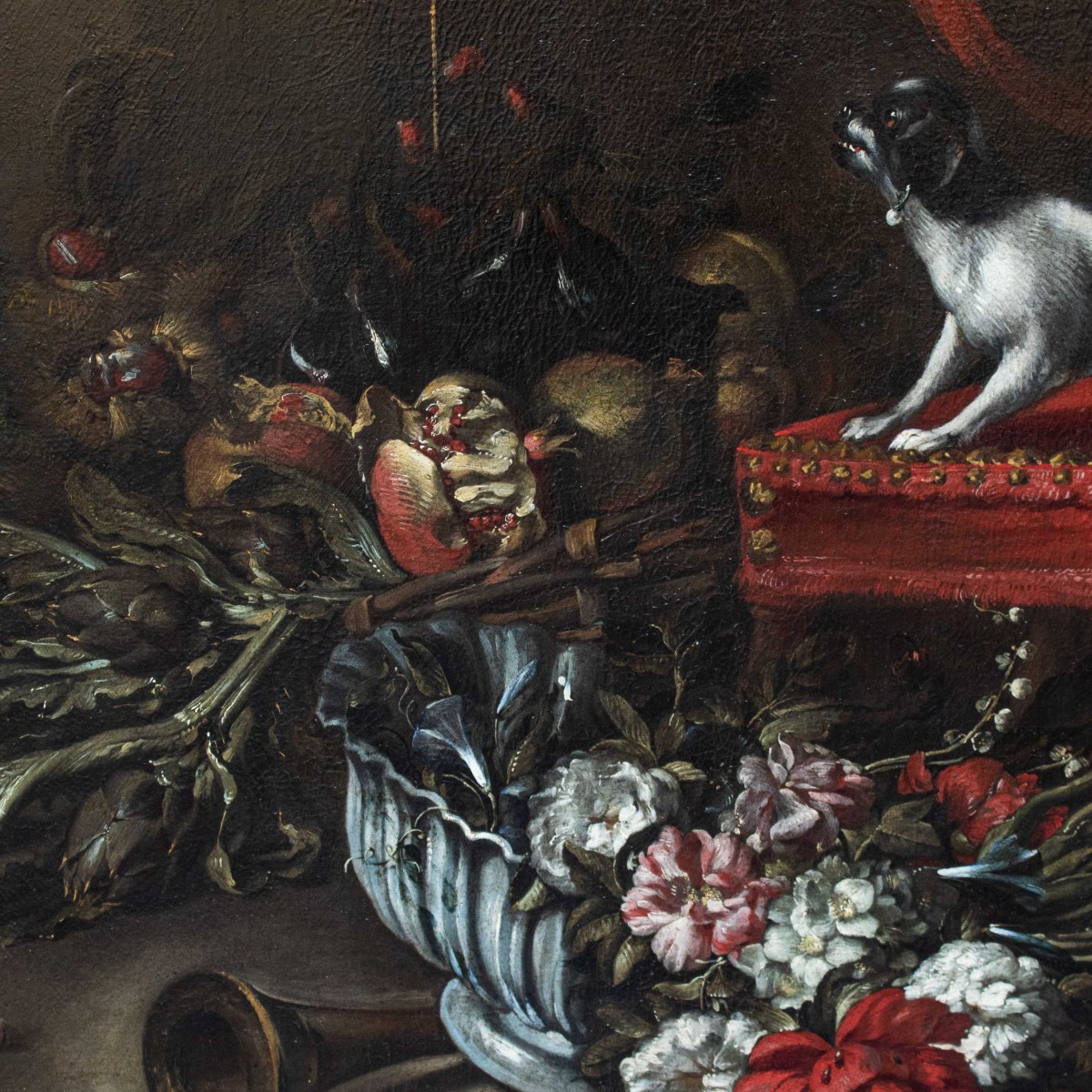
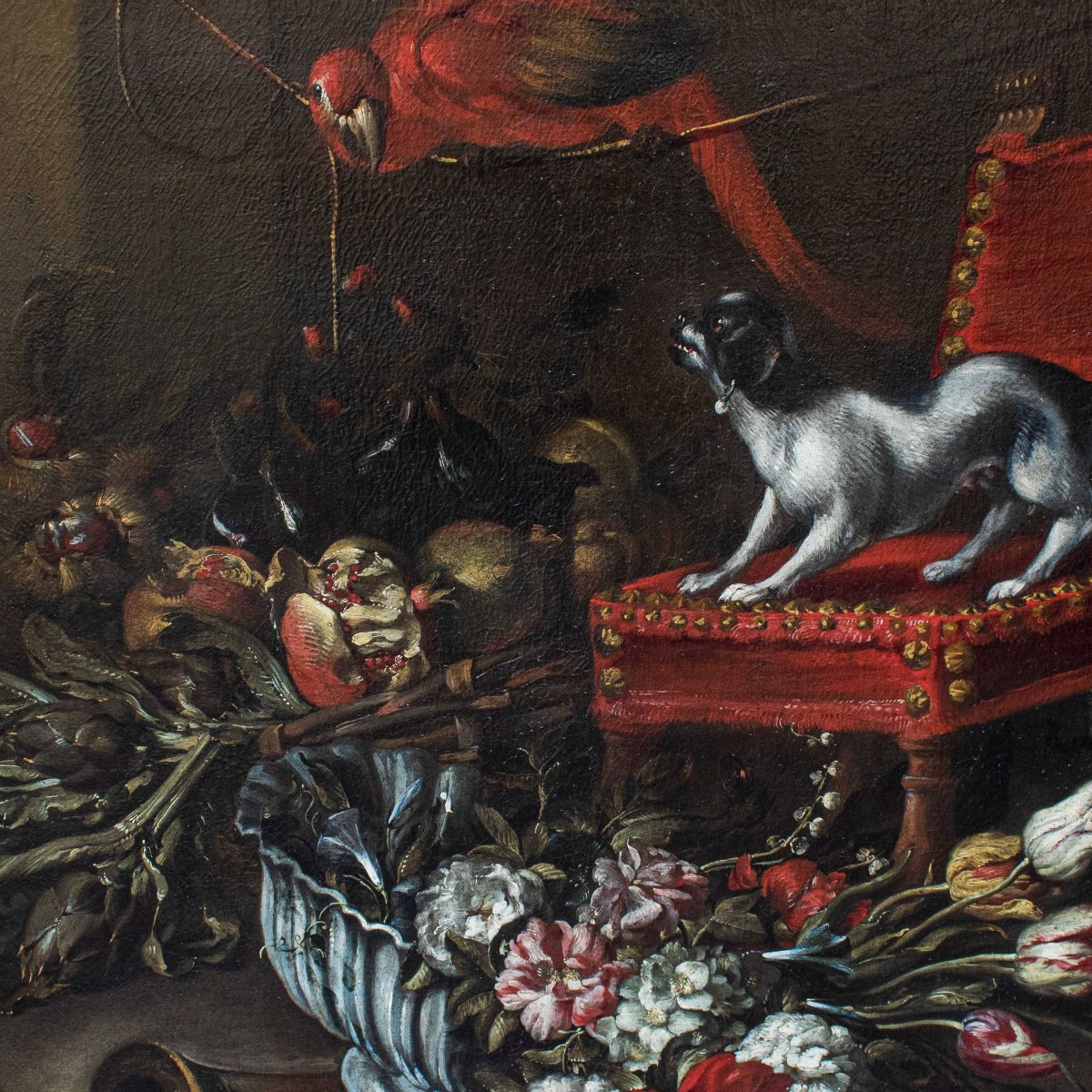
Still Life with Dog and Parrot
Oil on canvas, 91 x 126 cm – with frame, 108 x 145 cm
This painting is recognized as an autograph work by Stefano Camogli, known as Il Camoglino (active in Genoa from 1616 to 1638), one of the most esteemed still-life specialists of Genoese Baroque painting. Carlo Giuseppe Ratti wrote about him in the second volume of his Vite; the biographer provided further details in the pages dedicated to the life of Domenico Piola—Camogli's brother-in-law, as Camogli had married Piola's sister, Angiola. Ratti noted: "An excellent painter of arabesques, foliage, flowers, and fruit, and such things," skilled in designing ephemeral decorations, who, however, "not knowing... how to paint figures, made use of the young Piola in this regard; and as opportunities came quite frequently to Cammoggi, Piola thus had the chance to practice handling gouache colors." Further information about his life can be found in the manuscript draft of the Vite, which originally planned a section dedicated solely to Camogli. From this, we learn his approximate birth date (c. 1610) and his seniority over his brother-in-law Domenico, who practiced in his workshop while still a youth.
It is Ratti who provides the crucial information regarding Camogli's apprenticeship in the workshop of the Flemish master Jan Roos (Antwerp 1591 – Genoa 1638), who resided in Genoa, where he had made a name for himself specializing in still lifes and market scenes. In Roos's bustling studio, Camogli immediately demonstrated great mastery, particularly in floral passages—a talent for which Ratti describes him as "so celebrated in flowers."
From these few biographical records, scholars began reconstructing Il Camoglino's catalogue, primarily through stylistic analysis. His brushwork can be identified in works by both Roos and Piola. Examples include Roos's canvases depicting Nebuchadnezzar and the Golden Idol and Cyrus Sacrificing to the Idol Bel, where the offering to the pagan deity features a large vase of flowers characterized by brighter, ringing colors and a technique relying on impasto that leaves clear, distinct brushstrokes.
Camogli collaborated extensively with his brother-in-law Piola, with the former responsible for the still lifes and the latter for the figures. Seventeenth-century inventory records credit him with numerous collaborative paintings with Piola, such as the Infant Jesus within a Garland of Flowers at the Museo dell'Accademia Ligustica in Genoa, the antependium with St. John the Baptist among Flowers and Tendrils in the Cathedral of San Lorenzo, and the Allegory of Peace and Abundance—a work once attributed solely to Piola but now reinterpreted as a joint effort. As Piola gained renown, particularly after the plague of 1657 left him clear field, Camogli was increasingly involved in his brother-in-law's projects. Celebrated for his floral garlands, Camogli also collaborated with Gioacchino Assereto; their joint hand is recognized in the St. Joseph with the Infant Jesus at the Pinacoteca di Brera.
Camogli also designed ephemeral structures, such as the funeral catafalque for Philip IV in July 1667 and that of Cardinal Stefano Durazzo. Records also document his activity as a designer of floral embroidery patterns; scholar Marzia Cataldi Gallo hypothesized the existence of an as-yet unassigned embroidery workshop closely linked to the Casa Piola.
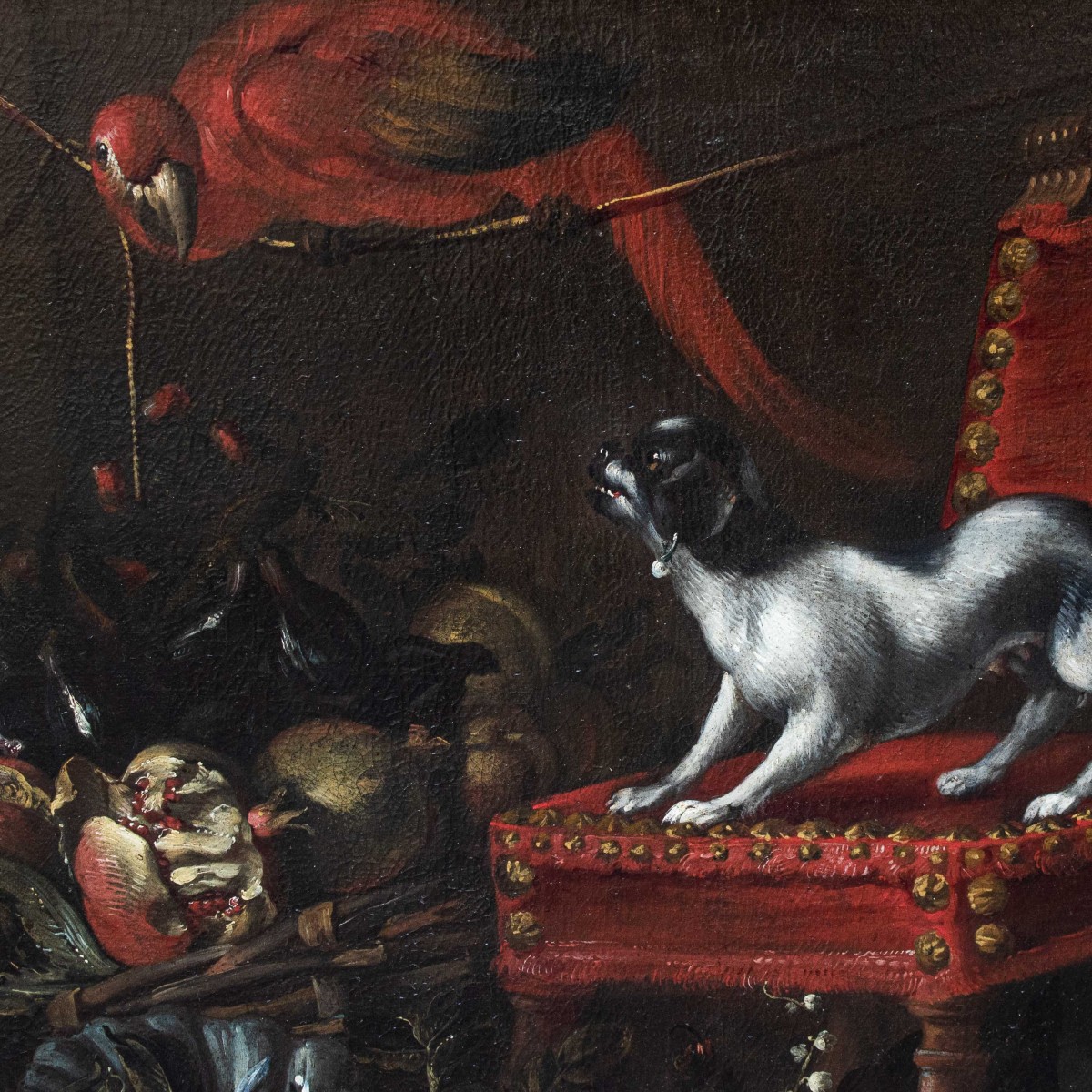
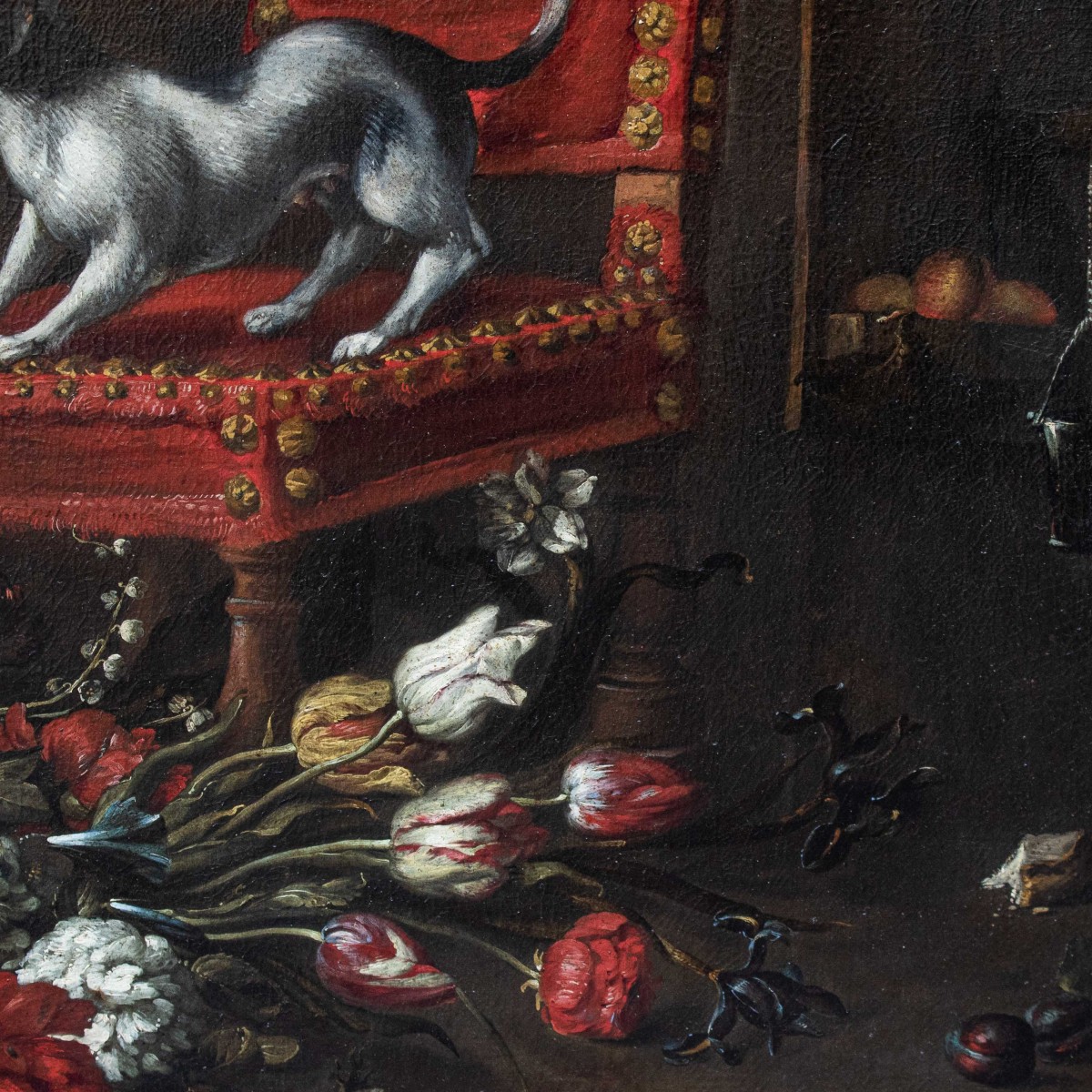
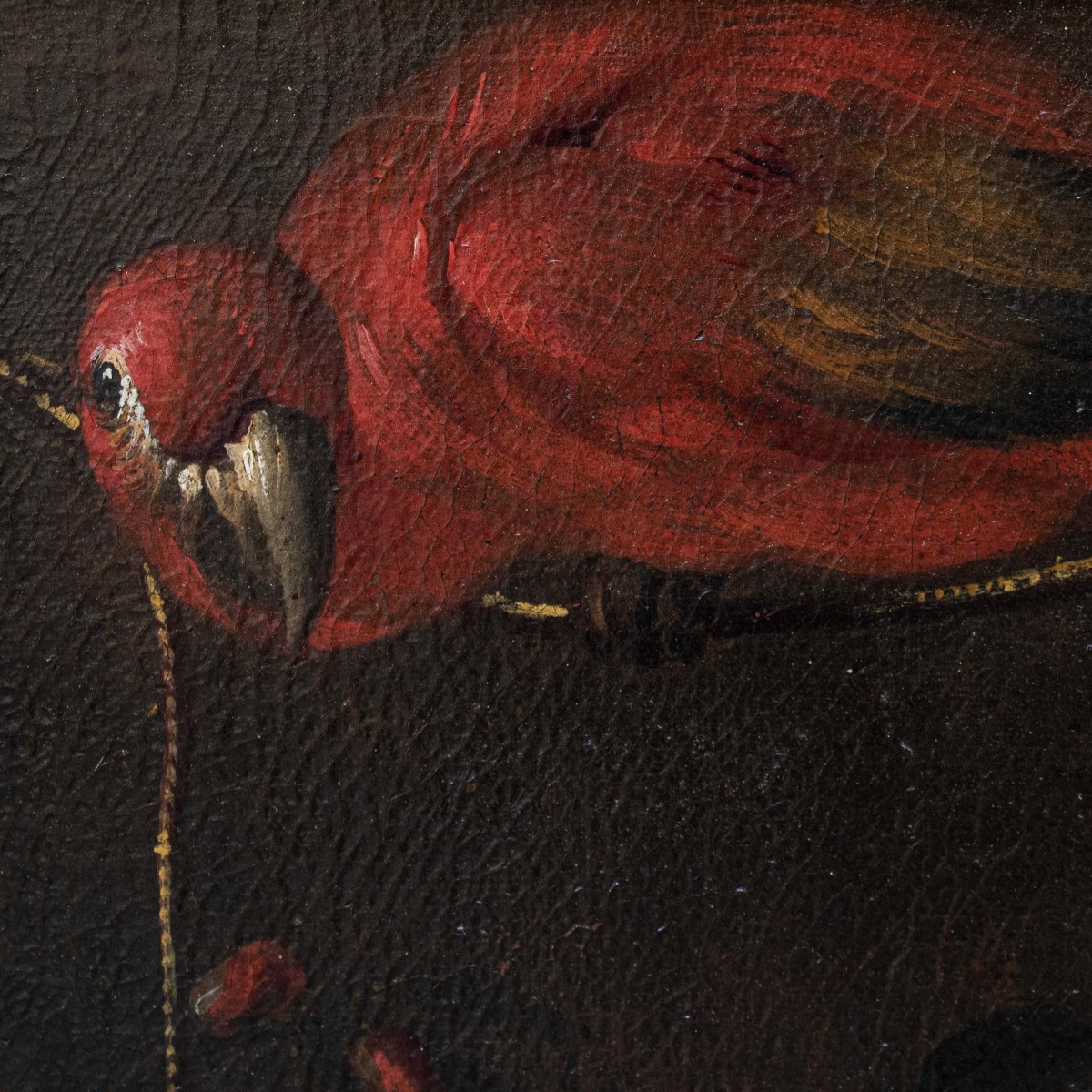
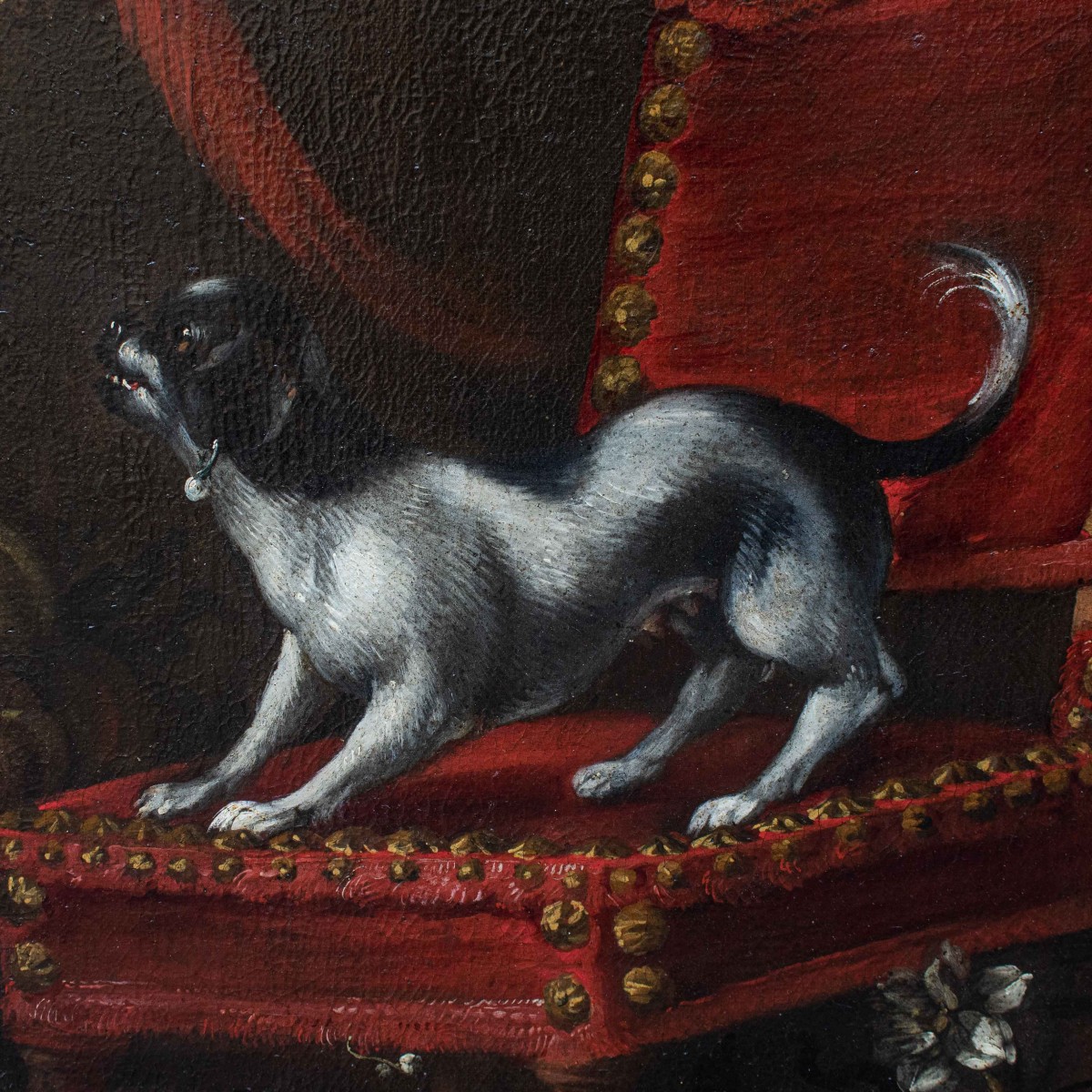
Stefano Camogli was a master of floral painting, fruit still lifes, and animal subjects, which he rendered with striking truthfulness. His style is characterized by bright, vividly contrasting colors, a sumptuously monumental composition, tactile softness, and a meticulous, Flemish-derived attention to detail. He was especially adept at portraying animals expressively and realistically—likely due to his access to a corpus of animal drawings by Sinibaldo Scorza (known for his small-scale mythological compositions featuring animals and his vast drawing collection), which was kept in Domenico Piola's workshop.
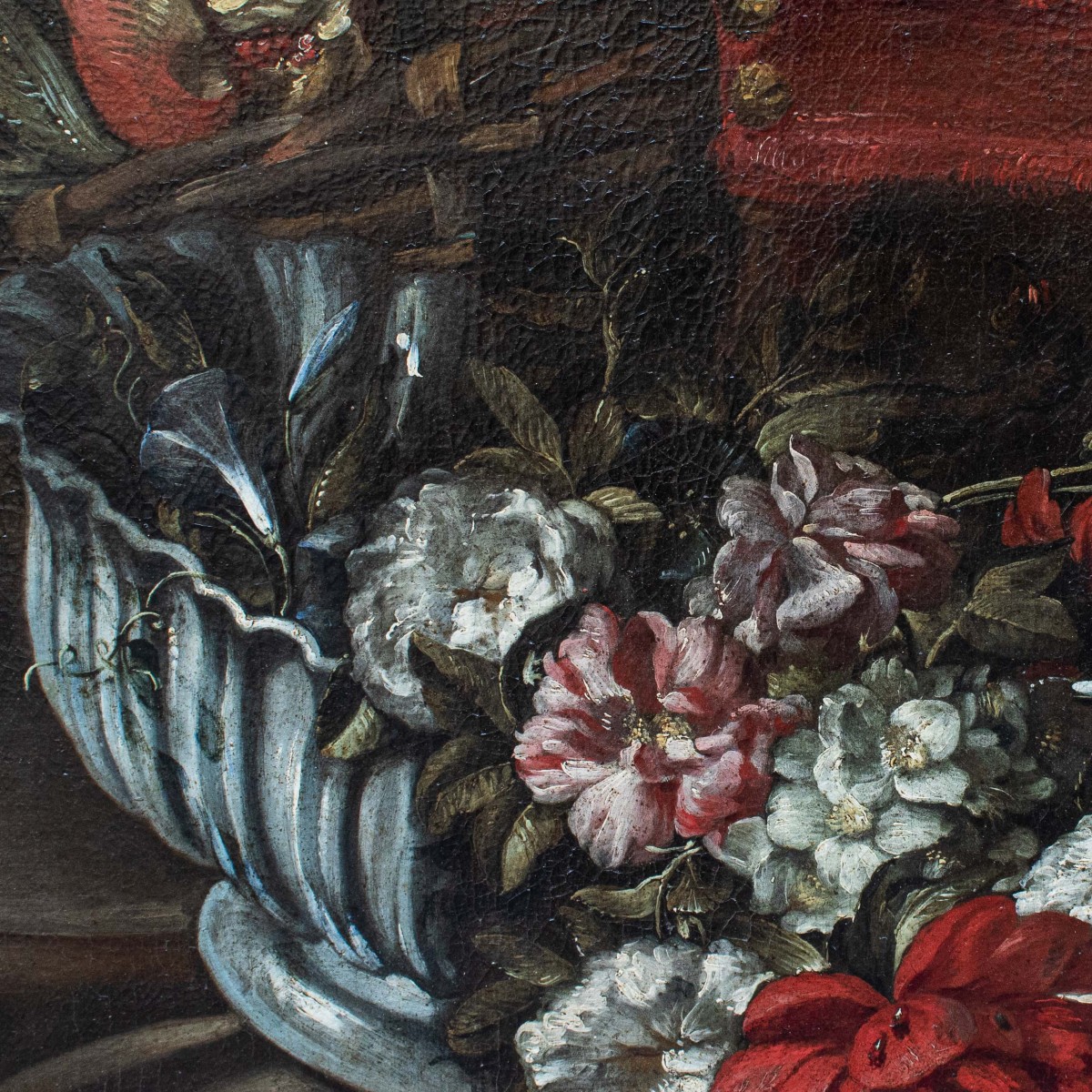
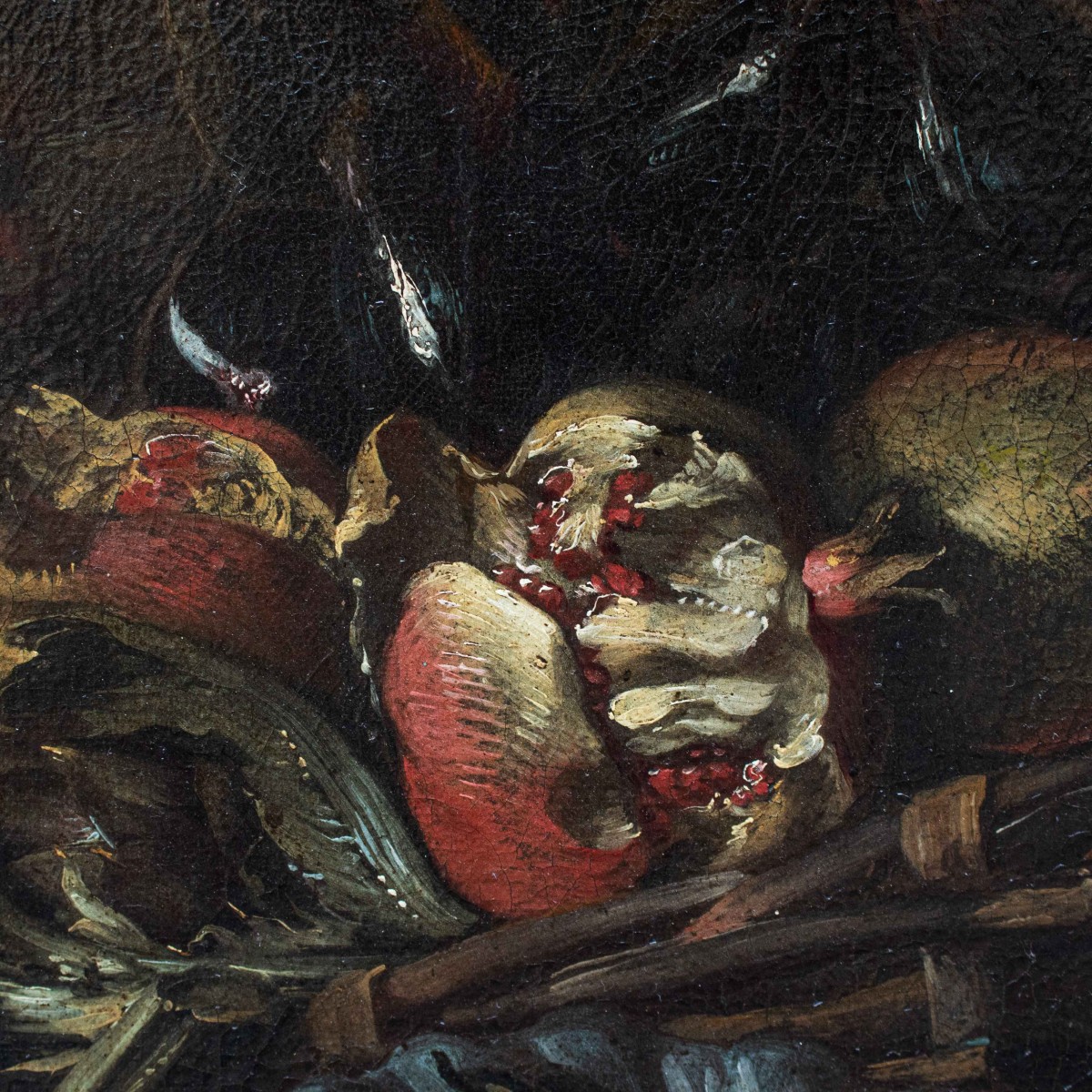
The present work fits seamlessly into Stefano Camogli's oeuvre. The floral passages executed in vibrant colors and the rich, painterly impasto are hallmarks of his style, as is the meticulous attention to detail seen in the rendering of the pomegranates, artichokes, and chestnuts with their burs—rendered needle by needle. The presence of the two animals, the dog and the parrot, further confirms his knowledge of Sinibaldo Scorza's models.
Delevery information :
Les frais d'expédition seront calculés au moment de la commande en fonction de la destination, des dimensions et du poids du tableau, ainsi que de l'assurance couvrant la valeur totale de l'œuvre.
For paintings purchased from abroad: following payment, the application process to obtain the export license (ALC - Attestato di Libera Circolazione) will be initiated. All antiques shipped abroad from Italy require this document, which is issued by the Ministry of Cultural Heritage. The procedure may take 3 to 5 weeks from the date of request; therefore, the painting will be shipped as soon as the document is obtained