Offered by Galerie Alexandre Piatti
REQUEST INFORMATION

Works of art, sculptures and furniture Haute Epoque
Some faces endure through the centuries without losing any of their presence. This one is the most striking example of that.
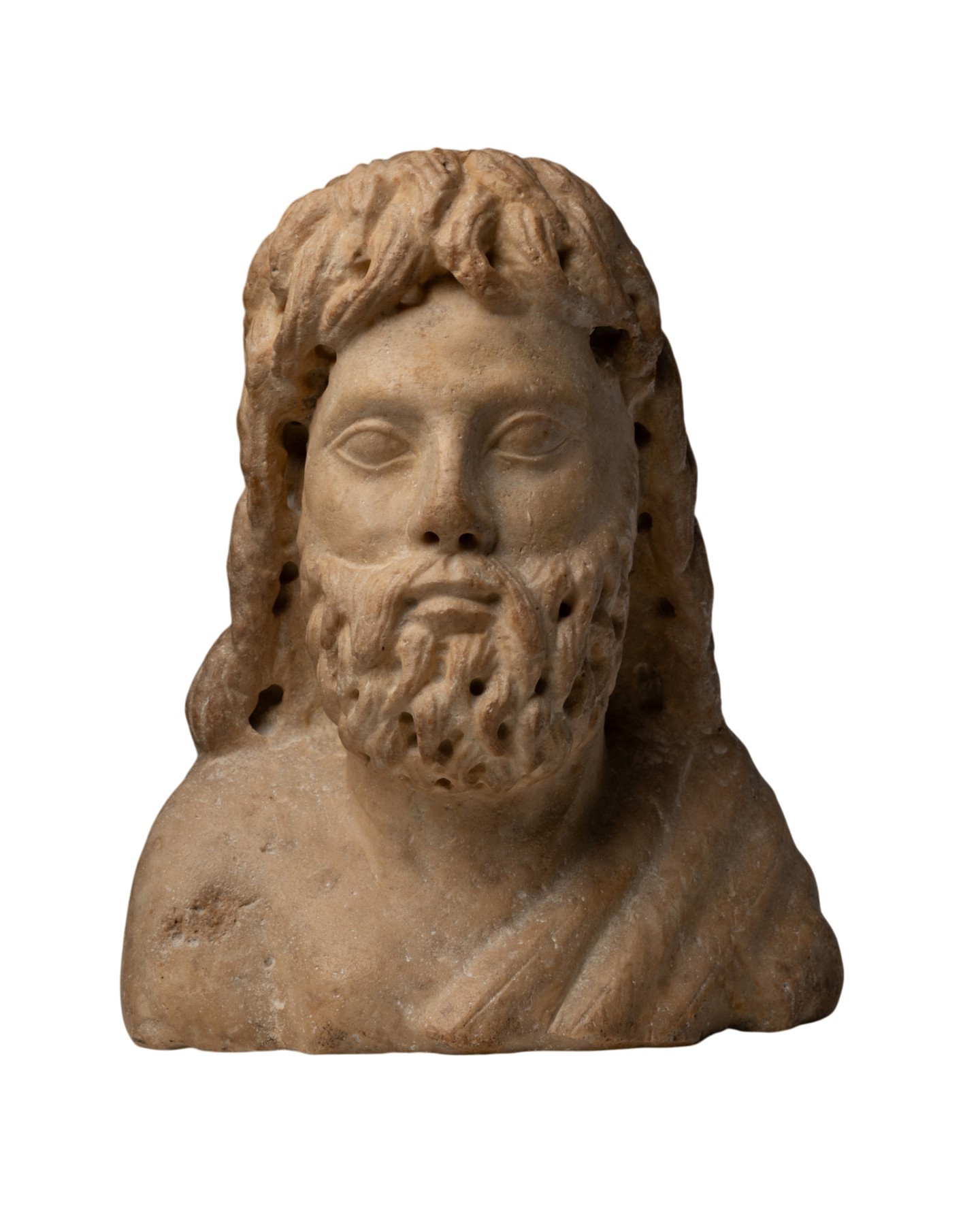
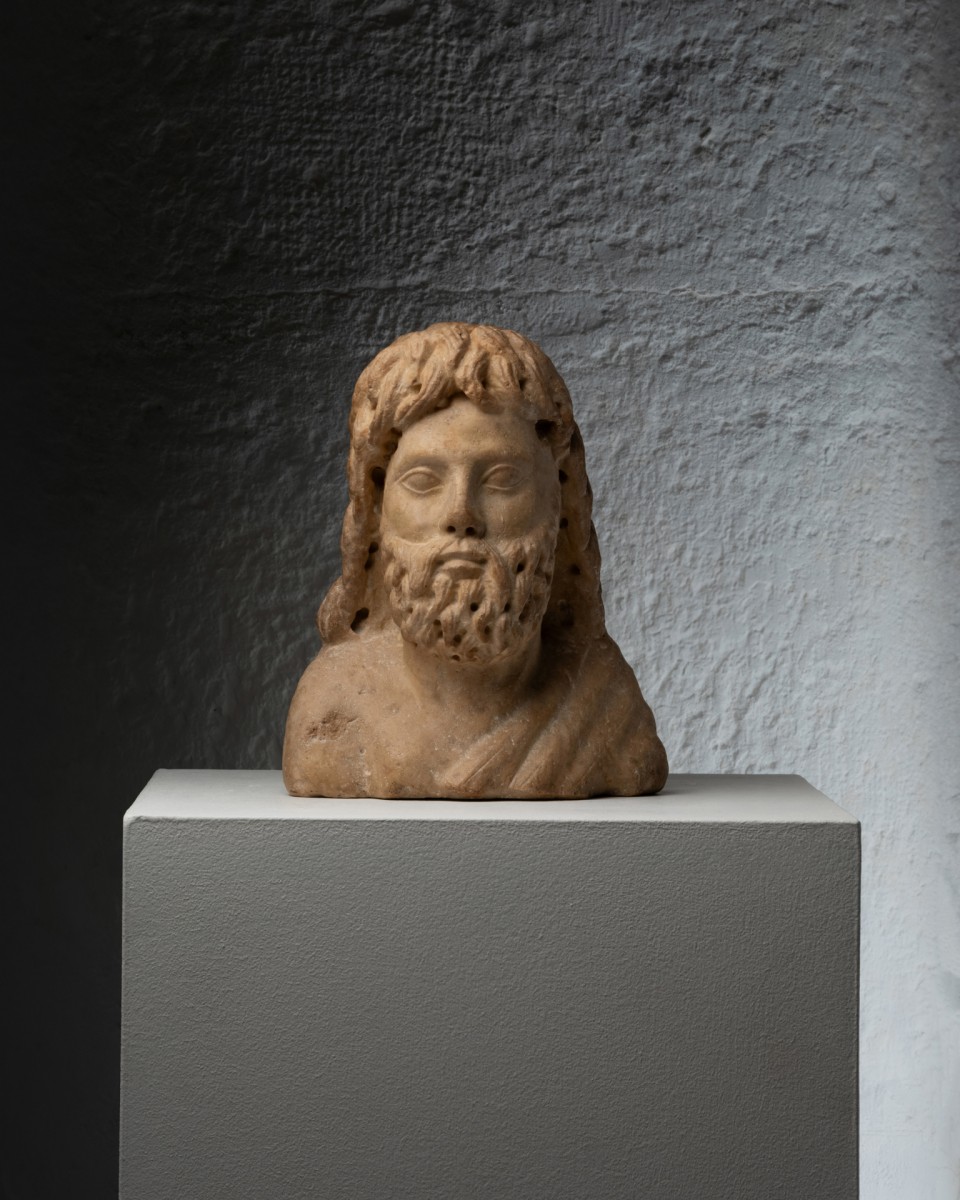
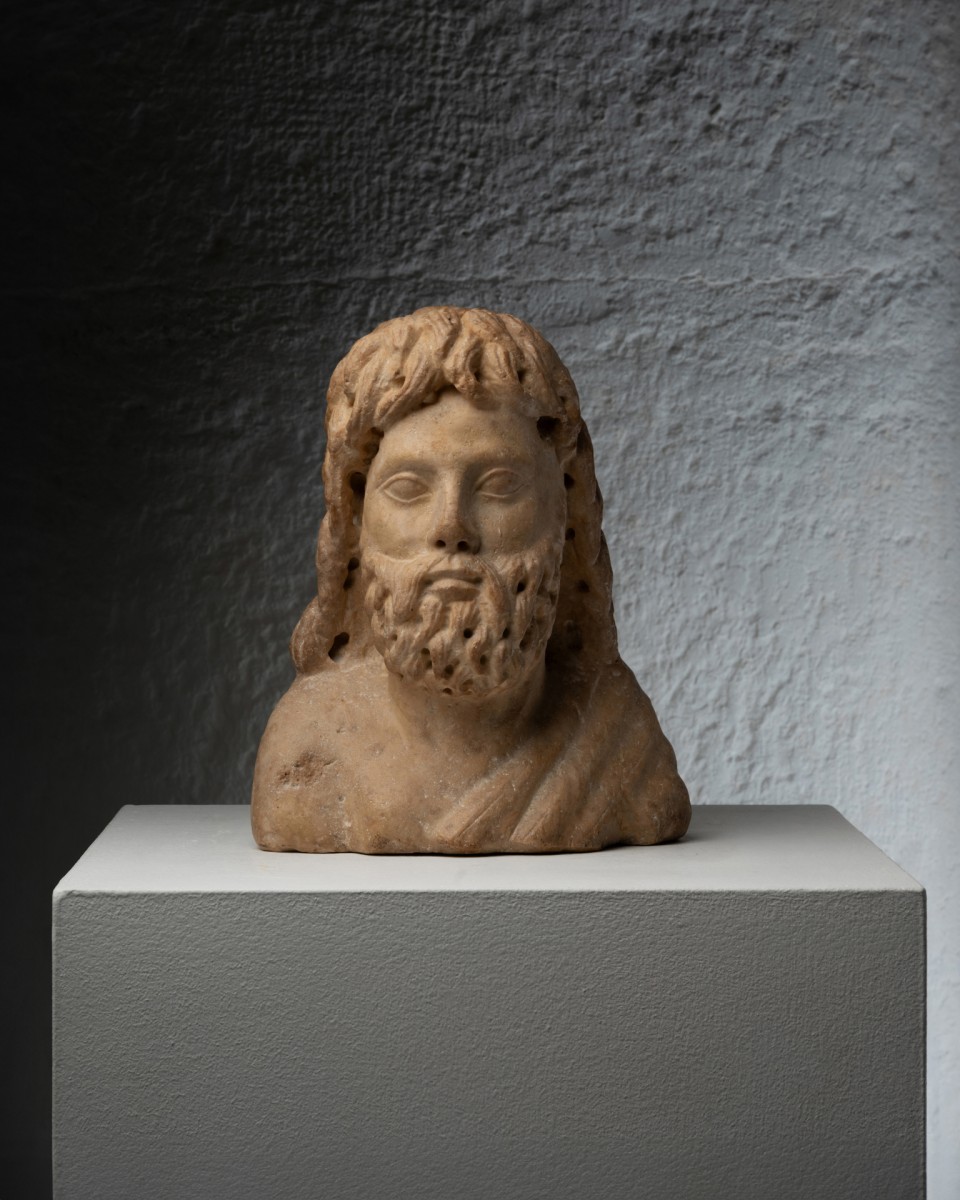
Carved from white statuary marble of remarkable quality—most likely of the Parian type, with a fine grain and slight translucency—this bearded male head immediately strikes the viewer with the intensity of its expression and the absolute mastery of its execution. It belongs to the great family of figures of wisdom from Late Antiquity: those powerful images that, in the history of Western art, mark the exact moment when the ancient world ceases to be itself and becomes something new.
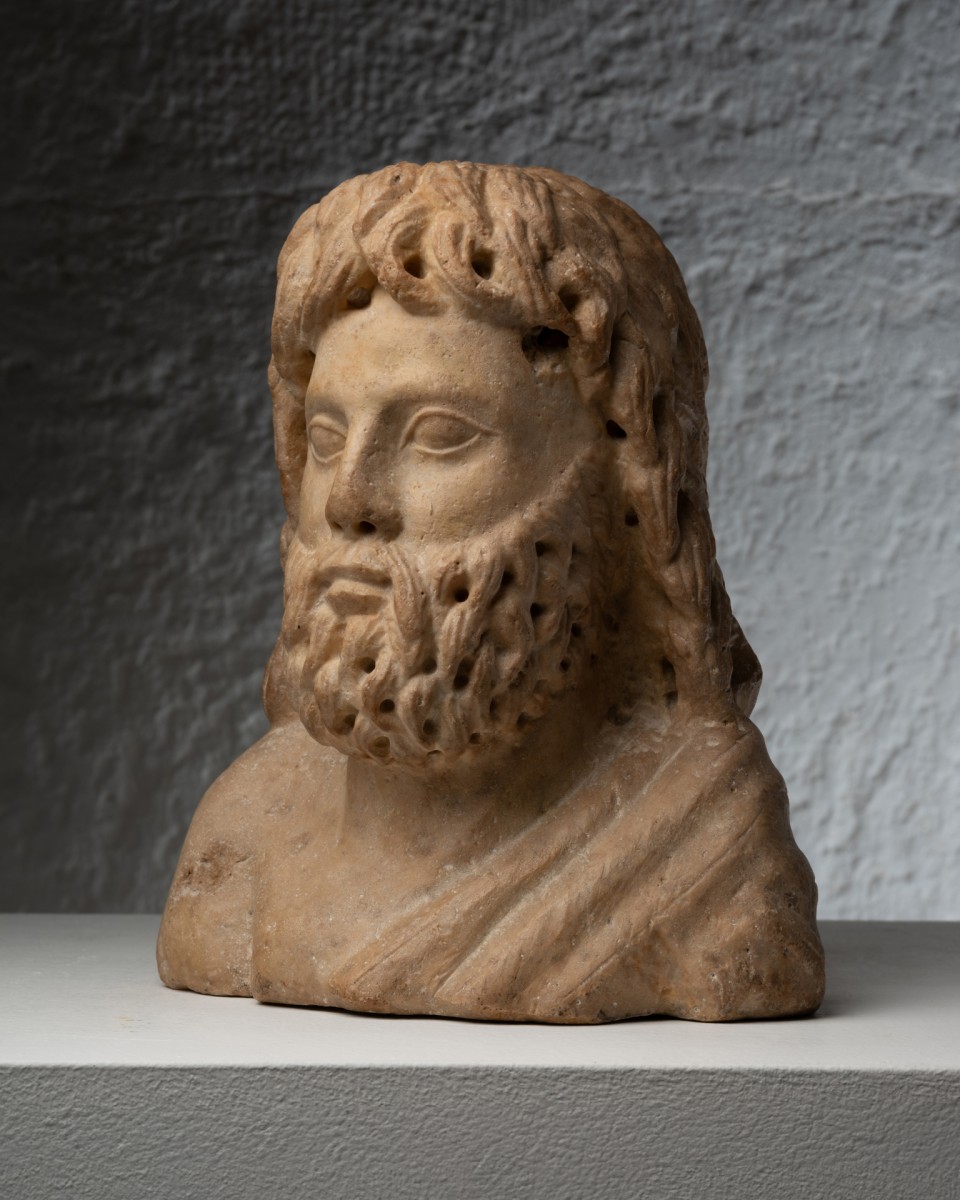
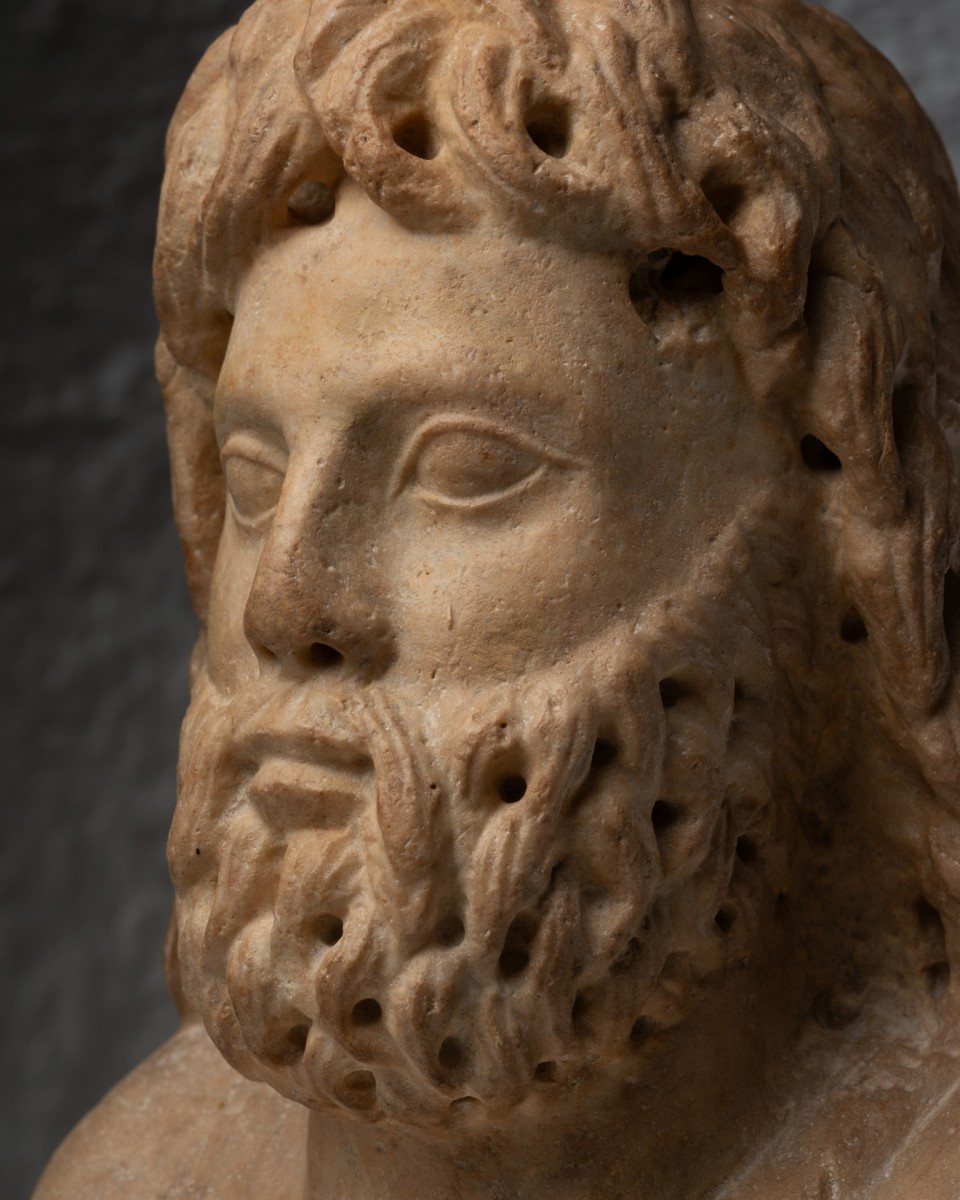
The face is of a rare sculptural quality. The broad, unobstructed forehead conveys a serene authority, without the dramatic tension found in imperial portraits. The almond-shaped eyes, slightly stylized, do not seek to faithfully reproduce anatomy: they gaze beyond, toward an invisible reality—a technique characteristic of the great spiritual sculpture of Late Antiquity, which substitutes an inner presence for naturalistic depiction. The mouth, discreet and almost silent, proclaims nothing: it suggests. The nose strongly defines the frontal axis of the face and reinforces the impression of monumentality.
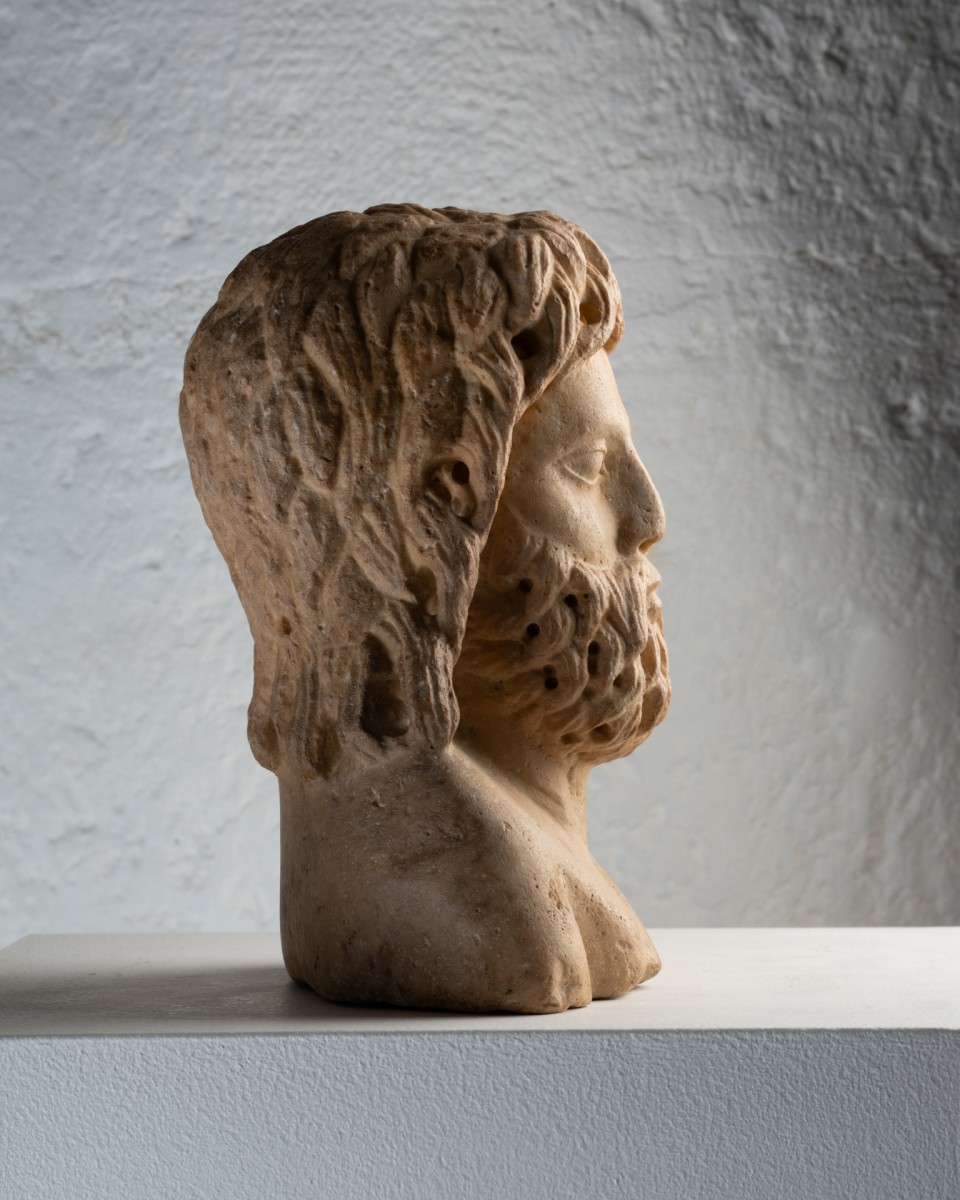
The beard and hair are the technical masterpiece of the entire work. Arranged in deep strands, drilled with exceptional virtuosity, they create a play of light and shadow of striking intensity. The sculptor did not merely depict a head of hair: he constructed it through light. This treatment—deep drill holes at the base of the strands, recesses separating the beard from the face, and volumes brought to life by contrasts—is one of the surest hallmarks of great late Roman sculpture, a direct heir to the workshops of the 2nd and 3rd centuries.
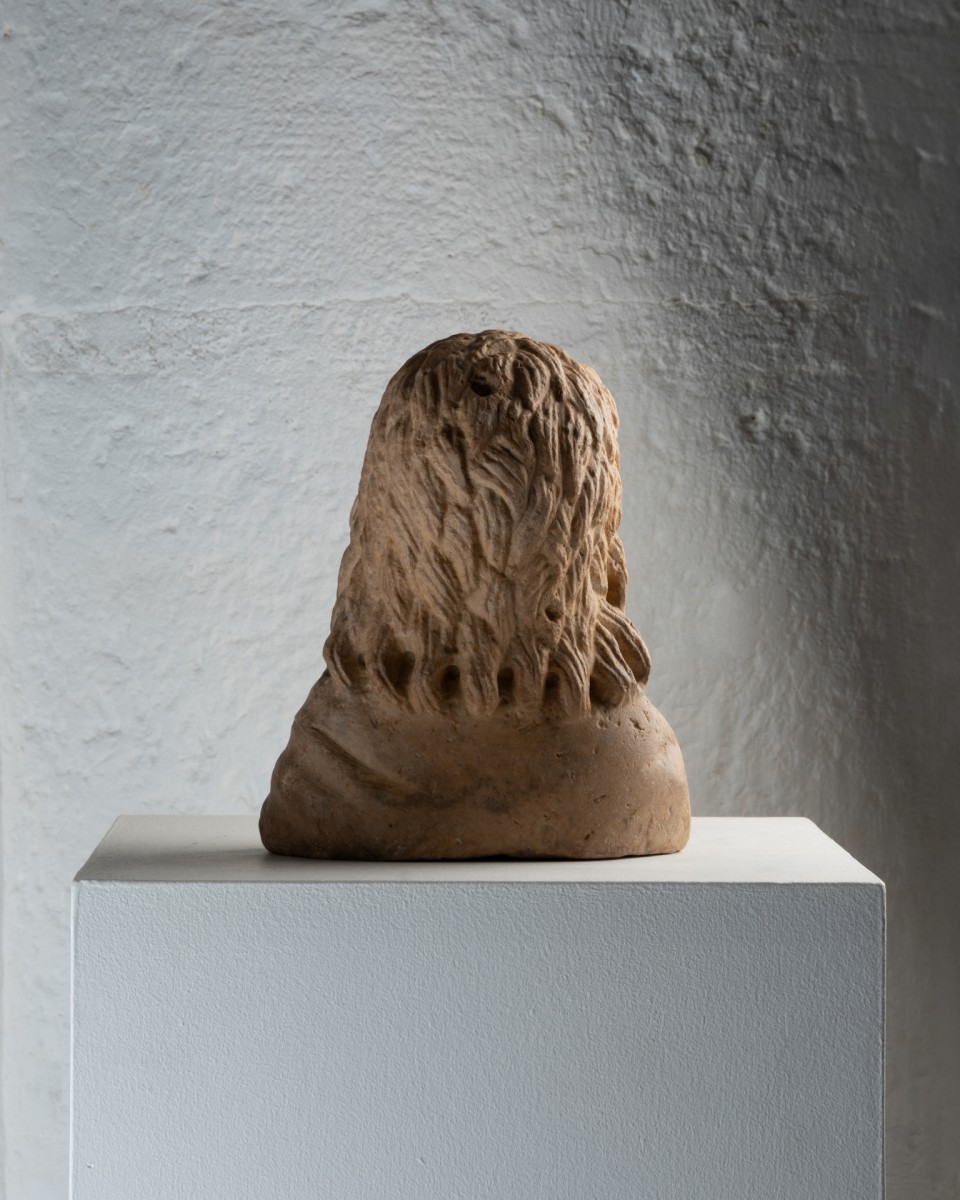
The drapery visible at the shoulder follows a linear, geometric pattern, consistent with the Late Antique aesthetic theorized by Plotinus in the *Enneads*: beauty lies no longer in the flesh or in movement, but in that which animates them. The hair, carefully styled at the back of the head rather than left unkempt, as in a freestanding sculpture, suggests a work intended to be viewed in the round, perhaps in a votive or prayerful context.
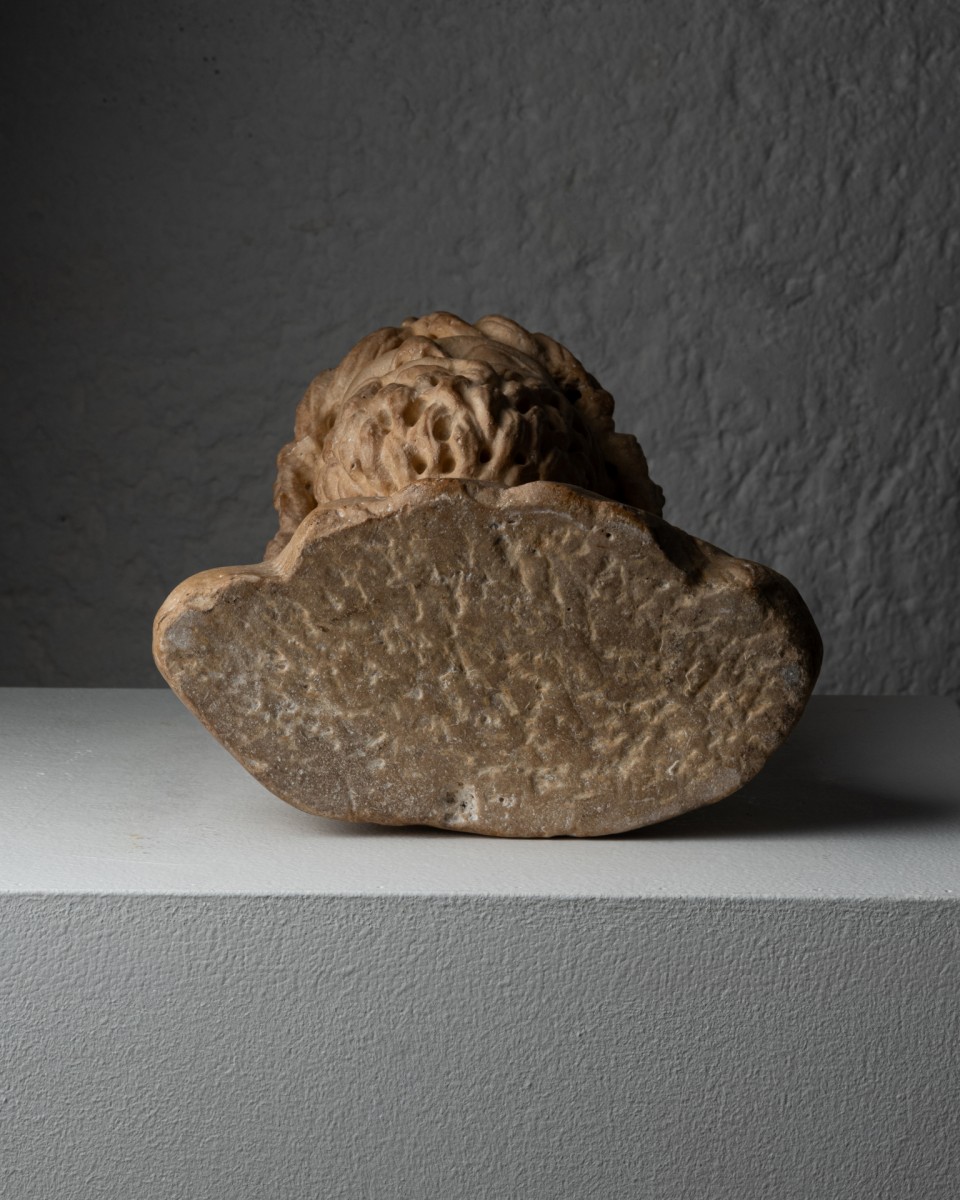
The antique brown patina bears witness to a long history and to preservation in a protected environment over several centuries. An ancient hole visible at the upper rear of the skull opens up fascinating biographical possibilities: a later modification to accommodate a halo, evidence of alterations made when the sculpture was transformed into a freestanding half-bust, or a remnant of a lost attribute.
The significance of this sculpture goes beyond its mere formal beauty. It stands at one of the most fruitful crossroads in the history of Western art: the moment when images from the ancient world—Zeus, the philosophers, Serapis—gradually transformed into Christian images, and when the face of the bearded Christ emerged precisely from this legacy.
When you look at it, something strange happens: your gaze hesitates. Is this a late Zeus? A philosopher? An apostle? An early depiction of Christ? This hesitation is not a weakness of the object. It is, quite literally, its subject. For Late Antiquity is precisely an era in which the boundaries between iconographic traditions become porous, where the same workshops, the same marble, and the same tools are used to depict both ancient gods and the earliest Christian figures. The philosopher becomes an apostle. The sage becomes Christ.
The quality of the drill bit—which is observable, measurable, and inherent to the very material of the work—unambiguously places the object within the technical vocabulary of late Roman sculpture. It places this head among the most prestigious comparisons, including the famous head of Zeus or Christ housed at the Metropolitan Museum of Art in New York, and the early Christian sarcophagi of 4th-century Rome, foremost among which is the sarcophagus of Junius Bassus (c. 359).
The hypothesis that the sculpture was reused in a Christian context—a practice that is well documented following the Edict of Thessalonica in 380, which established Christianity as the state religion—would lend the work an additional dimension: that of a direct, tangible witness to the transition between two civilizations.
This marble head cannot be reduced to Zeus, a philosopher, or Christ. It draws on each of them to embody something even rarer: the figure of the sacred sage, as conceived in Late Antiquity at the very moment when the ancient world was transforming into a Christian world. It belongs to the visual universe that gave rise to one of the most influential images ever produced by Western civilization.
The quality of the marble, the exceptional chisel work, the presence of the face, the deep patina, and the richness of its hypothetical history make it an object of uncommon rarity and historical significance for its size.
To date, no exact formal parallel has been identified in the public collections consulted. This uniqueness, far from being an obstacle, is probably the most eloquent indication of its significance.
Delevery information :
Please note that packing and shipping costs are not included in the price of the objects which are quoted ex shop.
Final amount including packing and shipment to be discussed with Galerie Alexandre Piatti.