Offered by Tobogan Antiques
REQUEST INFORMATION
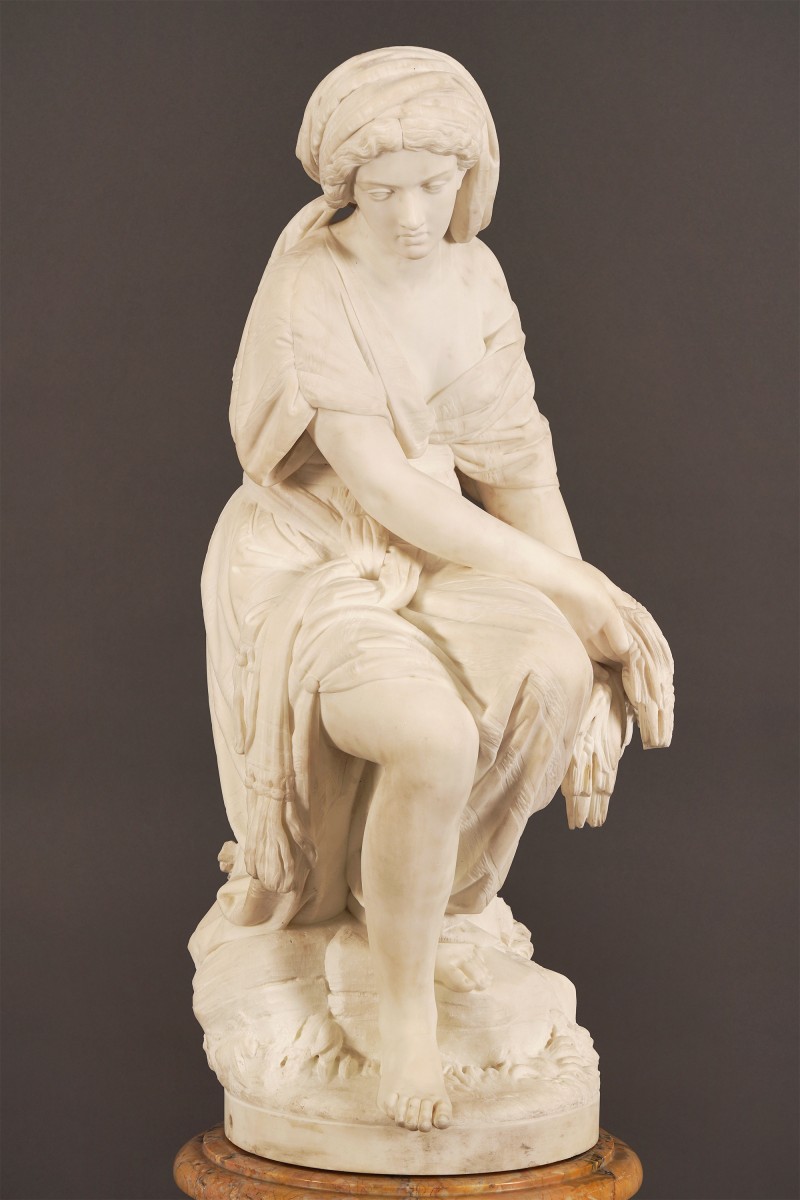
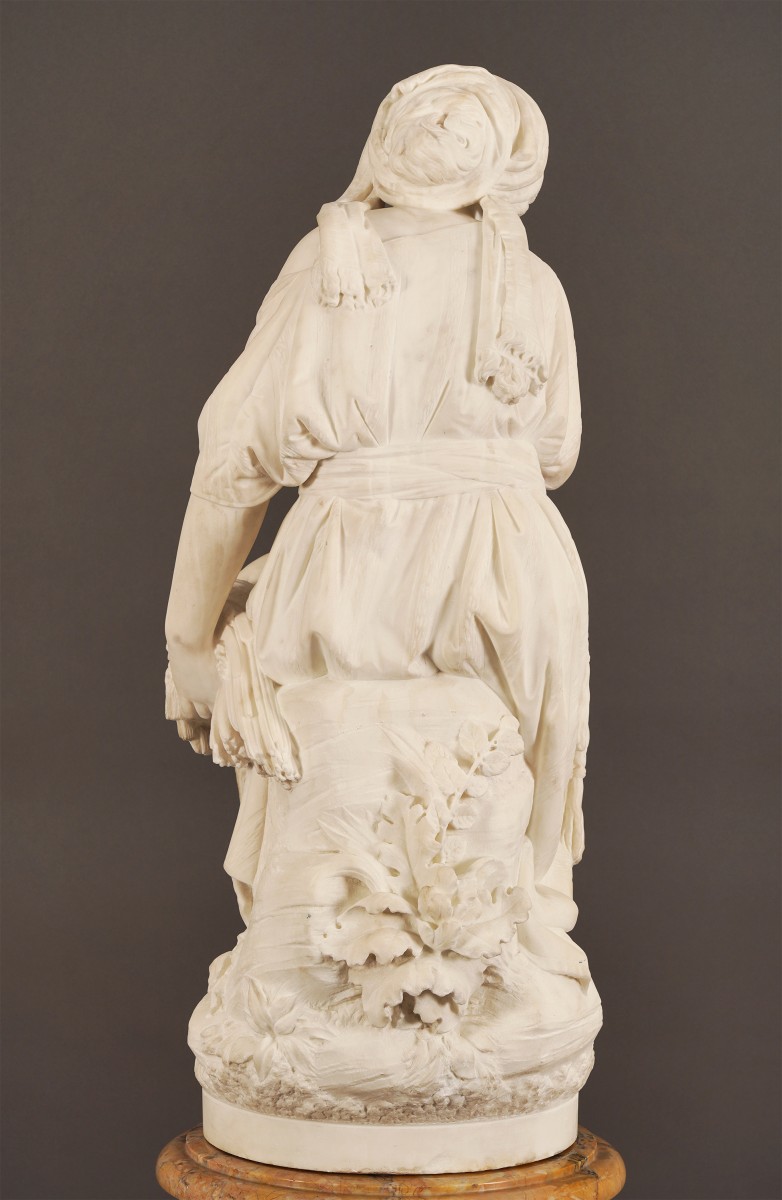
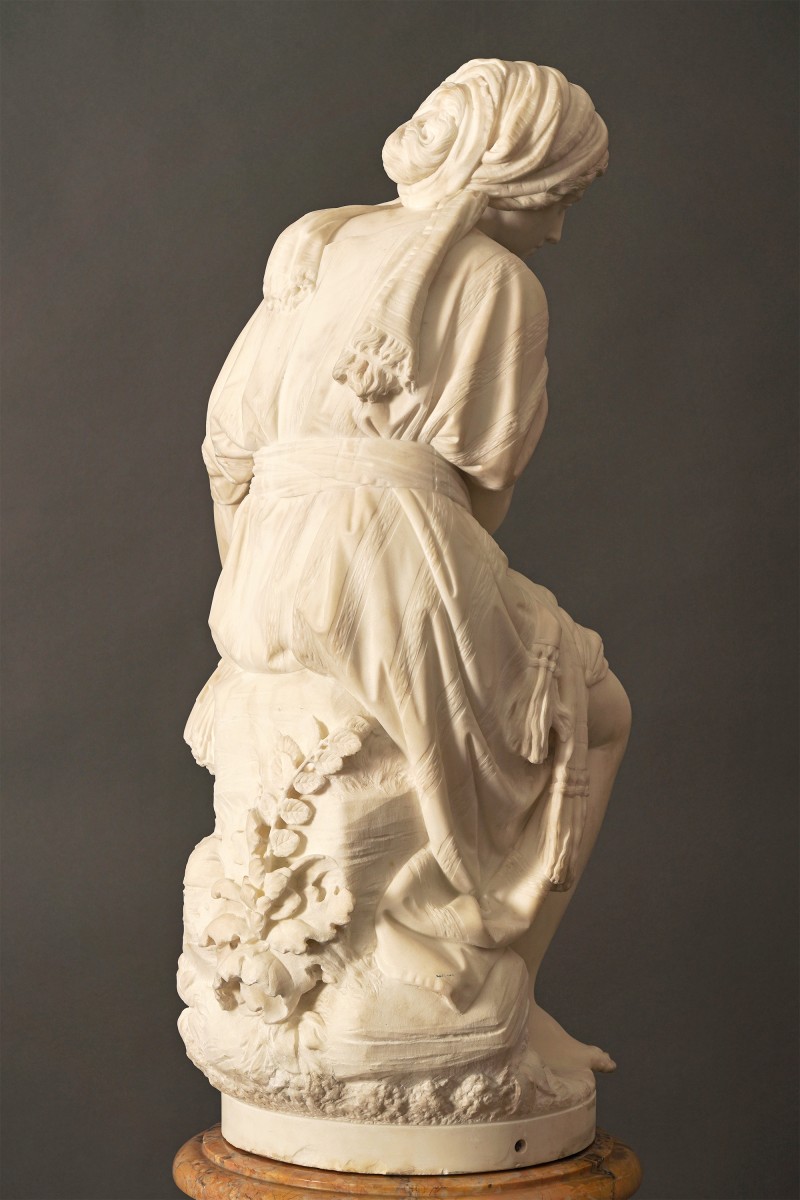

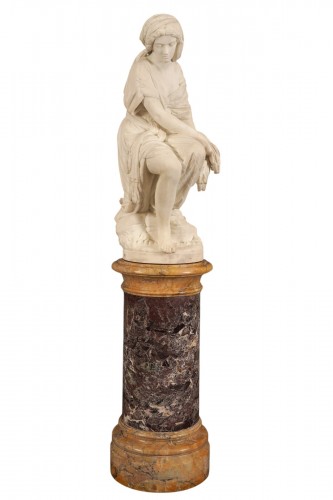
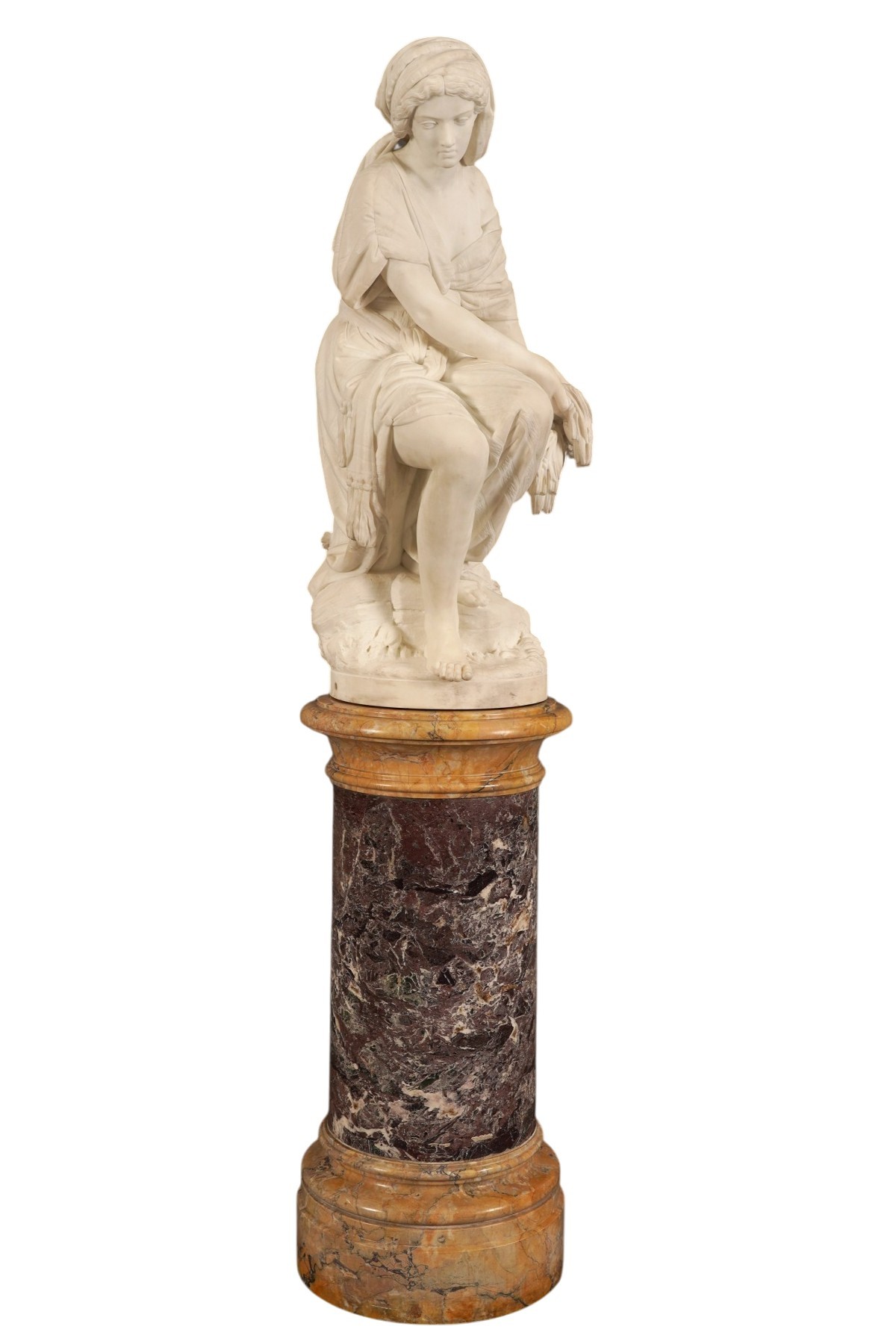
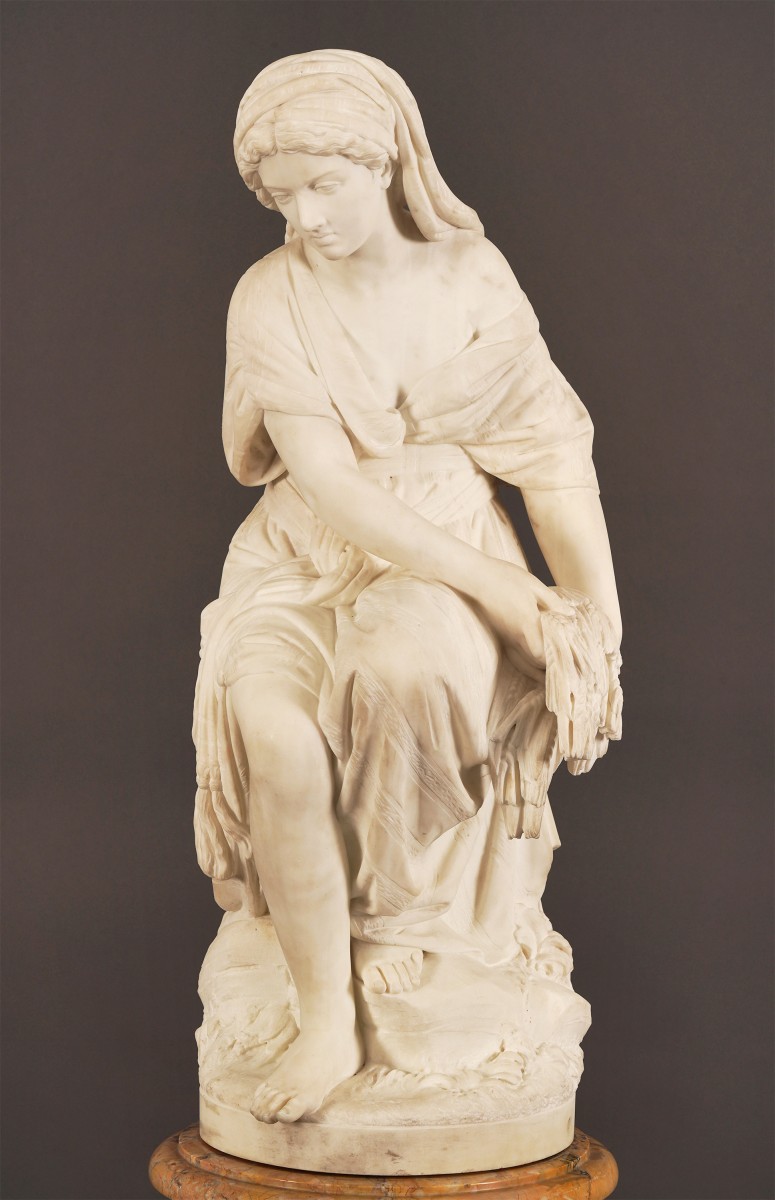
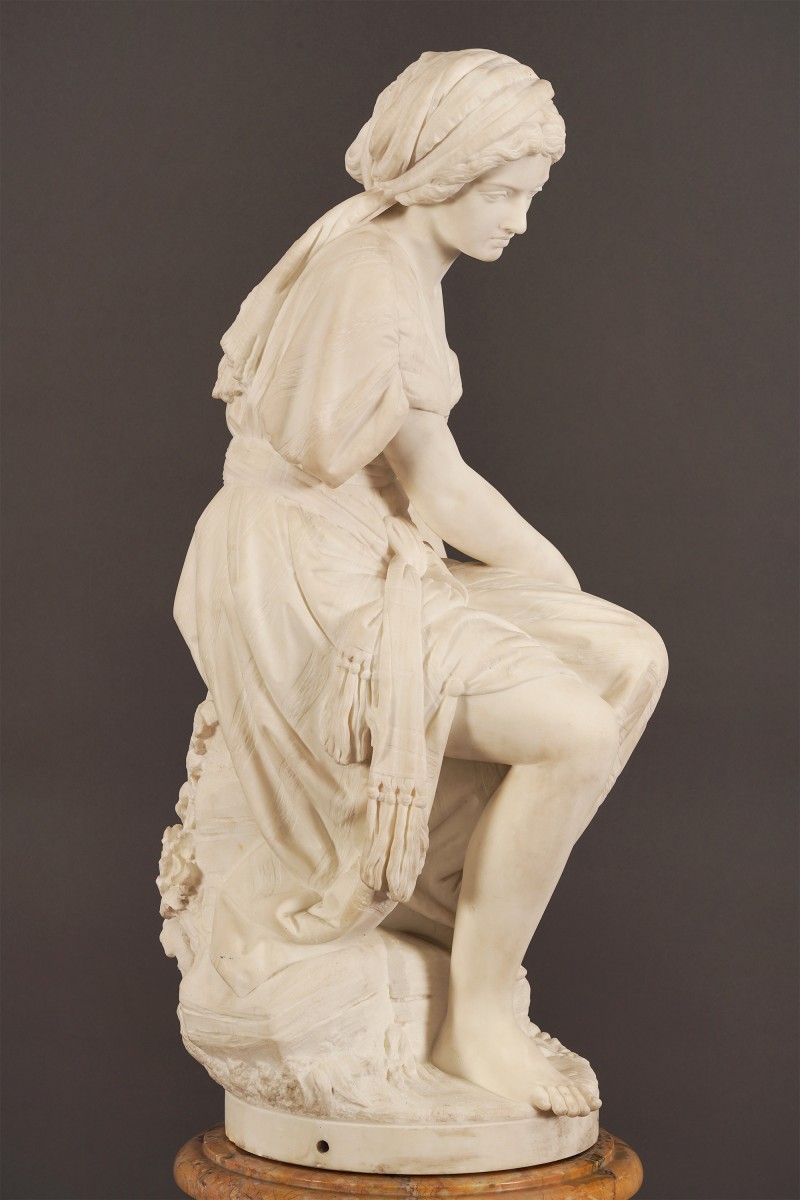
This sculpture in white Carrara marble represents Ruth, an emblematic figure of the Old Testament embodying fidelity, humility, and devotion. The young woman is depicted seated, in a contemplative and introspective attitude, with a posture slightly inclined forward. Her head is bowed, her gaze lowered, as if absorbed in silent meditation. Her facial features are regular and idealized; Ruth is not individualized but elevated to the status of a moral archetype.
The young woman is dressed in a simple tunic, cinched at the waist, with soft, flowing folds. A veil covers her head and falls over her shoulders, reinforcing the idea of modesty and belonging to a rural, biblical world. In her right hand, Ruth holds a sheaf of wheat, an essential iconographic attribute that directly refers to the biblical episode in which she gleans in the fields of Boaz. This detail anchors the figure in a specific narrative while also symbolizing abundance, patience, and industrious virtue. The position of the sheaf, slightly drooping, follows the overall downward movement, reinforcing the melancholic and meditative tone of the work. The base, treated in a restrained yet slightly naturalistic manner, suggests uneven ground evoking a field.
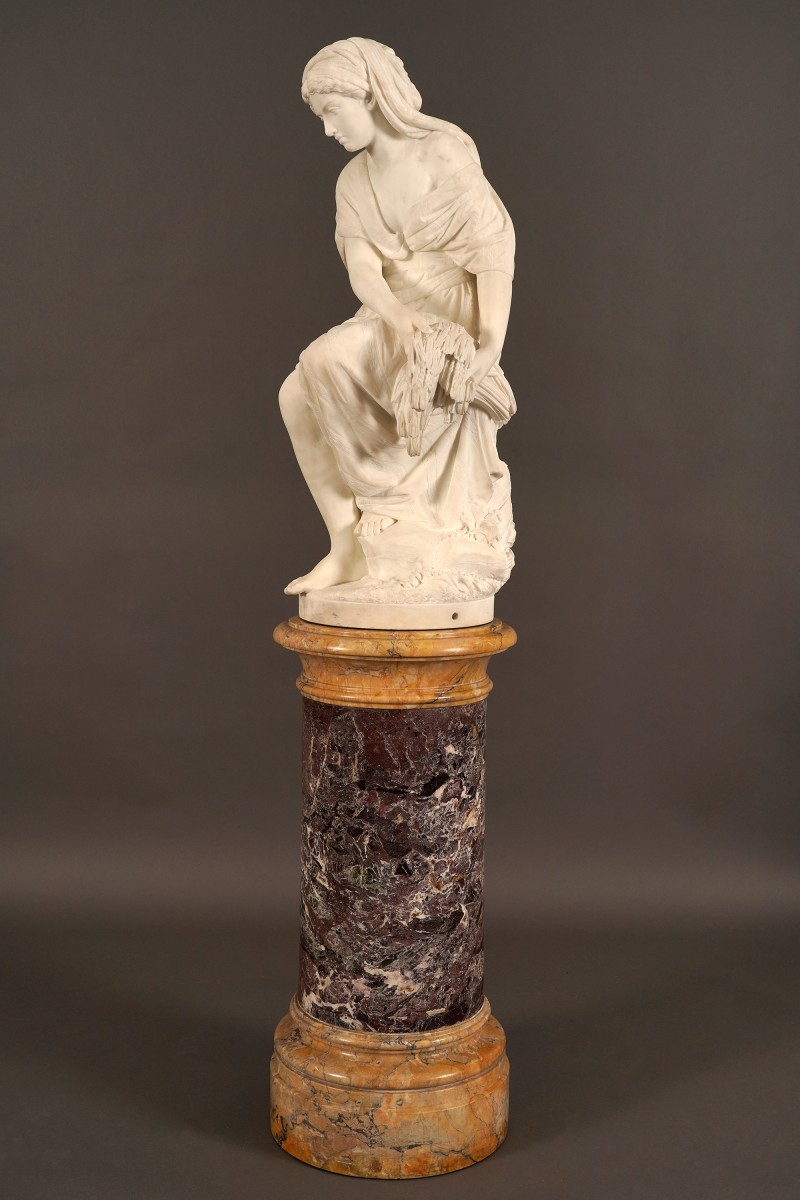
The sculpture rests on a column with a rotating mechanism.
The work belongs to an iconographic tradition that, from the 18th Century and especially in the 19th Century, favored a reading of female biblical figures that is both moral and emotional. It stands at the crossroads of several influences : an antique heritage in the idealization of forms, a Christian sensibility in the choice of subject, and a shift toward a more intimate expressiveness that anticipates developments in 19th Century sculpture.
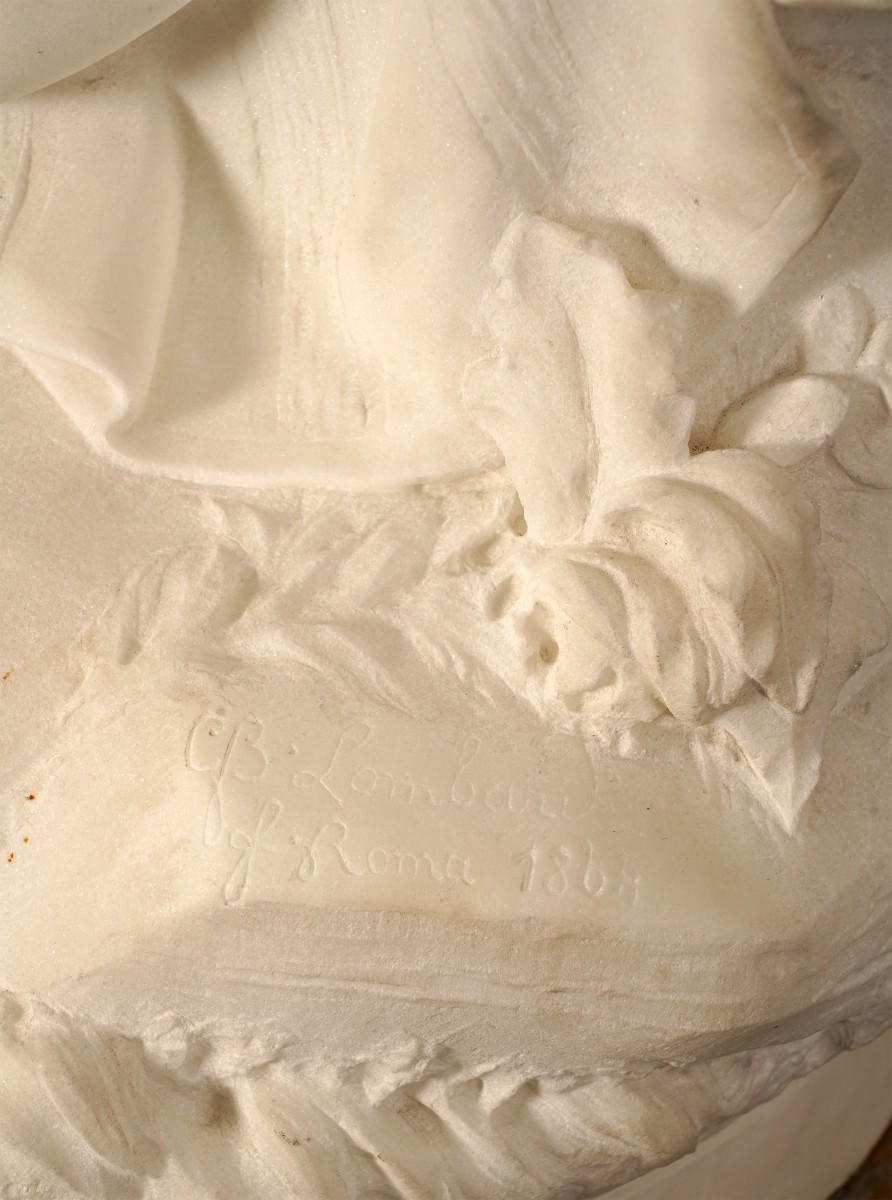
This sculpture is representative of the Italian sculptor Giovanni Battista Lombardi (1823–1880), the quality of the carving, the expressiveness, the softness and regularity of the features, and the treatment of the drapery are outstanding.
Biography
Giovanni Battista Lombardi (1823–1880) was an Italian sculptor renowned for his Neoclassical and Romantic works, which were particularly admired in the 19th century.
He studied at the Academy of Fine Arts in Brescia and later in Milan. Under the direction of Lorenzo Vela, he aligned himself with the Italian artistic tradition inherited from Neoclassicism, influenced by masters such as Antonio Canova. He settled in Rome, then a major center of European sculpture. There, he developed an international career, attracting an aristocratic and bourgeois clientele, particularly British and American, and produced busts, statues, and funerary monuments that were highly sought after at the time. He also created several sculptures of veiled young women, demonstrating his technical mastery of translucent marble.
Lombardi belongs to a generation of Italian sculptors who extended the Neoclassical legacy while incorporating a more emotional dimension characteristic of Romanticism. His works reflect a balance between classical idealization and delicate realism.
His sculptures are held in private collections and museums in Europe and the United States, as the Metropolitan Museum of Art in New York (“Susanna,” 1869, inv. N° 94.10.2a–c, and “Veiled Woman,” 1869, inv. No°1984.463).
Bibliography
Alfonso Panzetta, Dizionario degli sclutori italiani dell’ottocento e del primo novecento, Umberto Allemandi & C., 1994, Volume Primo, p. 167 and Volume Secondo, p.111