Offered by Galerie Alexandre Piatti
REQUEST INFORMATION

Works of art, sculptures and furniture Haute Epoque
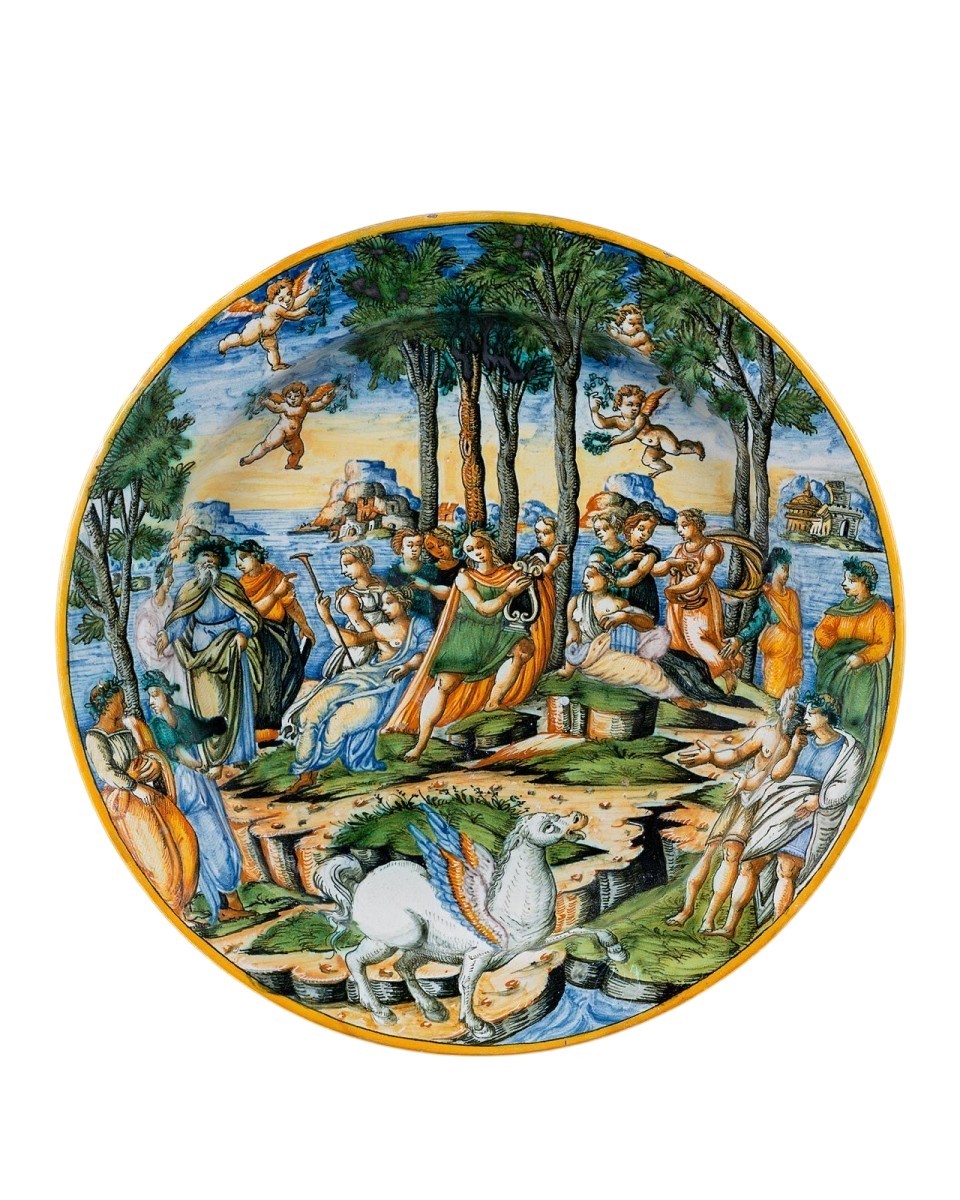
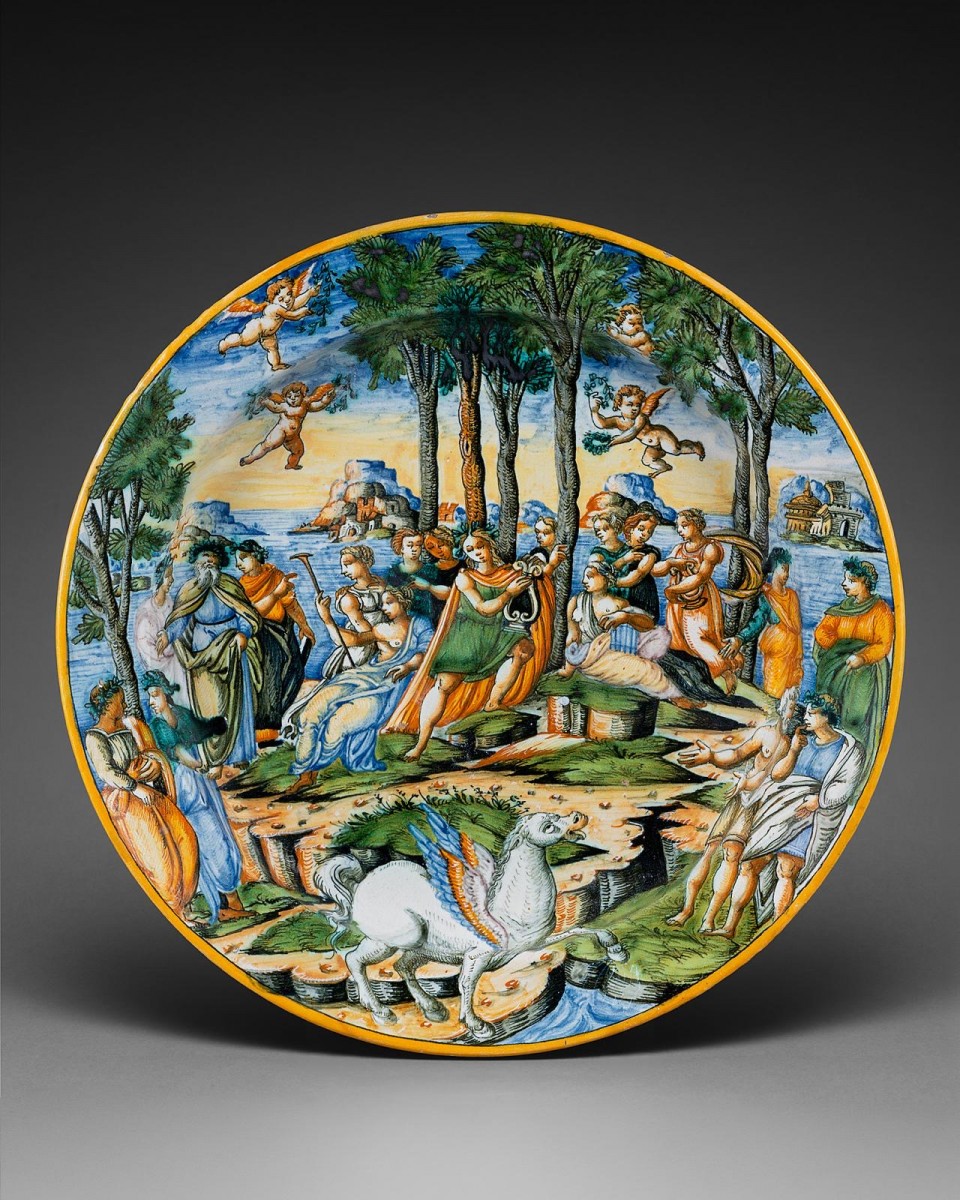
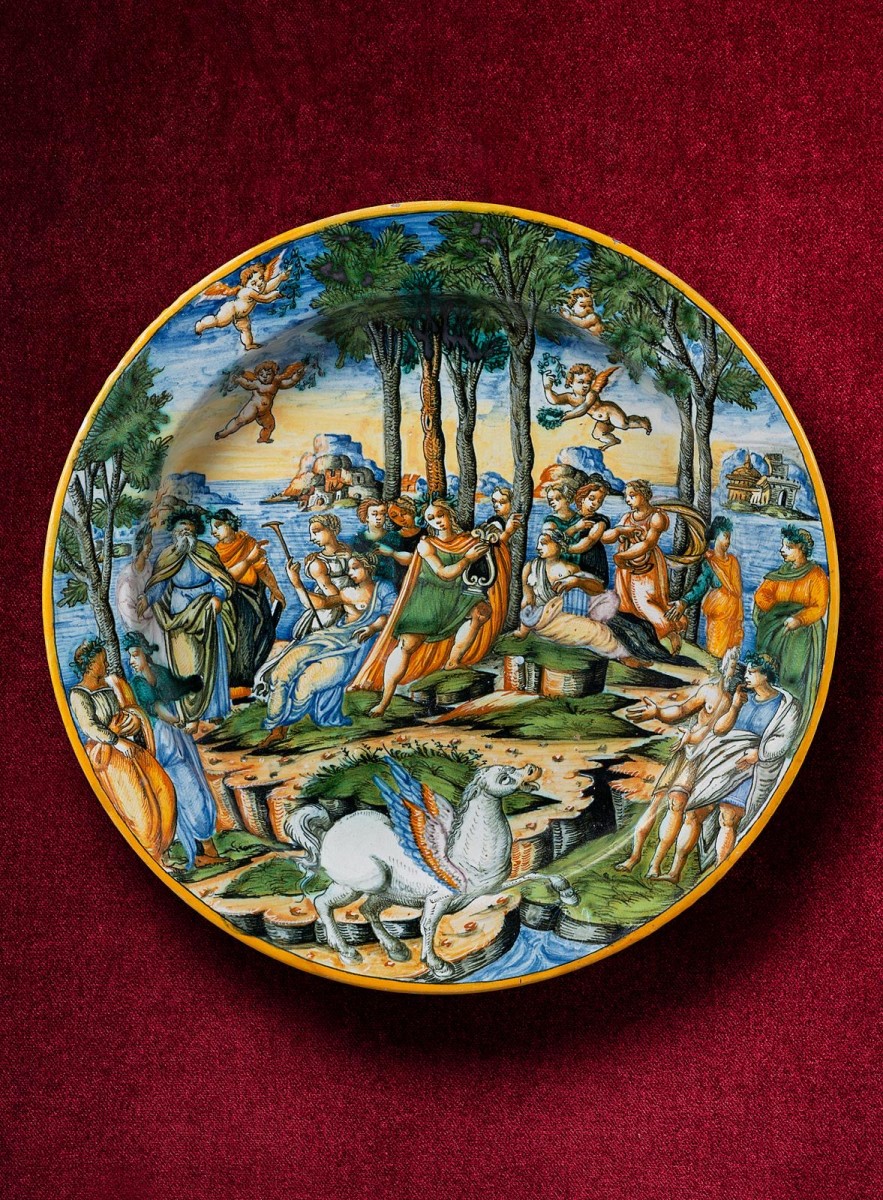
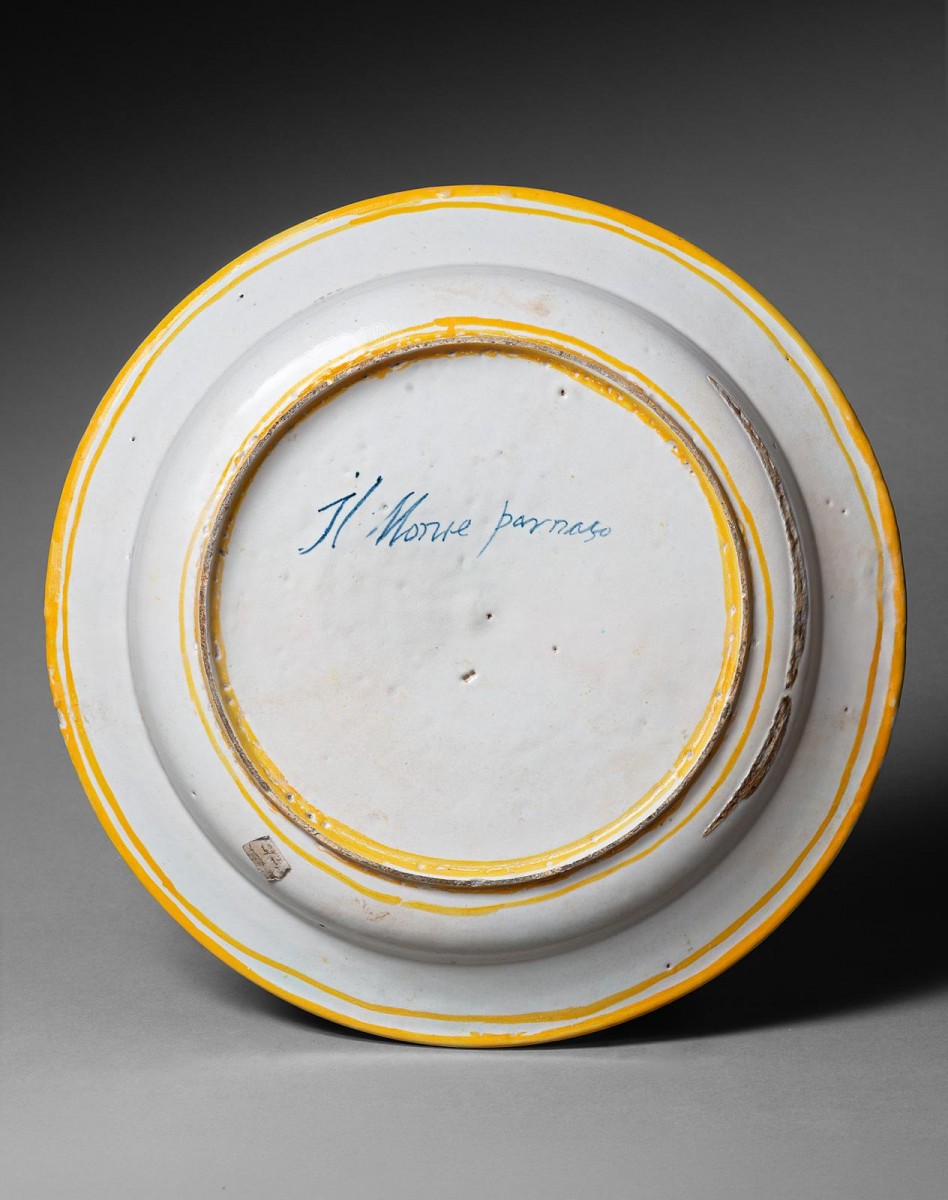
The dish features a tin-based glaze applied to both sides. The color palette—cobalt blue, manganese, copper green, black, antimony yellow, and ochre—is characteristic of late 16th-century Urbino production, a period during which the Patanazzi workshop, heir to the Fontana tradition, tended toward a more limited color range and a faster production process than that of the large istoriato pieces of the previous generation. The reverse bears the handwritten inscription “Il Monte Parnaso,” framed by concentric yellow circles—a common epigraphic practice in Urbino works intended for a cultured clientele who wished to identify the subject depicted.
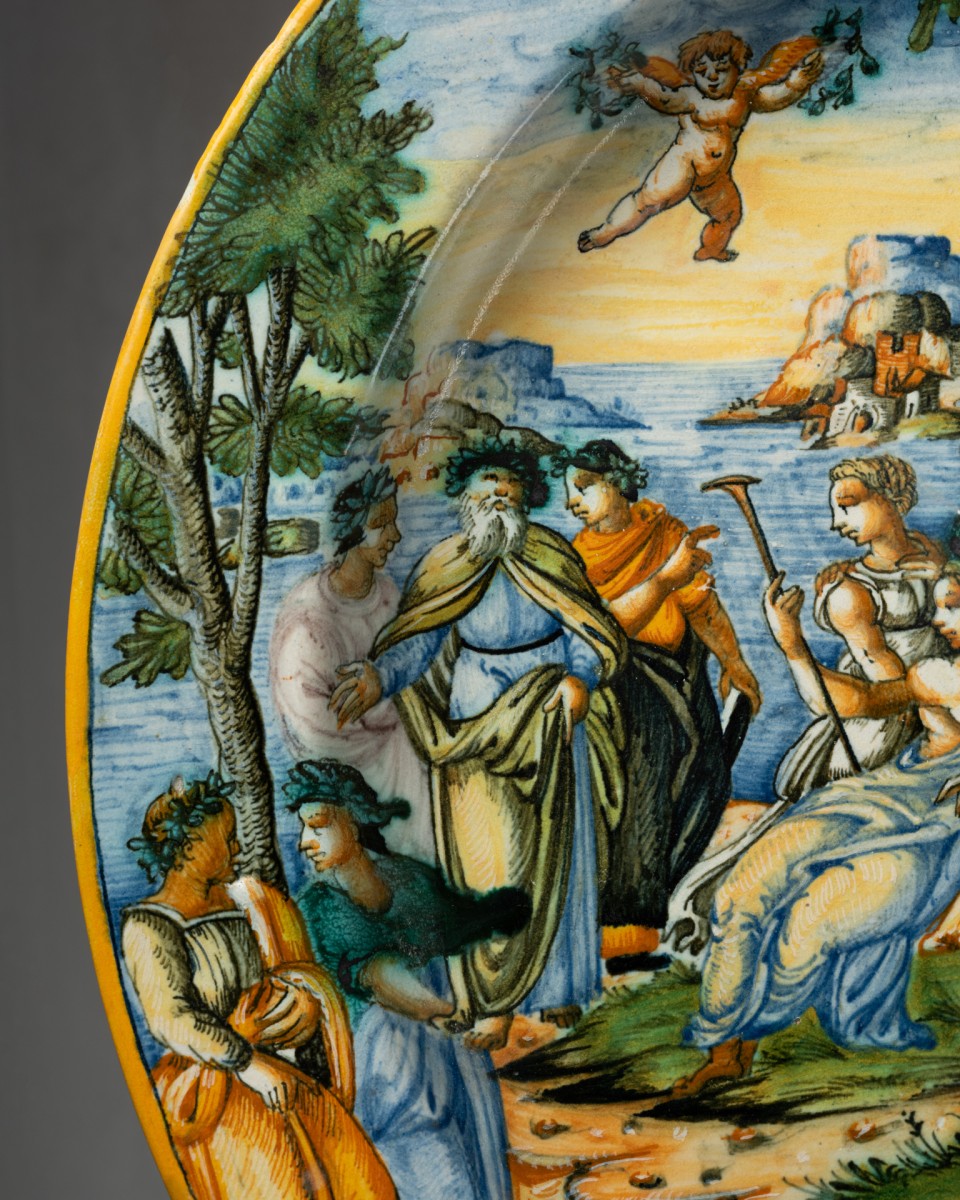
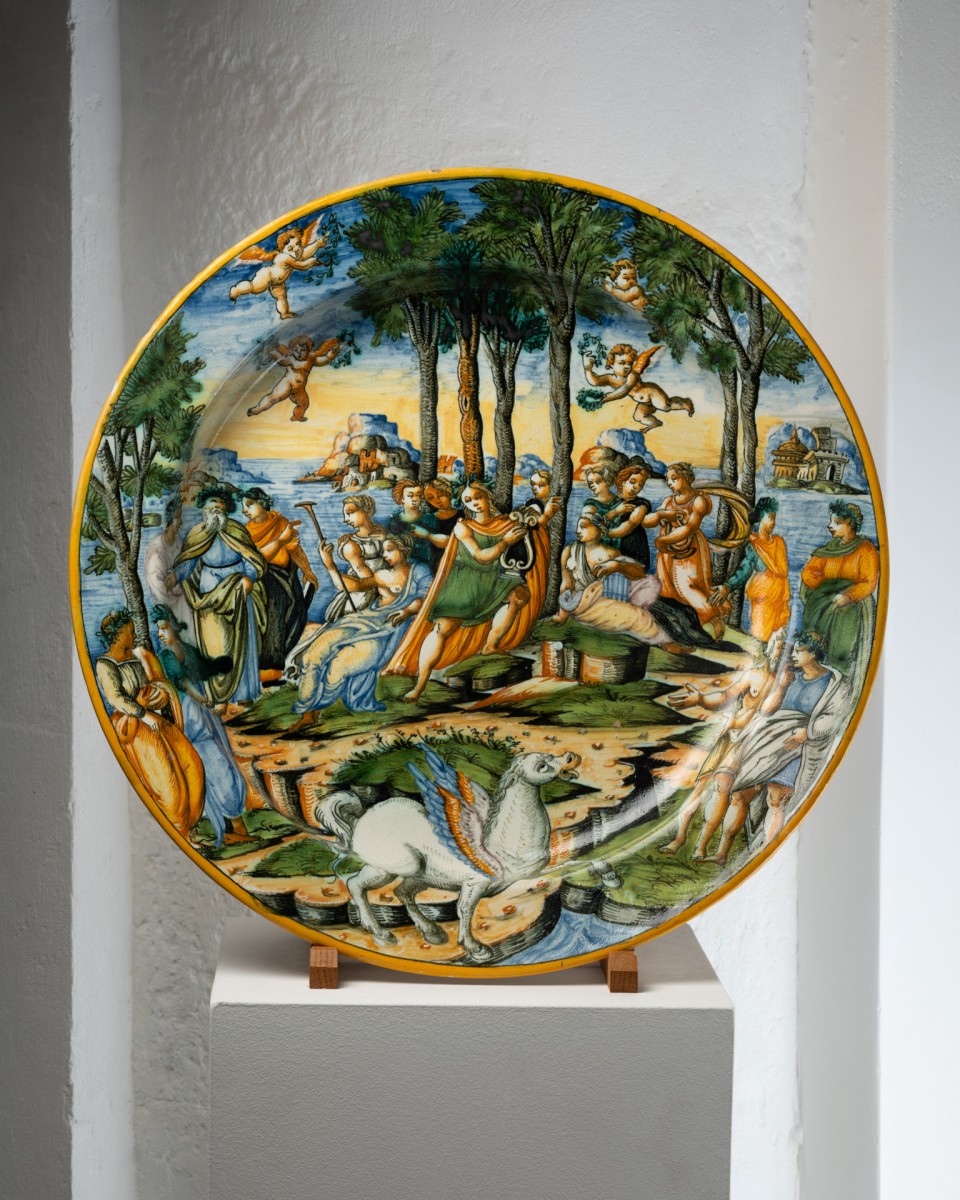
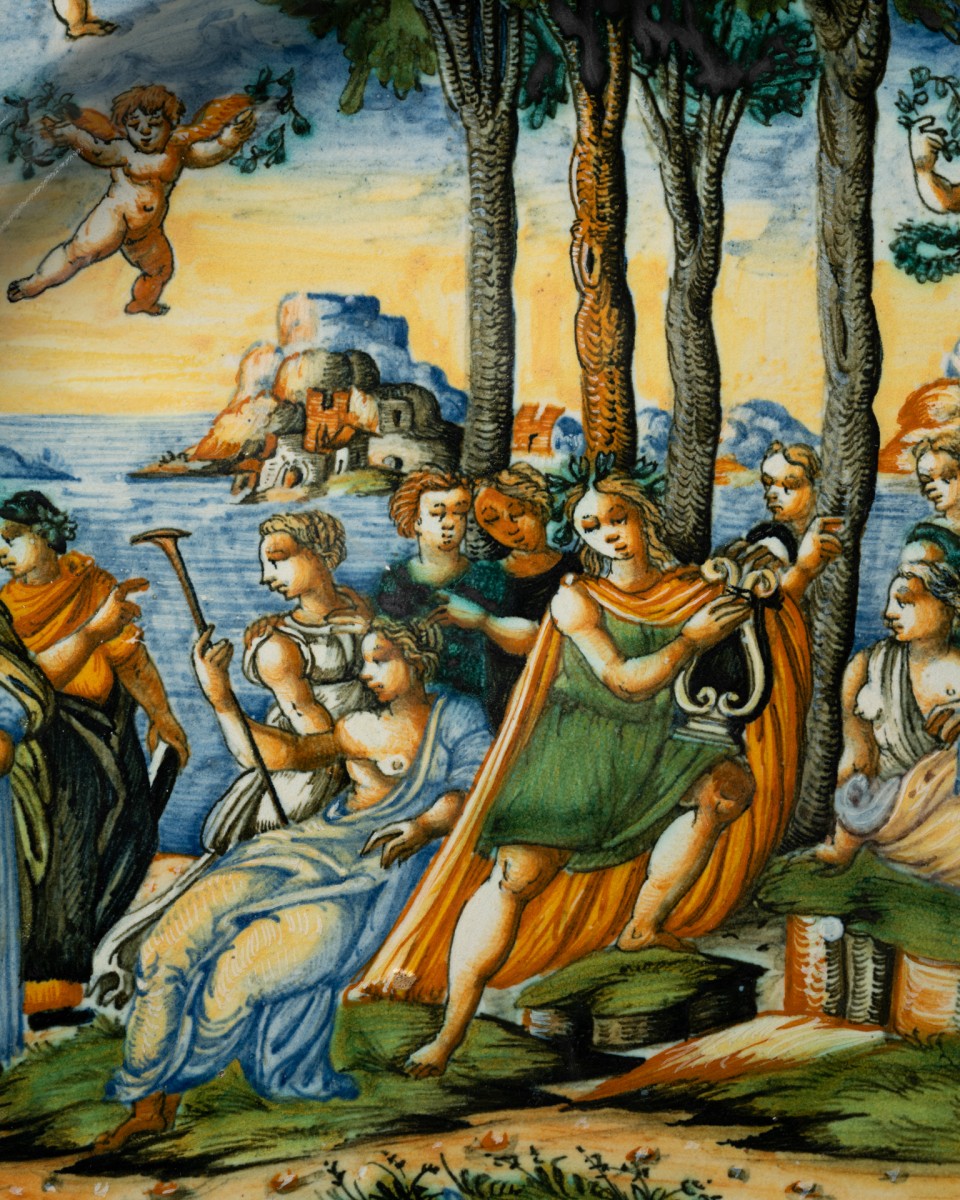
The composition unfolds, within a masterfully executed circular space, the mythological scene of Mount Parnassus, the sacred abode of Apollo and the nine Muses in the Greco-Roman tradition inherited from Hesiod and Ovid. The iconographic program draws directly on an engraving by Marcantonio Raimondi, based on a drawing by Raphael for the famous fresco in the Sala della Seignatura at the Vatican (1509–1511). The circulation of this model through prints—which were widely distributed in majolica workshops beginning in the second third of the 16th century—explains the existence of a nearly identical example preserved in Vienna, which Timothy Wilson attributes to the same artist, based on the similar style of the two pieces.
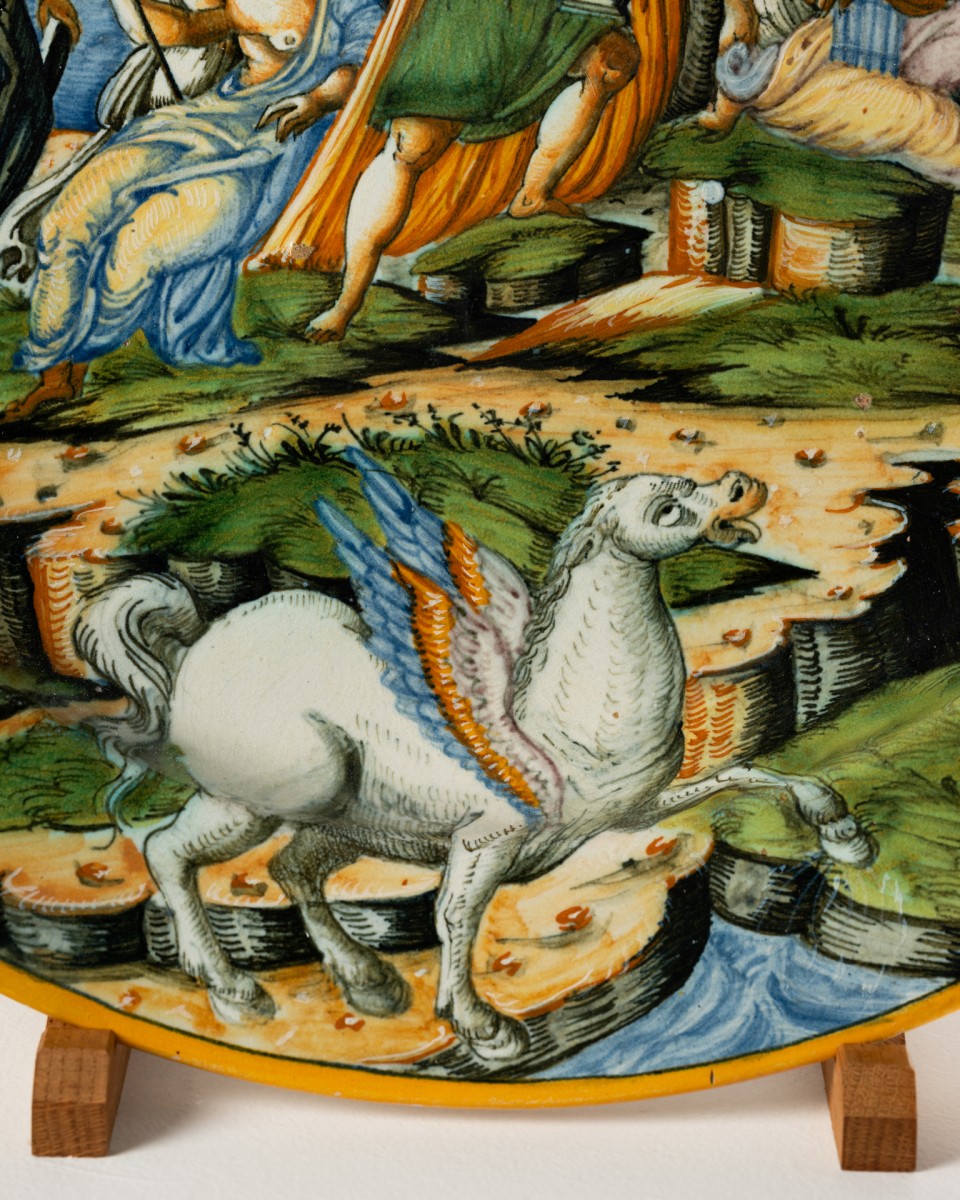
In the lower register, Pegasus, the winged horse born from Medusa’s blood, rests beside a spring whose bluish shimmer evokes the Hippocrene—the fountain that, according to myth, gushed forth when the horse struck the ground with its hoof on Mount Helicon, the slope of Mount Parnassus dedicated to the Muses. This spring, reputed to bestow poetic inspiration upon anyone who drinks from it, firmly anchors the scene in the topos of artistic and poetic inspiration.
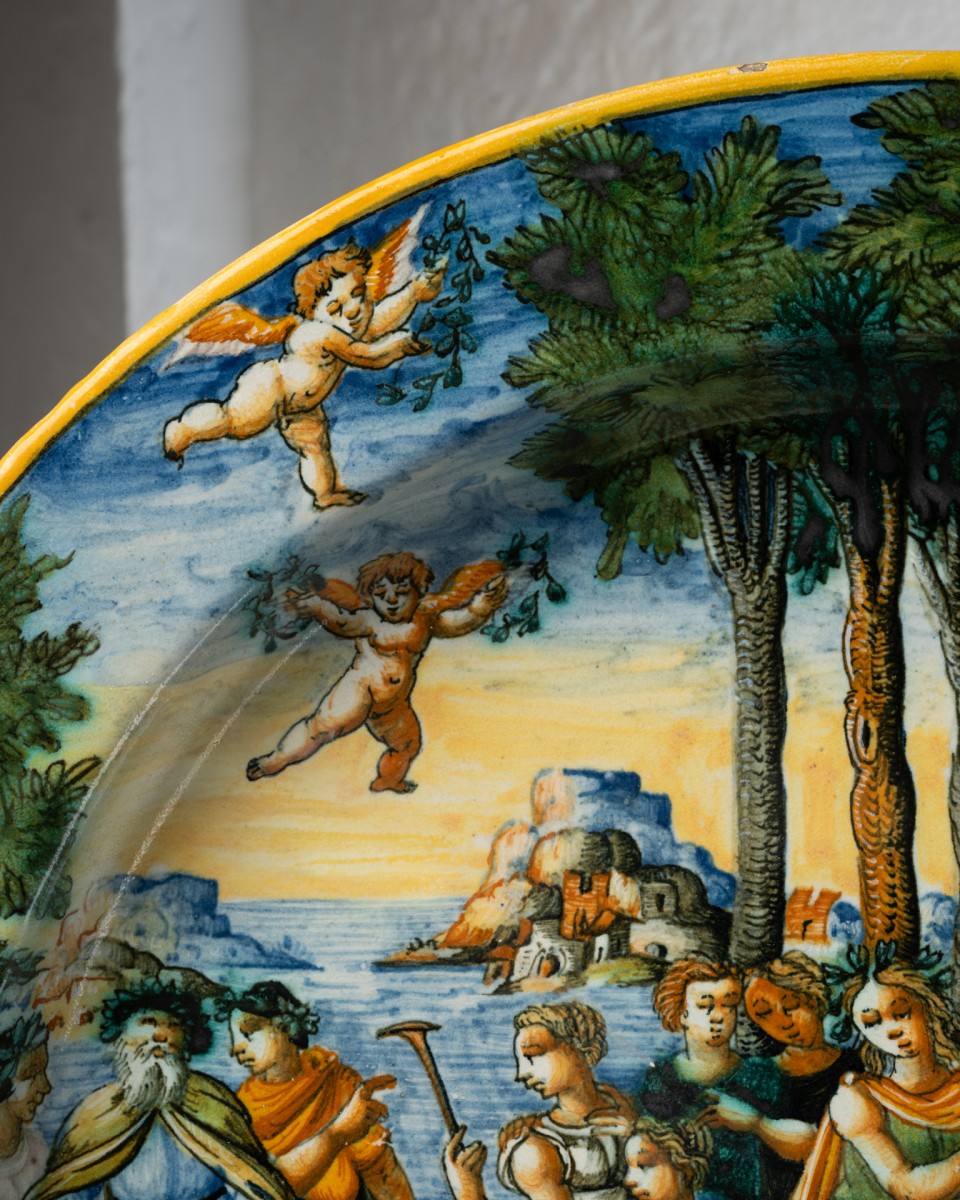
In the central register, atop a wooded hill covered with laurels and cypresses—the sacred trees of Apollo—stands the central group: a seated Apollo, surrounded by the nine Muses, whose attributes allow us to identify several of the figures. One holds a lyre or stringed instrument (Erato, the Muse of lyric poetry, or Apollo himself as Musagetes); another assumes a pensive posture associated with Polymnia, the Muse of sacred rhetoric; a third appears to hold a scroll evoking Calliope, the Muse of epic poetry. The semicircular arrangement reflects the symbolic hierarchy of the Apollonian assembly.
On the periphery of the divine group, male figures—an elderly, bearded man in a dark robe and young men in tunics—represent the laureates of various eras: poets, philosophers, and men of letters to whom the Muses have granted the gift of inspiration. The coexistence of these human and divine figures establishes the narrative tension that forms the foundation of the myth: the encounter between the man of genius and his celestial guides.
In the upper canopy, four winged Cupids (putti) frolic, waving laurel wreaths—the supreme poetic reward. These genies of inspiration lend the composition an upward momentum characteristic of Renaissance Apollonian iconography: the creative spirit literally flows between earth and sky.
In the background, the sea and its islands, dotted with classical architecture evoking an idealized Antiquity—a circular temple, domed buildings—form a locus amoenus in keeping with humanist depictions of Parnassus as a place of intellectual and aesthetic perfection.
The istoriata majolica of Urbino draws its iconographic models, almost as a matter of course, from the work of Raphael, who died in 1520—nearly forty years before the rise of the great Urbino workshops. It was primarily through prints—and in particular the engravings of Marcantonio Raimondi, Raphael’s official engraver—that these compositions circulated and spread among the ceramic workshops. The faience painters freely adapted them to the formal constraints of the circular medium, rearranging the figures while preserving the spirit of the original.
The istoriata majolica of Urbino draws its iconographic models, almost as a matter of course, from the work of Raphael, who died in 1520—nearly forty years before the rise of the great Urbino workshops. It was primarily through prints—and in particular the engravings of Marcantonio Raimondi, Raphael’s official engraver—that these compositions circulated and spread among the ceramic workshops. The faience painters freely adapted them to the formal constraints of the circular medium, rearranging the figures while preserving the spirit of the original.
Upon Orazio Fontana’s death, Antonio Patanazzi took over the workshop, ensuring stylistic continuity while initiating a transition toward more mass-produced pieces. Beginning in 1580, the Patanazzi family dominated the Urbino majolica market with four active members: Antonio, Alfonso, Francesco, and Vincenzo Patanazzi. This period of family dominance coincided with a noticeable evolution in production: the color palette narrowed, production speeds increased, and small objects—salt shakers, inkwells, and serving pieces—adopted a recurring ornamental repertoire in which winged sphinxes and mascarons appeared with increasing regularity.
Dating from the 16th century, this dish is a prime example of the Patanazzi workshop’s late mature period. The quality of the figurative design—superior to the workshop’s typical output at that time—as well as the existence of a nearly identical example preserved in Vienna, suggest the work of a highly skilled painter, trained in the Urbino tradition and perhaps itinerant—a hypothesis put forward by scholars as an alternative to a strict attribution to the Patanazzi workshop.
Delevery information :
Please note that packing and shipping costs are not included in the price of the objects which are quoted ex shop.
Final amount including packing and shipment to be discussed with Galerie Alexandre Piatti.