Offered by Antichità Castelbarco

Corrado Giaquinto (Naples, 1703 – Naples, 1765)
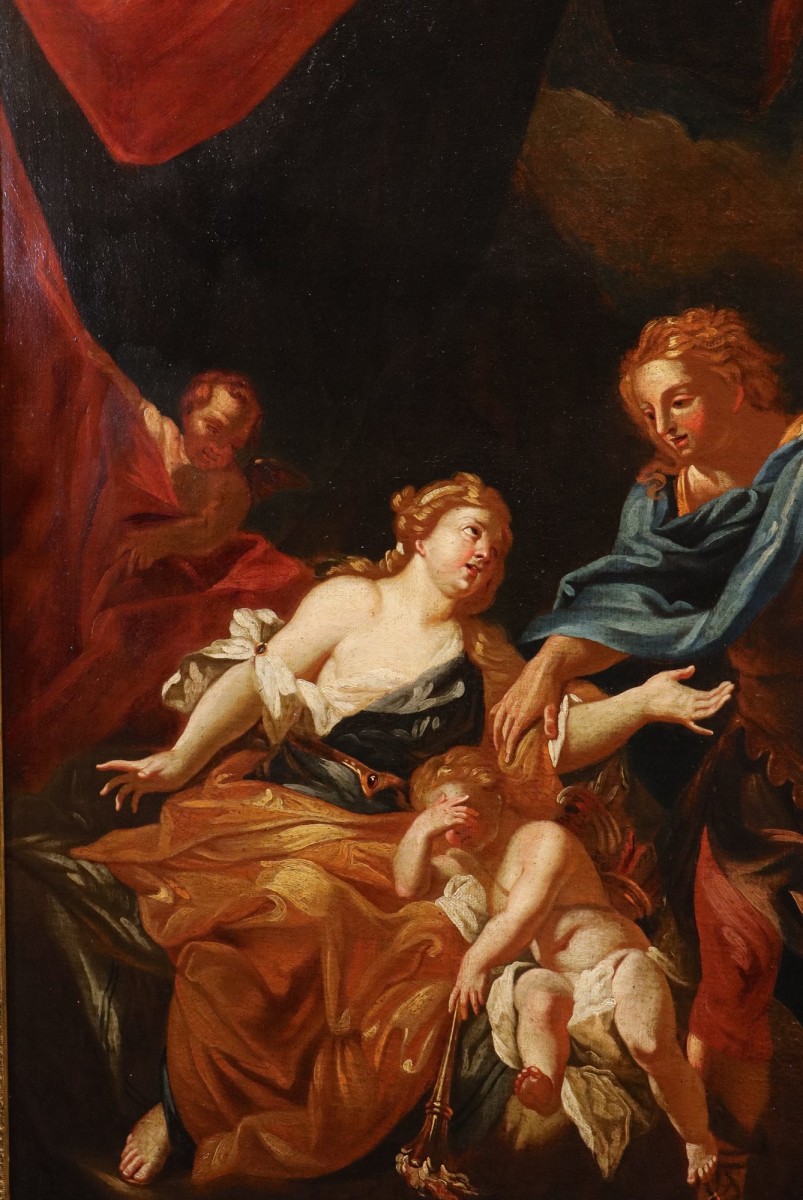
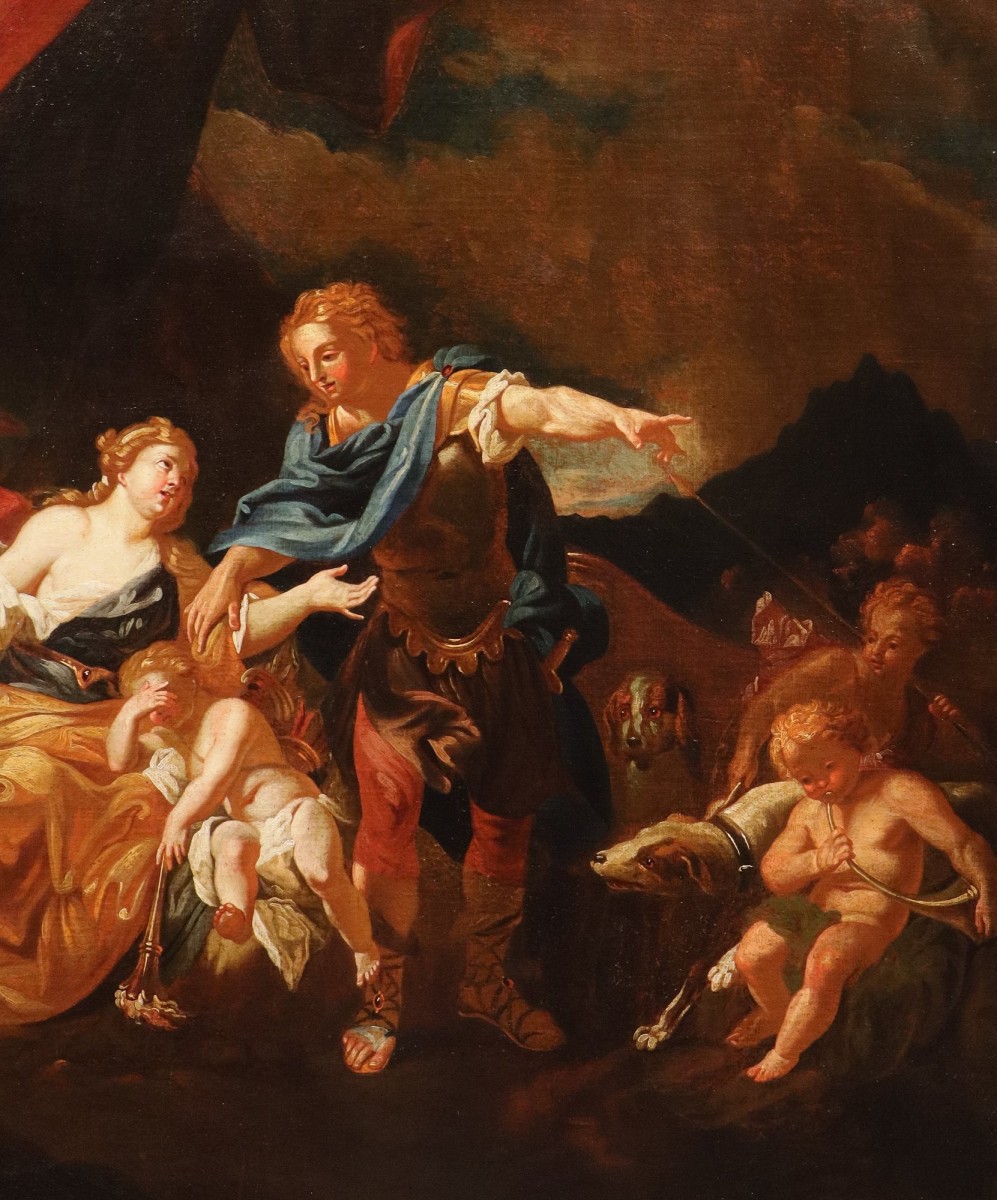
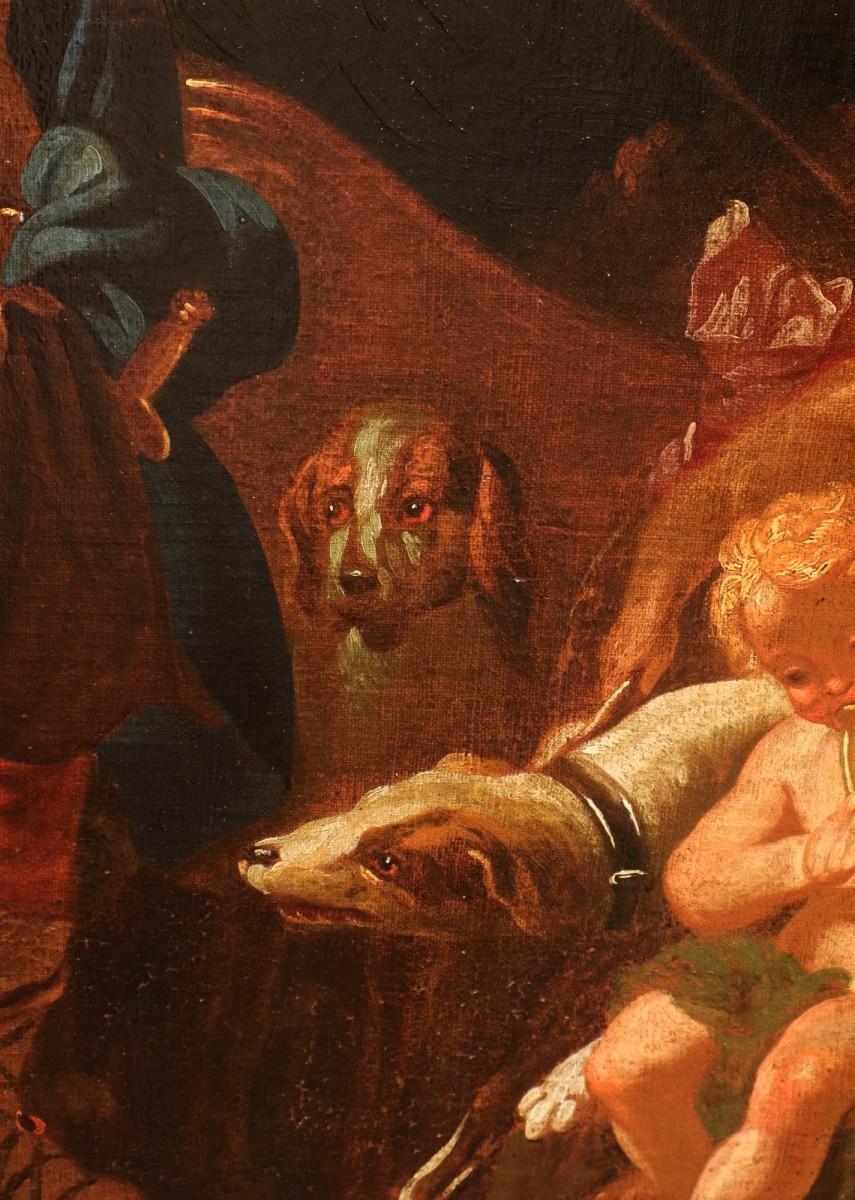
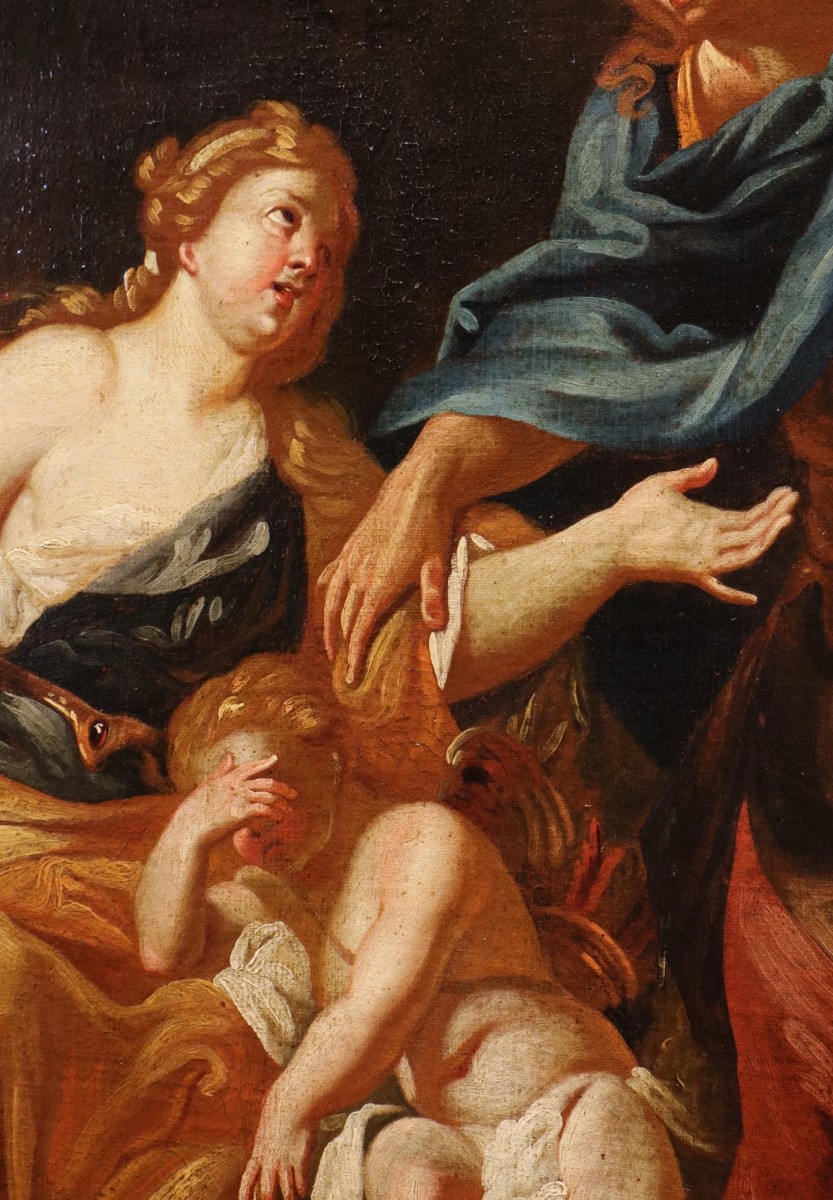
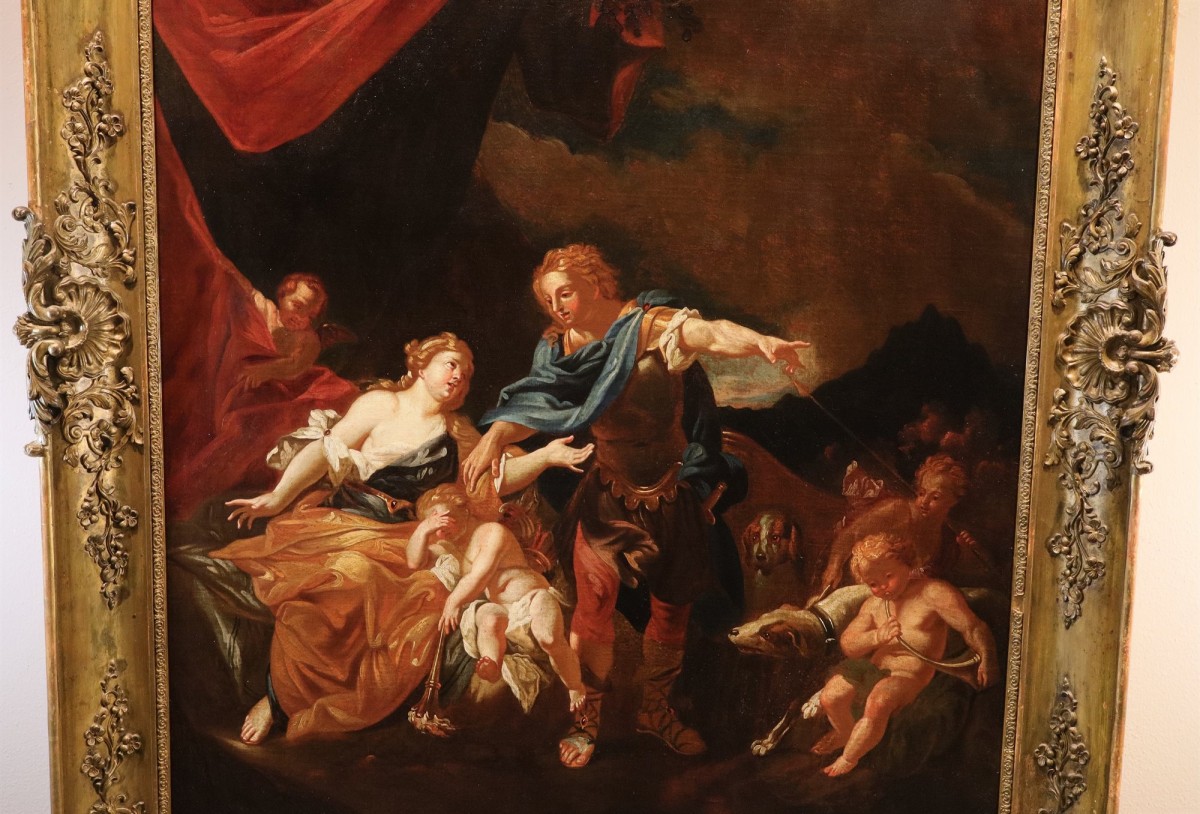
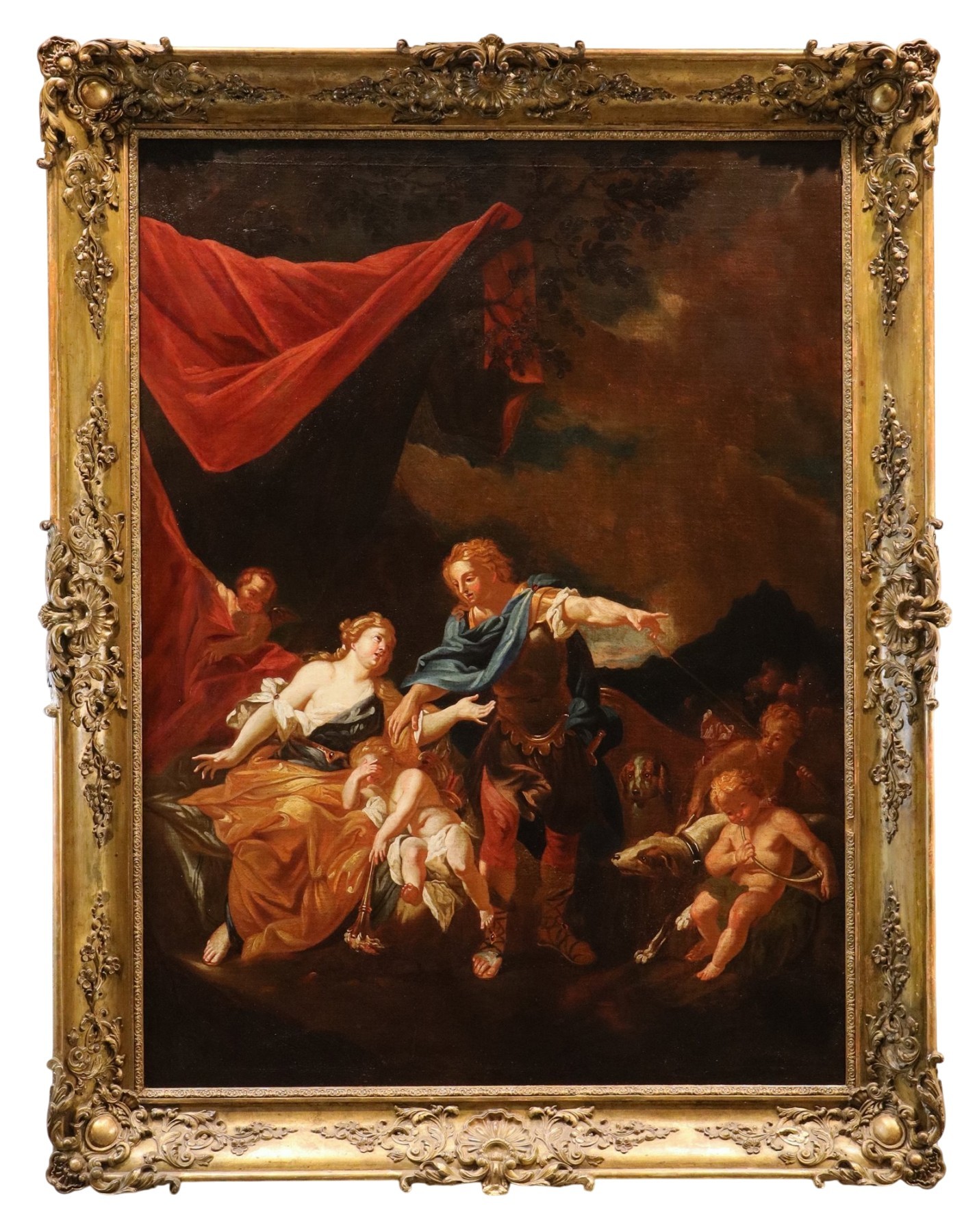
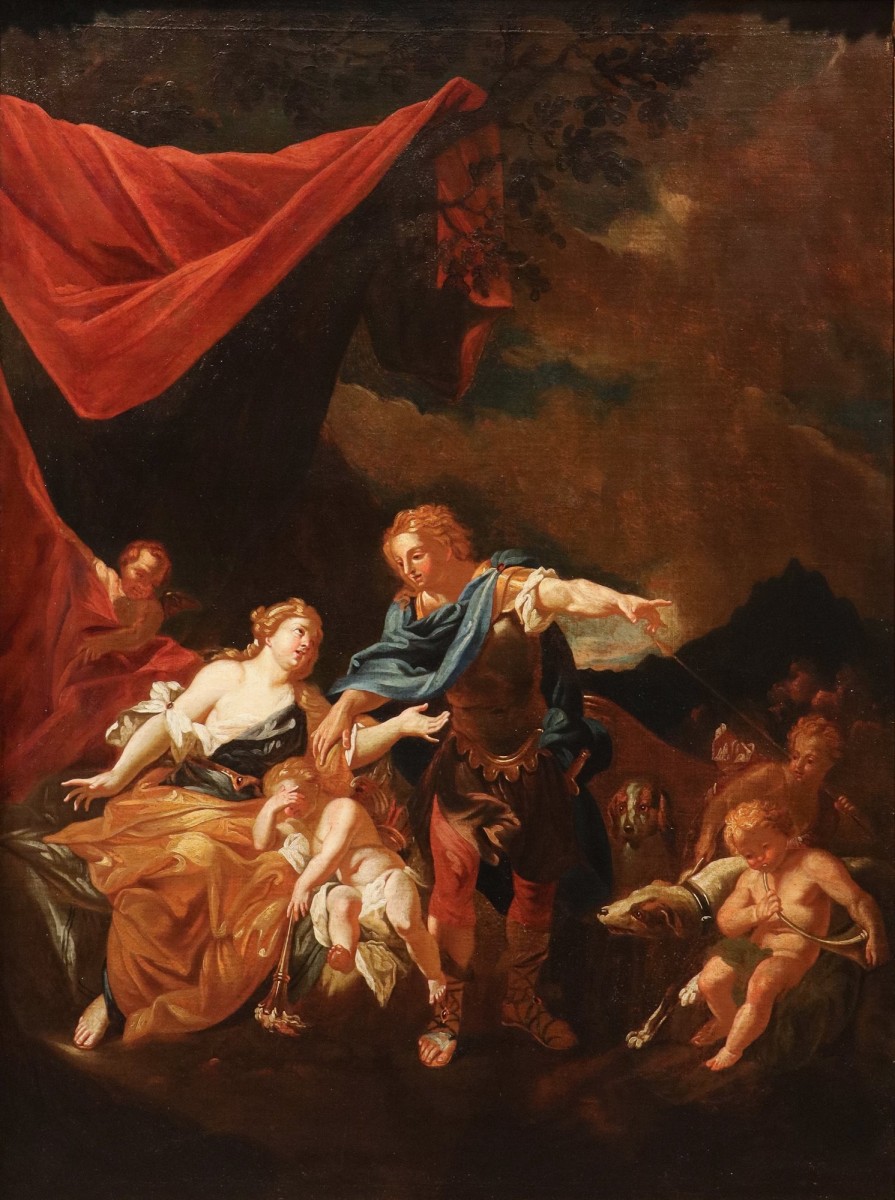
Venus tries to dissuade Adonis from going hunting
Oil on canvas 131 x 100 cm. – With an important period frame (imperfections, minor losses) 152 x 118 cm.
This work depicts the myth of Venus and Adonis, one of the most beloved mythological subjects in art, particularly during the Baroque period: drawn from the poem ‘Metamorphoses’ by the Latin poet Ovid (Book X, lines 525–559), it perfectly embodies the era’s sensibility for subjects of high emotional intensity, offering a perfect blend of strong passions and sensuality combined with a powerful dramatic charge.
In this instance, the story recounts the passion that blossomed – thanks to an arrow shot by Cupid – between Venus, the goddess of beauty and love, and the strikingly handsome young mortal hunter Adonis.
Despite the goddess’s warnings about the dangers of the forest, Adonis nevertheless decides to go on a hunting expedition, where he will be mortally wounded by a wild boar sent by the god Mars, who is jealous of their union.
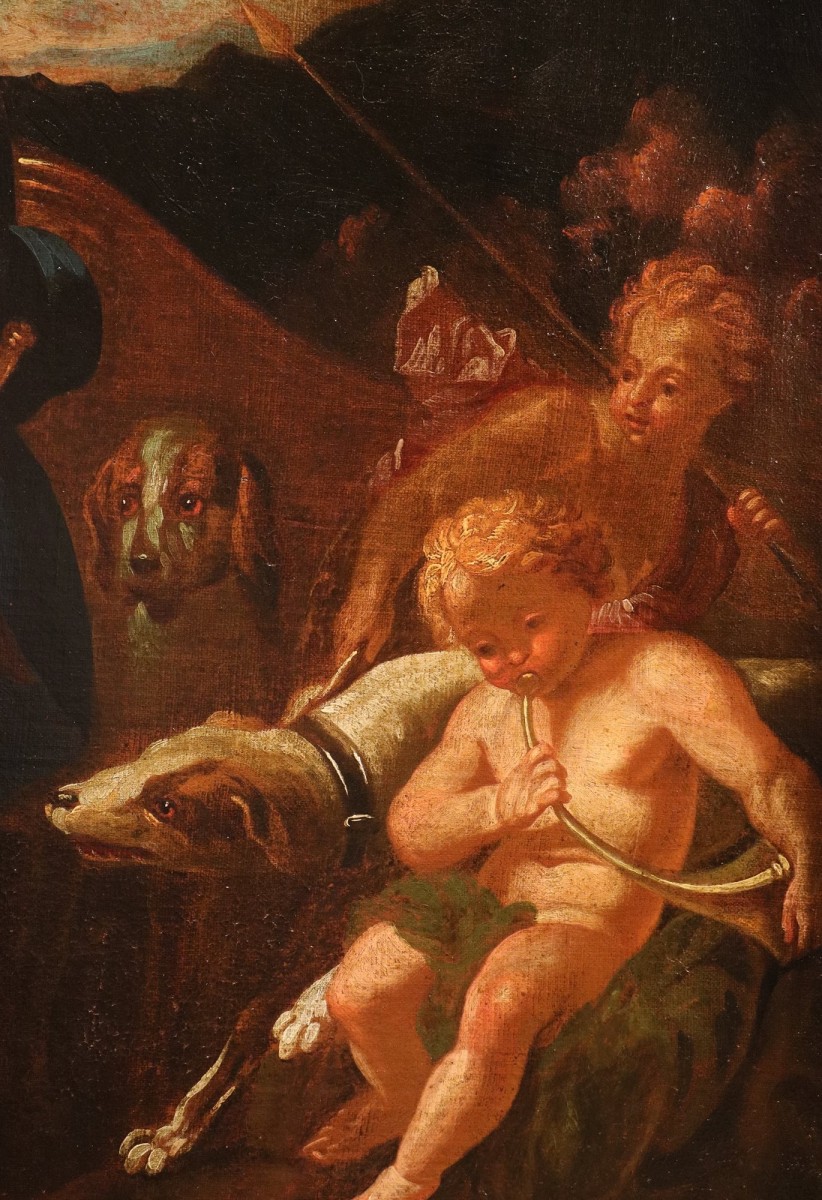
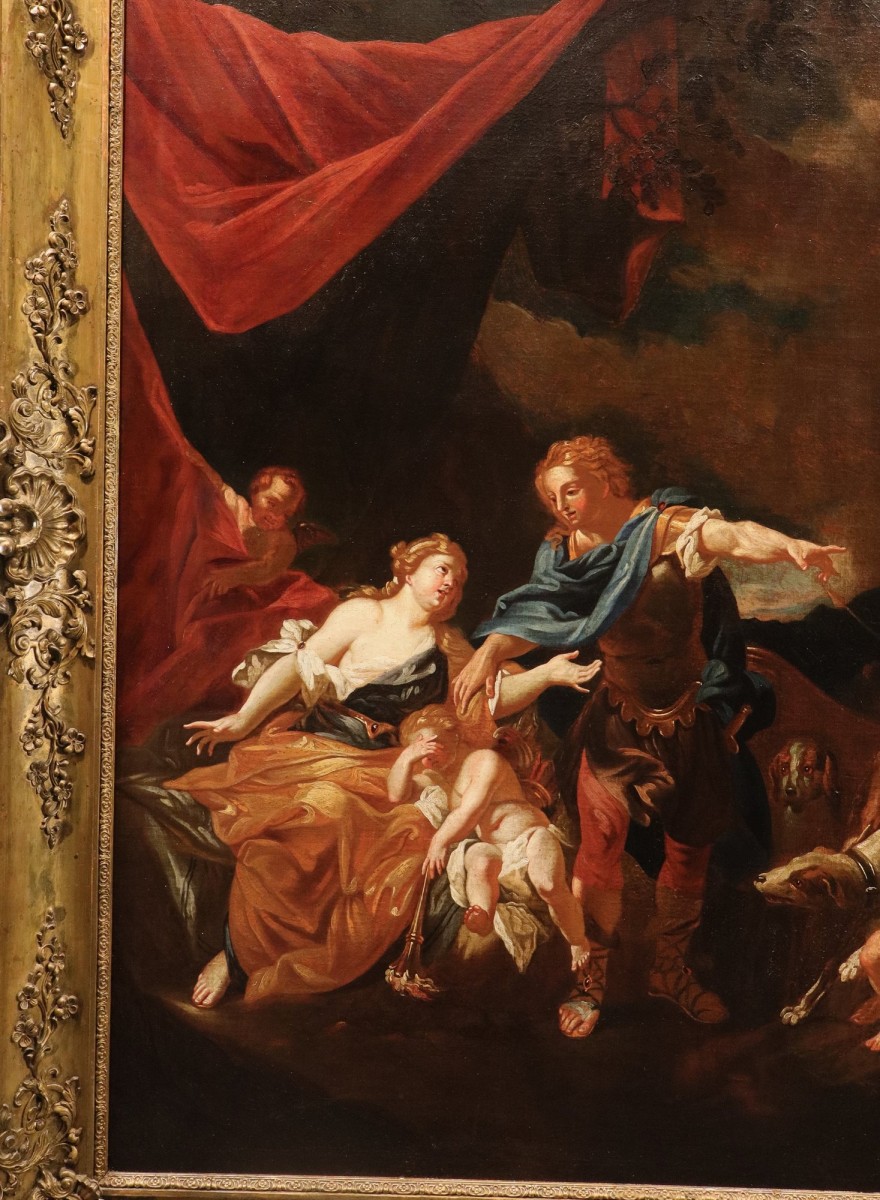
The composition does not depict the tragic ending, but instead focuses on the moment that precedes it: Venus’s futile attempt to hold back the young hunter before he meets his tragic fate.
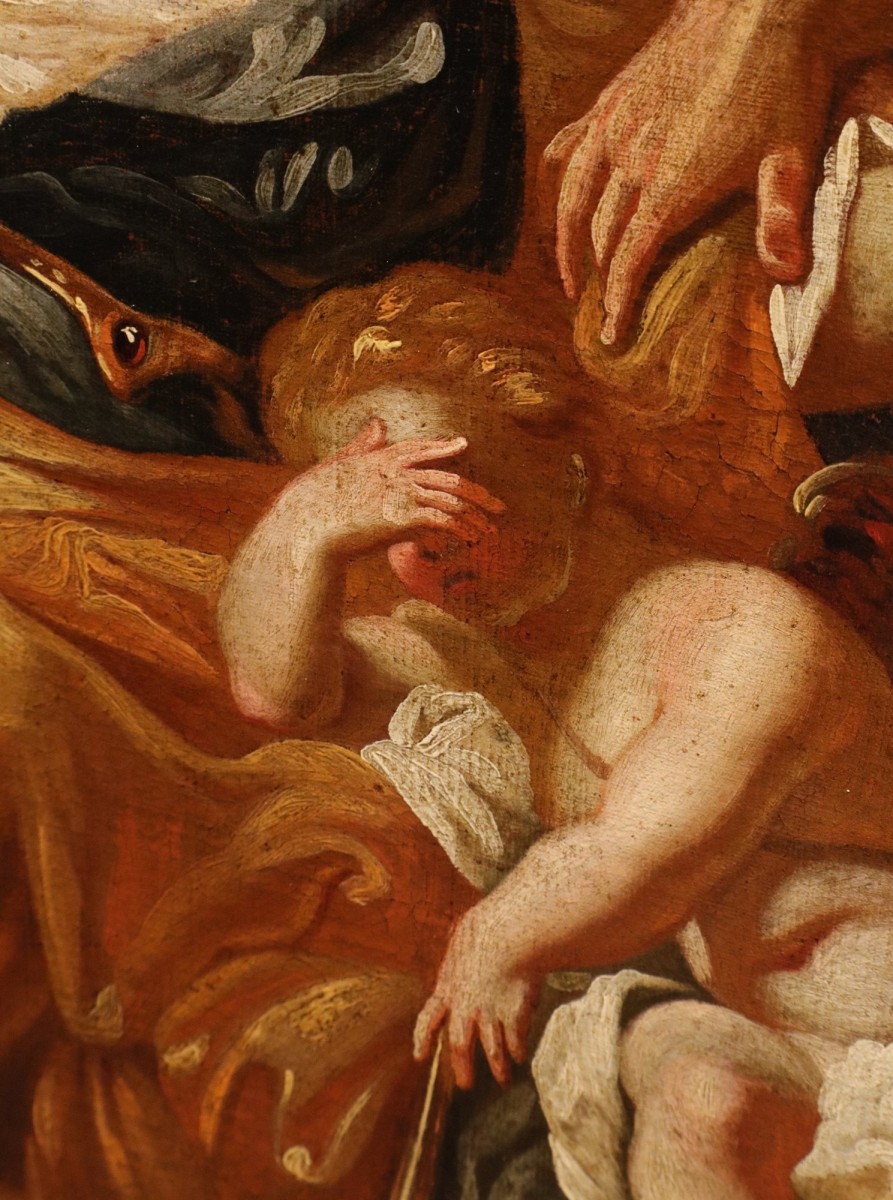
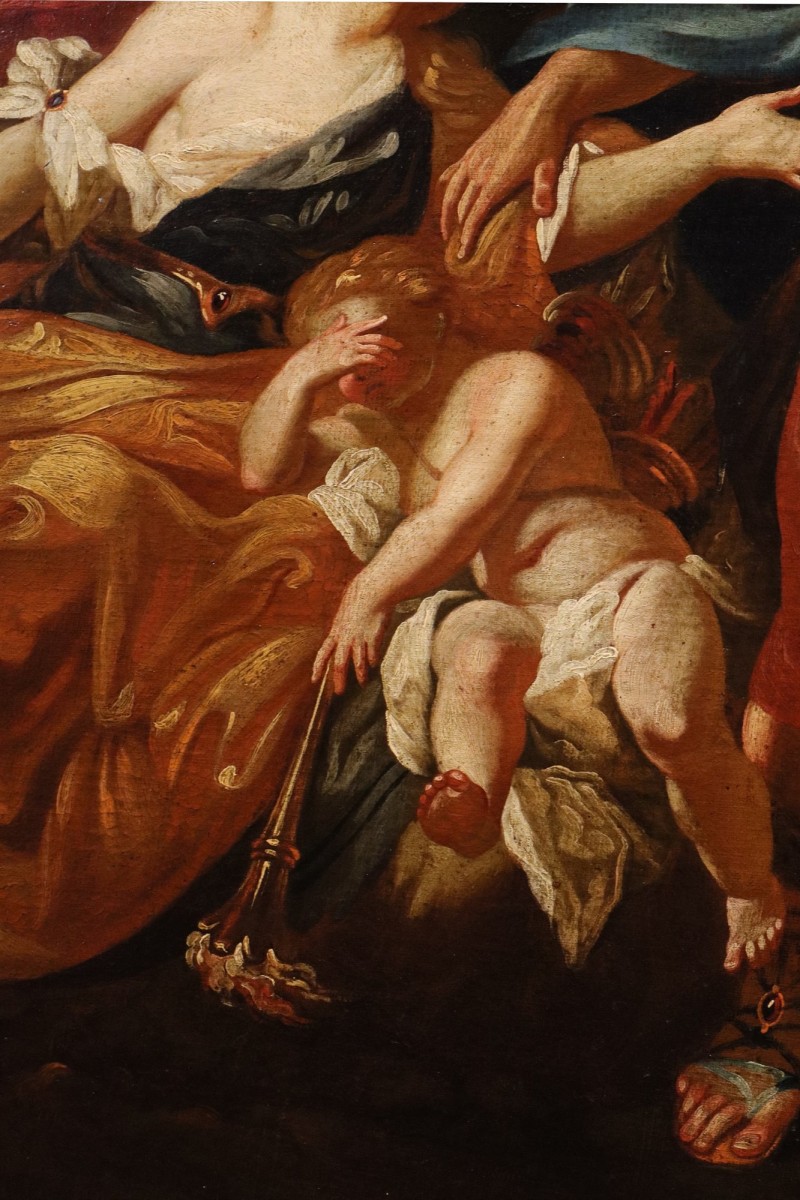
A particularly beautiful detail shows the little Cupid covering his face with his hand in a gesture of despair, as if foreseeing that the love between the two would soon come to an end: in one hand he holds a lit torch held upside down, a powerful symbol of classical origin, associated with unhappy love and the imminent end of earthly pleasures.
This is a work of significant artistic merit, attributable to the Italian painter Corrado Giaquinto (Naples, 1703 – Naples, 1765), one of the leading figures in 18th-century European painting, and, in our opinion, painted around 1740–1750, thus during the period of his full artistic maturity.
The canvas is, in fact, an emblematic synthesis of the master’s style during this phase, in which his style draws upon the elegance and lightness of the Rococo period, whilst retaining the grandeur of the late Italian Baroque, characterised by a soft brushwork that lends the figures an almost ethereal grace.
The scene is characterised by a strong sense of movement and energy, and a marked compositional theatricality inherited from the painter’s Neapolitan training, rendered through the use of a vibrant palette rich in warm, golden tones; the masterful, almost metaphysical use of light, which softly shapes the bodies, combined with the sinuous movement of the figures, are the artist’s unmistakable hallmarks during this period.
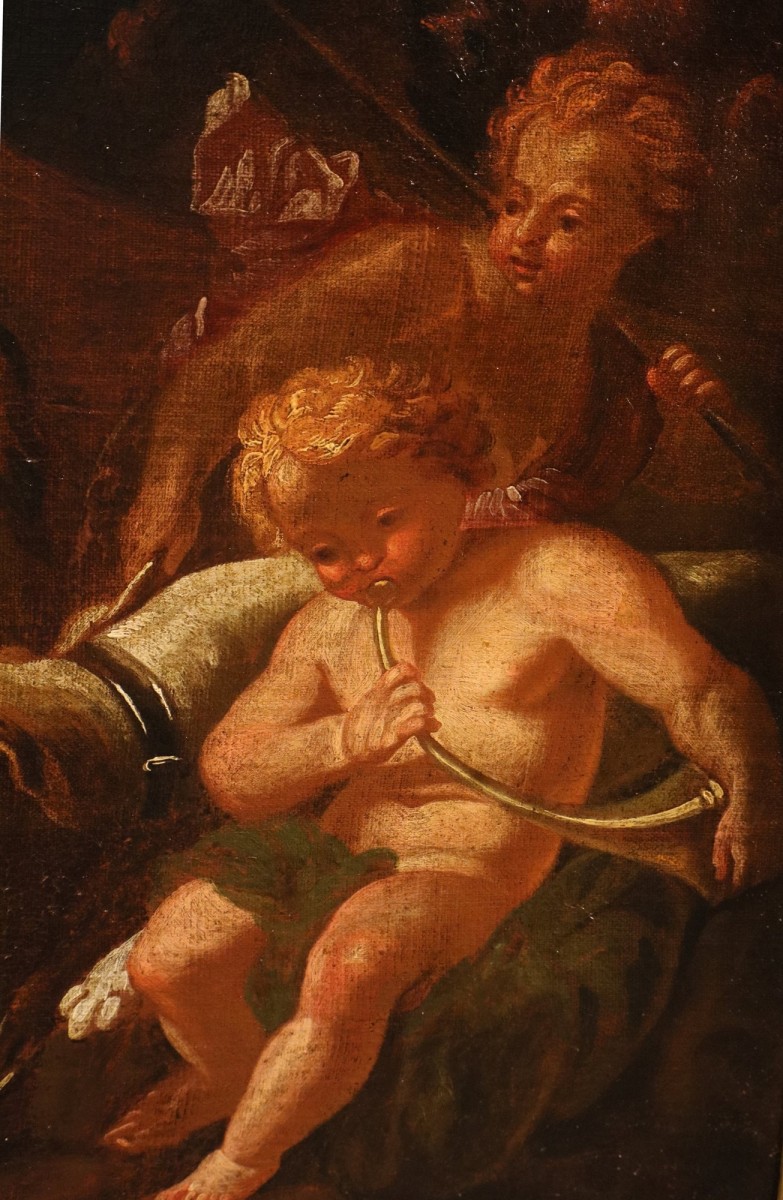
As is often the case in the painter’s other works, the pictorial space is conceived precisely as a theatrical stage, governed by dynamism and emotional intensity; the scene is framed by an imposing red drape suspended in the top left-hand corner, partly supported by a cherub, which emphasises this concept, framing the action just as in an opera set.
The nocturnal setting, a characteristic frequently seen in his works, also plays a crucial role, intended to lend further emotional impact to the story and, in this instance, to foreshadow the impending danger.
To support our attribution, we can compare the proposed painting with the following works by Giaquinto on mythological subjects, in which we can identify stylistic and compositional parallels: Fig. 1 – C. Giaquinto, The Death of Adonis, Villa della Regina, Turin
2 – C. Giaquinto, Venus Presenting Weapons to Aeneas, Quirinal Palace, Rome
3 – C. Giaquinto, Aeneas and Dido Caught in a Storm, Quirinal Palace, Rome
. 4 – C. Giaquinto, Ulysses and Diomedes in the tent of Rhesus, Civic Art Gallery, Bari
5 – C. Giaquinto, Judith and Holofernes, Palazzo Argento Provincial Museum, Lecce
Delevery information :
We take care of and organise the transport of the purchased works, both for Italy and abroad, through professional and insured carriers.
We take great care We personally take care of the packaging, to which we devote a great deal of care: each work is carefully packed, first with arti- cle material, then with a custom-made wooden box.
Should you have the desire to see this or other works in person, we would be happy to welcome you to our gallery in Riva del Garda, Viale Giuseppe Canella 18, we are always open by appointment only.