Offered by Franck Baptiste Paris
REQUEST INFORMATION
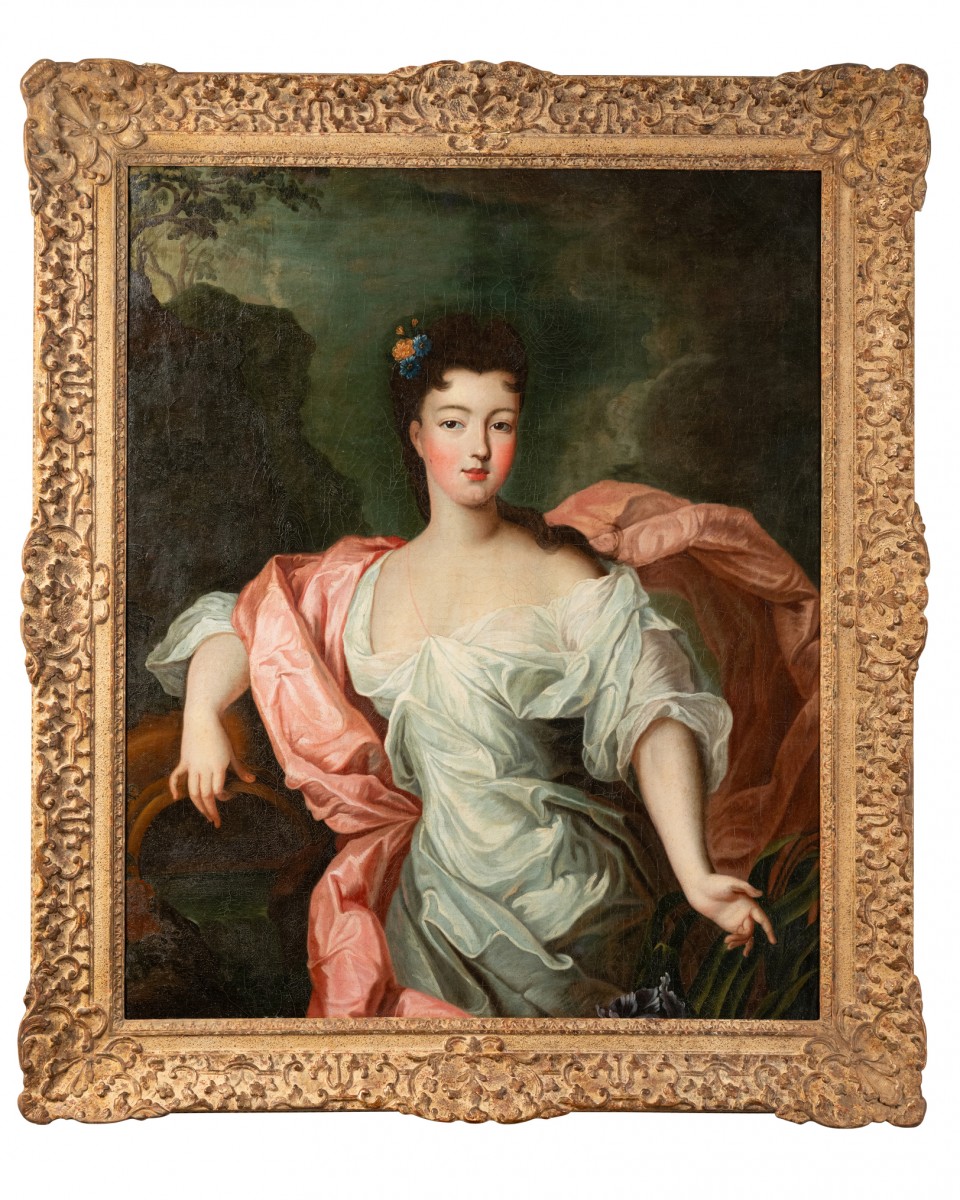

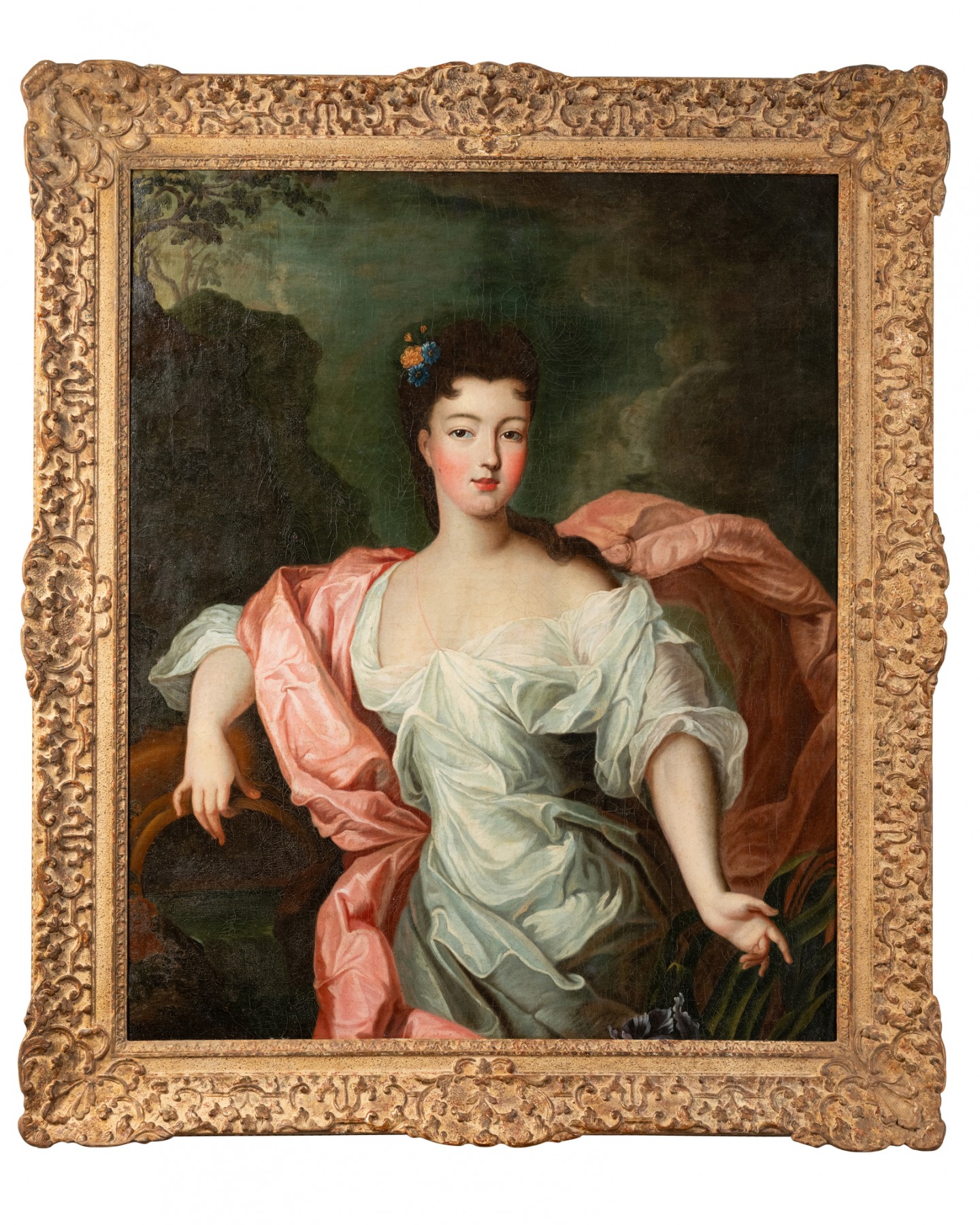
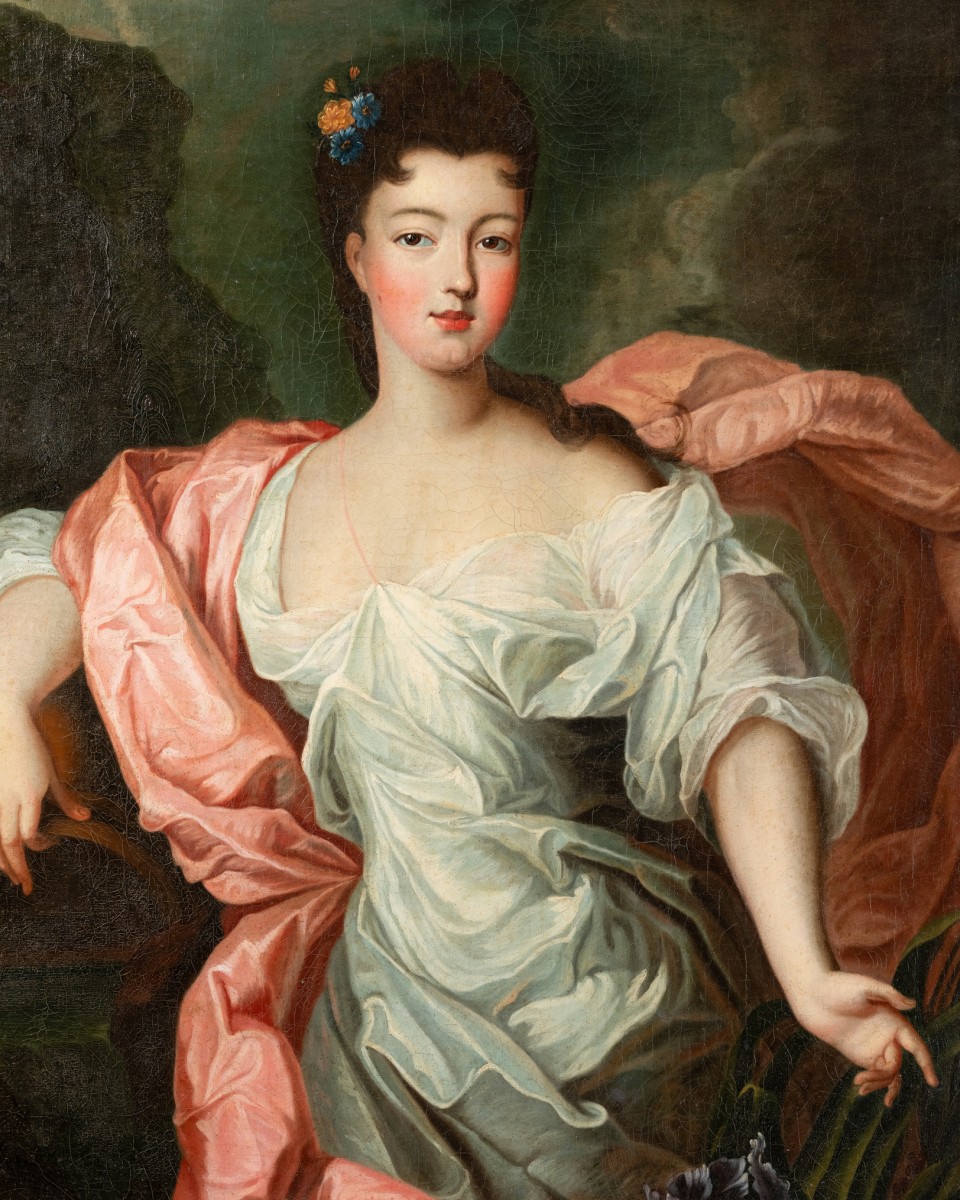
A charming portrait depicting a young woman facing the viewer, dressed in a light, pleated white gown and a pink drape. Set in a natural landscape, her right hand rests on an amphora from which a trickle of water flows, and her left hand delicately rests on reeds from which irises emerge. Her Fontange-style hairstyle, adorned with flowers, highlights a delicate face with a porcelain complexion and rosy cheeks.
By comparison with a known portrait in the collections of the Palace of Versailles, we can identify this painting as a version of the portrait of Louise-Élisabeth de Bourbon, Princess of Conti with Irises, painted by Pierre Gobert around 1720.
Oil on canvas, in excellent condition.
Attributed to Pierre Gobert and his workshop, Paris, circa 1720.
Regency-style frame in lacquered and gilded wood and stucco.
Dimensions:
Frame: Height: 127 cm; Width: 109 cm
Canvas: Height: 103 cm; Width: 85 cm
Our opinion: We know of two other versions of this portrait by Gobert: one, oval in shape with a barely visible background, in the collections of the Palace of Versailles; and a second, rectangular and larger than the one in Versailles, at the Château d’Aulteribe (Puy-de-Dôme). It is this latter version that we can compare to our painting. A discreet landscape under an overcast sky allows the princess to appear in an almost theatrical manner.
For a long time, there was uncertainty about the exact identity of the subject: the painting was known as a “Portrait of a Princess of Conti as Iris,” at a time when this title was held by four women simultaneously. This painting could depict Louise-Élisabeth de Bourbon-Condé (1695-1775) or her daughter-in-law, Louise-Diane d’Orléans (1716-1736). The Palace of Versailles recently settled this question and officially recognized this portrait as that of Louise-Élisabeth de Bourbon-Condé, granddaughter of Louis XIV, wife and later widow of Louis-Armand de Bourbon-Conti, making her Madame la Princesse de Conti III.
The very fair, pearly complexion; the deeply rosy cheeks; the large, slightly moist eyes; the small mouth with vermilion lips; and the somewhat idealized elegance of our subject, with light draperies in soft colors, are characteristic of the finest style of Pierre Gobert, the court's favored portraitist during the final years of Louis XIV's reign and the Regency.
Pierre Gobert (1662-1744)
The son of a sculptor, Pierre Gobert was admitted as a portrait painter to the Royal Academy of Painting and Sculpture in 1701. He quickly became one of the leading portrait painters at court at the end of Louis XIV's reign, notably serving as the official painter to the Condé family and the Lorraine court at Lunéville. His portraits exude a freshness and lightness that always enhance his subjects. His female portraits feature vibrant colors and flowing drapery that wraps around the body, magnifying the silhouettes. Gobert also frequently disguised his subjects as allegorical and mythological figures; this fashion, already well established under Louis XIV, continued under Louis XV with portrait painters like Nattier. Here, the Princess of Conti is depicted as Iris, messenger of the gods. The presence of the flower of the same name in the lower right corner of the canvas reinforces this metaphor.