Offered by Jan Muller
REQUEST INFORMATION

SIMON PIETERSZ. VERELST
Den Haag, 1644 - Londen, 1721
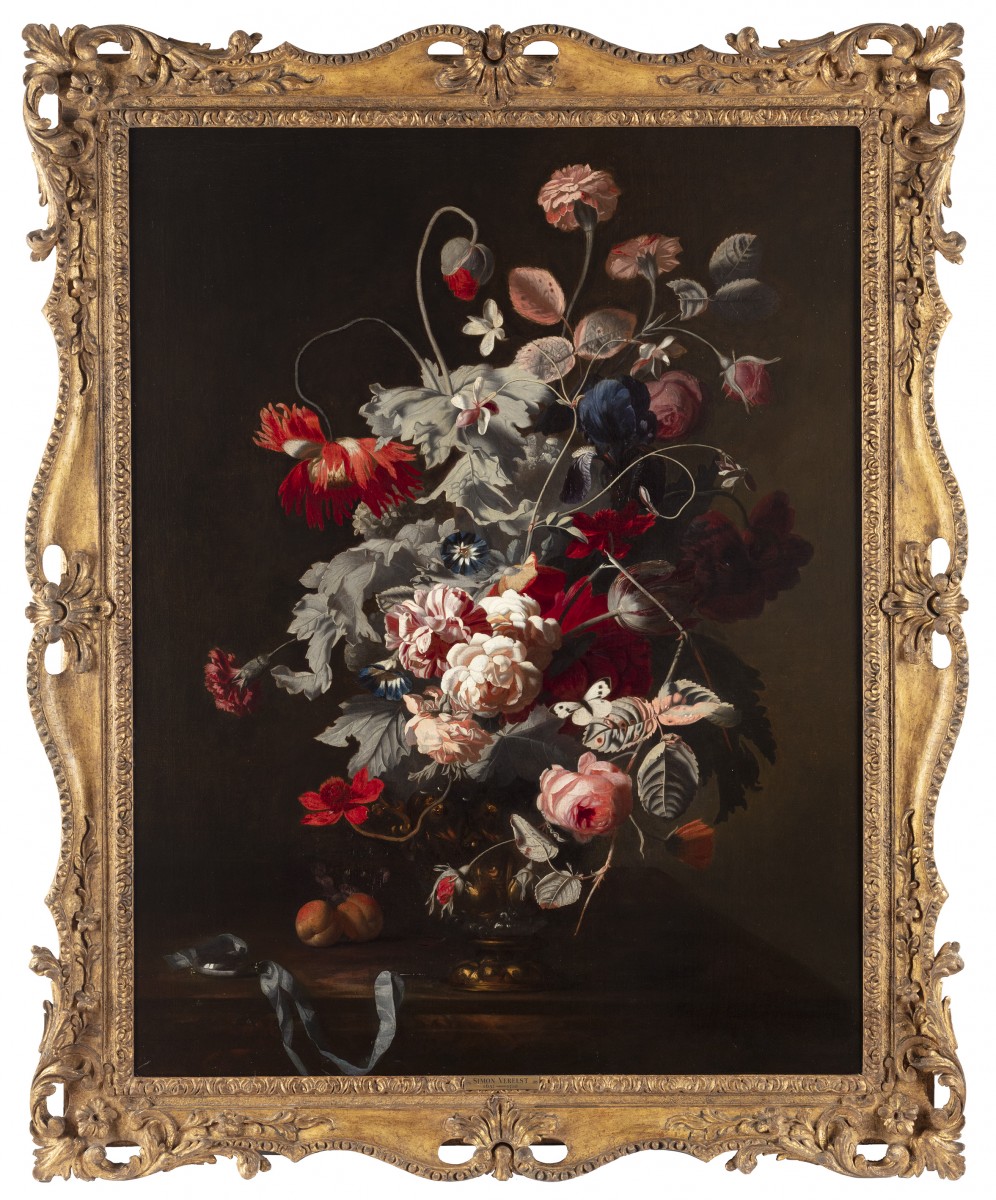
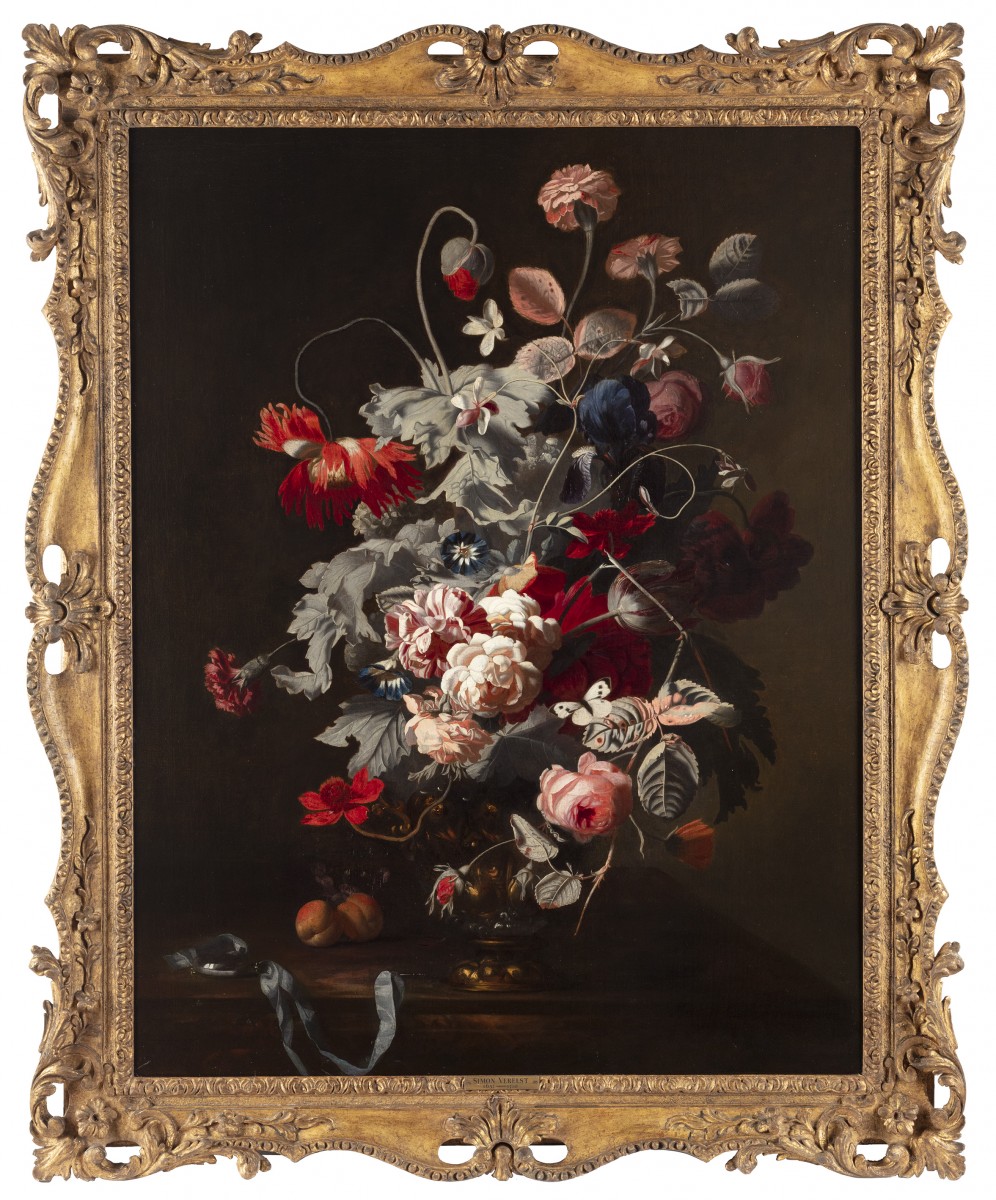
“A still life with flowers and a pocketwatch”
Oil on canvas
We’d like to thank dr. Fred Meijer for his expertise.
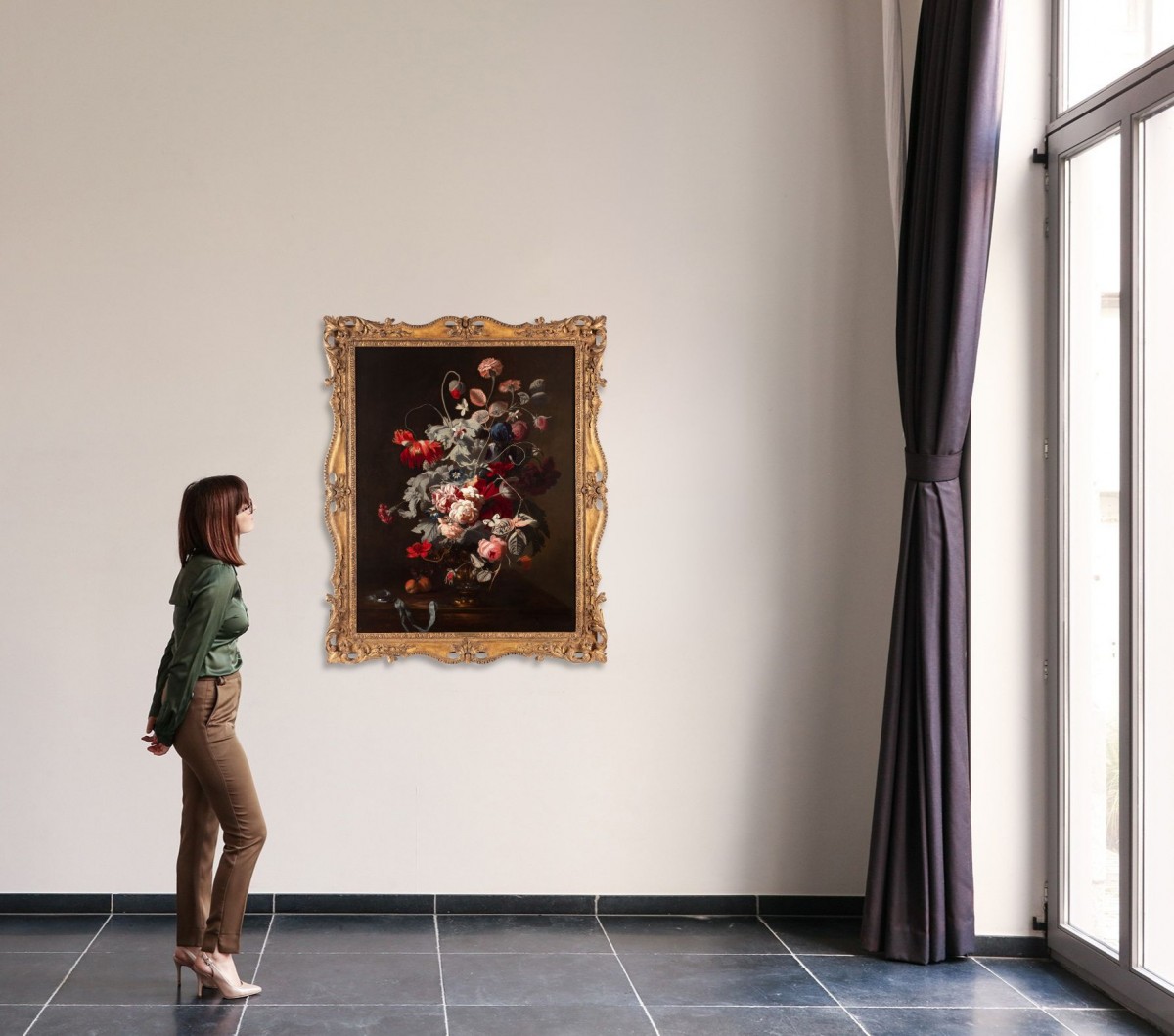
Dimensions 96 x 74 cm, 113 x 93 cm (framed)
THE ARTIST
Simon Pietersz. Verelst (1644–c. 1710–1717) was a Dutch-born painter who established himself in London and became one of the most celebrated still-life painters of his age. Trained in The Hague by his father, Pieter Verelst, alongside his brothers Herman and John, Simon joined the Confrerie Pictura in 1663. The art market in the Low Countries collapsed in the late 1660s. Simon found himself in extremely difficult financial circumstances and moved from The Hague to London perhaps by 1667. Many artists were forced to move abroad for economic survival. His father and now widower, Pieter, travelled to London with most of his children in 1668, dying in England in autumn 1668, perhaps leaving Simon with responsibility for the family.
Verelst is known for outstanding flower and fruit still life paintings. He quickly rose to prominence in England. His floral pieces impressed contemporaries like Samuel Pepys (an English writer and politician). Pepeys recorded a meeting on 11 April 1669 with “a Dutchman, newly come over, one Evarelst”. In his diary entry of 1669, he described Verelst’s flower paintings as ‘the finest thing that ever, I think, I saw in my life,’ noting how the dew on the petals was so realistic that he tried to touch it with his finger. Verelst’s reputation for creating lifelike depictions of flowers earned him admiration from the English elite, including members of the court of Charles II. For a time, he was one of the best-paid artists in London, producing both still lifes and portraits.
Yet his career was marked by turbulence. From the mid-1680s, Verelst displayed signs of mental illness. Jacob Campo Weyerman spent time in London between 1704 and 1720, and knew Simon Verelst. He also knew of Simon’s illness, but also wrote lengthy appraisals of Simon’s flower pieces. Weyerman also recounted anecdotes of his arrogance, eccentricities, and eventual periods of mania. At one point, Verelst referred to himself as the ‘God of Flowers’ and ‘King of Portrait Painters.’
His decline was accompanied by a drop in the quality of his work and much of his later production is lost or difficult to attribute. Despite this, the surviving still lifes, particularly those painted before his move to London, confirm his extraordinary technical skill, and justify his reputation as one of the masters of the floral genre.
THE ARTWORK
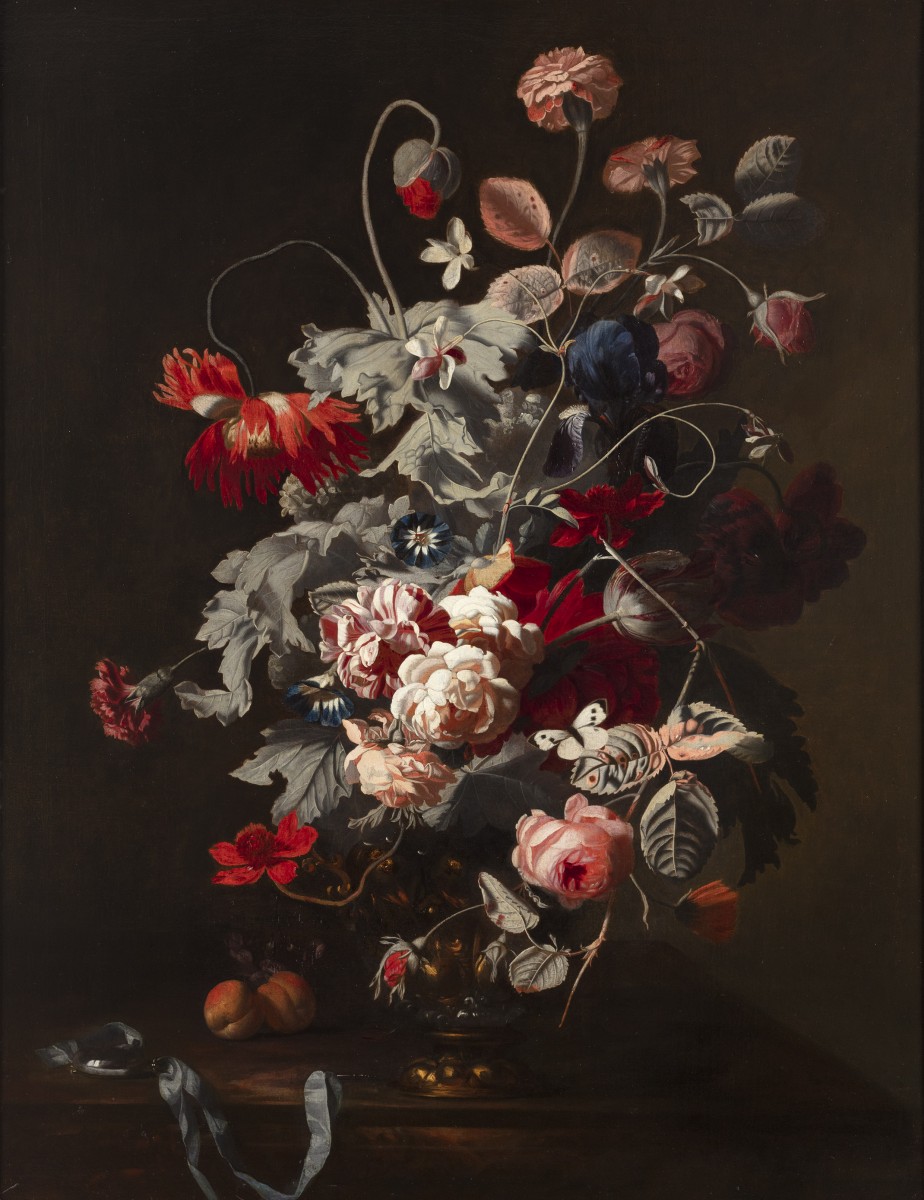
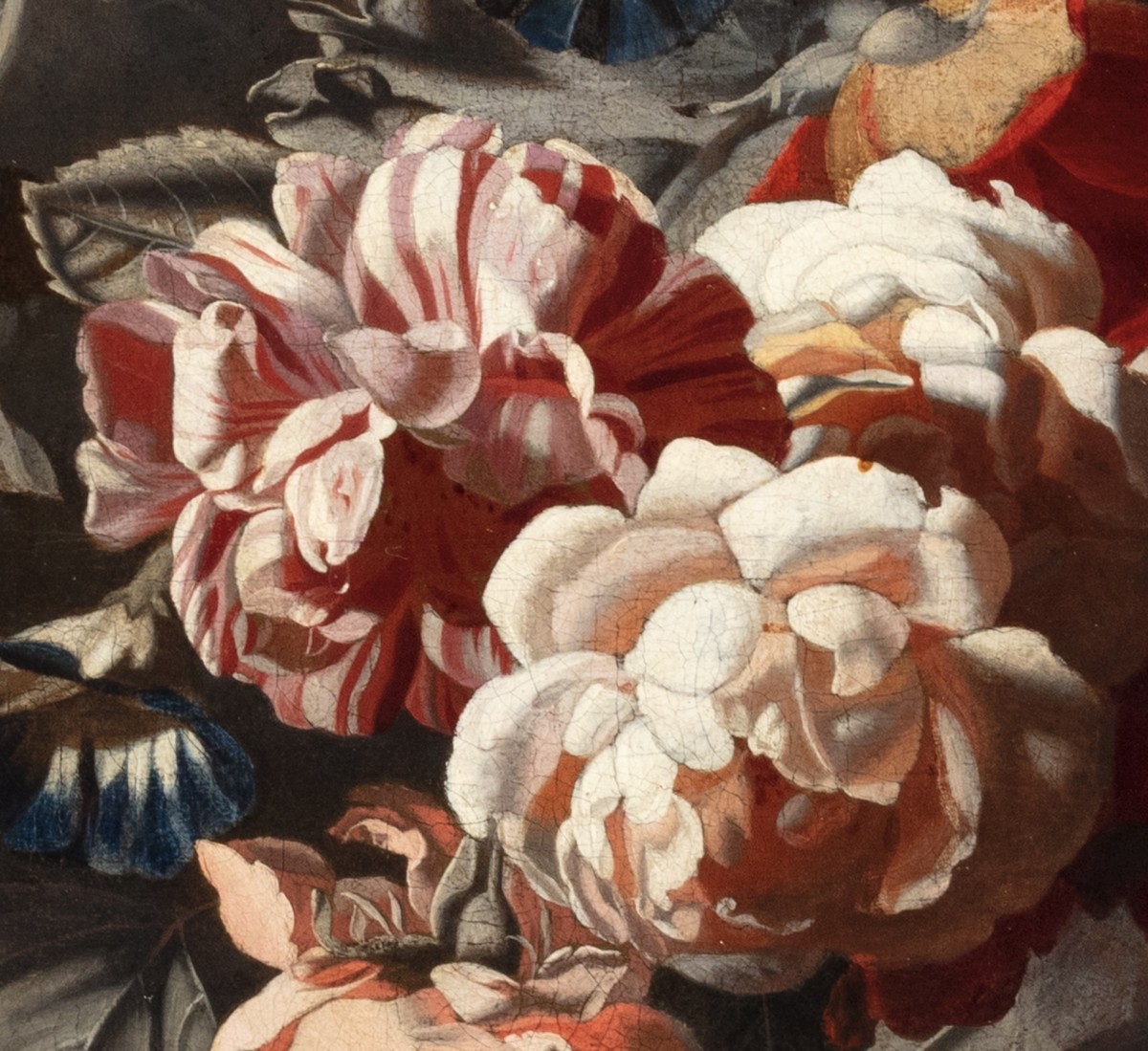
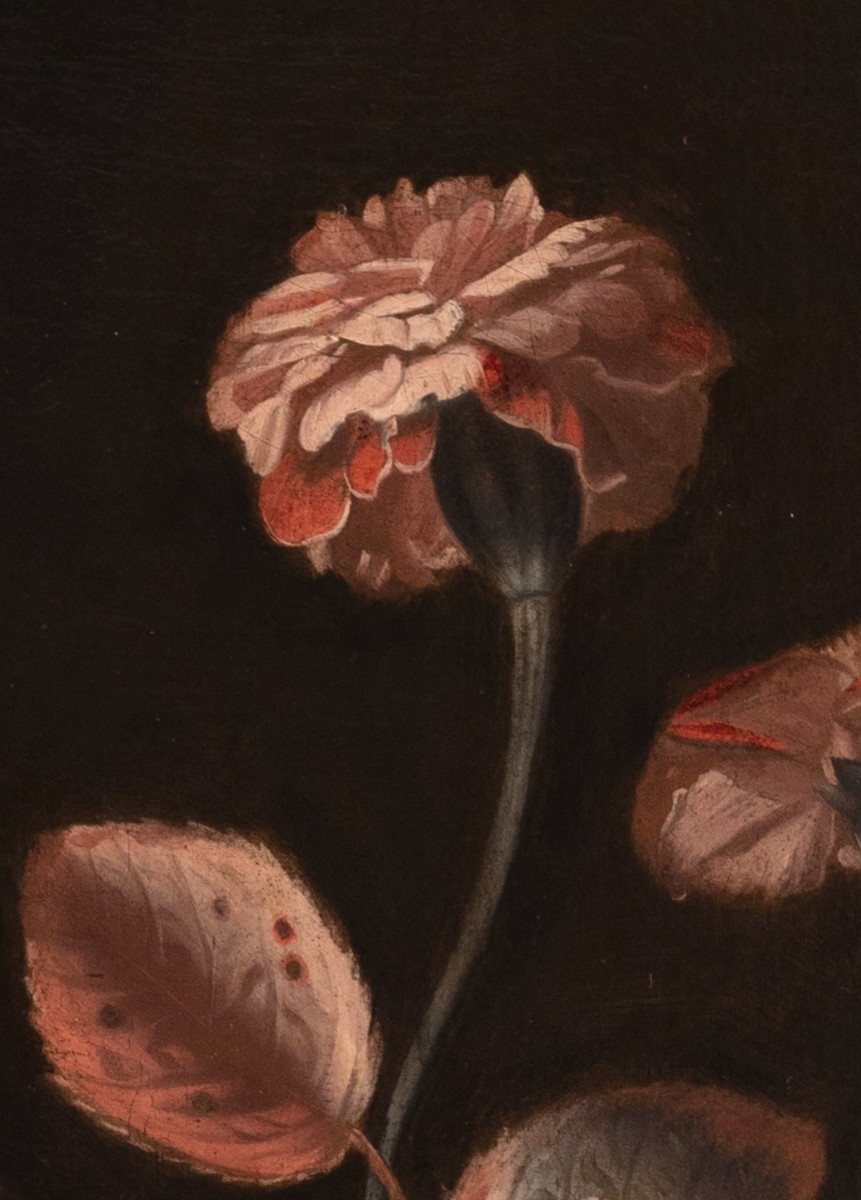
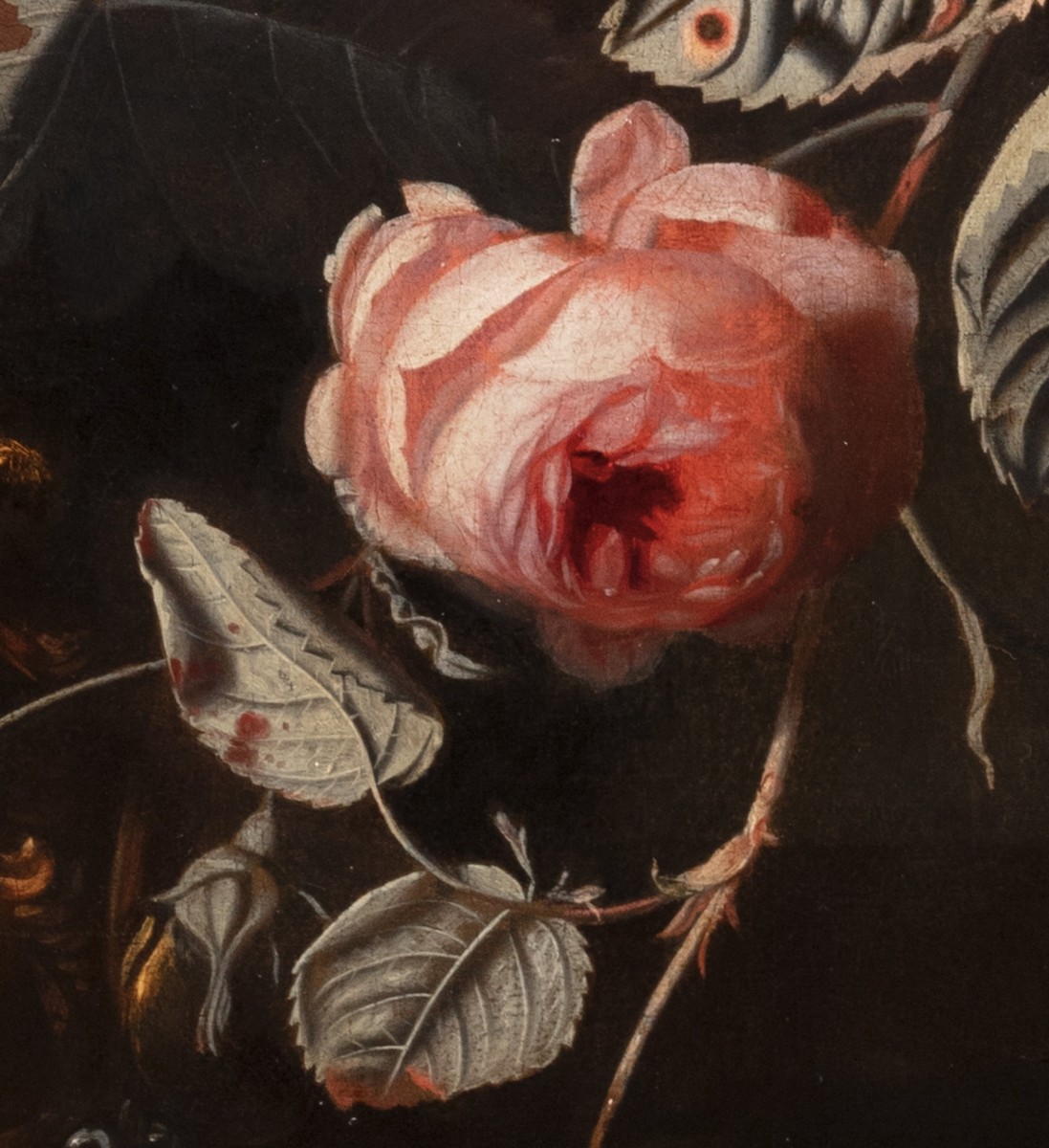
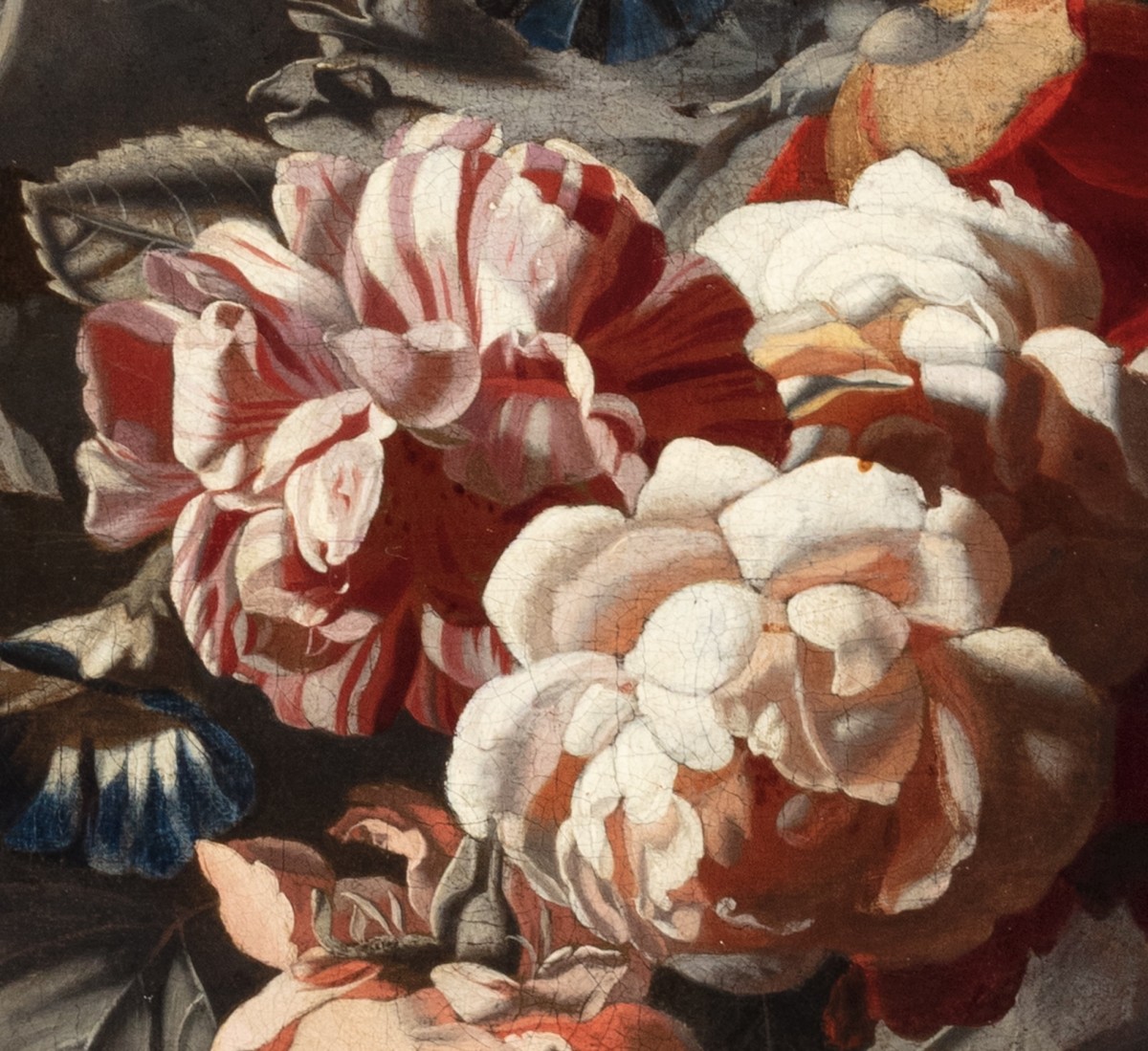
Verelst specialized in flower and fruit still lifes, and this painting exemplifies the qualities that made his work so admired. The composition shows a lavish bouquet of roses, tulips, peonies, and carnations arranged in an ornate vase, with delicate details such as a butterfly perched on one of the blossoms. On the table below, peaches, and a decorative ribbon add further richness and variety. The clock might be a symbolic addition. It appears on the table, and evokes the passage of time and the fleeting nature of beauty.
Like many 17th-century Dutch and Flemish still lifes, this work is both decorative and symbolic. The flowers themselves evoke abundance and natural beauty, but also fragility, as blooms inevitably fade. The butterfly may symbolize resurrection and transformation, while the clock points to mortality and the transience of earthly pleasures. Together, these elements place the painting within the tradition of vanitas still lifes, which blended rich detail with moral reflection.
Technically, Verelst’s mastery lies in his manipulation of light. He often used illumination from a small window to cast a focused, dramatic glow across the flowers, enhancing their textures and colors against a dark background. This technique highlights the subtle play of light on petals, leaves, and fruit, producing the illusion of three-dimensionality that so astonished Pepys and others.
By the 17th century, flower painting was an enormously popular genre in the Low Countries and beyond. Tulips, hyacinths, and other exotic blooms had been introduced into Europe during the 16th and 17th centuries, leading to famous episodes of speculation and “tulip mania.” For many buyers, paintings of rare flowers were more affordable and enduring than the plants themselves. Verelst’s art catered to this demand while elevating the genre through his technical brilliance.
In London, his floral works helped establish a strong taste for Dutch still lifes among English collectors. Though many of his later works have darkened due to the poor quality of pigments available in England, those painted earlier in the Netherlands still display their original freshness. These paintings confirm the contemporary judgment that Simon Verelst was, in his own words and those of his admirers, the ‘God of Flowers.’
Delevery information :
After reception of payment we can box and ship our items all over the world. Estimates of this service can be provided.