Offered by Galerie Nicolas Lenté
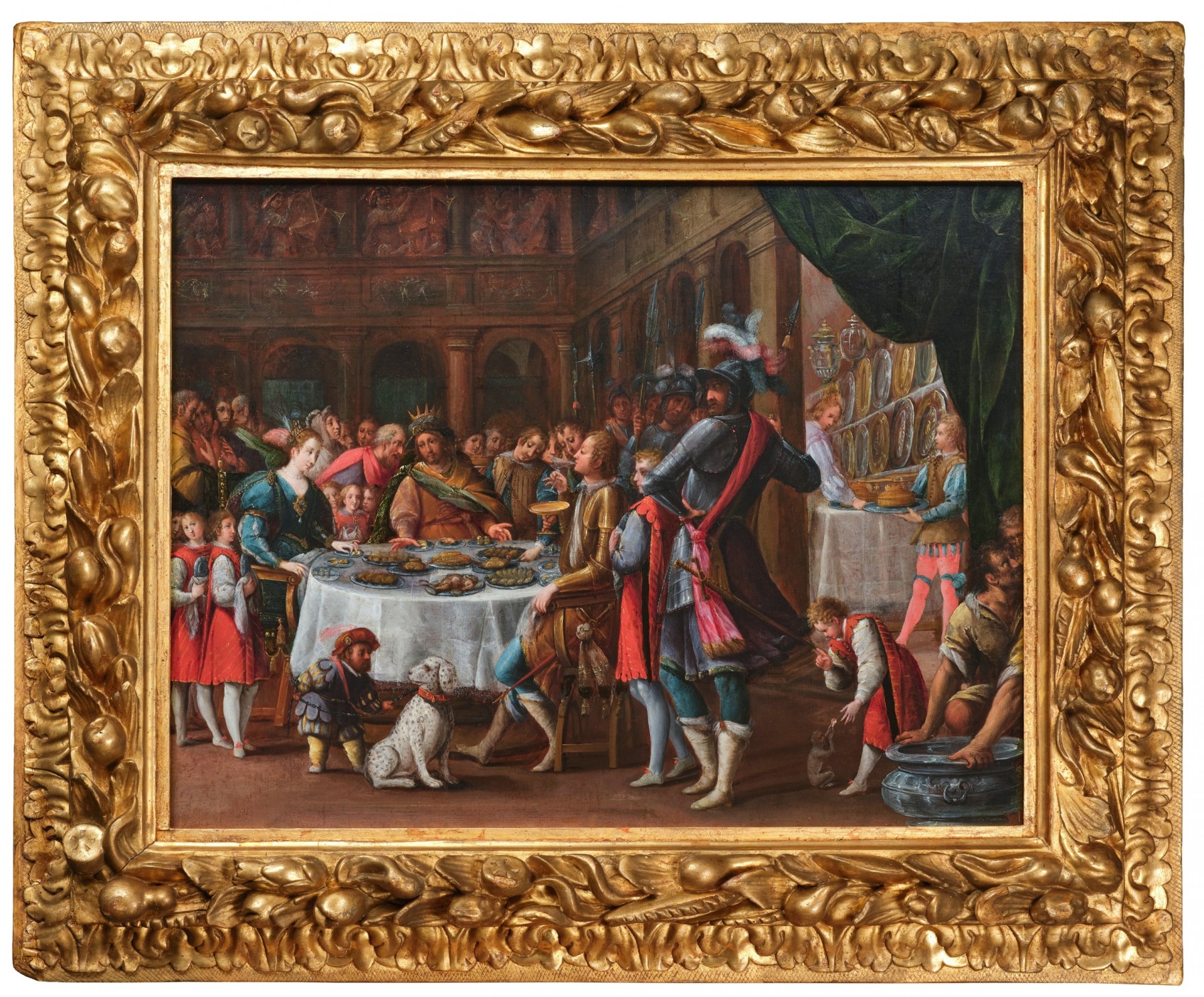

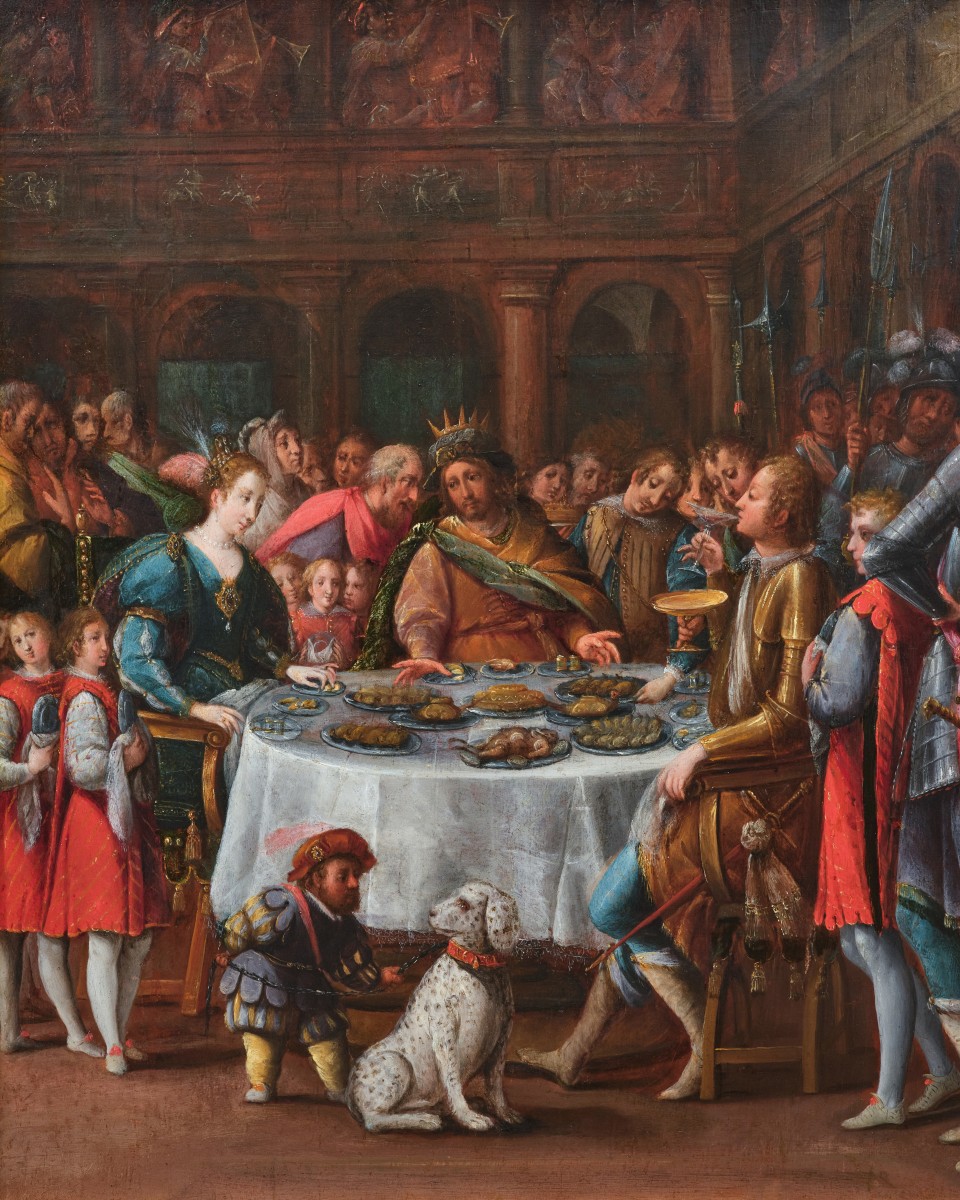
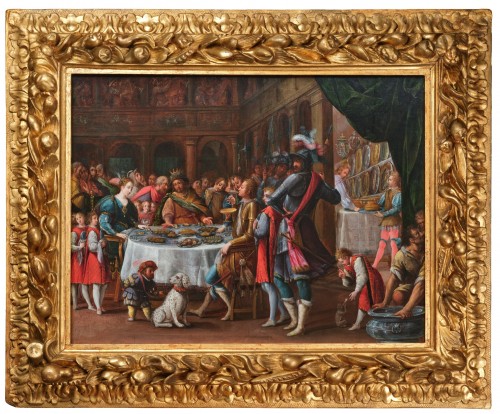
Ahasuerus and Haman at the Feast of Esther
Attributed to Denys Calvaert (Antwerp, 1540 – Bologna, 1619)
Early 17th century Italian School, circa 1610
Oil on poplar panel, dimensions: h. 52 cm, w. 67 cm.
A 17th century Italian carved giltwood frame, .
Framed: h. 76 cm, w. 93 cm
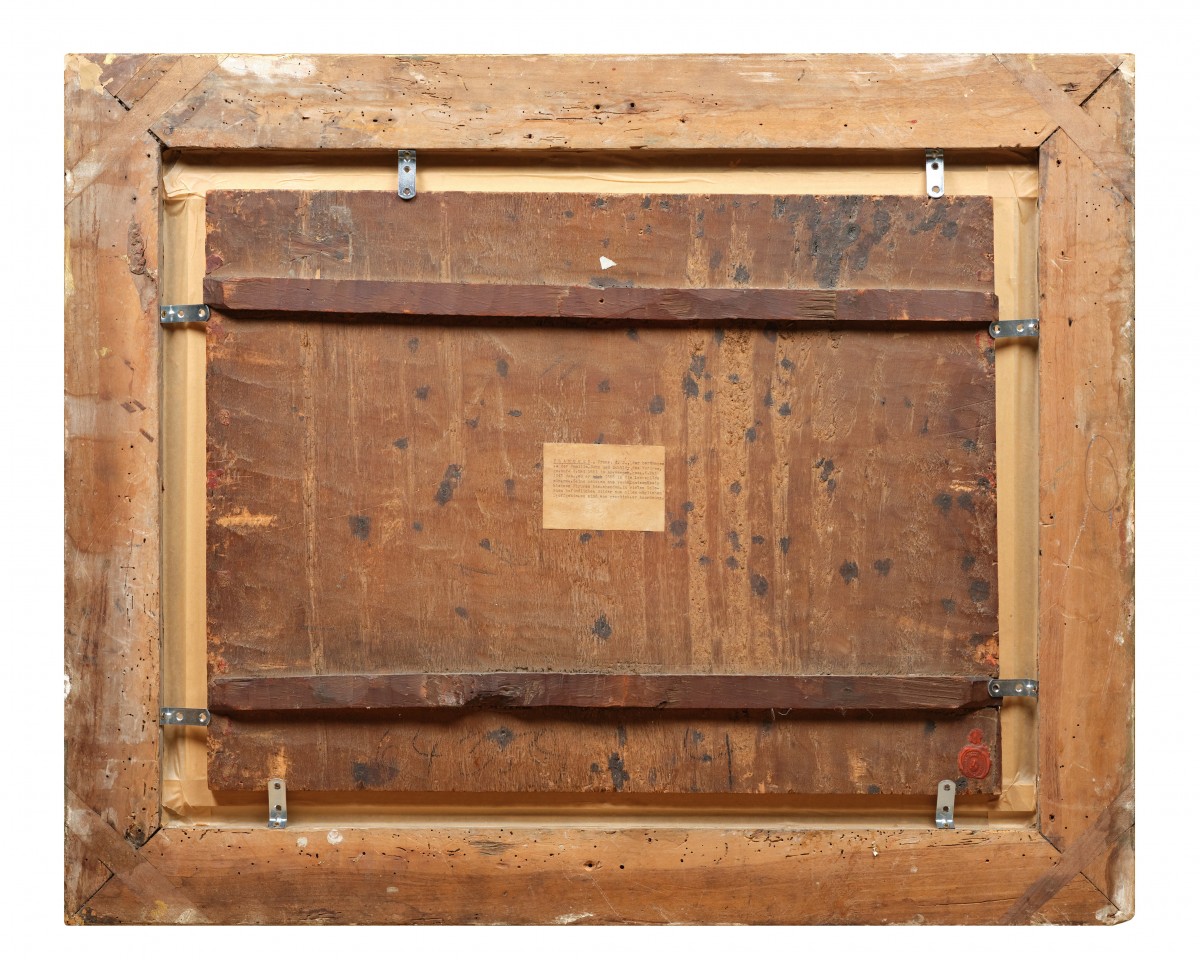
This work is sold with a certificate of authenticity guaranteeing its origin, date of execution and attribution to the artist.
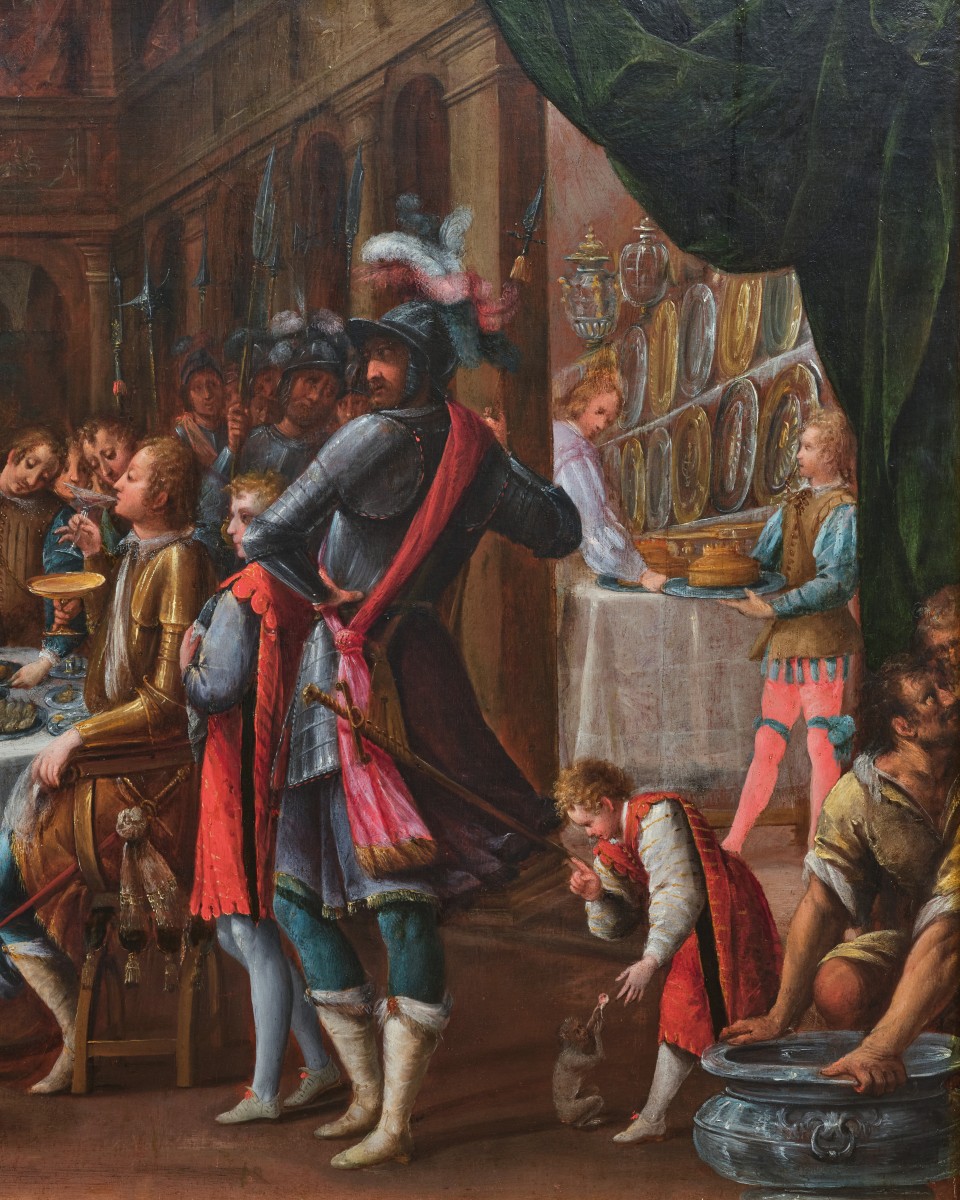
Our Feast of Esther illustrates one of the most famous episodes from the Book of Esther in the Old Testament. More than a simple representation of the biblical story, the work appears as a vast court scene where the sacred subject serves as a pretext for a display of splendor, wealth, and elegance, characteristic of the aristocratic culture of late Mannerism.
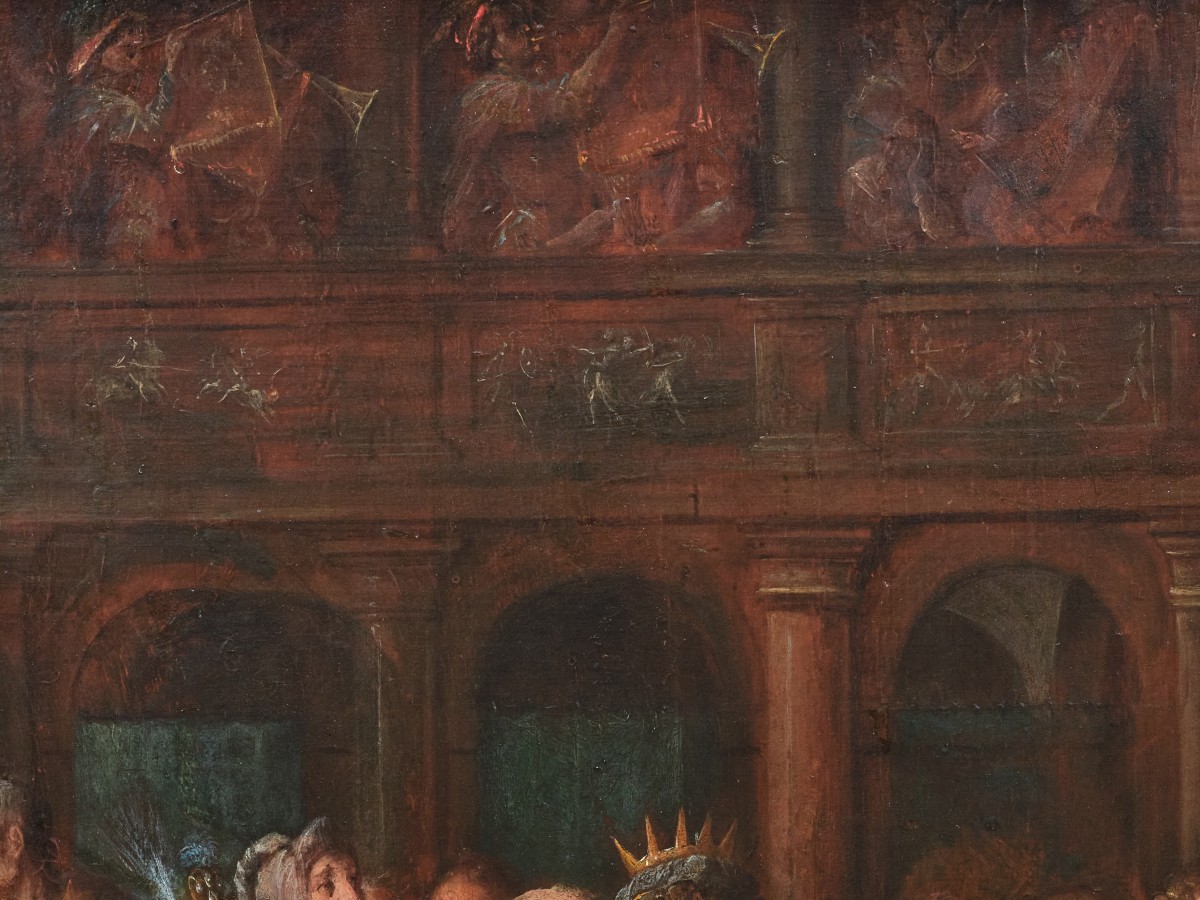
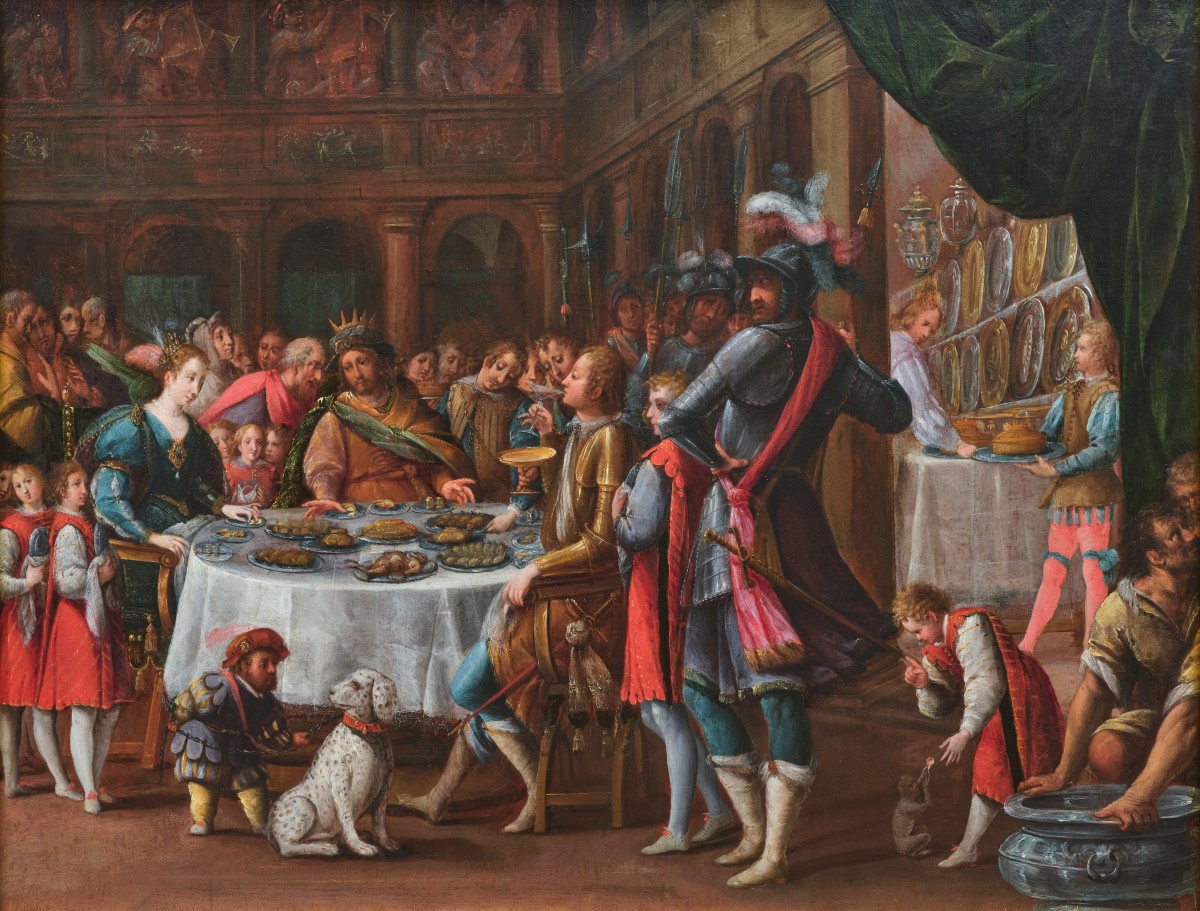
The scene unfolds in a vast palatial hall whose monumental architecture, punctuated by arcades and columns, creates a majestic setting. Musicians play their instruments in the arcades, their presence contributing to the animation of the scene and underscoring its ceremonial character. To the right, an imposing green curtain acts as a true theatrical curtain, reinforcing the spectacular nature of the composition. This theatricalization of space is typical of Mannerist culture, of which Denis Calvaert remains one of the most refined representatives in Bologna. The artist organizes the space around a large round table placed in the foreground, the true visual center of the work, around which a dense crowd of courtiers, servants, soldiers, and children are arranged.
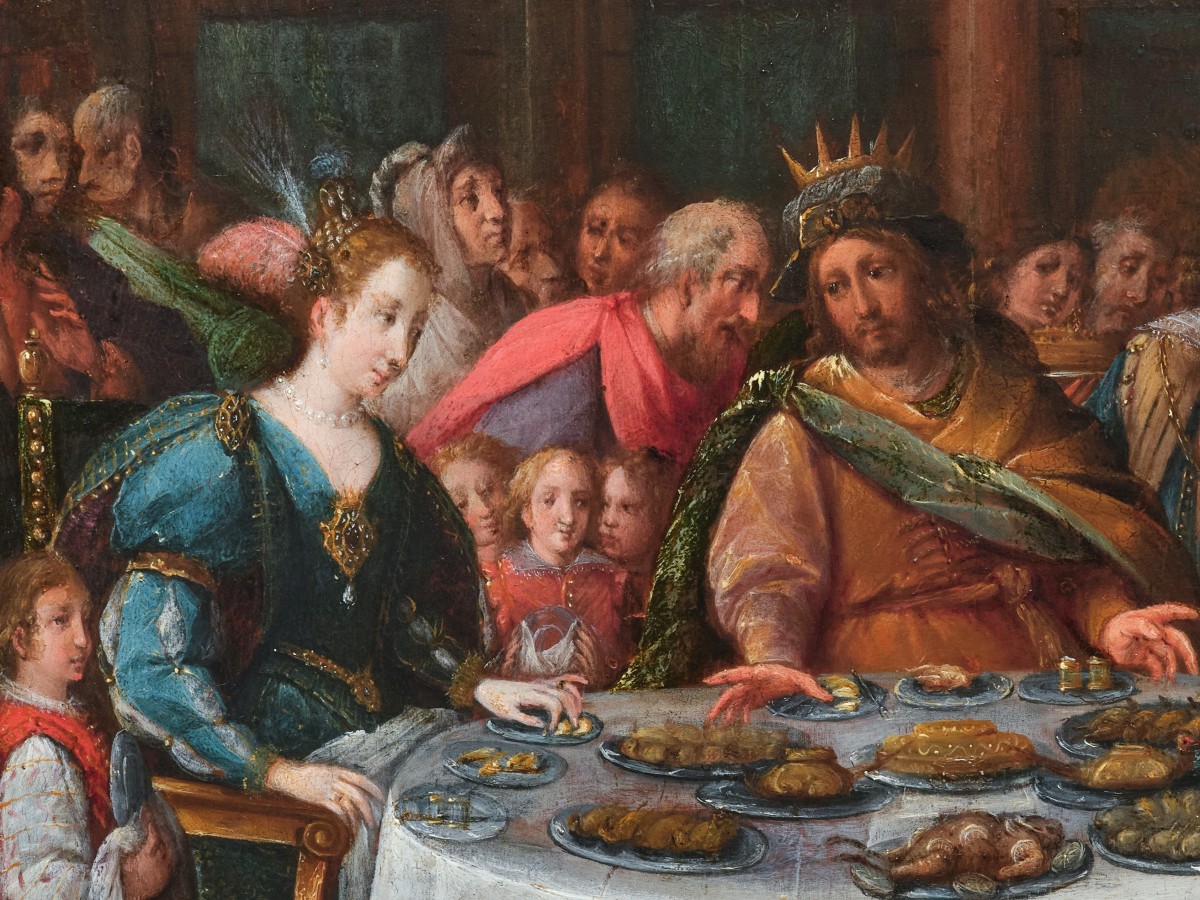
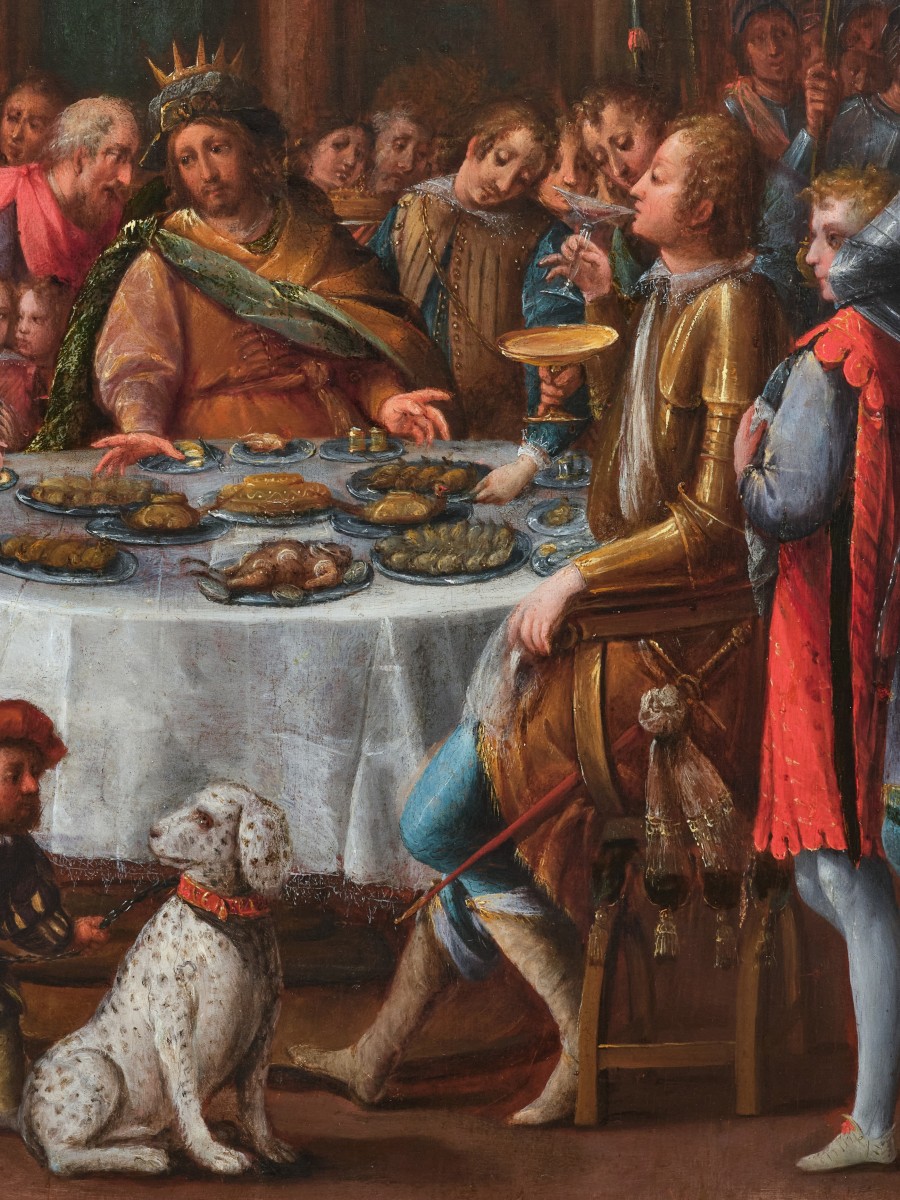
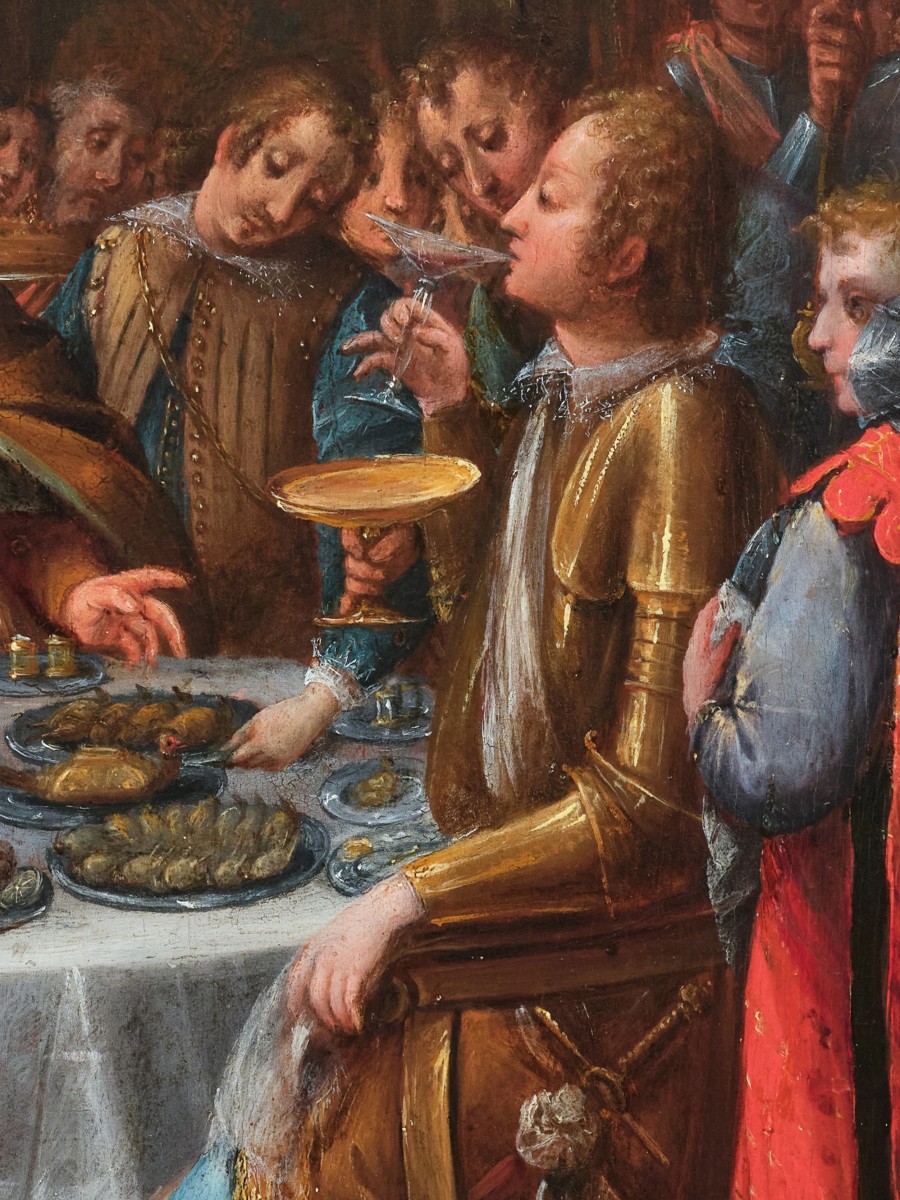
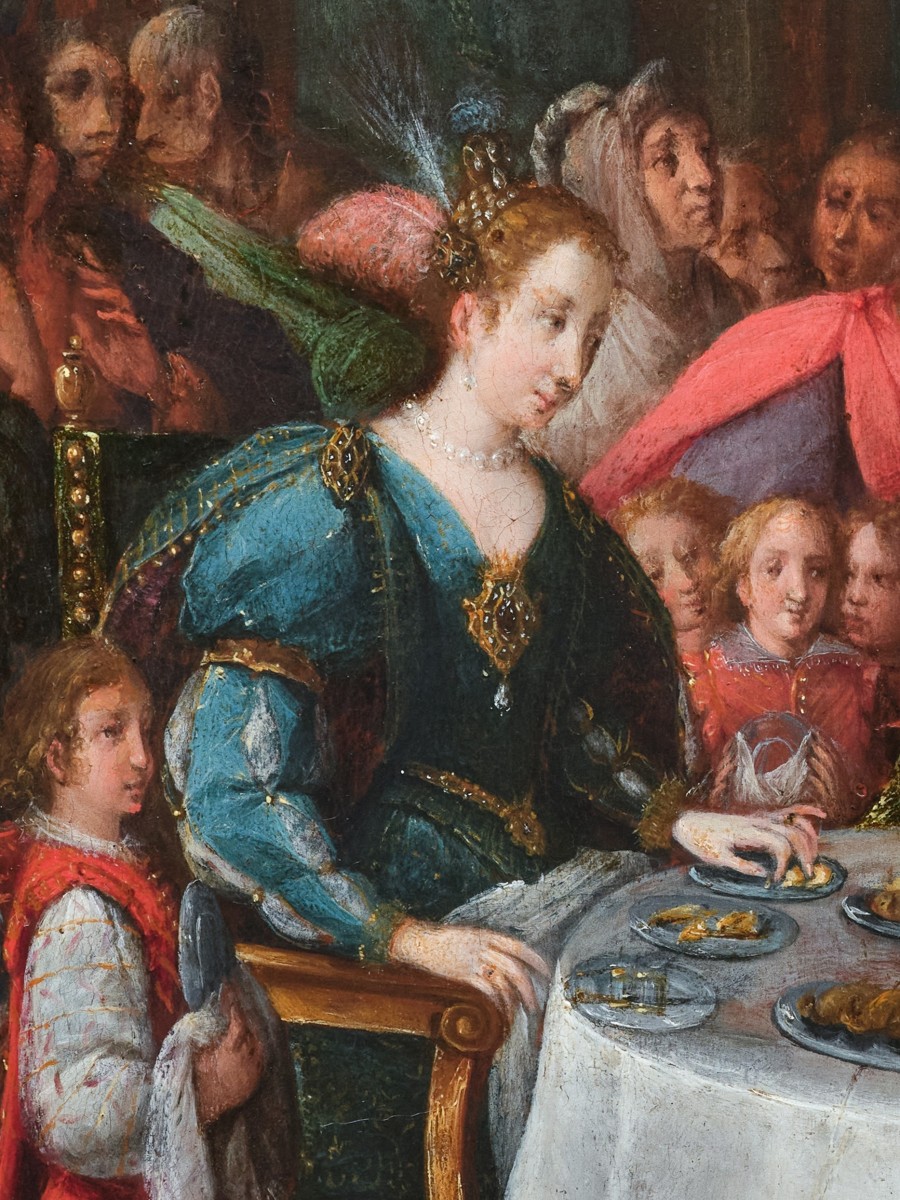
The biblical narrative focuses on the three figures seated at the table: Queen Esther, on the left, dressed in a sumptuous blue gown adorned with jewels; King Ahasuerus, positioned in the center and recognizable by his crown; and Haman, seated to the left of the sovereign, depicted raising a cup of wine to his lips. Clad in shining golden armor, Haman occupies a place of honor at the banquet, accentuating the dramatic irony of the scene, as his plot against the Jewish people is about to be revealed. The moment depicted thus seems to correspond to the banquet during which Esther reveals to the king the criminal intentions of her favorite. However, the painter's attention is not limited to this central episode. True to his penchant for rich and multifaceted narratives, Denis Calvaert multiplies the secondary figures that animate the scene and invite the viewer's eye to wander throughout the composition.
One of the painting's most remarkable aspects lies in this abundance of characters. Each group engages in a particular action: some courtiers lean towards the king, others converse discreetly among themselves, while servants bring dishes or present cups. This narrative density recalls the Flemish tradition from which Calvaert emerged. Born in Antwerp before pursuing his career in Italy, he retained throughout his life a pronounced taste for meticulous detail and teeming scenes, evident here in the variety of attitudes, expressions, and costumes.
In the center right, a group of soldiers stands out, their presence lending the scene an official and ceremonial air. An armored guard occupies a dominant position; his elegant, slightly elongated silhouette, accentuated by a spectacular plume and a red sash, is one of the composition's focal points. Behind him appear other men-at-arms armed with halberds. Their role transcends mere narrative function: they also serve to structure the space with their vertical lines and introduce particularly refined textural effects in the rendering of the metal armor. This attention to secondary figures is characteristic of Calvaert, who often gives as much importance to peripheral characters as to the main protagonists.
The richness of the costumes contributes significantly to the overall splendor. The shimmering fabrics, precious embroidery, colorful coats, and luxurious accessories testify to the care taken in representing the aristocratic world. The women wear elegant hairstyles adorned with pearls or jewels, while the men sport doublets, breeches, and brightly colored cloaks. The palette retains a remarkable freshness: the luminous blues, intense greens, delicate pinks, and vibrant reds recall the color harmonies found in several works attributed to Calvaert and constitute one of the most compelling arguments for this attribution.
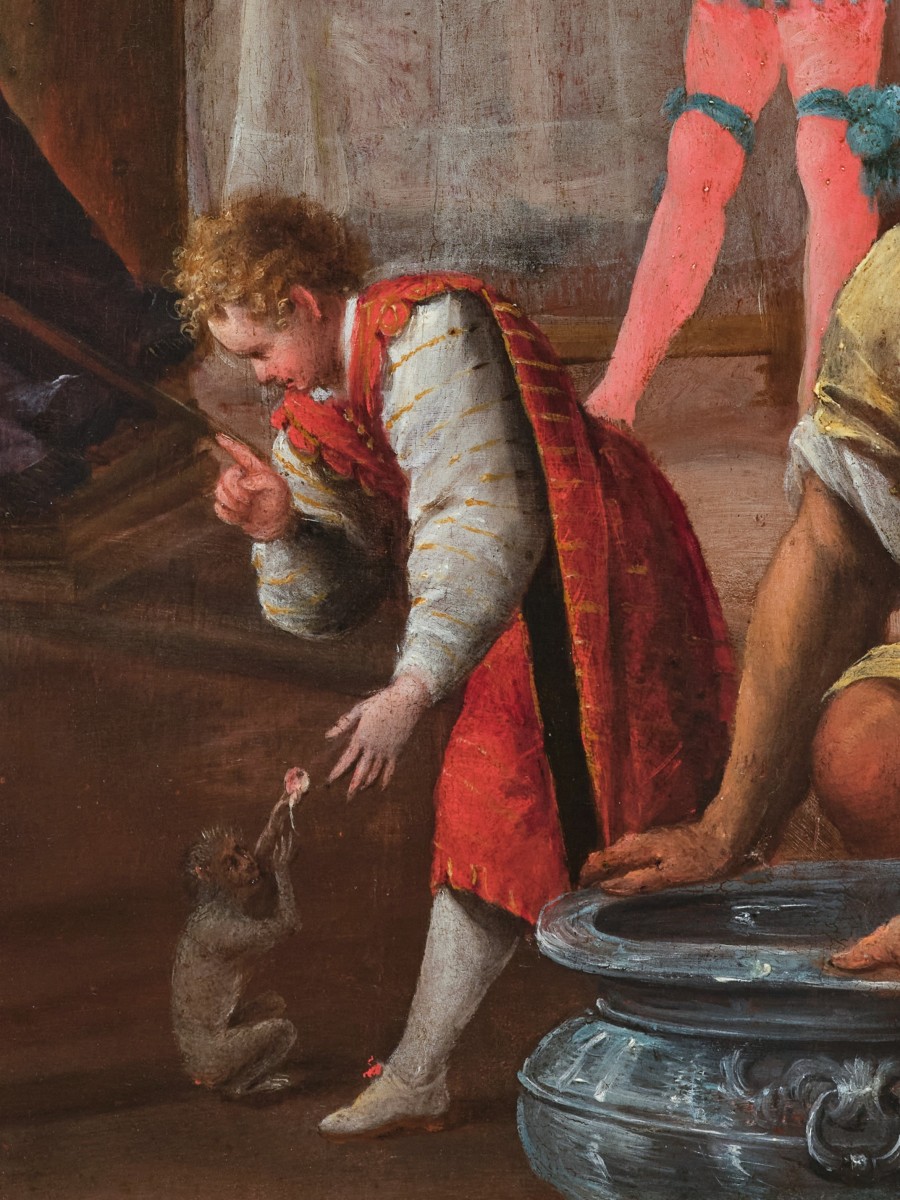
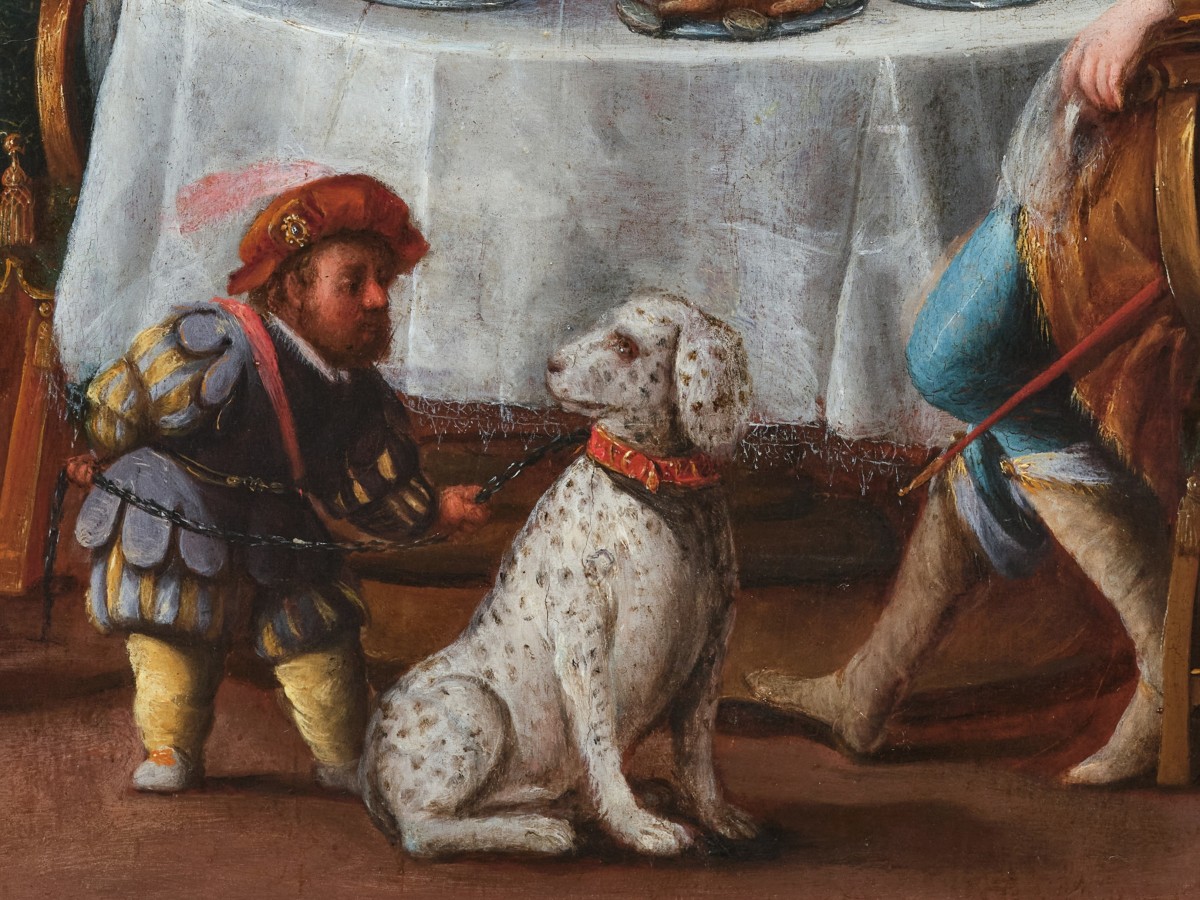
As is often the case in late Mannerist painting, the eye is constantly drawn to a series of anecdotal scenes that enrich the main narrative. In the foreground, a dwarf holds a spotted dog (a Dalmatian?) by a leash; the animal, sitting peacefully before the table, adds a familiar and lively touch. To the right, another child feeds a small monkey, a picturesque detail that contributes to the narrative charm of the work. These secondary episodes, unrelated to the biblical subject, testify to the artist's delight in observing and depicting human behavior in all its diversity.
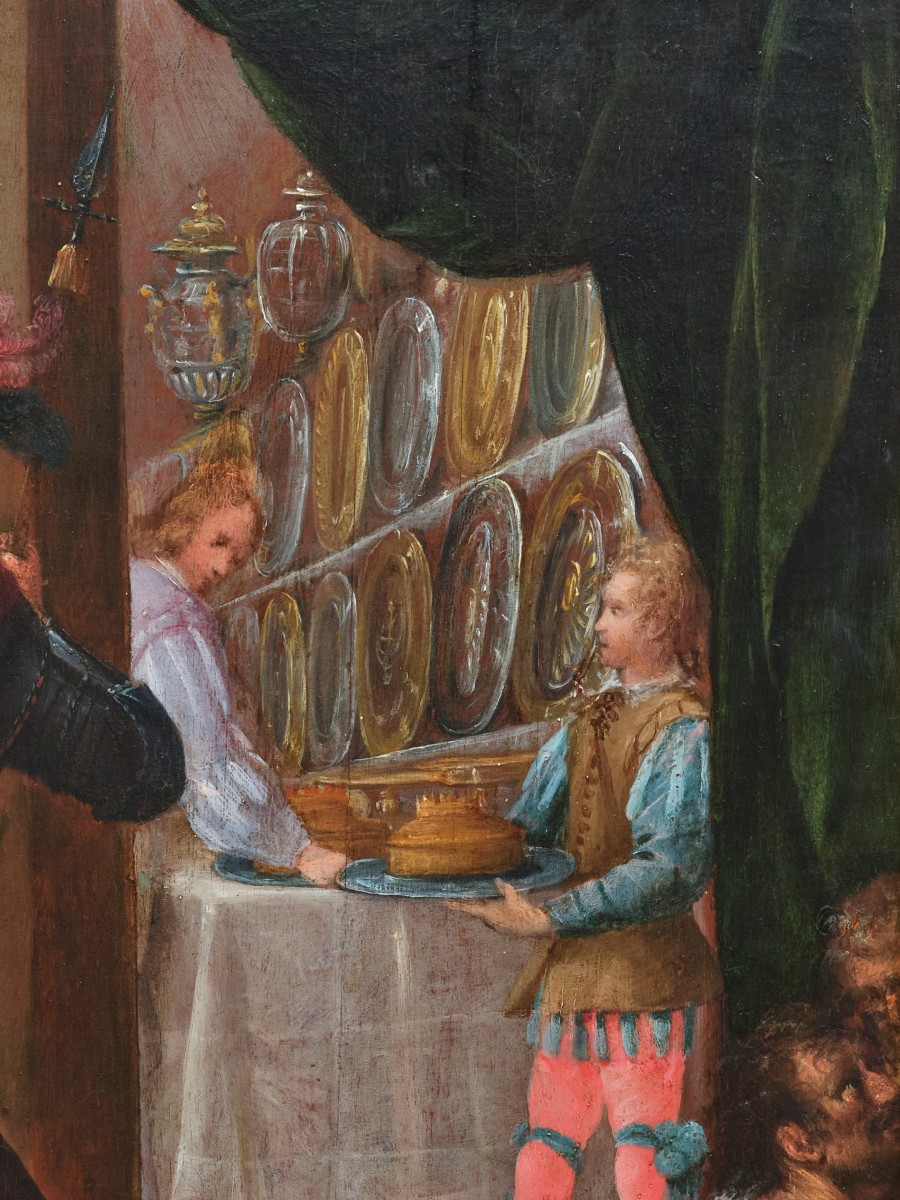
The sideboard on the right is another point of interest. Servants handle a rich array of ceremonial tableware, including ewers, cups, and silver platters. These precious objects are rendered with remarkable detail, reminiscent of the painter's Flemish origins. The same attention to detail is evident in the depiction of the food laid out on the table: poultry, fish, and serving pieces are rendered with almost naturalistic care, creating veritable still lifes integrated into the historical scene.
With its elegance, narrative richness, and decorative refinement, this Feast of Esther is fully in keeping with the aesthetic of Denis Calvaert and his Flemish origins. Several stylistic elements support an attribution to Calvaert: the figures with their slightly elongated proportions, the fresh and luminous palette dominated by vibrant blues, greens, and reds, the penchant for compositions populated with numerous figures, and the combination of Flemish precision and Italian sophistication all reinforce the validity of this attribution. The work thus captivates as much for the biblical narrative it illustrates as for the vibrancy of the countless details that animate this brilliant court scene.
Denys Calvaert (Antwerp, 1540 – Bologna, 1619)
Denys (or Denis) Calvaert was born in Antwerp around 1540, in the Southern Netherlands, then one of the main artistic centers of the Flemish tradition. Trained in this environment marked by a taste for meticulous detail and rich color, he left his native land at a young age for Italy, settling permanently in Bologna after a stay in Rome. There he developed an original style that combined the descriptive precision inherited from his Flemish origins with the Mannerist elegance of Italian painting. His Bolognese workshop acquired great renown and trained several important artists, including Guido Reni, Francesco Albani, and Domenichino. Remaining faithful to a refined aesthetic while the naturalism of the Carracci was gradually gaining ground, Calvaert remains one of the leading representatives of late Mannerism in Bologna. His work is characterized by elegant figures, luminous colors, and a remarkable synthesis of Flemish and Italian traditions. He died in Bologna in 1619, after having exerted a lasting influence on local painting.
Delevery information :
We organize the shipping and delivery of our artworks worldwide, working with specialized fine art carriers as well as DHL Express for the secure shipment of small and medium-sized works (up to 120 cm).
Each artwork is carefully packed and shipped in a custom-made transport crate to ensure optimal protection. All shipments are fully tracked and insured.
We pay the utmost attention to every stage of the shipping process to ensure fast, reliable delivery. Shipments via DHL Express are generally dispatched within approximately 7 days of purchase.
All of our artworks can be viewed at our Paris gallery and may also be collected in person.