Offered by Galerie Alexandre Piatti
REQUEST INFORMATION

Works of art, sculptures and furniture Haute Epoque
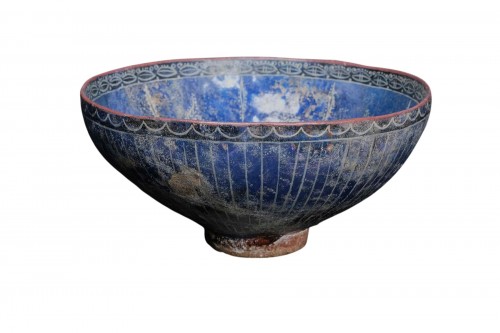
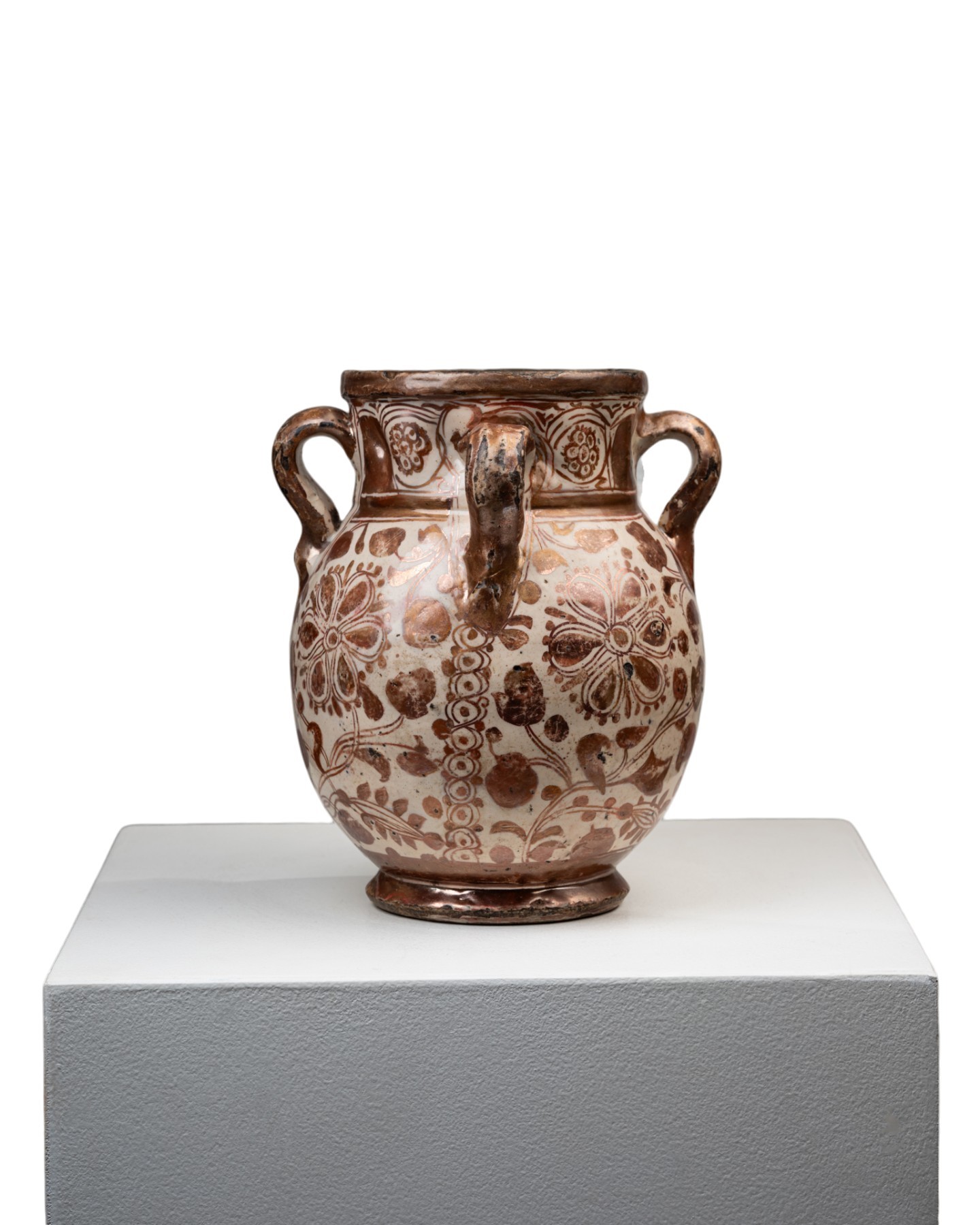
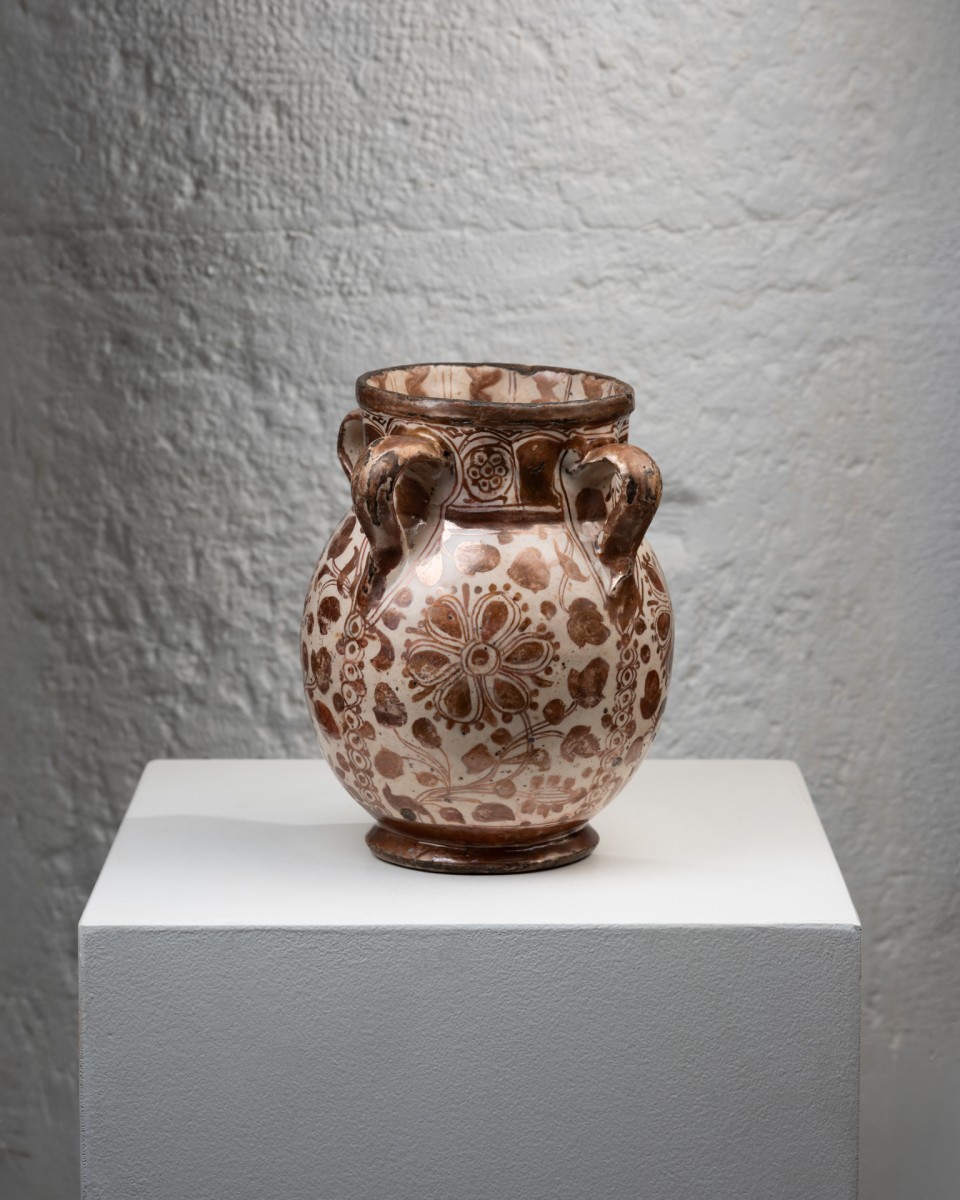
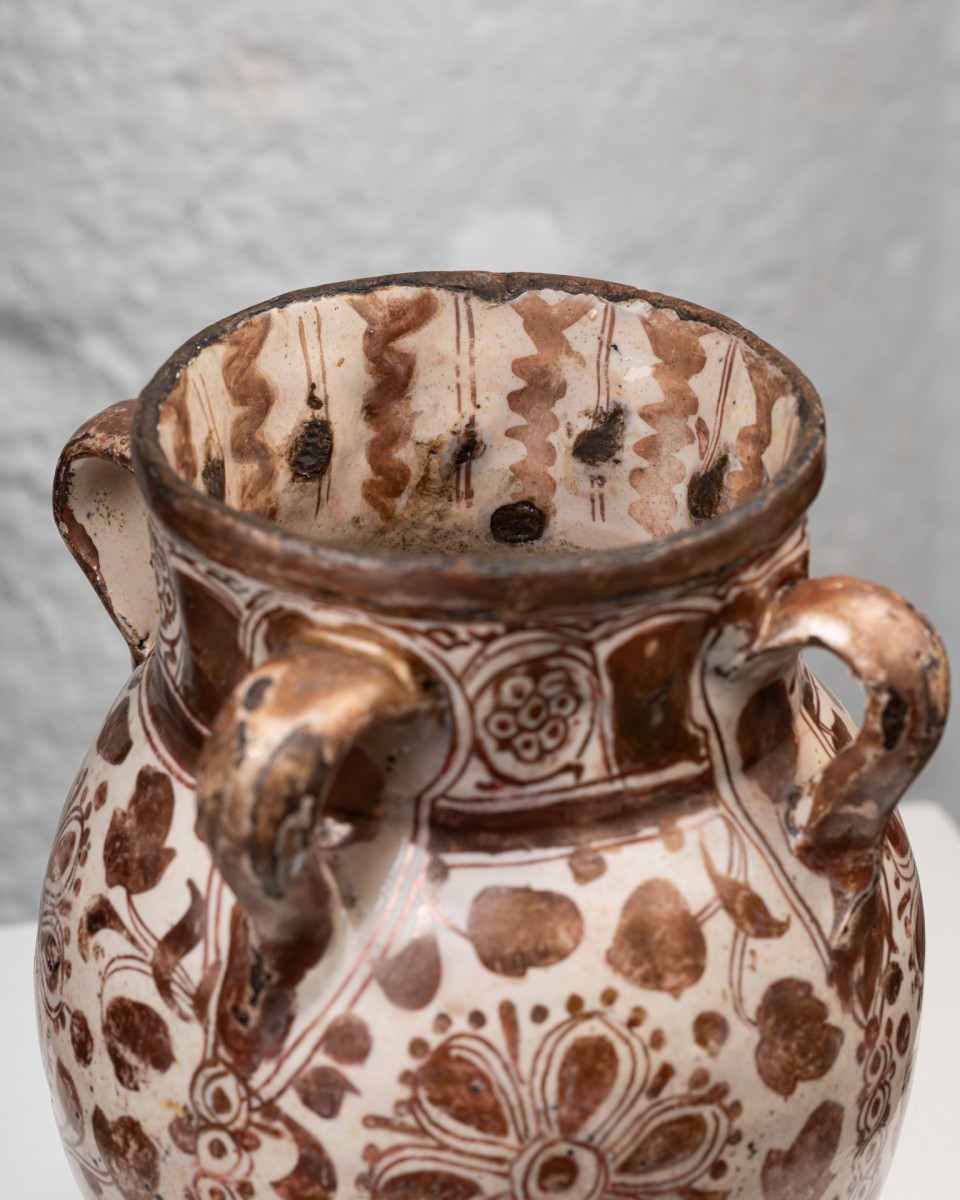
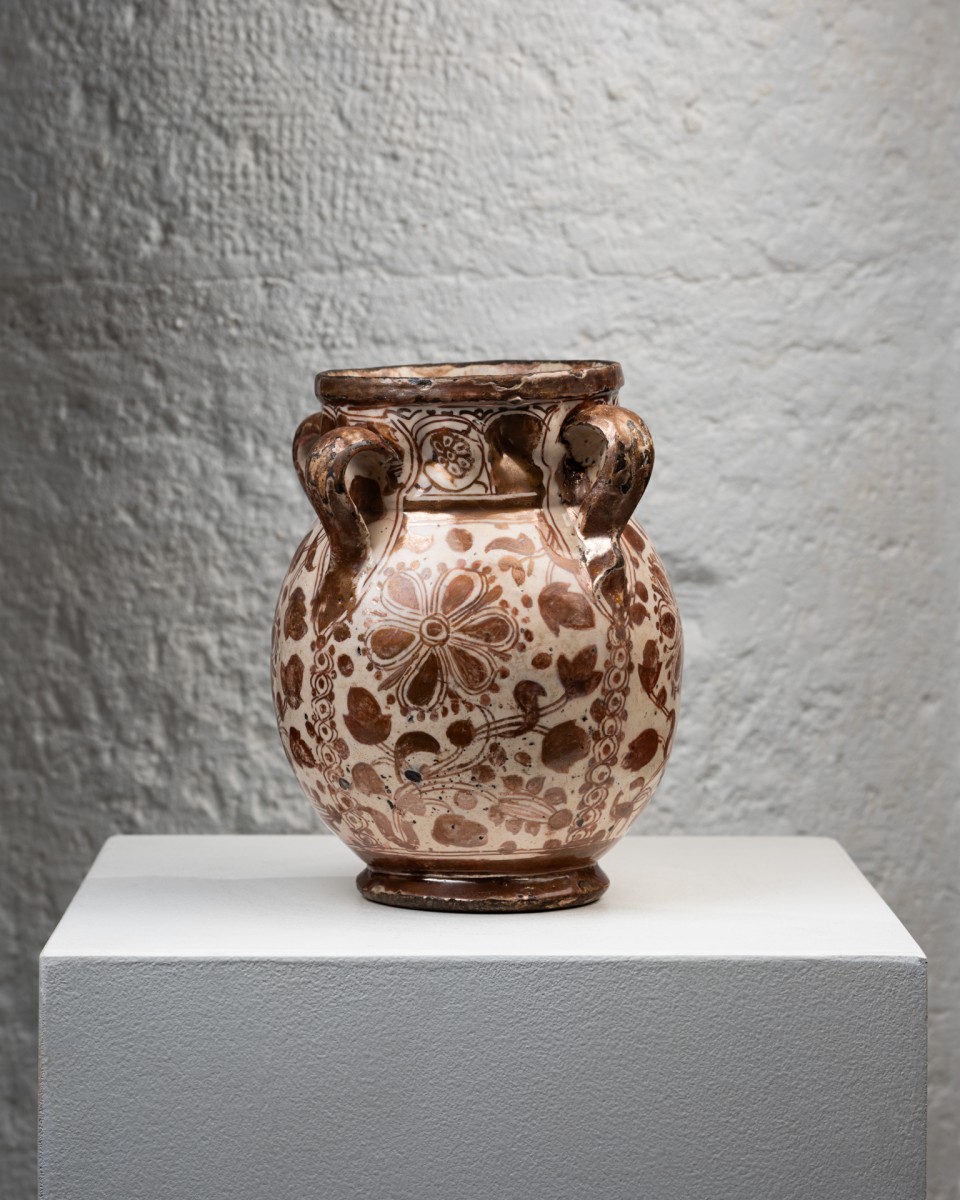
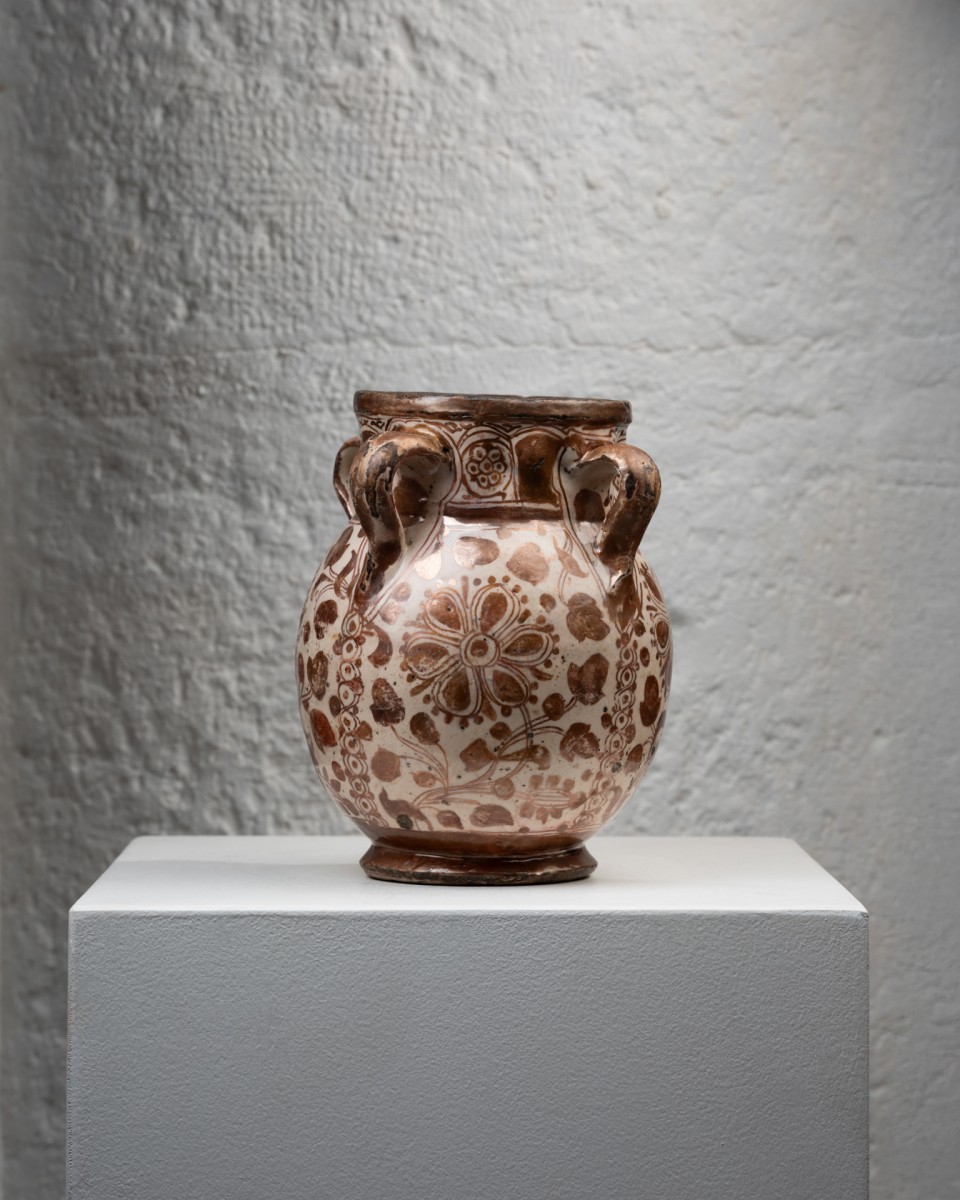
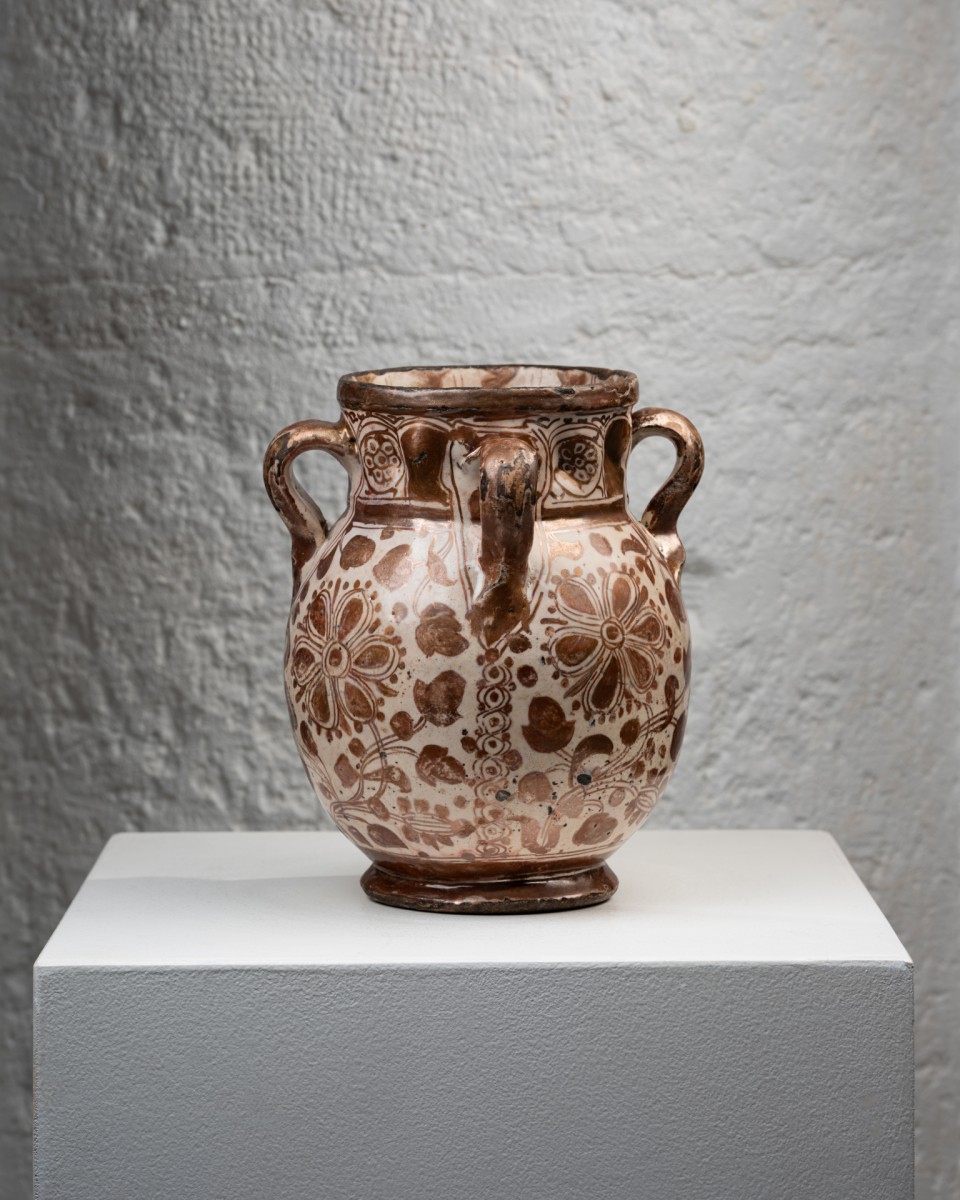
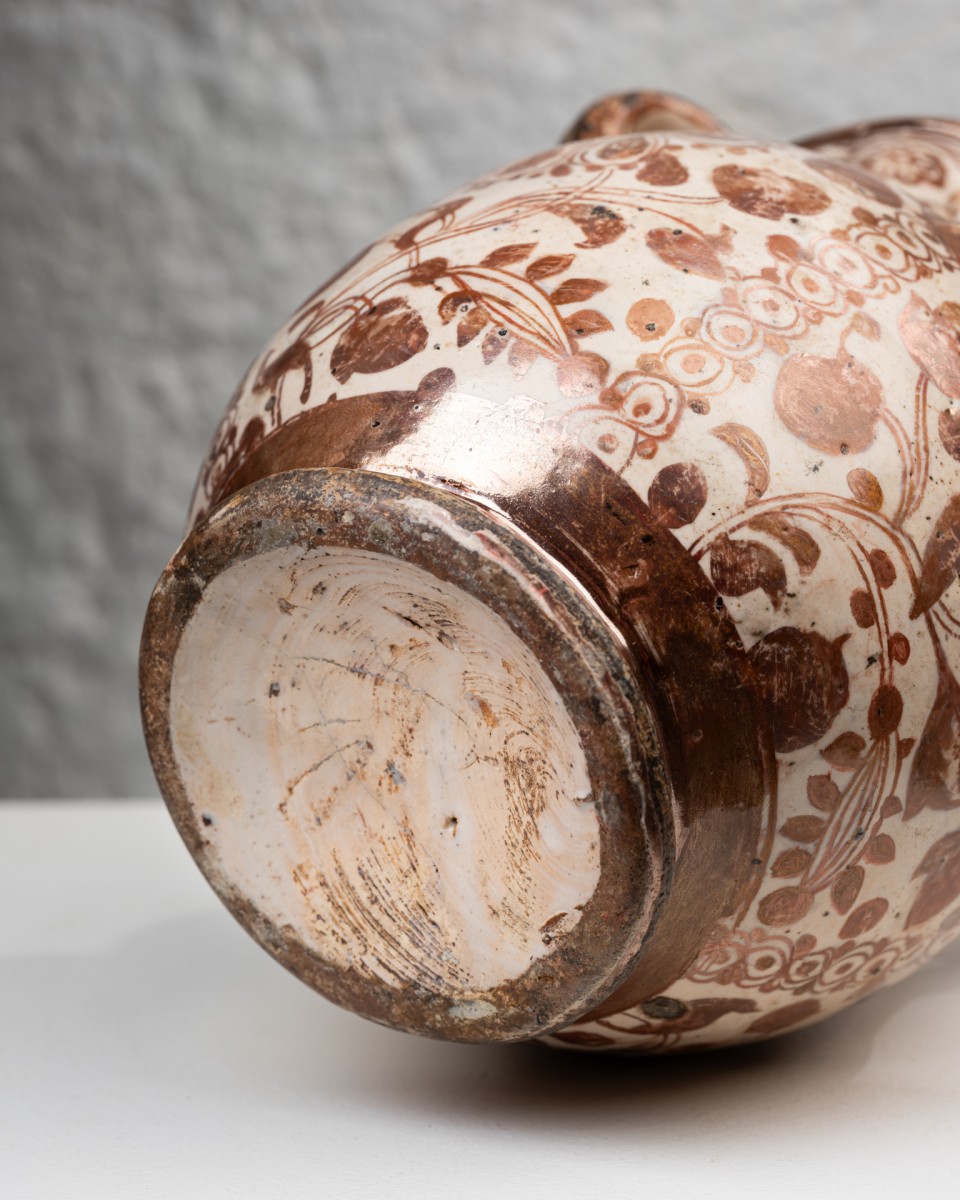
Hispano-Moorish lustrous earthenware in shades with intense metallic sheen on a creamy white glaze. A wheel-thrown jar with a rounded profile, featuring four cylindrical handles connecting the neck to the body without protruding beyond the opening, a wide neck, and a curved footring.
The Muslim conquest of Spain began in 711, following the defeat of the Visigothic king Roderic by the troops of Tariq ibn Ziyad at the Battle of Guadalete, which brought an end to the Visigothic kingdom on the Iberian Peninsula. It was under the Nasrid dynasty, founded by Muhammad ibn Nasr, that the Emirate of Granada—the last Muslim state of Al-Andalus—was established following its conquest in 1238. As the patron of the Alhambra’s construction, it was during the reign of Muhammad I of Granada that the ceramic arts received a significant boost with the introduction of cobalt blue from the East, likely during the immigration of Persian potters from the Seljuk period, who fled Iran in the face of Genghis Khan’s invasion in the early 13th century.
Rich in clay soils thanks to its marshes, the Valencia region produced, prior to the conquest of 1238, earthenware with a white tin glaze—a technique widespread in the Muslim world but absent elsewhere in Europe. The only pigments used to decorate these pieces were blue, brown, and green.
In 1309, Pere Boil of Aragon (d. 1323), “Mestre Racional,” first lord of Manises and diplomat in the service of James II of Aragon (c. 1267–1327), went on a mission to Granada. It appears that during this diplomatic mission, Pere Boil met the former governor of Málaga, Abu Said, son of Ismail and nephew of Muhammad I. Following this meeting, it seems that agreements were reached between the two men to introduce the “obra de Maliqa” (work of Málaga) into the workshops of Manises. It also seems likely that Nasrid potters settled in Manises at that time, bringing with them the secret of glazed cobalt blue. It also appears plausible that contacts between the Crown of Aragon and the Middle East, thanks to the diplomatic missions established in Alexandria and Beirut during the reign of James I of Aragon, had a direct influence on production in Paterna and Manises.
The metallic lustre decoration was invented by Muslim potters in the 9th century. This technique involved painting a design composed of oxidized metallic elements—copper and silver—onto the surface of a piece that had already been fired with its glaze; the piece was then fired at a lower temperature in oxygen-depleted kilns. This reduction firing encouraged the oxides to penetrate the glaze while transforming them into microparticles of metal. From Al-Andalus, the production of lustrous earthenware spread throughout Europe through massive exports from centers such as Málaga and Valencia.
One of the oldest surviving documents likely concerning the “obra de Maliqa,” that is, Malaga ceramics—a reference to which in Arabic appears on the reverse of a plate preserved in Berlin —is an inventory from the English port of Portsmouth dated 1289, which records the arrival of a shipment of ceramics with “strange reflections” intended for Eleanor of Castile (1241–1290), the first wife of Edward I of England. Another document, dated 1297 in Collioure, also mentions the importation of ceramics from Málaga.
When the Arabs lost control of the port of Algeciras, which was subsequently reconquered by King Alfonso XI in 1344, the export of gilded ceramics from Málaga encountered difficulties, a situation that would contribute to the great boom of the Manises kilns, which operated at full capacity from the early 14th century through the third quarter of the 15th century. Thus, the gilded production from the workshops of Manises, Paterna, and Valencia in general came to be referred to in documents of the time as “obra de Maliqa,” “Melica,” or “Maliqua,” supplanting the term that had initially been used for Nasrid gilded ceramics from Málaga. It was not until documents dating from the mid-15th century that the expressions “obra de Manizes” and “operam terre de Manizes” appeared.
The earliest known date for the gilded tableware from Manises dates back to the year 1325. That of the gilded and blue tableware from the same kilns is documented starting in 1333, the date of the first known contract in which the expression “opus terre daurati cum zafra” (work in gilded earthenware with cobalt blue) appears. According to notarial documents from the second quarter of the 14th century, we can identify the names of several Mudejar potters: Albocayrén, Alfalem, Almoxoní, Almurci, Bençuleymen, Bonçor, Hiça, Marmola, and Zuleymen, as well as a Christian, Bonanat Martíneç. Among the most notable dynasties are the Almurci (or Almorci), active in Manises from the 13th to the late 15th centuries, and the Alcudo, active from 1404 onward.
Notarized documents have made it possible to identify 46 potters working in the Valencia region between 1350 and 1429, including 27 Muslims, 17 Christians, and 2 converts. It is evident that most of the potters were Muslims, yet the trade was predominantly in the hands of Christian merchants. During the wars between Pedro I of Castile and Pedro IV of Aragon in 1363–1364, Manises was almost entirely destroyed, forcing all its inhabitants to seek refuge in Valencia. The town was rebuilt between 1369 and 1372 under the leadership of Felipe Boil, Lord of Manises, who gave new impetus to the local ceramics industry. A document dated 1407 mentions the potter Hamet Jáfer of Manises, whose son, Jáfer Almaguef, residing in the Moorish quarter of Valencia, was engaged in the trade of buying and selling ceramics.
Numerous royal commissions for gilded tableware and earthenware tiles in Manises and Paterna are documented as early as the second half of the 14th century, attesting to the influence of these workshops: Cardinal Audoin Aubert (1364), King Pedro IV of Aragon and Queen Leonor of Sicily for their residences in Tortosa (1370), Barcelona (1376, 1382), and Valencia (1382), the Duke of Berry (1382), and the Duke of Burgundy (1391). The heraldry found on many pieces with metallic sheen attests to the importance of exports throughout Europe.
Moorish art actually refers to the artistic production developed by Muslims forcibly converted to Christianity through the edicts of conversion promulgated by the Catholic Monarchs in 1502, following the fall of Boabdil, the last Moorish king of Granada, in 1492. In the history of ceramics produced on Spanish soil, it is therefore necessary to clearly distinguish between the three existing types of gilded tableware: Nasrid, Mudejar, and Moorish.
The opinions of ceramic historians differ regarding the dating of this collection of pieces, with chronological estimates ranging from the second half of the 14th century to the early 15th century.
Delevery information :
Please note that packing and shipping costs are not included in the price of the objects which are quoted ex shop.
Final amount including packing and shipment to be discussed with Galerie Alexandre Piatti.