Offered by Gregory Redding
REQUEST INFORMATION
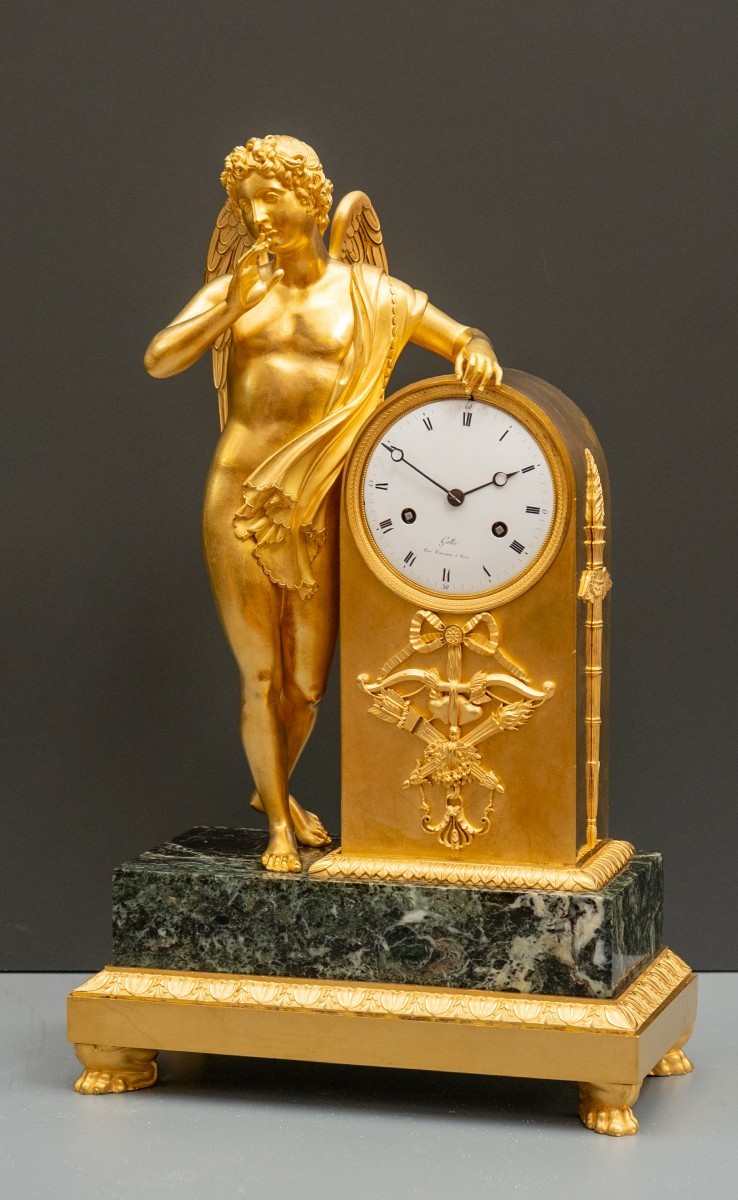

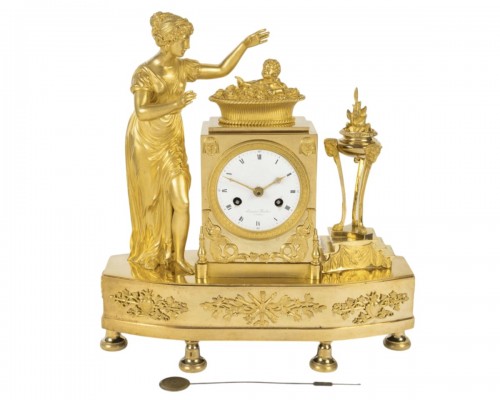
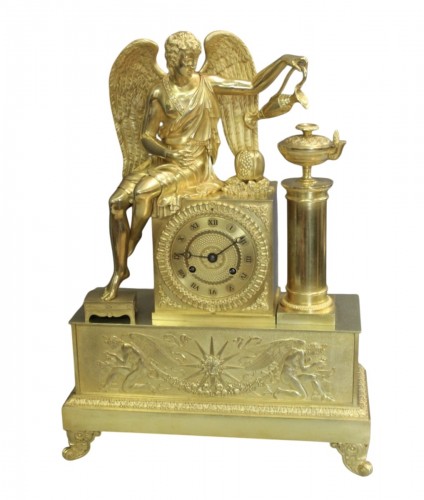
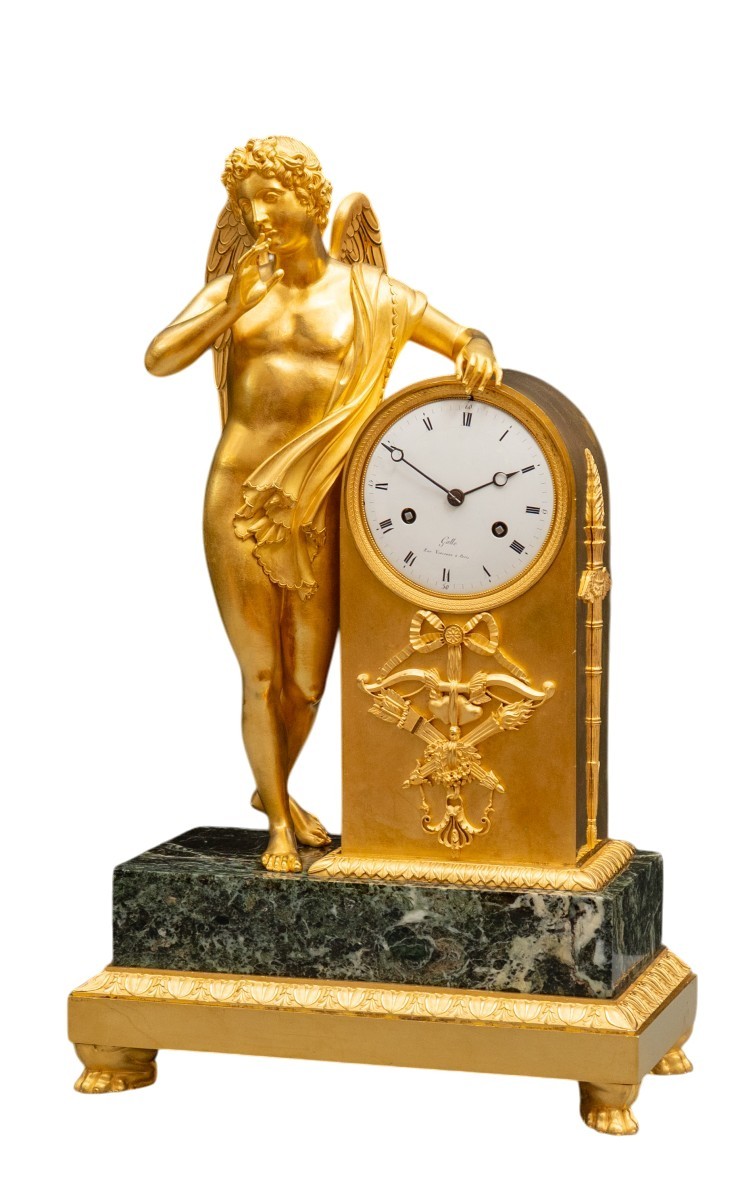
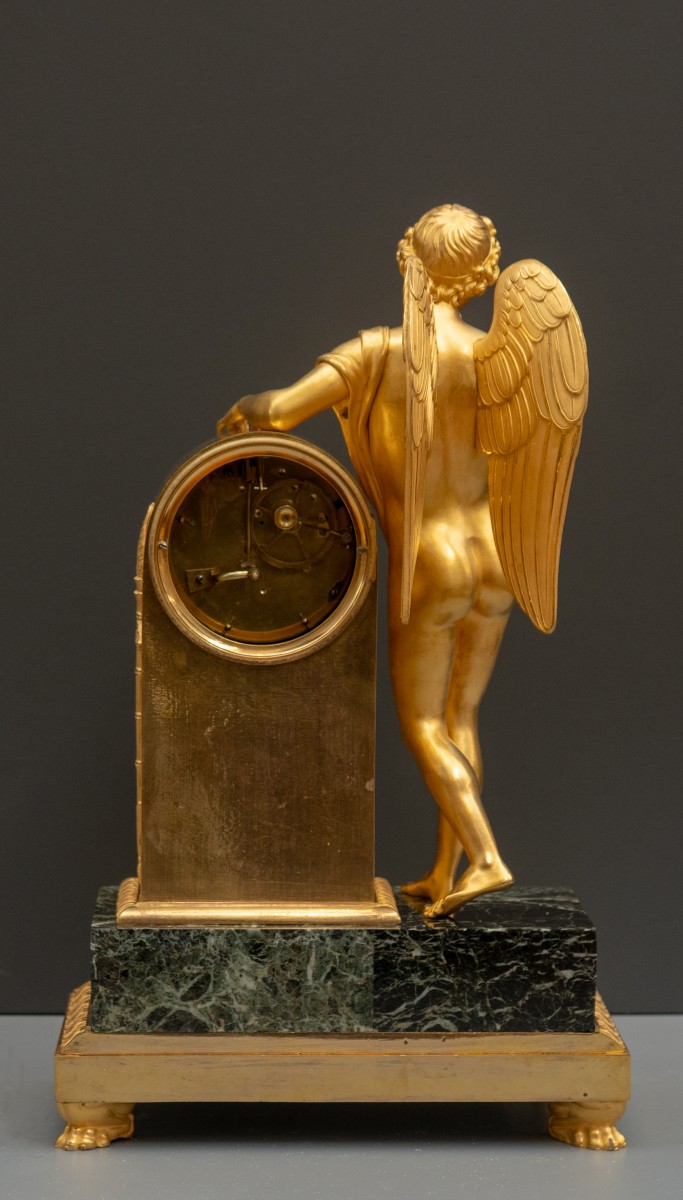
Fine French Empire mantel clock in chased and mercury-gilt bronze on a verde antico marble plinth, figuring Eros as Harpocrates, god of silence, standing with his right index finger raised to his lips and his left arm resting on the drum-form clock case. The winged adolescent is modelled in the round after the Antique, the drapery falling in rhythmic folds behind the body, the anatomy finely chased with alternating matt and burnished surfaces. The arched case is applied with a pendant trophy of love comprising a ribbon-tied bow, crossed quiver and torches beneath the dial, flanked to the right by an upright flaming arrow. The white enamel dial, signed Galle, Rue Vivienne à Paris, shows Roman hour numerals and Arabic five-minute markings, with pierced Breguet-style blued steel hands; twin winding arbors for the eight-day movement striking hours and half-hours on a bell. The whole raised on a rectangular verde antico marble base set on a gilt bronze plinth with lotus-leaf frieze and lion paw feet.
The model, known as L'Amour Silencieux or L'Amour au doigt sur la bouche, derives from Antique prototypes of Harpocrates and enjoyed lasting success in the Parisian bronze trade of the Empire and early Restauration periods. It was produced by several leading ateliers including those of Pierre-Philippe Thomire and Claude Galle, with comparable examples preserved in the Château de Malmaison and the Mobilier National.
Claude Galle (1759-1815) was among the foremost bronziers of the Napoleonic era, fournisseur to the Garde-Meuble Impérial and supplier to the Tuileries, Saint-Cloud, Fontainebleau and the Grand Trianon. The workshop at 60 Rue Vivienne was continued after his death by his son Gérard-Jean Galle (1788-1846).
Signature: Galle, Rue Vivienne à Paris (on the dial)
Materials: Chased and mercury-gilt bronze; verde antico marble; white enamel dial
Dimensions: H. 49 cm x W. 30 cm x D. 15.5 cm
Period: Empire / early Restauration, circa 1815-1820
Literature:
Pierre Kjellberg, La Pendule française du Moyen Âge au XXe siècle, Les Éditions de l'Amateur, Paris, 1997
Elke Niehüser, French Bronze Clocks 1700-1830, Schiffer Publishing, Atglen, 1999
Hans Ottomeyer and Peter Pröschel, Vergoldete Bronzen. Die Bronzearbeiten des Spätbarock und Klassizismus, Klinkhardt & Biermann, Munich, 1986
Tardy, La Pendule française, 3 vols., Paris