Offered by Galleria la Bocchella
REQUEST INFORMATION

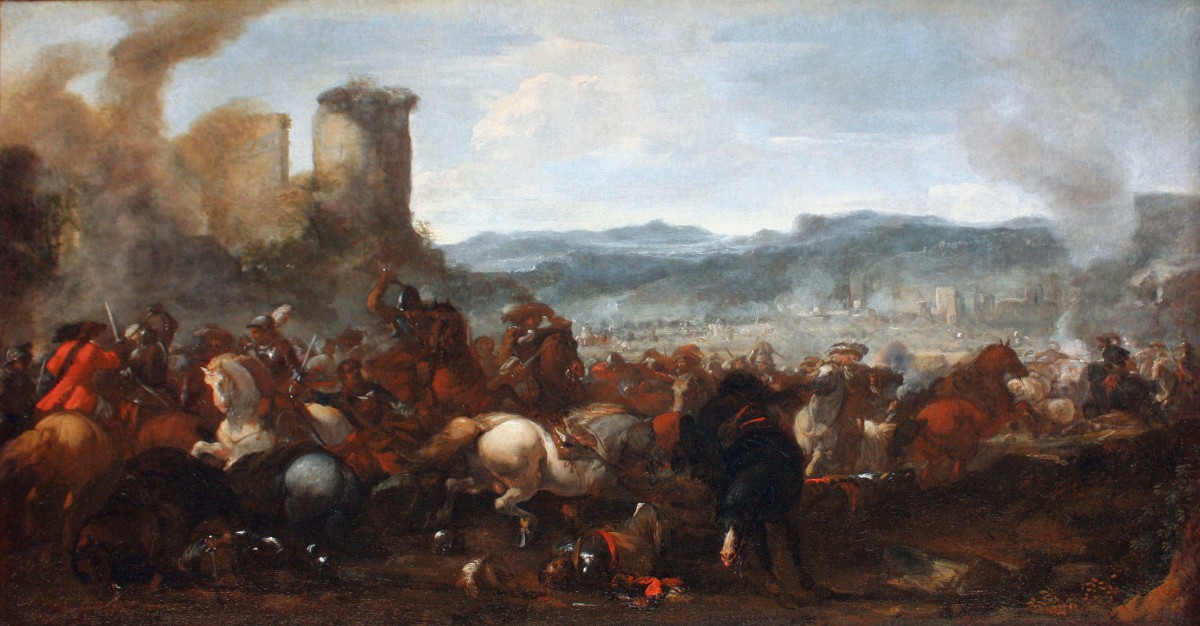
The painting is an oil on canvas measuring cm. 74 x 138
Framed measure cm. 97 x 160
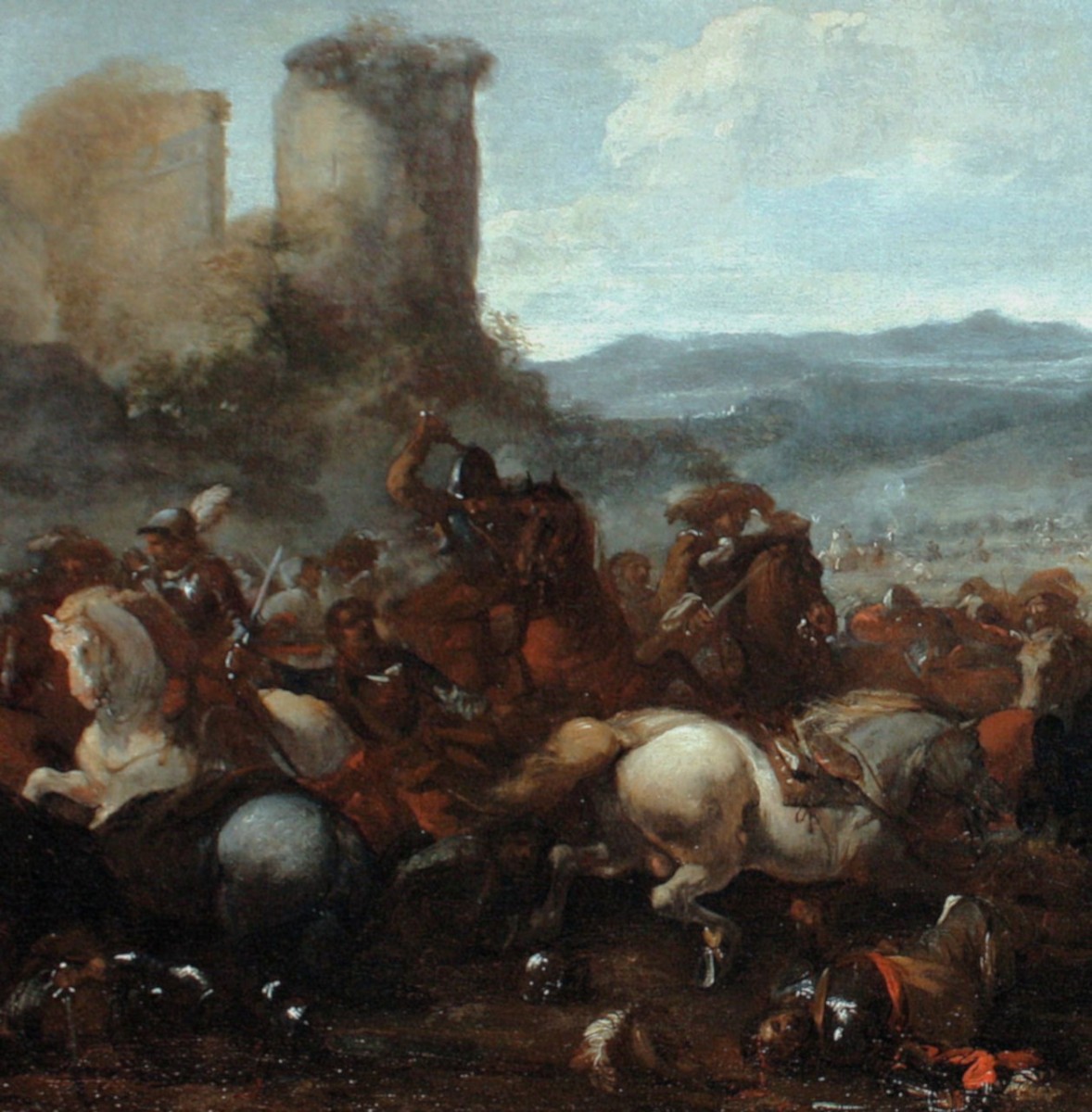
It depicts a battle with a cavalry clash
The painting was identified via email by Prof. Giancarlo Sestieri as the work of the French artist Jacques Courtois known as il Borgognone
Borgognone was a Franco-Italian painter, draftsman, and printmaker. He was active mainly in Rome and Florence and became known as the leading battle painter of his era. He also created historical paintings and portraits. He became a Jesuit at an advanced age, while continuing to paint. Jacques Courtois was born in Saint-Hippolyte, near Besançon (Franche-Comté), in present-day France, at the time a Spanish possession of the Holy Roman Empire. He was the son of the obscure painter Jean-Pierre Courtois. Very little is known about Guillaume's youth, but it is assumed that he received his initial education from his father. He had two younger brothers who also became painters: Guillaume (Guglielmo Cortese) (1628-1679) and Jean-François (circa 1627-?). Since his brother was also later known as "the Burgundian" (a reference to their origins in Burgundy, called the County of Burgundy or Franche-Comté in French), some works by the two brothers have been confused. The father brought his sons to Italy around 1636, when they were still young. They traveled first to Milan. According to contemporary biographers, he served for three years in the Spanish army. During this period he drew marches and battles, combat scenes, landscapes and military costumes. After leaving the army, he studied for a time in Milan with an unidentified sculptor. He moved to Bologna in 1639, where he first entered the studio of Jérôme Colomès, a painter from Lorraine. According to the first Italian biographer Filippo Baldinucci, Courtois' talent was noticed in Bologna by the prominent painters Guido Reni and Francesco Albani. He continued his apprenticeship in Siena, where he studied for a period at the school of Astolfo Petrazzi. It is possible that brothers Guillaume and Jacques remained together until the late 1640s. Courtois stayed for a short period in Florence, where he met two Northern painters: Jan Asselijn, a battle painter, and Matthieu van Plattenberg (known as "Monsù Montagna"), a sailor. He went to Rome around 1639-1640, where he initially obtained permission to live in the monastery of Santa Croce in Gerusalemme in Milan thanks to the intercession of the abbot Don Ilarione Rancati. The abbot was instrumental in securing Courtois's first official commission, a large fresco depicting the multiplication of the loaves and fishes in the monastery's refectory (1641). In Rome he became friends with Pieter van Laer, a Dutch genre painter active in Rome, where he was known by the nickname "Bamboccio". Pieter van Laer was known for his genre scenes, animal paintings and landscapes, which included scenes of everyday life set in the surroundings of Rome. The genre painting style practiced by Pieter van Laer was followed by other Northern and Italian painters. These followers became known as the Bamboccianti and a painting in this style as a Bambocciata (plural: Bambocciate). Michelangelo Cerquozzi, the leading battle painter in Italy in the early decades of the 17th century, who also painted genre scenes in the style of the Bamboccianti, recognized Courtois' talent and encouraged him to paint battle scenes. Marauders Attacking a Group of Travelers in the early to mid-1640s began to attract the patronage of prominent Roman noble families, including the Sacchetti, Chigi, and Pamphili families. It was Pietro da Cortona who introduced him to these noble families. He also worked for patrons outside Rome and abroad, in Spain and Italy. In 1647 Jacques Courtois married in Rome Anna Maria Vaiani, daughter of the minor Florentine painter Alessandro Vaiani, who was also a painter and engraver. His wife was already forty years old when he married. The marriage was unsuccessful and the couple soon separated for unknown reasons. When Courtois left Rome for Siena, she did not follow him. Courtois was called to enter the service of Prince Mattias de' Medici, then governor of Siena and brother of Ferdinand II de' Medici, Grand Duke of Tuscany. The prince tried, unsuccessfully, to reconcile the spouses. The couple was not reunited when Courtois returned to Rome later that year. After his wife's death in 1654, Jacques Courtois had to manage the family estate and provide dowries for two of his sisters, Ursuline nuns in Fribourg, Switzerland. He also created some religious works for their convent. He spent some time in Bergamo, as documented by the altarpiece with the Madonna and Saints in the parish church of Villa d'Adda, signed and dated 1656. In Bergamo, the artist met Count Carlo Giacomo Vecchi, the still life painter Evaristo Baschenis and the art dealer Alberto Vanghetti, for whom he painted numerous paintings and with whom he maintained a close correspondence until 1657. He later went to Venice at the invitation of Nicolò Sagredo, Venetian ambassador to Rome, where he had already met his brother Guillaume. Sagredo commissioned Courtois to create two lunettes above the side doors of the church of San Marco and some sacred scenes in the gallery. After stopping in Padua and Bologna, Courtois returned to Florence in 1656 to work in the service of Prince Mattias de' Medici, who brought him back to Siena. In 1657 he returned to Rome, where he entered the Jesuit order. After joining the Society of Jesus, he painted numerous works on religious subjects, but later also returned to his favorite theme: war. He began signing his drawings with an ink cross. In 1668 he became a priest. He received commissions for frescoes in the Church of the Gesù, the mother church of the Jesuits in Rome. He was still working on this project when he died in Rome on 14 November 1676.
Delevery information :
After receiving payment, we can arrange shipping of your paintings worldwide. You can request a quote or, if you have a trusted courier, let us know.