Offered by Costermans Antiquités
REQUEST INFORMATION

Old Masters paintings, 16th, 17th and 18th furnitures and works of art
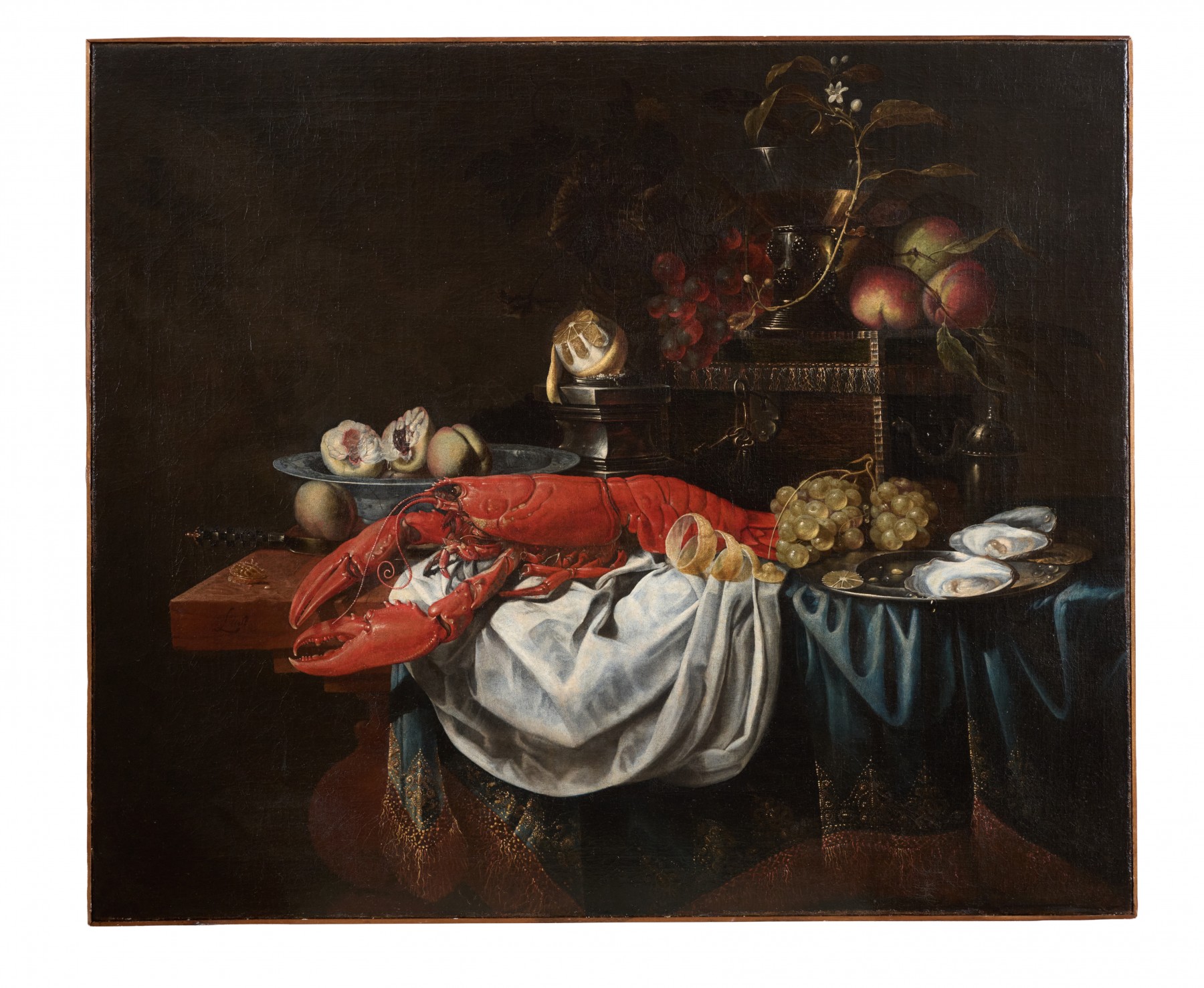
At the centre of the scene, a bright red lobster is prominently displayed on a skilfully draped white tablecloth. To its left is a bowl of lemons, and to its right a dish filled with grapes and oysters. In the shadows of the background, a container and other citrus fruits can be made out.
The treatment of light, concentrated in the foreground, powerfully isolates the objects and sets them sharply against the dark background. This accentuated chiaroscuro lends the composition an atmosphere that is both solemn and meditative, characteristic of still lifes conceived as a reflection on luxury and the fleeting nature of earthly pleasures.
Dr Fred Meijer confirms the painting’s authenticity and states that it should be attributed exclusively to Jan-Baptist Lust, and not to Carstian Luyckx, as had previously been suggested (see Sotheby’s, Milan, 9 June 2009, lot 44).
Several painters bearing the name Lust are known, but their styles differ significantly. The work presented here shows clear affinities with those of Jan Davidsz. de Heem as well as with those of G. van Deynum. This stylistic similarity is consistent with archival records: Jan-Baptist Lust is registered with the Guild of Saint Luke in Antwerp in 1649–1650 as a pupil of Andrea Benedetti — whose small painting mentioned earlier recalls his style — who himself trained under Jan Davidsz. de Heem.
Jan Baptist Lust was a 17th-century Flemish painter who specialised in still lifes. He was admitted to the Guild of Saint Luke in Antwerp in 1649/50.
To date, only one other painting has been provisionally attributed to Lust: a small still life (20.1 × 27.7 cm) depicting a lobster, fruit and oysters arranged on a laid table, though the signature remains questionable (Dorotheum auction, 16 June 2011, lot 352; Hampel, Munich, 1 April 2022, lot 1375). This small-format work could represent an earlier stage in the development of our more ambitious composition, which bears a clearly legible and authenticated ‘Lust’ signature on the edge of the table.
The work presented here reveals a clear influence of Jan Davidsz. de Heem, from whom it borrows the refinement of the composition and the sense of light contrast.