Offered by Gregory Redding
REQUEST INFORMATION

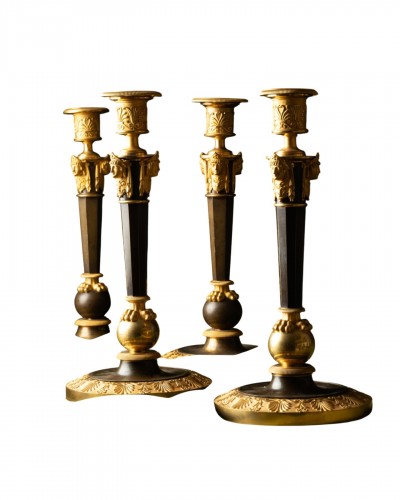
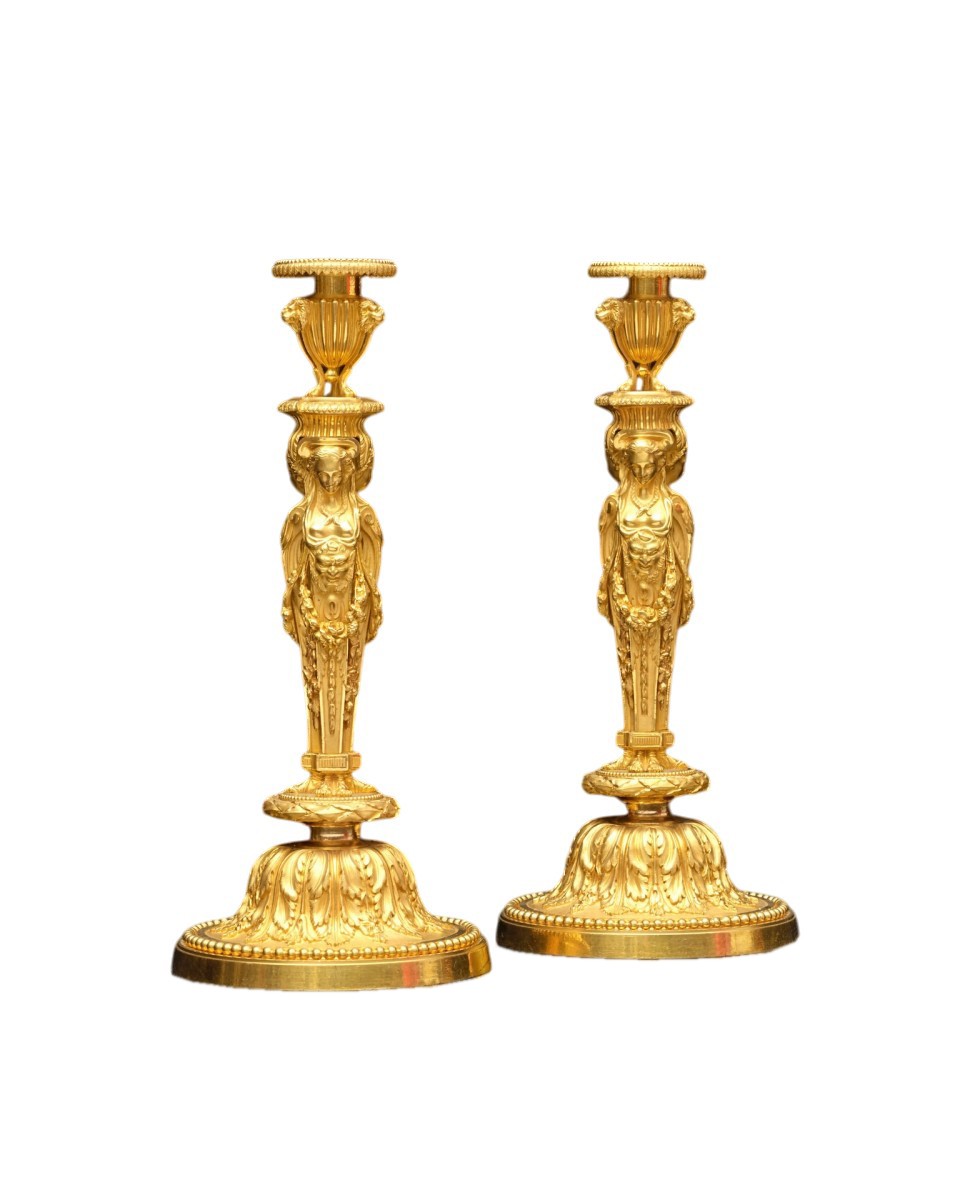
Paris, circa 1820 — Height 32 cm
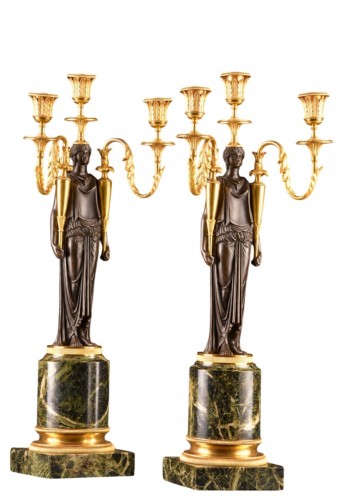
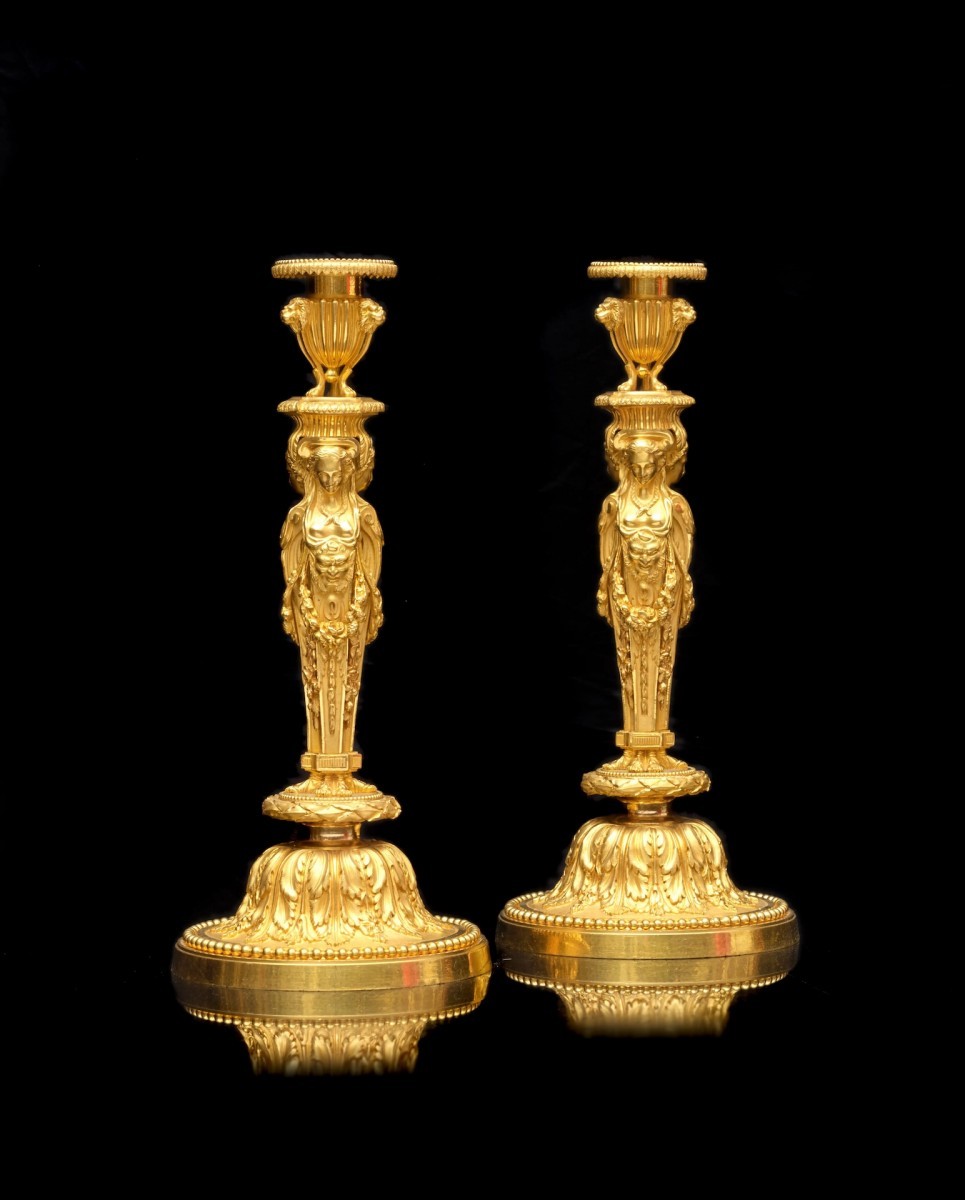
Each candlestick with a gadrooned urn-form nozzle cast with lion heads on monopodia supports, the shaft formed as three conjoined caryatid herms issuing from tapering angular supports headed by bacchic masks above floral swags, the caryatids' feet resting upon a circular plinth with laurel leaf border, above a spreading acanthus-cast base with beaded border.
These candlesticks follow a celebrated model attributed to Jean-Démosthène Dugourc (1749–1825), one of the foremost French ornamental designers of the late eighteenth century, who served as Architecte et Déssinateur du Cabinet de Monsieur, brother of Louis XVI. The original design is preserved in the Musée des Arts Décoratifs, Paris, and the first examples of this model are believed to have been executed by the distinguished ciseleur-doreur François Rémond (1747–1812) for the marchand-mercier Dominique Daguerre as early as 1783.
Closely related candlesticks are preserved in the Wallace Collection, London, and a pair of identical design dating from circa 1785 is recorded in Schloss Pillnitz, Dresden.
A refined and scholarly example of the Restauration period's continuing engagement with the great decorative programmes of Louis XVI's court.
Literature
Hans Ottomeyer and Peter Pröschel, Vergoldete Bronzen, Munich, 1986, p. 286, pl. 4.15.2, illustrating a pair of candlesticks of identical design, circa 1785, Schloss Pillnitz, Dresden; and pl. 4.15.3, for a related set by Pierre Gouthière, circa 1785.
Peter Hughes, The Wallace Collection Catalogue of Furniture, London, 1996, pp. 1232–35, F164–5, for a pair delivered by Claude-Jean Pitoin to Marie-Antoinette in 1781; and pp. 1246–50, F174–5, for a comparable pair with four caryatids supplied by François Rémond to Dominique Daguerre in 1783.
Alan P. Darr et al., The Dodge Collection of XVIII Century French and English Art in the Detroit Institute of Arts, 1996, p. 131, nos. 71.216–71.217, for a pair of identical design, circa 1850–1900.