Offered by Gregory Redding
REQUEST INFORMATION
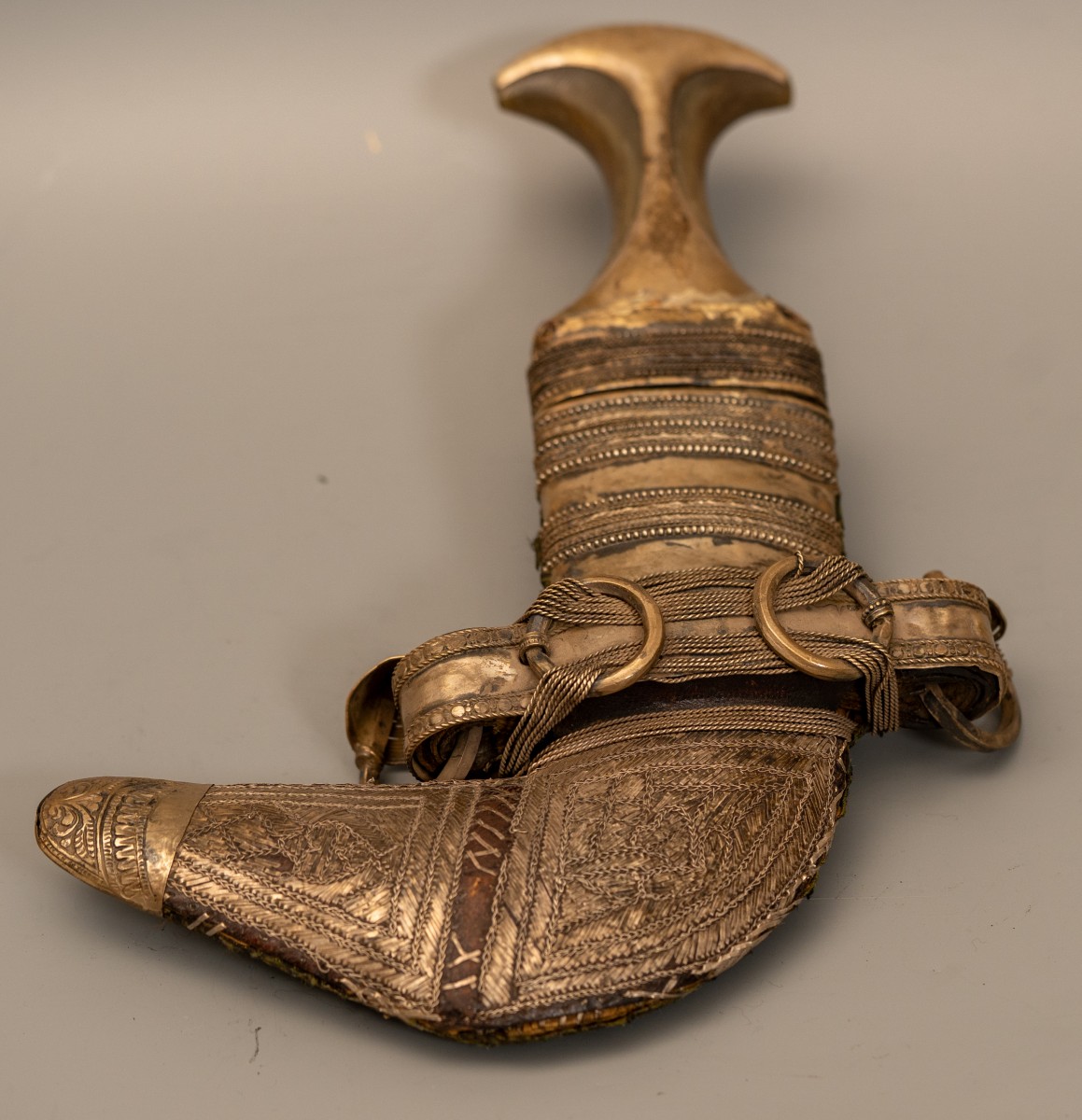
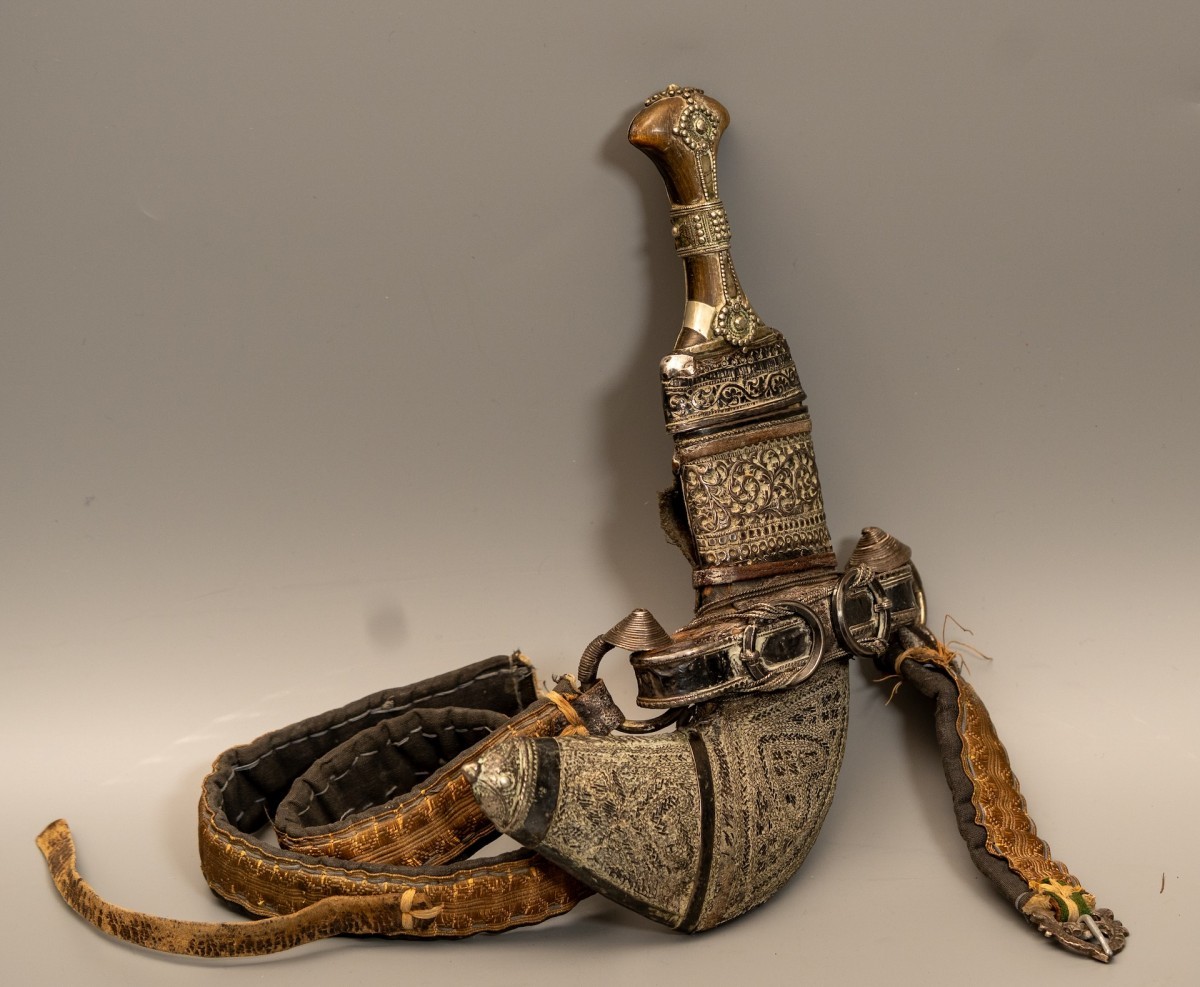

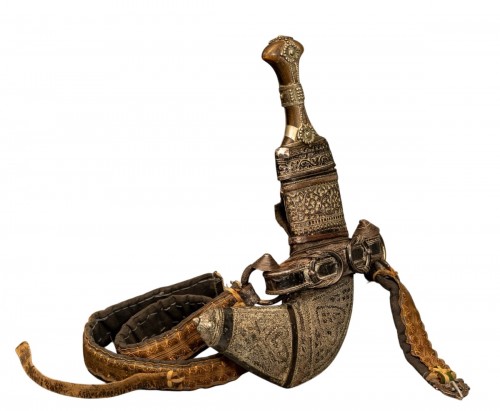
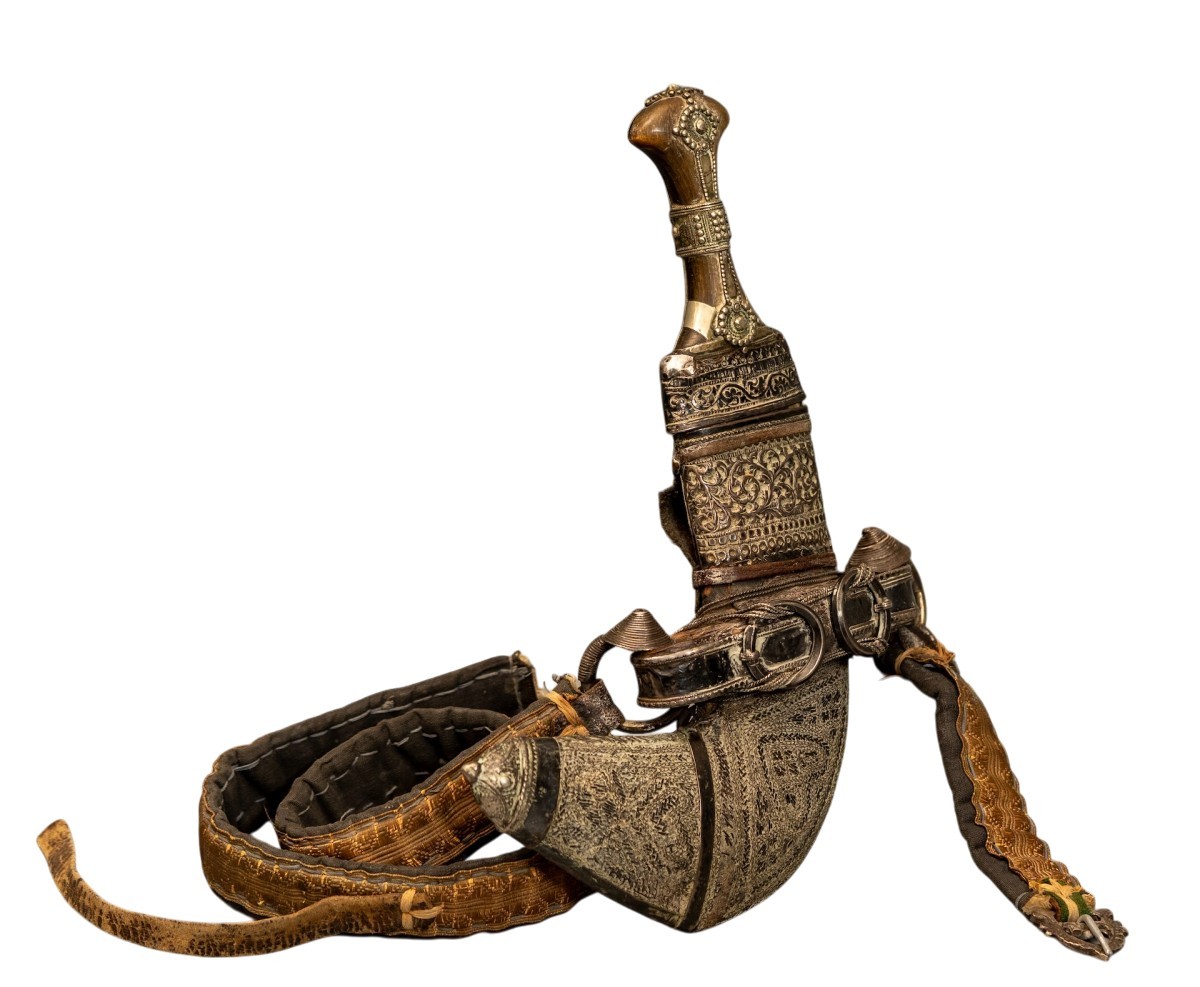
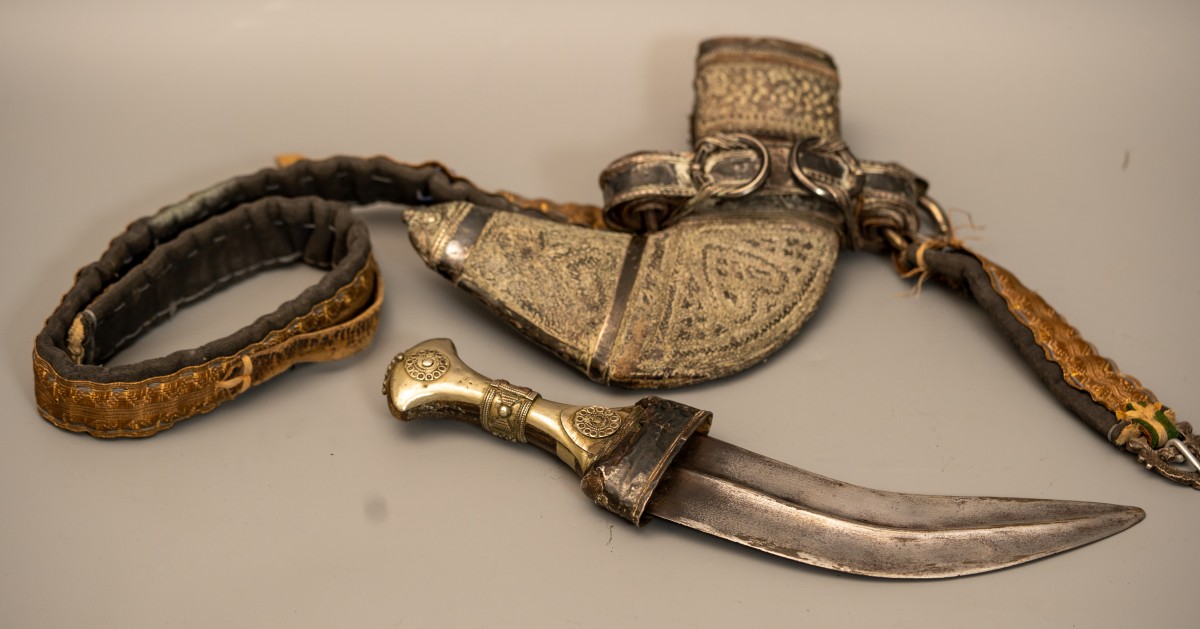
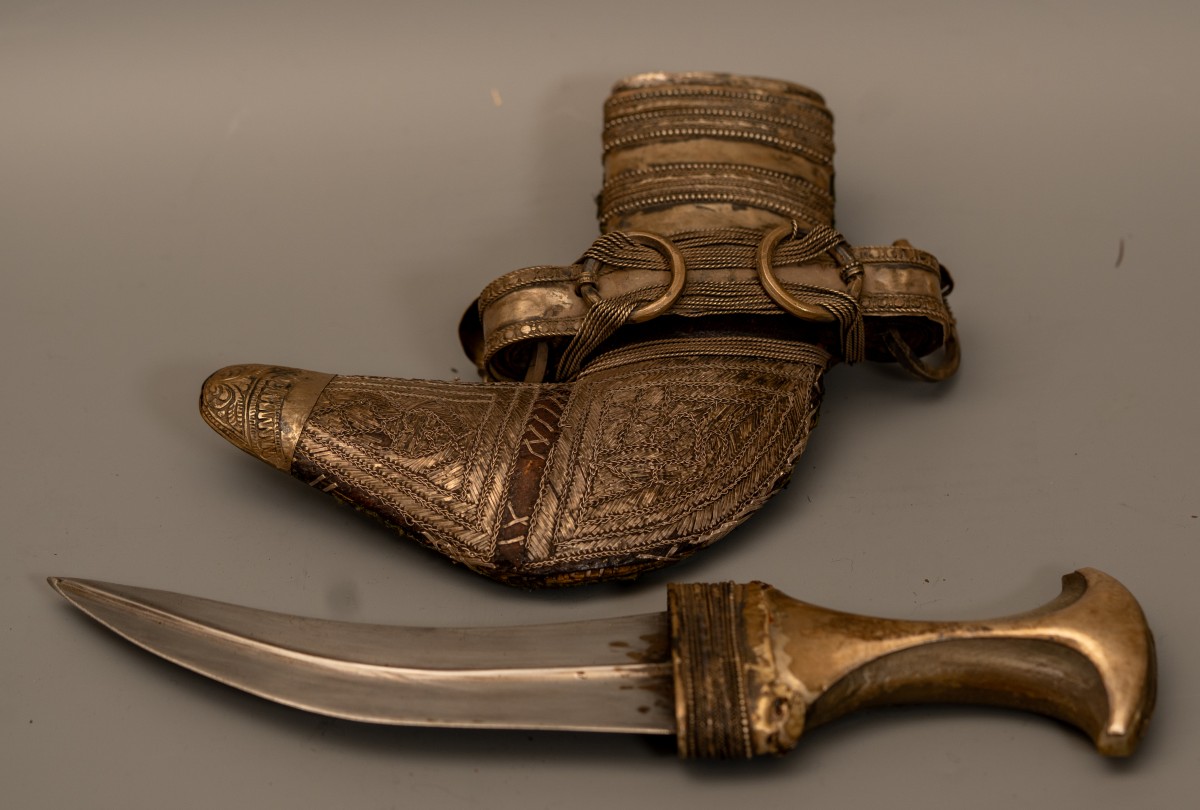
A rare and interesting ensemble of two 19th-century Yemeni janbiya daggers, each with its scabbard, together with an original woven hizam belt, and an associated companion knife (sikkin). The two janbiyas represent distinct regional traditions within Yemeni silversmithing, making this an unusually instructive pairing for the collector of Islamic arms and Arabian ethnographica.
Janbiya I — Sanaa Highland Type
The curved double-edged steel blade of characteristic Yemeni profile with pronounced central ridge (sabar). The handle (maqbad) in dark buffalo horn or hardwood, fitted with white metal (silver alloy) mounts decorated with fine granulation and applied beaded wire borders; the pommel terminal with circular rosette boss, a hallmark of Sanaa workshop production. The bolster mount worked with scrolling foliate ornament in repoussé. The scabbard (ghilaf) of the characteristic bulbous kidney-shaped Yemeni form, over a wooden core covered in leather and encased in embossed white metal sheet throughout, densely worked with scrolling arabesques and geometric cartouche panels, the recessed grounds deliberately oxidised to achieve strong tonal contrast against the burnished raised ornament. Silver suspension loops and ring hardware intact. Accompanied by the original hizam belt of padded construction faced with woven silk and metallic-thread brocade in gold and dark tones, with silver terminal mounts, and a companion sikkin with gilt-metal mounted handle and brocade-covered scabbard with green stone-set silver finial.
Janbiya II — Southern Yemen / Hadhramaut Coastal Type
The curved single-edged steel blade of slightly different profile, bright and largely uncorroded. The handle of distinctive broad flat T-bar form in gilt metal — a pommel type associated with the southern Yemeni and Hadhramaut coastal tradition, distinct from the mushroom-top highland form. The scabbard of similar kidney-shaped outline but decorated in an entirely different and more labour-intensive technique: the surface entirely covered with applied twisted wire and beaded wire filigree, built up in geometric cartouche and foliate arabesque patterns of considerable technical refinement. The upper section of the scabbard bound with multiple horizontal bands of beaded and twisted wire, creating a richly textured surface. Suspension rings on twisted wire mounts. The warmer, more golden tone of the metal throughout suggests either a higher-copper silver alloy or gilt brass; testing recommended.
The two pieces are not a matched set but a complementary pair representing two of the principal regional traditions of Yemeni janbiya production. Such pairings, assembling examples of contrasting type, are consistent with the collecting practices of 19th-century European travellers and diplomats active in the Arabian Peninsula. Offered together, they constitute a more instructive and visually varied ensemble than two identical examples.
Condition:
Janbiya I: silver mounts with consistent age patination; belt textile faded but complete; blades with use patination.
Janbiya II: gilt metal mounts with surface wear and some losses to underlying material at the bolster; filigree wire decoration largely intact; blade bright and sound.
Literature:
Elgood, Robert: The Arms and Armour of Arabia in the 18th, 19th and 20th Centuries, Scolar Press, Aldershot, 1994
Elgood, Robert (ed.): Islamic Arms and Armour, Scolar Press, London, 1979
Stone, George Cameron: A Glossary of the Construction, Decoration and Use of Arms and Armor in All Countries and in All Times, Southworth Press, Portland, 1934 (repr. Jack Brussel, New York, 1961), pp. 310–311 (s.v. "Janbiya")
Hales, Robert: Islamic and Oriental Arms and Armour: A Lifetime's Passion, Robert Hales Ltd., London, 2013